Posts Tagged ‘Brooklyn’
usual symptoms

– photo by Mitch Waxman
Existential reality and physical weakness govern this day, as your humble narrator is off to the shining city for consultations with the staff of medical specialists and practitioners whose art maintains an acceptable equilibrium between life and death for him. They plan on siphoning off some of my very lifeblood, and subjecting it to alchemical tests, as well as poking and piercing at my increasingly fragile leather with instrumentation whose appearance fills me with a nameless dread. Their prescribed potions will be assessed for effectiveness, and I will face inquisition regarding diet and lifestyle.

– photo by Mitch Waxman
Such exposure to the vagaries of science are required by the increasing fragility and easily upset homogeneity of life as one grows older, part of the overdue bill owed to the universe for that lifestyle of youthful vulgarity and distasteful indulgence which I once enjoyed. I prefer to tuck my conscious mind away in a little corner of my head, behind my left ear, and let them do to my body what they will- for that is the whole of their law. The great equalizer in our society is always found in the hospital ward, where commoner and king alike find themselves sitting on a paper covered table while wearing a cheap gown as strangers perform laboratory tests upon them.

– photo by Mitch Waxman
The staff of medical professionals which are employed on my behalf are, despite my lowly status and financial devastation, actually quite competent and highly placed- ignoring their vast experience and advice would be (and is) foolish. Weak in mind as well as body, I often dismiss this advice, but that is is part of the strange trade off one often makes in modern life- sacrificing what you know is good for you in favor of the quick fix and a feel good option. Seldom do I leave their offices without dire predictions or warnings having been offered, and today will most likely not be an exception.
inviting grottoes

– photo by Mitch Waxman
These shots were captured on one of the Newtown Creek tours I participated in last week. As mentioned in the past, your humble narrator considers this troubled waterway to be one of the most visually interesting places in the entire City of Greater New York. You can have the skyscrapers, I’ll be quite happy staying right here.

– photo by Mitch Waxman
I’m nearly recovered from the embarrassment and shame experienced after having stood in front of so many “normal people” and presuming to attempt a narration presenting a compact history of the Creek. Cogent and compact, the version of the story of this place which I presented to the audience was necessarily brief- an overview which covered the period of European occupation of these wetlands and the later industrial period which transmogrified it into the current condition.

– photo by Mitch Waxman
The good news for your humble narrator, a shocking and hollow shadow of a man, is that once more I am free from public duty and obligation for a time. The blue Newtown Creek Alliance cap which I’ve been wearing all year is at last hanging on a peg, and will be needed infrequently for a time. Researches into the historical firmament of Newtown Creek have resumed, and the eternal wondering statement of “Who can guess, all there is, that might be buried down there?” has returned to my lips.
quite submerged

– photo by Mitch Waxman
Today, I’m going to be uncharacteristically quiet, it’s all about the pictures. I was dreaming about flying again, in the manner of a super hero, and pulled these shots (some of which you’ve seen in other posts) together.

– photo by Mitch Waxman
Whenever I can attain some altitude, an attempt is made to record it, especially in the low lying areas of western Queens and North Brooklyn. In this shot, it was the Roosevelt Island Tram which elevated my point of view.

– photo by Mitch Waxman
Attempts and entreaties have been made- but so far- nobody in Long Island City has offered me roof or high floor access to shoot from one of the tower buildings. Haven’t asked anyone on Roosevelt Island yet, but the views of Queensboro and the East River must be glorious at night from there.

– photo by Mitch Waxman
I have been to the Ravell Hotel roof, which is in the lower right hand corner of the shot, which offers amazing views of the bridge and whose vantage lines up with the burning thermonuclear eye of God itself for “Manhattanhenge“.

– photo by Mitch Waxman
In Long Island City, the industrial zones are typically low lying in character, with few buildings exceeding 4 stories. Extreme reticence has been exhibited by property owners, when approached with requests of photographic access to their roofs or grounds. Insurance liability is the usual reply.

– photo by Mitch Waxman
The ultimate viewing platform, of course, would be from the Citibank Megalith. Like Odin on his hildskalf, one might observe the entire world from up there, seeing the in the perspective of that thing in its summit which cannot possibly exist and does not think or breathe, yet hungers.

– photo by Mitch Waxman
From up there, the entire soup bowl of New York Harbor is available for viewing. The megalith is visible from many faraway points in the harbor, and if you can see it- it can see you. On a clear day, the thing in its summit (were it to exist) can see the Narrows and Long Island Sound and Jamaica Bay and the Hudson.

– photo by Mitch Waxman
Terrestrial and aquatic vantages have been my only succor in recent months, but an urge to look down from above is upon me, and scry the ancient patterns of life which invisibly govern the present City.

– photo by Mitch Waxman
Probably why I’m dreaming of flying…
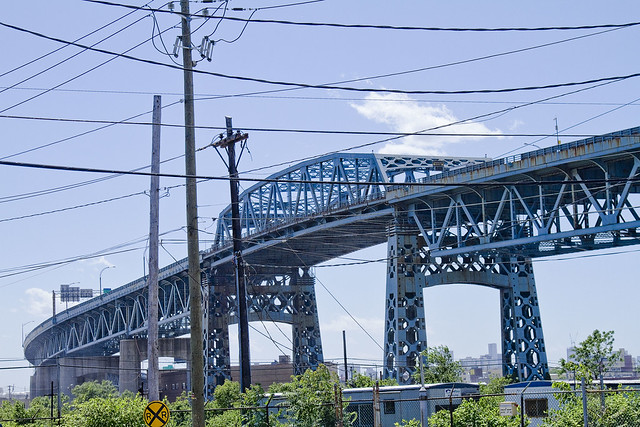
Happy Birthday, Kosciuszko Bridge

– photo by Mitch Waxman
A virtual guarantee is offered that this is the only posting you will see today commemorating and wishing the Kosciuszko Bridge a happy 72nd birthday. Some 26,298 days ago, Robert Moses saw the first link in a crazy idea of his which would one day be called the “Brooklyn Queens Connecting Highway” open for business.

– photo by Mitch Waxman
The Meeker Avenue Bridge opened on August 23rd, 1939 (renamed in 1940 as The Kosciuszko Bridge) – some 631, 152 hours ago. It was promised to allow easy egress to the World’s Fair, and was a showpiece project for the Great Builder.

– photo by Mitch Waxman
From a Newtown Pentacle posting of December 8, 2010– in which the big K was described as thrice damned:
Damned Once- The Kosciuszko Bridge catches radio frequency emissions from several nearby commercial radio broadcast antennas. A lot of it.
Whatever knows fear burns at The Kosciuszko Bridge’s touch.
Damned Twice- The Kosciuszko Bridge is at extreme risk in the eventuality of a seismic event. The Brooklyn pier actually sits on the Creek bed, some 6 meters below grade, but the Queens side is anchored on piles driven into the mud. The hard soil around Queens Plaza will merely shake, but the land surrounding the Newtown Creek will liquify.
Damned Thrice- The Kosciuszko Bridge once had pedestrian walkways, but they were removed in 1961. Can you imagine what kind of photos would be possible on a pedestrian walkway 124 feet over the Newtown Creek?
– photo by Mitch Waxman
Like many things and people who are 72 years old, the Kosciuszko Bridge is not long for this world. Why not raise a glass to it tonight, and acknowledge its long service to the City?
Click here for a sentimental slideshow of the old girl from the last couple of years
putrescent juice

– photo by Mitch Waxman
My long, indeed “Grand Walk”- a semi conscious amble whose path is revealed only by images found on my camera card sometime later- had carried me from Manhattan to the Grand Street Bridge. A revelation and totem of the political border of Queens and infinite Brooklyn, it would not be inappropriate to describe it as a former gateway to hell itself.
Not quite 100 years ago, the sky would have been black with the product of smokestacks, and every surface exposed to their fumes would be painted with a greasy residue of the worst kind of filth imaginable.
from Harper’s weekly, Volume 38, 1894- courtesy Google books
AN INSALUBRIOUS VALLEY.
The city of Brooklyn, having purged itself of the malodorous political institutions that were so long a blot upon its southern border, might well turn its attention to some nuisances of a more literally malodorous kind that flourish along its northern border, a detailed description of which will be found in another column of the Weekly’. It appears that in an early day the valley of Newtown Creek, which is the boundary between Kings and Queens counties, was selected by various manufacturers as an eligible site for the location of factories. The location was then far on the outskirts of the city, and no doubt quite unobjectionable. A great variety of institutions were set iu operation here, including those useful and necessary but unpleasant factories whose purpose it is to transform the animal refuse of a city into merchantable produce. The gases generated by these factories had an odor almost unendurable, as any one can testify who was accustomed to travel on the Long Island Railroad from the Thirty-fourth Street ferry in years gone by. But so long as railroad passengers were the only sufferers, nothing could be done to abate the nuisance, and there were for a long time no residents near to make complaint, as the growing city very naturally held back at a respectful distance from so undesirable a neighborhood.

– photo by Mitch Waxman
If one did not frequent the district, the smell would be overwhelming but the sense most offended would likely be the visual faculties. There are things which ordinary people should not see or know too much about. The customs and mores of the graveyard come to mind, and so does the imagery produced on the battlefield or on the inside of a slaughterhouse.
Amidst the farms of oil tanks and forests of chimneys, without gazing too deeply, one would notice the mounds of dead horses and dogs first- then, the tons of human shit would come into focus.
from The Sanitary Era, Volume 1, 1887, courtesy google books
Newtown Creek — No city in the Union has so foul a pest hole at its boundaries as Brooklyn. The sludge acid discharged from the works of the Standard Oil Company seems to possess an ominous potency for stirring up the sewage in the creek, and its black and thickened current seethes with bubbles of sulphuretted hydrogen. The shores, banked with this acid and with nameless filth, empoison the atmosphere at low water, while every rising tide seems to free a new supply of sludge. When to the oil industry is added the manufacture of fertilizers and a plenitude of pigs along Queens County shore, the sources of supply for a great nuisance or a grievous plague are discernible to all but official eyes and nostrils. Newtown Creek should be filled up, though not with sludge acid, and the nuisance makers removed to a distance. Our, Health Commissioner is authority for the statement that “You might as well try to fight the devil as the Standard Oil Company.”

– photo by Mitch Waxman
At this spot on the Newtown Creek, where the bone boilers and fat renderers rubbed shoulders with glue factories and manure manufacturers and acid factories, infernal mountains of organic waste materials were gathered. Necessary for the industrial pursuits of these corporate entities- the rail brought Manhattan and Brooklyn’s putrescent garbage, human waste, dead animals and anything else which once lived to them.
There was one company whose particular specialty was recovering useful chemicals from rotting cow and pig blood, produced in fantastic amounts by the armies of butchers staffing the slaughterhouses of New York and the abattoirs of Brooklyn.
No. 4—Grand Street Bridge—
The contract for the construction of this bridge was awarded to Bernard Rolf, on August 7, 1900, at an estimated cost of $173.379.90. The bridge should have been completed on October 21, 1901, but it was fourteen months later, December 26, 1902, before it could be used, and then for only part of the day; and it was not until February 5, 1903, that it was accepted and declared open for traffic.
The contractor presented claims for extra allowances, and a committee, consisting of the late Mr. C. C. Martin, Consulting Engineer; the then Deputy Commissioner, and the Engineer in Charge, reported a finding, which was accepted by the contractor and the City. The total cost of the bridge was $172,748.06.
Several important changes were found necessary in the operating machinery; New end wedges have been put in place and steel bearings have replaced certain cast-iron ones. One hand-turning gear has been installed. Stationary signal lamps, showing white and red, have been placed at the ends of the draw span. Hanging platforms have been erected at the ends of the draw span, and a platform built around the centre pier. These platforms have more than paid for themselves in the cost of repairs and erection. The railing has been painted, and the draw is working satisfactorily.

– photo by Mitch Waxman
Maspeth, troubled motherland of Queens, lays claim to this corner of the Creeklands in modernity and when exiting the Grand Street Bridge onto Grand Avenue (it changes to Avenue as it enters Queens, transmogrifies into Broadway at the heart of historic Newtown at Queens Blvd., and loops into Astoria finally terminating nearby Hallets Cove at the East River) one can say one has been there, although the lovely hills and quaint homes by which one might normally distinguish Maspeth are not present here.
Heaps of fecal matter and rotting pestilence, along with storm clouds of buzzing insects, are mentioned in first hand accounts gathered over a multiple decade period regarding this area.
from Illustrated history of the borough of Queens, New York City, 1908 courtesy google books
The untold thousands who travel every year to and from the places of amusement on the shore of the Atlantic Ocean, or to and from the large race-tracks, ride along the anything but beautiful banks of Newtown Creek, and gain from them their impression of what the borough is. This is the first impression, and therefore the strongest, and it is difficult to dispel it, for the majority of people stick to a conviction once formed, and are loath to change it, even in the face of powerful arguments. Nobody likes to admit that he was wrong or mistaken in his judgment; it is rather human to defend a position once taken.even after one has begun to doubt its correctness. And it is no exaggeration to state that perhaps ninety per cent of all the people passing through Queens Borough know nothing of it except that it contains dismal swamps, railroad yards and factories distributing evil smells and ugly to the last degree.

– photo by Mitch Waxman
Odd, the shot above and others not published indicate that my so called “Grand Walk” took an unexpected turn at this point, leaving Grand and turning North at Page Place. This is the first deviation from common street car and trolley routes which my dreaming gait carried me through.
I must have seen one of the odd cats which frequent or inhabit the area, a polydactyl line which has been mentioned in prior postings of this, your Newtown Pentacle.
from The City record, Volume 6, Part 4, 1878, courtesy google books
Newtown creek ior many years has been a source of nuisance. It receives the contents of several of the large sewers ot Brooklyn. From above Penny Bridge to the East river are factories of various descriptions, oil refiners, fat inciters, gut cleaners, distilleries, car stables, super-phosphate factories, ammonia works, varnish works, and last, but not least, immense piles of stable manure, stored for future shipment, the refuse from all of which runs into the creek, and polluting the waters to such an extent as to have killed all the fish. At low tide acres of land, covered to the depth of several inches with fat, the refuse of the oil-stills, are exposed. At high tide the oily portion of this refuse floats on the surface of the water, still giving forth its characteristic tarry odor. To add to this, many oil works, when the storage tanks are full, run their waste alkali and even their sludge-acid into the creek ; in the latter case giving rise to the well known sludge smell. During the visit of Drs. Chandler and Janeway, on the 14th inst., the material flowing from the drains at the Franklin Oil Works and at Pratt s Refinery was tested and found to be decided acid, affording proof that the sludgeacid was being discharged as above stated.
Frequently during the agitation of the oil with the oil of vitriol the covers of the agitating tanks are left open and the tfl-smefling fumes are allowed to escape into the air.
Near by are also melters boiling fat in open kettles, a method long since abandoned in New York. The stench from all these various operations is very offensive. There is a preference on the part of the manufacturers of fertilizers to manipulate the sludge-acid in the vicinity of the oil works, especially during hot weather, since it is asserted that if sludge-acid is diluted soon after its flow from the agitator, about twenty-five per cent, of it readily separates as tar, but if allowed to stand for forty eight hours in warm weather it becomes thick and ropy, the tar rises slowly and is removed with difficulty and only in small quantities. Moreover, transportation of the extra bulk of tar increases its cost to the consumer. On the other hand, as the acid is sold by yearly contract, as soon as the storage tanks are full, the refinery has no object In its further preservation and naturally allows the surplus to run into the creek.

– photo by Mitch Waxman
Imagine the scene, a century past, in this place where the industrial revolution happened. Further, let us speculate whether the bone boilers and fat renderers would sell their services as “recycling” in our modern context with it’s sophisticate euphemism. See the smoking stacks atop the mills, smell the rich perfume offered by the offal docks, hear the machines and pumps grinding away, touch the cadaverous piles of rot, taste the world which was.
Who can guess, all there is, that might be buried down there?
from Annual report of the State Board of Health of New York, 1883, courtesy google books
Simon Steinfel’s rendering establishment, which is on Furman’s island in Newtown creek (and within the limits of Newtown), gives off very offensive emanations for a long distance in the course of the railway route. Great quantities of decomposing animal matters were found upon the premises in barrels and otherwise packed in readiness for rendering.
- Kirkman & Sons’ rendering establishment, near Steinfel’s, boil and render fat and scrap in open kettles.
- At John C. Muller & Co.’s bone-black factory, at the same place as above mentioned, imported and domestic bones are burned, after being boiled in open kettles to remove all fat. The bone-tar, one of the results of bone varnish, is mixed with soft coal and burned as fuel. It is very offensive.
- C. Meyer’s bone-black factory, at the same place and of essentially the same business, is very offensive. The odor is described by the inspectors, who are expert chemists, as being extremely pungent and sickening. They say: It is doubtful if this industry can be carried on without being offensive constantly. The drainage of all these works on Furman’s island, on Newtown creek, as here described, passes out through an open ditch into the creek.
- Henry Berau’s rendering establishment on Newtown creek has the contract for removing dead animals from Brooklyn. This place is tributary to that of Preston’s, already described. His business is exceedingly offensive, and too near the populous cities and their suburbs.
- These several places are sources of constant offensiveness to railway travelers, and few have any idea of the sources whence the stenches come.
- Brooklyn Excavating Co.’s dumping of night soil is carried on near the border of Brooklyn city-lines, between Grand street and North Second street, only 300 feet from the railroad track. The stench from the nuisance is exceedingly offensive.
- Benjamin Eosenzweig’s fat rendering near Newtown creek, near the railroads, is excessively offensive, the work being carried on from seven in the evening till five in the morning.
- G. W. Baker’s fertilizer factory, close by the railroad track, between Grand street and Metropolitan avenue, is excessively offensive. It manufactures rotten bone manure, tank sediment manure and neatsfoot oil.


 The Newtown Pentacle