Posts Tagged ‘cemetery’
Mt Zion 2- Palaces of Light

– photo by Mitch Waxman
Seeking to avoid the infantile menace of the odd and possibly mutated Maspeth children whose appearance filled him with an unguessable sense memory of pure terror, your humble narrator hurriedly entered the incredible locale of Mount Zion Cemetery. Located analagously to the 2nd, 3rd, and 4th Calvary Cemeteries, Mount Zion is 78 acres and holds a staggering 210,000 interments.
There are a few mausoleums here, but nowhere close to the multitudinous monuments found in nearby Calvary in number or ostentatious quality- however- the remarkably detailed metalwork on the doors of the Katcher monument demand notice and consideration from passersby. Click the photo below and check out the larger incarnations of it at our flickr page for a lot of detail.
The monuments contained within our gates are a window to the past and a connection to the future. The inscriptions on these memorials tells us of relationships; Cherished Mother, Father, Beloved Aunt or Uncle. They sadly pay tribute to those who have passed on before us while leaving behind remembrances sometimes in the form of a sepulcher photo. The use of these miniature photos was popular in Eastern Europe and the custom was continued here by the Jewish immigrants. These photos were images burnt into porcelain and glazed. The monuments themselves are of a time when cookie-cutter and factory turned out stones were unheard of. The tree of life signifying a person’s life cut too short and the infant graves with their sand stone markers topped off with images of little lambs are a small sampling of the way in which the dead were honored.

– photo by Mitch Waxman
Extraordinarily engraved and artistically molded by sculptor’s hands, the remarkable monuments of Zion are provided with generations of patina courtesy of the city surrounding them. A caustic etching (manufactured by acid rain, air pollution, and that miasmic suggestion of indescribable colours spreading around- and indeed- swirling within a nearby cataract of tears called the Newtown Creek) worms into and corrodes the metal. Once, there must have been a population of skilled metal artisans located in Blissville or nearby Maspeth.
from wikipedia
Since the Industrial Revolution, emissions of sulfur dioxide and nitrogen oxides to the atmosphere have increased. In 1852, Robert Angus Smith was the first to show the relationship between acid rain and atmospheric pollution in Manchester, England. Though acidic rain was discovered in 1852, it was not until the late 1960s that scientists began widely observing and studying the phenomenon. The term “acid rain” was generated in 1972. Canadian Harold Harvey was among the first to research a “dead” lake. Public awareness of acid rain in the U.S increased in the 1970s after the New York Times promulgated reports from the Hubbard Brook Experimental Forest in New Hampshire of the myriad deleterious environmental effects demonstrated to result from it.

– photo by Mitch Waxman
The older parts of the place are in fairly good repair, all things considered, but there are still subsidences and the occasional overturned headstone. In these older sections, where the deaths are listed as having occurred in the 1900’s or earlier, things are a little worse for wear. In defense of the organization though, signs of ancient and recent repair are everywhere, and several grounds keepers were observed as on duty and performing maintenance.
from chabad.org
The blood and limbs of an individual are considered by Jewish law to be part of the human being. As such, they require burial. If the deceased was found with severed limbs, or with blood-stained clothes, both the limbs and the clothes must be buried with him.
If limbs were amputated during one’s lifetime, they require burial in the person’s future gravesite. If he does not own a plot as yet, or if he is squeamish in this regard, it should be buried in a separate plot, preferably near the graves of members of his family. The limbs are cleansed and placed in the earth. No observance of mourning is necessary.
Jewish law generally discourages contribution of one’s limbs to hospitals. If one has absolutely stipulated that a limb be donated for medical research, the question of following his will depends on many details, and requires rabbinic research. It is best, therefore, to consult an expert on Jewish law. At any rate, even if it were permitted, the limb would require burial when it is no longer in use by the medical institution.

– photo by Mitch Waxman
Some of the older parts of Mount Zion, however, are deteriorating badly – as the same atmospheric and hydrological processes whose chemical actions are eating away at the metals also affect the stone and cement – but nowhere at Mount Zion are observed the sort of malefic horrors rumored to be playing out at the Bayside Cemetery further east (where exposed human remains and desecrated tombs have been found- click here).

– photo by Mitch Waxman
A squirming mass was moving about the hole in the monument, but I couldn’t get close enough with the shallow zoom on my trusty G10. By the time I arrived close enough, only this last vanguard was visible, as his fellows had fled into the aperture (squamous, the loathsome reptile’s camouflage can be penetrated in the top left quadrant of this zoomed in enlargement).
One of my spells began just then and a swooning faint elevated my conscious center to the top of my head and then right down to my bottom which sat down on a section marker block. While resting, and remembering the unwholesome children whose menace remained just outside the cemetery gates, I noticed this sad scenario.
from nyc.gov
(document refers to 2004 budget- I’ve got photos of the floods they’re talking about in 2007, and the project has been concluded only this past summer of 2009)
54th Avenue is main entranceway to Mt. Zion Cemetery. Roadway is totally eroded and there is water flowing on this street on a regular basis. DEP investigated and found underground springs that allows for water to eminate through the road. Currently DDC is designing sewer replacement, new catch basins, etc., to alleviate this condition. The project must move forward so as to improve this road, eliminate the chronic water from underground springs, and to provide for a developed street safe for vehicular traffic and accessibility to the cemetery.

– photo by Mitch Waxman
What genuine manifestation of joy is excited within the sorts of people who commit this sort of vandalism escapes logic. All over Mt. Zion, indeed- throughout the Cemetery Belt- you see smashed portrait photos, toppled and broken stones, blasted out windows of stained glass. What sort of braying underworld of iconoclasts- savage atavists all- may run loose, here, in the Newtown Pentacle after dark? Could some ghoulish legion pray upon this place, and could it somehow be related to the large pored and scaly looking children whose malefic staring had hastened me into this place? They seemed precluded from entering the cemetery, for some reason. Perhaps… this is where they wanted… me… to…
from nylandmarks.org
The general type of stone used in the grave marker should be identified as accurately as possible. Stones can be identified by first observing for crystals. If crystals are visible, the stone is likely a marble or granite. Granite is typically more strongly colored, has larger crystals, and is significantly harder than marble. If the stone contains visible grains of sand and has clearly defined layers, the stone is probably a sandstone. If the stone does not contain crystals or sand grains, it is likely to be either limestone, which is normally a light beige or brown color, or slate, which is often bluish with clearly defined layers.
Stone identification is not always this simple. Some limestones, for example, have semi-formed crystals that give it a marble- like appearance. Also, some sandstones are so finely grained and buff in color that they resemble limestone.

– photo by Mitch Waxman
note: There are some things which you must never think about. Paranoia, jealousy- that sort of thing. A thought virus… or an emotional infection… you must never entertain these thoughts, lest they sour the meat in your head. Thinking these thoughts, the very eidelons of “a very bad idea”, can cause a psychotic break- and then “the Man” comes for you. Stop.
Your humble narrator, unfortunately, didn’t stop himself from thinking one of the “very bad ideas” whose generally loathsome and indescribable impression was shattered when a nearby pheasant suddenly shot into the air from behind a headstone. The shock of the sudden noise and movement overcame me, and that’s when I passed out in Mount Zion, on the tangled hilltop at Path number 13.
Encountered another one of these “very bad ideas” in researching this post – if you read this, you might go crazy- good luck:
also from nylandmarks.org
Ground-penetrating radar (GPR) is a non-invasive geophysical remote sensing device that utilizes the transmission of electromagnetic waves called radar. The electromagnetic waves are transmitted into the earth and are reflected by discontinuities or disruptions caused by changes in materials electrical properties. The discontinuities that do not follow natural patterns are called anomalies. GPR thus provides a nondestructive means of mapping subsurface objects and disturbances associated with human activity through the identification of anomalies. GPR surveys of burial grounds have been conducted to determine the presence or absence of anomalies related to the presence of potential unmarked graves within specific project areas. GPR allows cultural resource management (CRM) professionals to locate areas of interest within cemeteries without disturbing objects or the ground, enabling them to plan their site excavations and site management with minimal worry of disturbing or destroying unmarked burials. GPR systems collect geophysical data that provides information on the location of probable disturbances, such as grave shafts, based on the changes in soil properties within grave shafts and the surrounding soil. GPR data can also provide information on the existence or absence of caskets or burial chambers. Because GPR is a non-invasive method, it does not provide conclusive evidence that any anomalies identified during the survey are related to human burials. By comparing the data from known burials within a burial ground with data from areas with no grave markers, however, it is possible to identify unmarked grave locations by their similar data patterns.
Mt. Zion 1 – imps of the perverse

– photo by Mitch Waxman
What would appear to be a Jewish section of the vast funerary complex that is 2nd and 3rd Calvary Cemeteries, is actually a distinct cemetery organized as and referred to as Mount Zion.
It made a convenient hiding spot for me one day when a group of children on Maurice Avenue took notice of me and began to follow me around. The possibility of some vaguely malign intention toward me, on their part, caused a near faint and I ran away- here’s what happened.
Narrow, juvenile faces, their appearance and aspect were dominated by a toothy grimace- much wider than the usual proportion- and oddly jowled chins. The corners of their mouths stretched to mid cheek and passed well beyond the bulging center point of those widely set and unblinking milky blue eyes- which I attribute to the possibly mutagenic qualities of the chemical pollution of that nearby extinction of hope called the Newtown Creek.
A little girl amongst them, barefoot and carrying a polydactyl calico which was buzzing with attention, pointed me out and all the other odd looking children turned and stared in my direction. A vast physical coward, and unable to withstand even the thought of defending myself against a crowd of 10 year olds, your humble narrator screamed a shrill shriek and broke into a clumsy run to make an escape to hallowed ground.
Mount Zion Cemetery encompasses an area of 78 acres. This cemetery is located in Maspeth, Queens near the Manhattan Border. When this cemetery was first established the surrounding area was considered to be rural. There was an ongoing need for burial spaces to accommodate the explosion of the immigrant population in not only Queens, but also the nearby neighborhoods of Manhattan and Brooklyn. Mount Zion Cemetery has more than 210,000 burials on its 78 acres making it one of the more interesting burial grounds.

note: Mount Zion has come up once before, in the shot above from a Newtown Pentacle post of June 22- called Newtown Grafiti

– photo by Mitch Waxman
Once within the iron gates of Mount Zion, I enacted an old Brooklyn “run away and hide from pursuers strategy” which basically boils down to running around at full speed in a completely random manner and finding something to hide behind or in. Luckily, the tightly packed environs of this Cemetery make for good cover, and I was dressed in a black fedora and black raincoat- making the perfect camouflage for blending in with other visitors at Mt. Zion.
Once, this panic stricken series of turns and circles was called “cheese it”, and the modern English would call it “Leg it”. I knew a guy who once fled from the cops through 4 blocks of brooklyn backyards, hopping a six foot chain link fence every 30 yards, ran across Flatbush, through a golf course, then ran across the Belt Parkway, and dug himself a sand dune hole to spend the night in near Plum Beach. Brooklyn thing.

– photo by Mitch Waxman
There are distinct sections in Mount Zion, organized by burial society. Jewish Burial Societies are usually connected either to a Temple Congregation or Secular Association. The Secular ones would often be organized by a labor union, or by a brokerage business that sought to buy a large number of plots at a discount and sell them at a profit. Much information is available online about these societies if one can read hebrew or yiddish. There is also a modern and ancient division.
Some parts of the place date back to the 19th century, others have fresh interments. Unlike other faiths represented nearby, Jewish tradition calls for a single occupant in a grave. As such, the organization and placement of funerary rite and remains demands much lateral sprawl, and like most older Jewish cemeteries- Mount Zion seems crowded and claustrophobic.
But, it’s a good place to hide from those weird Maspeth kids, if you lords and ladies of Newtown don’t mind- let’s just hang out here a little while- OK?
That little girl with the maladapted and curiously 9 toed cat, she said something to the oldest boy that sounded like a name… Y’ha-nthlei?
from wikipedia
A headstone (tombstone) is known as a matzevah (“monument”). Although there is no Halakhic obligation to hold an unveiling ceremony, the ritual became popular in many communities toward the end of the 19th century. There are varying customs about when it should be placed on the grave. Most communities have an unveiling ceremony a year after the death. Some communities have it earlier, even a week after the burial. In Israel it is done after the “sheloshim”, the first thirty days of mourning. There is no restriction about the timing, other than the unveiling cannot be held during certain periods such as Passover or Chol Ha’Moed.
At the end of the ceremony, a cloth or shroud covering that has been placed on the headstone is removed, customarily by close family members. Services include reading of several psalms (1, 23, 24, 103), Mourners Kaddish (if a minyan is available), and the prayer “El Malei Rachamim.” The service may include a brief eulogy for the deceased.
Tales of Calvary 6

– photo by Mitch Waxman
Looming, in this place, is the megapolis. Here lies Tammany, gazing eternally upon their work. The city. The great city.
The greatest and last of their projects is promontory above the shield wall of Manhattan, a familiar vista of Calvary Cemetery offered as an iconic representation by most.
The tower called the Empire State building was built, almost as an act of pure will, by a former newsboy from South Street.
from wikipedia
The Empire State Building is a 102-story landmark Art Deco skyscraper in New York City at the intersection of Fifth Avenue and West 34th Street. Its name is derived from the nickname for the state of New York. It stood as the world’s tallest building for more than forty years, from its completion in 1931 until construction of the World Trade Center’s North Tower was completed in 1972. Following the destruction of the World Trade Center in 2001, the Empire State Building once again became the tallest building in New York City and New York State.

– photo by Mitch Waxman
The people buried here arrived in and encountered a very different city- a divergent concept of a city- than the one we imagine. They were fleeing religious war and famine, and even the hazardous journey to an unknown country was better than staying where they were. The first surge of them was Catholic, they came from Poland, Germany, Italy, and like that newsboy from South Street – Ireland.
Especially Ireland.
(the Jews were present as well, but were subsumed by larger descriptions of nationality, and they would describe themselves as Germans or Poles before bringing up religion)
Before the Civil War, New York was ruled by the “knickerbockracy“, a social elite who were labeled “the 400” by Samuel Ward MacAllister. Greedy poor and useless, immigrant mouths to feed were dumped by the courts of Europe on New York’s docks, where they instantly took to crime and profligacy. The dregs arrived like ocean waves, and the disgusted Anglophile and Dutch elites saw to it that these wretched masses would be excluded from power and opportunity in the protestant republic.
also from wikipedia
The Empire State Building was designed by William F. Lamb from the architectural firm Shreve, Lamb and Harmon, which produced the building drawings in just two weeks, using its earlier designs for the Reynolds Building in Winston-Salem, North Carolina, and the Carew Tower in Cincinnati, Ohio (designed by the architectural firm W.W. Ahlschlager & Associates) as a basis. Every year the staff of the Empire State Building sends a Father’s Day card to the staff at the Reynolds Building in Winston-Salem to pay homage to its role as predecessor to the Empire State Building. The building was designed from the top down. The general contractors were The Starrett Brothers and Eken, and the project was financed primarily by John J. Raskob and Pierre S. du Pont.

– photo by Mitch Waxman
Ethnic associations formed amongst the new immigrants, who were victimized by discriminatory policies of government and racial prejudice. One of these ethnic clubs began political organization amongst the immigrant grass roots, and registered voters began to appear in the river front slums, and especially in the Five Points in Manhattan.
from wikipedia
Tammany Hall (Founded May 12, 1789 as the Tammany Society, and also known as the Society of St. Tammany, the Sons of St. Tammany, or the Columbian Order), was the Democratic Party political machine that played a major role in controlling New York City politics and helping immigrants (most notably the Irish) rise up in American politics from the 1790s to the 1960s. It usually controlled Democratic Party nominations and patronage in Manhattan from the mayoral victory of Fernando Wood in 1854 through the election of John P. O’Brien in 1932. Tammany Hall was permanently weakened by the election of Fiorello La Guardia on a “fusion” ticket of Republicans, reform-minded Democrats, and independents in 1934, and despite a brief resurgence in the 1950s, it ceased to exist in the 1960s.

– photo by Mitch Waxman
Impeachable offense was just part of doing business back then, and the ethnic associations could muster significant and reliable turnouts on election day for whoever was willing to pay. Soon, the associations began to congeal into ethnic blocks. The largest one of them all was called Tammany Hall, and it began to pick its own people to run for office instead of supporting the landed gentry or the degenerate Dutch.
also from wikipedia
Despite occasional defeats, Tammany was consistently able to survive and, indeed, prosper; it continued to dominate city and even state politics. Under leaders like John Kelly and Richard Croker, Charles Francis Murphy and Timothy Sullivan, it controlled Democratic politics in the city. Tammany opposed William Jennings Bryan in 1896.
In 1901, anti-Tammany forces elected a reformer, Republican Seth Low, to become mayor. From 1902 until his death in 1924, Charles Francis Murphy was Tammany’s boss. In 1927 the building on 14th Street was sold. The new building on East 17th Street and Union Square East was finished and occupied by 1929.[6] In 1932, the machine suffered a dual setback when Mayor James Walker was forced from office and reform-minded Democrat Franklin D. Roosevelt was elected president of the United States. Roosevelt stripped Tammany of federal patronage, which had been expanded under the New Deal—and passed it instead to Ed Flynn, boss of the Bronx. Roosevelt helped Republican Fiorello La Guardia become mayor on a Fusion ticket, thus removing even more patronage from Tammany’s control. La Guardia was elected in 1933 and re-elected in 1937 and 1941. He was the first anti-Tammany Mayor to be re-elected and his extended tenure weakened Tammany in a way that previous “reform” Mayors had not.

– photo by Mitch Waxman
That boy from the South Street water front, who watched as the East River Bridge being built, lost his father at age 13. He left school and went to work, first at an oil company and later at the Fulton Fish Market- which netted him the astounding salary of $15 per week. He developed a certain celebrity in the 4th ward because of his good fortunes, and came to the attentions of the Tammany men, who discovered a certain “likeability” in him.
from pbs.org
Built during the Depression between 1930 and 1931, the Empire State Building became the world’s tallest office building — surpassing the Chrysler Building by a whopping 204 feet. The design of the building changed 16 times during planning and construction, but 3,000 workers completed the building’s construction in record time: one year and 45 days, including Sundays and holidays. The Empire State Building is composed of 60,000 tons of steel, 200,000 cubic feet of Indiana limestone and granite, 10 million bricks, and 730 tons of aluminum and stainless steel.

– photo by Mitch Waxman
By 1895, the young man was appointed a clerk to the Commissioner of Jurors and was noticed by Thomas F. Foley- the boss of Tammany. Shortly, He was an assemblyman in Albany, and spent 12 years gathering patronage and clout in the capital of New York State. By 1913, he had become Speaker of the House and the most influential man in Albany. As a reward for his services, Tammany appointed him Sheriff of New York, a lucrative position in those days. By 1918, He was elected Governor of New York State and came to national prominence during his 4 terms in office.
In 1928 he ran for President of the United States, this Irish kid from South Street, and a young Franklin D. Roosevelt was honored with placing his name before the convention. He lost to Herbert Hoover, whose many supporters publicly voiced concern about the Tammany contagion spreading into Washington and across the nation. In 1932, he lost the nomination of his party to Franklin D. Roosevelt.
from wikipedia
Horses were used for transportation in 1900, as they had been throughout the history of the city. There were 200,000 of them in the city, producing nearly 2,500 short tons (2,300 t) of manure daily. It accumulated in the streets and was swept to the sides like snow. The smell was quite noticeable. Introduction of motor vehicles was a profound relief.
The municipal consolidation would also precipitate greater physical connections between the boroughs. The building of the New York City Subway, as the separate Interborough Rapid Transit Company and Brooklyn-Manhattan Transit Corporation systems, and the later Independent Subway System, and the opening of the first IRT line in 1905 marked the beginning of what became a force for population spread and development. The Williamsburg Bridge 1903 and the Manhattan Bridge 1909 further connected Manhattan to the rapidly expanding bedroom community in Brooklyn. The world-famous Grand Central Terminal opened as the world’s largest train station on February 1, 1913, replacing an earlier terminal on the site. It was preceded by Pennsylvania Station, several blocks to the south.
These years also saw the peak of European immigration and the shifting of that immigration from Western Europe to Southern and Eastern Europe. On June 15, 1904 over 1,000 people, mostly German immigrants, were killed when the steamship General Slocum caught fire and burned in the East River, marking the beginning of the end of the community in Little Germany. The German community was replaced by growing numbers of poorer immigrants on the Lower East Side. On March 25, 1911 the Triangle Shirtwaist Factory fire in Greenwich Village took the lives of 145 mostly Italian and Jewish female garment workers, which would eventually lead to great advancements in the city’s fire department, building codes, and workplace regulations.

– photo by Mitch Waxman
Disgusted with politics and betrayed by the last of the Knickerbocker elite, the newsboy governor turned to private business. Amongst other ventures, he became president of that company which would construct the Empire State Building at the height of the Great Depression. One or two of his friends also came in on the venture.
That iconic structure is located, incidentally, on the former site of the original Waldorf-Astoria Hotel– a regular haunt and preferred meeting place for the elite “four hundred”.
from greatbuildings.com
The architectural, commercial, and popular success of the Empire State Building depended on a highly rationalized process, and equally efficient advertising and construction campaigns. Skillful designers of Manhattan office buildings, architects Shreve, Lamb, and Harmon were familiar with the imperatives of design and construction efficiency that maximized investors’ returns by filling the building with tenants as soon as possible. …
The Empire State Building, like most art deco skyscrapers, was modernistic, not modernist. It was deliberately less pure, more flamboyant and populist than European theory allowed. It appeared to be a sculpted or modeled mass, giving to business imagery a substantial character…

– photo by Mitch Waxman
As Governor, this Tammany man rewrote the labor laws after the Triangle Shirtwaist fire and, oversaw the creation of much of modern New York. As a private citizen, he used his extensive patronage and political muscle to build the Empire State Building in an astounding 410 days. President Herbert Hoover cut the ribbon on opening day, however.
His name was Alfred E. Smith. Al the happy warrior to his constituents.
Governor Smith died October 4, 1944 at 6:28 AM.
Click here to listen to a history.com audio file of Al Smith speaking “on New York”.
Click here to access a google map with the actual location of the monument, which doesn’t seem to exist anywhere else on the web.

– photo by Mitch Waxman
He lies in Calvary next to his wife, Catherine A. Dunn Smith.
Alongside them are those generations that came to a city -of wooden clapboard walls rising from unpaved roads – and died in a shining metropolis of glass and steel towers accomplished by their labors. The great city of the age was built by those that lie in Calvary Cemetery, here in the muladhara of the Newtown Pentacle.
note: the view of the Empire State Building, from the gravesite of Governor Smith, is obscured by more modern mausoleum monuments.
In 1918, to the surprise of many, he was elected Governor of the State of New York. Although he lost the 1920 election, he ran successfully again in 1922, 1924, and 1926 – making him one of three New York State Governors to be elected to four terms. While Governor, he achieved the passage of extensive reform legislation, including improved factory laws, better housing requirements, and expanded welfare services. Additionally, he reorganized the State government into a consolidated and business-like structure.
Governor Smith won the Democratic Party’s nomination for President of the United States in 1928. During his campaign he continued to champion the cause of urban residents.
Things you learn from being a ghoul

St. Michael’s Cemetery- photo by Mitch Waxman
As has been mentioned in the past, your humble narrator suffers from a serious health condition, which necessitates regular physical exercise be performed as a curative. These long walks around the Newtown Pentacle, prescriptive in their origins, have made me curious about the things I encounter. Notwithstanding the industrial wonders of Newtown Creek or that clockwork malevolence of marching progress evidenced in Long Island City, desire arises in my heart for quiet… peace… and the company of some semblance of nature.
Here in northwestern Queens, the closest thing to a sylvan glade available to the public for peaceful perambulation are graveyards.

St. Michael’s Cemetery- photo by Mitch Waxman
Despite my great affection for the viridian devastation of Calvary Cemetery, it is quite a long walk from ruby lipped Astoria to the blighted hillocks of Blissville, and in these days of approaching winter- the sun’s journey ends in late afternoon. Calvary will consume you, if you stray too far from the light, and the wise visit it early in the day.
A mere half mile from Newtown Pentacle HQ, however, can be found St. Michael’s. 88 acres of manicured grounds, St. Michael’s is an island of calm in the middle of Astoria. Unlike Calvary, St. Michael’s is a nonsectarian burial ground, and exhibits the legendary diversity of populations for which Queens is renowned worldwide within its loamy depths.
(we’ll be exploring St. Michael’s more thoroughly in future posts, but for now…)
Recently, on one of my ghoulish walks around the place, I encountered strange fruit.
from St. Michael’s
St. Michael’s Cemetery is situated in the borough of Queens in New York City. Established in 1852, St. Michael’s is one of the oldest religious, nonprofit cemeteries in the New York City metropolitan area which is open to people of all faiths. It is owned and operated by St. Michael’s Church, an Episcopal congregation located on the Upper West Side of Manhattan.
The original property for St. Michael’s Cemetery was purchased in 1852 by the Rev. Thomas McClure Peters and occupied seven acres. Over the years St. Michael’s gradually acquired additional land to its present size of approximately eighty-eight acres. Because it was Dr. Peters intention to provide a final dignified resting place for the poor who could not otherwise afford it, areas within the cemetery were assigned to other free churches and institutions of New York City. These areas are still held for the institutions they were assigned. As a service to its diverse constituency, St. Michael’s continues to this day provide burial space for individuals and families from all classes, religions and ethnicities. St. Michael’s reflects the demographic and historical trends of New York City. Walking through the older sections of the cemetery, you will find burials representing the 19th and early 20th century immigrants.
In the late 1980’s St. Michael’s began building community mausoleums in order to more efficiently utilize the remaining unoccupied space and offer attractive, affordable final resting places. Currently, we are planning a new mausoleum complex at 49th Street and Grand Central Parkway Service Road.

St. Michael’s Cemetery- photo by Mitch Waxman
About the size of an orange, or large apple, the ruggose skin of the fruit had a sickly yellow-green coloration. Abundant, the fallen spores were obviously in season. Ignorant of the specificities of arborial lore, nocturnal researches of North American cultivars suggested that this sort of ovum was typical of an Osage Orange- Maclura pomifera to those in the know.
from wikipedia
Osage-orange, Horse-apple, Bois D’Arc, or Bodark (Maclura pomifera) is a small deciduous tree or large shrub, typically growing to 8–15 metres (26–49 ft) tall. It is dioeceous, with male and female flowers on different plants. The fruit, a multiple fruit, is roughly spherical, but bumpy, and 7–15 cm in diameter, and it is filled with a sticky white latex sap. In fall, its color turns a bright yellow-green and it has a faint odor similar to that of oranges.
Maclura is closely related to the genus Cudrania, and hybrids between the two genera have been produced. In fact, some botanists recognize a more broadly defined Maclura that includes species previously included in Cudrania and other genera of Moraceae.
Osajin and Pomiferin are flavonoid pigments present in the wood and fruit, comprising about 10% of the fruit’s dry weight. The plant also contains the flavonol morin.
Recent research suggests that elemol, another component extractable from the fruit, shows promise as a mosquito repellent with similar activity to DEET in contact and residual repellency.

St. Michael’s Cemetery, Maclura pomifera, or Osage Orange fruit – photo by Mitch Waxman
An important plant to the native american cultures, the Osage Orange tree produces wood which is dense and fibrous, ideal for the body of a Bow and it is one of the highest rated “fuel woods“. Resistant to insect and fungus, Osage wood is also prized for use in fenceposts. It grows in the form of a dense thorned thicket surrounding the central trunk, and produces the “orange” which is largely passed over by mammalian scavengers like Squirrels and Raccoons. Prized by Horses and Mules (horse apples), the original range of the tree was confined to the southwest, but its value as a hedge plant and naturally replenishing cattle fence was instrumental in it being planted all over North America.
from horticulture and home pest news
The Osage-orange is native to a small area in eastern Texas, southeastern Oklahoma, and southwestern Arkansas. This region was also the home of the Osage Indians, hence the common name of Osage-orange. White settlers moving into the region found that the Osage-orange possessed several admirable qualities. It is a tough and durable tree, transplants easily, and tolerates poor soils, extreme heat, and strong winds. It also has no serious insect or disease problems. During the mid-nineteenth century, it was widely planted by midwest farmers, including those in southern Iowa, as a living fence. When pruned into a hedge, it provided an impenetrable barrier to livestock. The widespread planting of Osage-orange stopped with the introduction of barbed wire. Many of the original hedges have since been destroyed or died. However, some of the original trees can still be found in fence rows in southern Iowa. Trees have also become naturalized in pastures and ravines in southern areas of the state.
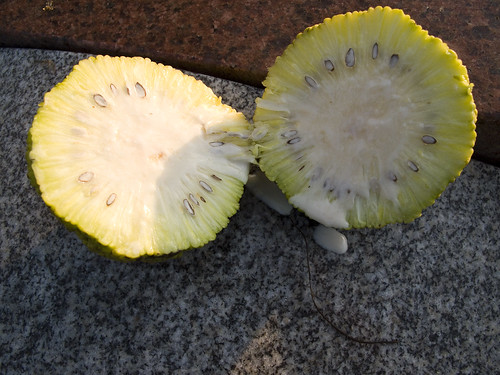
St. Michael’s Cemetery, Maclura pomifera, or Osage Orange fruit – photo by Mitch Waxman
Like all fruiting plants, an animal conspirator is required to complete the life cycle of the Osage Orange, expanding its range via the digestive processes of a ranging forager. Ever efficient, nature would not waste its time producing an energy rich fruit that attracts no living animal to it. Theories abound as to the identity of this partner organism, and an extinct equine is one of the evolutionary vectors theorized to have played this role for the Osage (thought likely due to the browsing preferences of modern Horse and Mule), but an intriguing notion is put forth by Connie Barlow of Harvard’s Arnold Arboretum who offers the theory that the anachronistic fruit of the Osage Orange’s partner animal was in fact a long extinct North American Elephant- the Mammoth.
Practicers of the left handed path of forbidden knowledge prize Osage wood for usage in wands, believing it to be useful when invoking mysterious spirits emanating from the bowels of the earth- those never human elemental intelligences, and the spirit animal guides associated with Native American Shamanic beliefs.
Osage-Orange is a native tree coming from a relatively small area in eastern Oklahoma, portions of Missouri, Texas and Arkansas. While used for centuries by native Americans in its original area for war clubs and bows, it was the first tree Lewis and Clark sent back east from St. Louis in 1804. Yet, with that modest beginning, the Osage-Orange probably has been planted in greater numbers throughout the United States in the 19th and early 20th century than almost any other tree species in North America. Because of its value as a natural hedgerow fence, it made agricultural settlement of the prairies possible, it then led directly to the invention of barbed wire in 1874, and then provided most of the posts for the wire that fenced the West. It is still considered the best wood for making archer’s bows. The Osage-Orange is one of America’s more interesting natives. It has at least two Internet web sites dedicated to keeping Osage-Orange enthusiasts informed (see www.osageorange.com and www.hedgeapple.com).
Happy Thanksgiving.
Tales of Calvary 5- Shade and Stillness

– photo by Mitch Waxman
In the past, the desolating loneliness and isolation which define my internal dialogue have been described to you simply – I’m all ‘effed up.
Shunned by those considered normal, my human– all too human- nature forces visceral desires for companionship. Lacking fellowship amongst the the living, one instinctively reaches out for those things which are no longer- or have never been- alive. That odd man in the filthy black raincoat that you might glimpse as you drive past the graveyard, scuttling along taking pictures of sewers and odd boxes in the Cemetery Belt- might very well be your humble narrator.
I was at Calvary Cemetery, intent on investigating the puzzling knots I had observed, beneath a hilltop tree- fed by some morbid nutrition, when I came across the Sweeney monument.
The Association for Gravestone Studies makes available this pdf file of a 19th century monumental bronze catalog, incidentally, as well as this discussion of “White Bronze“.

– photo by Mitch Waxman
Unlike the celebrated O’Brien clan, whose final destination is found closer to the apex of Calvary’s hills, the Sweeneys are shadowed by time. Social standing and class status drove the generations buried up here to seek a favorable and expensive bit of real estate, away from the common rabble and poor being laid into marshy trenches at the shallow of the hill in their thousands, and to lie for eternity with “their own kind”.
The princes of the City, and their courts, lie in Calvary Cemetery– not far from worm scarred timbers whose titan bulk restricts an elixir of extinction known as the fabled Newtown Creek from mingling with the blessed soils of Calvary. Unguessable springs of subterrene putrefaction percolating with horrors beyond the grave’s holding flow still beneath the streets of Newtown- vestigial streams and waterways that are imprisoned in masonry and brick tunnels. Directly mixing, in hideous congress, the liquefied effluvia of the long dead found in the hydrologic column of Calvary with the exotic chemistries of Newtown Creek? Who can guess would result?
Whoever the Sweeneys were, their family plot is located in a fairly exclusive area of the 19th century’s ex-population, and pretty close to the top of a hill. What’s odd here, and remarkable, is the enigmatic knots of this token affixed to the Sweeney monument- a trinket which had obviously weathered more than one change of season.
Unknowable implications are suggested by the urgency of this arcane reference found in the New York State Cemetery Law.

– photo by Mitch Waxman
Symbolic gifts to the dead and the placement of totemic representations at graves are expected behaviors, when confronted with the brutal truth of mortality, from individuals who experience the death of a family or peer group member. Every cemetery in the area, the sheer acreage of which -in this case- can be observed from space, has posted regulations on appropriate and allowed markers and monuments. Certain obtuse expressions of grief are disallowed due to the necessary maintenance and landscaping of the grounds, and good taste is enforced.
Another odd set of provisions is found in the Penal Law section of the aforementioned codification of New York’s cemeteries.

– photo by Mitch Waxman
Noticing that that the oddly complex knotting of the cord implied commonality with the nearby red and blue knotted cords, I decided to have a closer look. There was a second color of cordage in the knots, a dirty and weathered yellow which was only present in one spot. The pendulum which the arrangement supported was either cheap electroplated metal or some sort of ruggose plastic. It was a sort of cartouche, an amulet shaped in a manner commonly recognized as a heart, suspended by a twisted tendon of oddly knotted string.

– photo by Mitch Waxman
Suspicious that this might be something other than innocent, and knowing the predilection of certain groups for the usage of bodily liquids in their rites, your humble narrator used a trusty all in one Leatherman brand tool to examine it further. It is important, when walking in the hallowed grounds of Calvary, to try not to touch anything lest something touch you back. Things found there, if they can catch the smell of you, might follow you home and demand to be fed.
Of course, I mean the hundreds of feral cats which stalk Calvary’s hills, and it is best that they stay here where it is always safe for them. Neighborhood gossips- their odd comment phrased with a raised eyebrow and knowing squint- hoarsely whisper the opine: In Calvary Cemetery, no man may kill a cat…
Also from New York State, a manual for the new treasurer, a business plan and model to follow for the mortuary industry’s promise of “Perpetual Care”.


 The Newtown Pentacle