Posts Tagged ‘DUGABO’
singularly heavy

– photo by Mitch Waxman
So, nowadays one finds oneself hanging off bridges late in the evening attempting to capture “time exposures” after realizing that there aren’t all that many “night shots” in the library. Honestly, even I find this behavior suspicious, which is why there aren’t that many “night shots” in the aforementioned library. When the thermonuclear eye of god itself shines not upon the Newtown Creek is when a lot of the really “fun stuff” happens around these parts, only a small part of which involves a rodentine army which emerges and swirls out from hidden apertures in the concrete devastations.

– photo by Mitch Waxman
The first and second shots featured today are captured from the Pulaski Bridge, specifically the staircase which carries pedestrian traffic to Borden Avenue from the elevated path. The shot above looks toward Greenpoint with Manhattan behind it. The shutter was open something like eight seconds, which is why the water appears glassy and the artificial lighting of parking lot and lamp posts have taken on a star like halo. The halo is caused by the iris shutter mechanism within the camera, and is shaped by the blades of the device.

– photo by Mitch Waxman
The big problem I’m having with gathering this sort of material is actually the pedestrian nature of my movements. As automotive conveyance is a luxury which I currently do not enjoy, there are large sections of the Creeklands which I just don’t want to walk through at night. A vast physical coward and feckless quisling, the problems your humble narrator is experiencing are dual.
First- I am simply too meek and bookish to trust that the cruelty of the nocturne streets will leave me unmolested, and second- I fear that which may be revealed in the result. Who can guess what it is, that might march about the deserted industrial lowlands of the Newtown Creek when free from the tyranny of casual observation?
strange corridors

– photo by Mitch Waxman
Staying current on the story of Newtown Creek involves attending a lot of meetings. Some are private, most public. Often, they came rapid fire and it feels as if every other evening is consumed. One of the many community groups which hold such gatherings is the Newtown Creek Monitoring Committee. I’m a guest at this particular gathering, and as such an attempt is made to remain silent and observe the proceedings.
The group engages in a dialogue with representatives of the NYC DEP, who are offered input from community representatives regarding issues that might arise from the presence of the Newtown Creek Waste Water Treatment Plant.
One of these issues, as you would imagine, is the spread of odors emanating from the vast facility.

– photo by Mitch Waxman
The DEP contract with a company, called “Odor Science and Engineering”, who specialize in the detection and discovery as well as elimination of point sources for malodorous gases. Luckily, an inspection of the plant by the company was scheduled for the following week and Christine Holowacz (DEP community liaison) arranged for a few of us to accompany the effort.
Pictured above is Kate Zidar (Newtown Creek Alliance Executive Director) and Laura Hoffman (Newtown Creek Monitoring Committee), who with myself, showed up bright and early to be fitted with hard hats and vests.

– photo by Mitch Waxman
We were introduced to Dr. Ned Ostojic Ph.D and P.E., Odor Science & Engineering’s Vice President & Director of Engineering.
A tall and dignified fellow, Dr. Ostojic spoke with a barely detectable yet pleasant European accent and was extremely hospitable to us as he described his function at the plant. An engineer, he was tasked with not only finding the sources of odor but describing practical solutions to eliminate them.

– photo by Mitch Waxman
Dr. Ostojic produced a device whose purpose was to combat a human perception bias called environmental adaptation. To describe it simply, the human mind filters out environmental stimuli to create a sense of “normalcy”. If you live on a noisy street, your brain filters out most of that noise and you become inured to the environmental background level. The brain functions in the same way with smell, something I know to be accurate. When I encounter the smell of the Newtown Creek, or of any sewer plant, no reaction is displayed while others openly gag.
My brain has become adapted to Newtown Creek.

– photo by Mitch Waxman
He asked us not to make fun of the devices name, which was a “Nasal Ranger”.
It allows calibrated measurement of smell based on a concentrating chamber which lies behind an aperture dial. The dial allows ever smaller samples to be inhaled into the device, which can then be graded on a subjective and numerical scale. Good science, don’t forget, is all about measurement and objective recording. The Nasal Ranger removes personal interpretation from data records, as its operators are trained according to an empirical standard.

– photo by Mitch Waxman
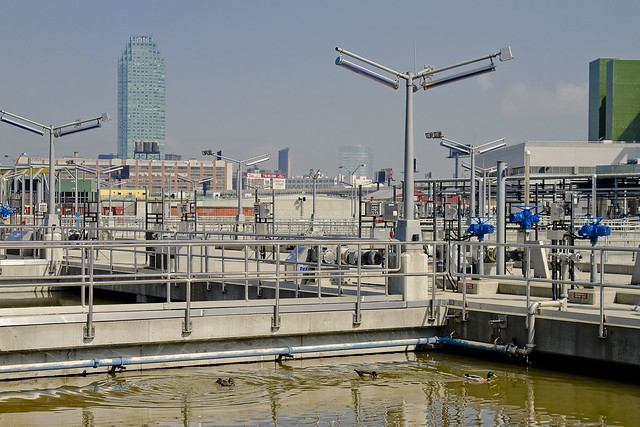
We three accompanied Dr. Ostojic on his walk through of the plant, and his duty this day was the inspection of the settling tanks which allow sewer borne debris to drop out, or be be skimmed from, the wastewater flow before it enters those famous digester eggs which distinguish this plant and betray its location on the skyline of New York City.

– photo by Mitch Waxman
Several times has your humble narrator been allowed to enter and record the grounds of this facility, found along the Newtown Creek, but this side of things has always been off limits because of extreme danger.
One of the curious facts related to me that day was that , were one of us to slip and fall into the highly aerated water and sewage in the tanks surrounding us, the liquid would not display much buoyancy. Because of all the dissolved gas in the liquid, neither would it slow your fall much and you would plummet- as if through air- some two stories to a hard cement floor.
In no uncertain terms, I was told, you would die. This was confirmed by one of my union buddies, who works at another plant in the DEP system.

– photo by Mitch Waxman
This is somewhere around midway through the sewage treatment process, after the larger bits of solute and debris carried in the flow have been removed. When the raw flow hits the plant, it carries wood and boxes and all sorts of garbage and debris with it. This gross matter is removed mechanically at another part of the plant. Next up is grit, which can be sand, soil, or just plain old coffee grounds. The rate of speed at which the wastewater races through the system makes even such innocuous contaminants hazardous to the works, and is removed by more specialized machines housed in separate “grit buildings”.

– photo by Mitch Waxman
Of course, nothing is perfect, and the job of these settling tanks is to skim off any floatable material which has evaded prior filtration. Fats, oils, and a surprising number of cigarette butts, tampon applicators, condoms, and other floatable material is seen at the collection side of the tanks. As they are open to the air, this is one of the spots which Dr. Ostojic regularly inspects and pays a great deal of attention to. He was constantly checking his readings and observations against the prevailing winds.

– photo by Mitch Waxman
Dr. Ostojic wasn’t alone for the inspection and was working with the fellow pictured above, who introduced himself as Gary Grumley. Mr. Grumley was working with a different detection device than Dr. Ostojic, a hydrogen sulfide detector.
Hydrogen sulfide, of course, is a colorless gas which is infamous for the fecund smell of decay commonly referred to as “rotten eggs”. Such emissions are responsible for a lot of community complaints, and are unfortunately part of the complex chemistry which accompanies the disposition of sewage.

– photo by Mitch Waxman
The device itself seemed sturdy, and Mr. Grumley arranged it neatly for photographing. He had begun work several hours prior to our arrival and began transmitting his findings and observations to Dr. Ostojic.

– photo by Mitch Waxman
A graphic map of the plant with its multitude of buildings, service areas, and zones was on Dr. Ostojic’s clipboard.
A running tally of various areas where an unexpected or intense odor was encountered had been kept, and each occurrence was registered with a numerical value or rating. We didn’t encounter anything truly horrible btw.
– photo by Mitch Waxman
An example was offered later in the day by the DEP’s Superintendent of the Plant, Jim Pynn, of Dr. Ostojic’s contributions.
It seems that a problem had developed around the hatches leading to an underground tank, cylindrical in shape, which had been located in a rectangular shaped shaft. An onerous odor was regularly emerging from the shaft, and Dr. Ostojic was called in. He determined that as wind passed over it, a venturi was forming in the space between the cylinder and the right angled walls which suctioned the tainted air from it’s enclosure and into the open air.
Dr. Ostojic’s simple solution, adding chevrons to the sides of the tank which would abort the formation of a vortex, saved the plant a costly redesign of the affected area. The smell stayed where it was meant to, as well.

– photo by Mitch Waxman
Dr. Ostojic was gracious and quite patient with us. A loving nickname for him, which is offered with wide smiles and a wink by those who work at the plant, is “Ned the Nose”.
Usually, when one is invited to attend a meeting at an industrial site in Greenpoint, Brooklyn- with someone named Ned the Nose- the encounter seldom turns out to be as pleasant as this was.

– photo by Mitch Waxman
Newtown Pentacle, we go these places so you don’t have to.
ALSO:

Your humble narrator will be narrating humbly at this year’s Obscura Day event on April 28th, leading a walking tour of Dutch Kills. The tour is already a third booked up, and as I’m just announcing it, grab your tickets while you can.
“Found less than one mile from the East River, Dutch Kills is home to four movable (and one fixed span) bridges, including one of only two retractible bridges remaining in New York City. Dutch Kills is considered to be the central artery of industrial Long Island City and is ringed with enormous factory buildings, titan rail yards — it’s where the industrial revolution actually happened. Bring your camera, as the tour will be revealing an incredible landscape along this section of the troubled Newtown Creek Watershed.”
For tickets and full details, click here :
obscuraday.com/events/thirteen-steps-dutch-kills-newtown-creek-exploration
wildly luminous

– photo by Mitch Waxman
In yesterday’s posting, a object d’art was found along Laurel Hill Blvd. At the foot of that ancient byway lies an intersection with Greenpoint Avenue, and the bridge named for it. The street lamps are often utilized by your humble narrator as “something to hide from oncoming traffic behind” and recently I’ve noticed some odd graffiti popping up on them.
Not your usual “gangsta” braggadocio or “tags” nor “ironic hipster commentary”, these involve the bible.

– photo by Mitch Waxman
The scrawl I’m referring to on this pole, which is on the western corner, is not the interesting tidbit about people of Korean abstraction which is written on the masking tape holding the pen- instead it’s the “Sin is the Devil” which caught my attention.
In the American King James version, at least, this correlates to 1 John 3:8
“He that commits sin is of the devil; for the devil sins from the beginning. For this purpose the Son of God was manifested, that he might destroy the works of the devil.”
Hmm.

– photo by Mitch Waxman
Maybe I’m just stupid, but Psalms 141.6 doesn’t include the quotation above, which most likely comes from “Romans 5:13- For until the law sin was in the world: but sin is not imputed when there is no law.”
The Psalms quotation would be “Their rulers will be thrown down from the cliffs, and the wicked will learn that my words were well spoken“.
– photo by Mitch Waxman
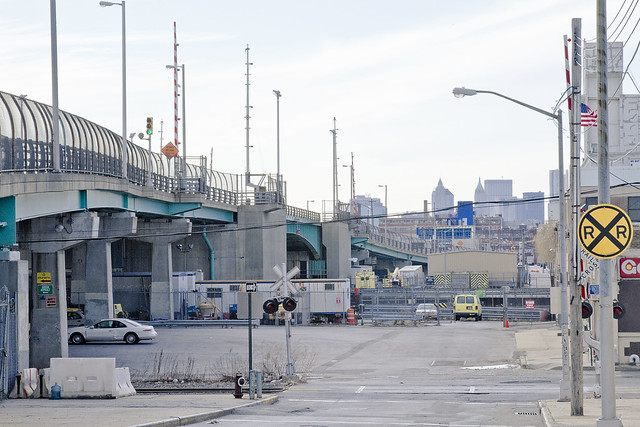
DUGABO (or Down Under the Greenpoint Avenue Bridge Onramp), it would seem, can now boast of hosting a foe of evil.
Wonder what might happen should they spy the Blissville Banshee as she floats down the Newtown Creek, spy the occultists who make altars in area cemeteries, or wonder at the tales of an antique and quite spectral locomotive passing the Bliss Tower on its way to Deadman’s Curve at Berlin Hill?
Would we see an exorcism in DUGABO?
ALSO, this Friday:

My own attempt at presenting a cogent narrative and historical journey “up the creek” is up coming as well-
Your humble narrator will be narrating humbly on Friday, February 24th at 7:30 P.M. for the“Ridgewood Democratic Club, 60-70 Putnam Avenue, Ridgewood, NY 11385” as the “Newtown Creek Magic Lantern Show” is presented to their esteemed group. The club hosts a public meeting, with guests and neighbors welcome, and say that refreshments will be served.
The “Magic Lantern Show” is actually a slideshow, packed with informative text and graphics, wherein we approach and explore the entire Newtown Creek. Every tributary, bridge, and significant spot are examined and illustrated with photography. This virtual tour will be augmented by personal observation and recollection by yours truly, with a question and answer period following.
For those of you who might have seen it last year, the presentation has been streamlined, augmented with new views, and updated with some of the emerging stories about Newtown Creek which have been exclusively reported on at this- your Newtown Pentacle.
For more information, please contact me here.
What: Newtown Creek Magic Lantern Show
When: Friday, February 24th at 7:30 P.M.
Where: Ridgewood Democratic Club, 60-70 Putnam Avenue, Ridgewood, NY 11385
sober and solitary
– photo by Mitch Waxman
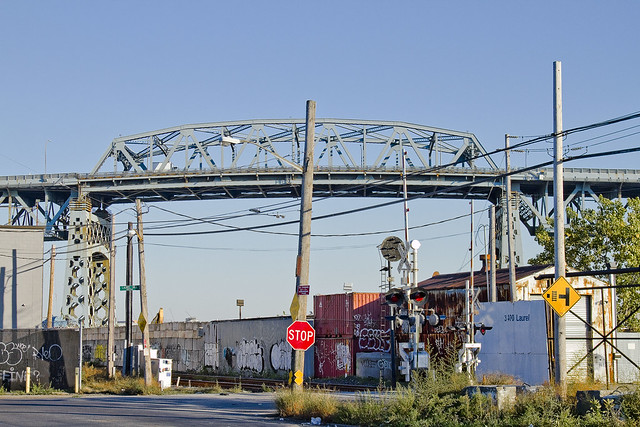
The other day, your humble narrator was seeking adventure and illumination amongst the mouldering tombstones and oil soaked sands of Blissville. This is an industrial stretch, closer to DUGABO than it is to DUKBO, with the cyclopean walls of Calvary Cemetery defining the northern side of the street and an unbroken facade of industrial buildings and warehouses on the the south, which is also the direction in which the fabled Newtown Creek might be found by those that seek it out.
This is formerly one of the most loathsome stretches of the Creeklands- home to oil works, distilleries, and fat rendering plants.

– photo by Mitch Waxman
On the gates of what was once the vast rendering plant of Van Iderstines, a noxious industrial combine which was reviled by its neighbors during the century it squatted squamously upon this spot, this artwork was observed. This was no mere graffiti scrawl, instead this was an affixed installation, one which was obviously prepared elsewhere.
Content and subject matter are curious… and more than curious…

– photo by Mitch Waxman
Your humble narrator grew interested upon noticing the presence of the double helix in the design, and the labeling which is meant to indicate the various amino acids which DNA is composed of. The “genetic code” as it is called, is actually represented by just four letters representing the chemical nucleotides which form the “double helix”- G,A,T, and C.
The four bases found in DNA are adenine (abbreviated A), cytosine (C), guanine (G) and thymine (T)

– photo by Mitch Waxman
A secondary piece was hung nearby, this one showed greater restraint than the first, but absent the chaotic charisma of the first.
Wouldn’t it be a wonderful thing if the fences and gated properties of the Newtown Creek waterfront became a sort of guerrilla gallery for local artists. Imagine mile after mile of bizarre conceptions and twee fever dreams installed in the dead of night by a virtual and quite fey army of artists. Not “tagging”, of course, just tacking up something on paper whose impermanence was part of its very composition. Do the art on rice paper or something that will just turn to pulp when it rains.
A friend of mine once did an ad agency mailing for some “green” client, and her gimmick was to use paper into which flower seeds were embedded at the paper mill (and it was printed using soy inks, of course), and you were meant to just plant the advertisement in a pot after reading it.

– photo by Mitch Waxman
Being the sort of damaged individual that you’ve come to expect me to be, Lords and Ladies, an attempt was made to decode this particular painting. It soon became apparent that expertise in organic chemistry would be required to profoundly critique it, something which it would be foolhardy to attempt. A cursory scan of the various formulae revealed that some of these are indeed actual chemical descriptors for amongst other things- restriction enzymes.
The usage of the infinity symbol and the other text is a mystery to me, but overall I liked the art.
ALSO, this Friday:
My own attempt at presenting a cogent narrative and historical journey “up the creek” is up coming as well-
Your humble narrator will be narrating humbly on Friday, February 24th at 7:30 P.M. for the“Ridgewood Democratic Club, 60-70 Putnam Avenue, Ridgewood, NY 11385” as the “Newtown Creek Magic Lantern Show” is presented to their esteemed group. The club hosts a public meeting, with guests and neighbors welcome, and say that refreshments will be served.
The “Magic Lantern Show” is actually a slideshow, packed with informative text and graphics, wherein we approach and explore the entire Newtown Creek. Every tributary, bridge, and significant spot are examined and illustrated with photography. This virtual tour will be augmented by personal observation and recollection by yours truly, with a question and answer period following.
For those of you who might have seen it last year, the presentation has been streamlined, augmented with new views, and updated with some of the emerging stories about Newtown Creek which have been exclusively reported on at this- your Newtown Pentacle.
For more information, please contact me here.
What: Newtown Creek Magic Lantern Show
When: Friday, February 24th at 7:30 P.M.
Where: Ridgewood Democratic Club, 60-70 Putnam Avenue, Ridgewood, NY 11385
Project Firebox 30

– photo by Mitch Waxman
It lives on the corner of Van Dam and Review, and clearly remembers when the self storage place across the street was a pickle factory. Like all long time residents of Queens, it can barely recognize the place these days, but carries on and sallies forth on the daily round. It’s not old enough to remember the Greenpoint Avenue Bridge burning down, twice. Neither does it remember Gleason’s trolleys nor the vast funeral cortèges that emptied the Five Points as they proceeded to Calvary. Memory is not a strong point for its kind, for as a watchman, the sole function it must serve is to raise the alarum.


 The Newtown Pentacle