Posts Tagged ‘East River’
No Necronomicon, but…
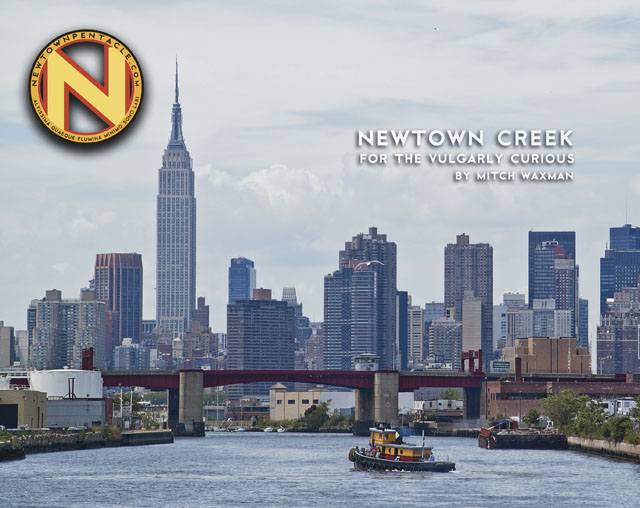
Here’s why so many posts in the last few weeks have been late, Lords and Ladies.
“Newtown Creek for the Vulgarly Curious” is a fully annotated 68 page, full-color journey from the mouth of Newtown Creek at the East River all the way back to the heart of darkness at English Kills.
Check out the preview of the book at lulu.com, which is handling printing and order fulfillment, by clicking here.
Every book sold contributes directly to the material support and continuance of this, your Newtown Pentacle.
“Newtown Creek for the Vulgarly Curious” by Mitch Waxman- $25 plus shipping and handling.
Superfund me

– photo by Mitch Waxman
LO, BEHOLD, and TREMBLE… for the Newtown Pentacle is back in session…
Over several of the last few years, agents and officials of the Federal Government have conducted a strange and secretive investigation into certain conditions within and around the ancient New York waterway called the Newtown Creek.
The public first learned of it in 2009, when a vast series of public meetings and pronouncements were offered by agents of the Environmental Protection Agency which confirmed and introduced the news that the ancient corridor of industry and forbidden history called the Newtown Creek was being considered for inclusion on the Federal Superfund list.
This listing would bestow extraordinary powers over the waterway, and ultimate authority, to the Federal Government. Effectively, the 3.8 mile long border of Brooklyn and Queens with its enormous number of crumbling bulkheads, worm eaten piers, and supposedly empty warehouses are now the responsibility of the G-Men. Uninquiring souls let the occurrence pass as one of the major developments in a spasmodic war on environmental pollution and the toxic legacy of the industrial revolution.
from epa.gov
Release date: 09/27/2010
Contact Information: John Senn (212) 637-3667, senn.john@epa.gov
(New York, N.Y.) The U.S. Environmental Protection Agency (EPA) today added Newtown Creek in New York City to its Superfund National Priorities List of the country’s most hazardous waste sites. The final listing will allow EPA to conduct a comprehensive evaluation of the creek to determine what remedial actions need to be implemented. Various sediment and surface water samples have been taken along the creek. Potentially harmful contaminants such as pesticides, metals and polychlorinated biphenyls (PCBs) have been detected in Newtown Creek along with volatile organic compounds (VOCs). VOCs are potentially harmful contaminants that can easily evaporate into the air.
“The toxic pollution in Newtown Creek is more than a century in the making. EPA is placing Newtown Creek on the Superfund list to ensure the creek receives a thorough cleanup,” said EPA Regional Administrator Judith Enck. “Newtown Creek is a key urban waterway, which provides recreational and economic resources to many communities. Throughout the investigation and cleanup, we will work closely with the communities along the creek to achieve a revitalization of this heavily-contaminated urban waterway.”
EPA proposed Newtown Creek be added to the Superfund NPL list in September 2009. EPA received and considered public comments on its proposal before making its final decision.

– photo by Mitch Waxman
On Monday the 27th of September in this year of 2010, the EPA announced the Superfund listing of Newtown Creek would be moving forward.
Interesting coincidences abound for this date:
The first Ford Model T rolled off the assembly line in 1908 in Detroit, Einstein had his E=MC2 formula published for the first time in 1905, Crete fell to the Turks in 1669, and the Jesuits were granted a Papal charter in 1540. The Warren Commission released its report on the assassination of President John F. Kennedy in 1964, the Ottoman Siege of Vienna began in 1529, the Taliban captured Kabul in 1996, and Thomas Nast was born in 1840.
It is also 110 years and 19 days after this report appeared in the NY Times, and some 122 years and 11 days since this report appeared in the same publication.
also from epa.gov
EPA had previously responded to requests by members of Congress to evaluate specific sites along Newtown Creek by publishing a September 2007 report that contained a review of past and ongoing work being conducted to address the Greenpoint oil spill as well as recommendations regarding future work to assist with the spill response. The state of New York referred the site to EPA due to the complex nature of the contamination in the creek. EPA’s Superfund study and cleanup are expected to focus on the sediments in the creek and on identifying and addressing sources of pollution that continue to contribute to the contamination.
Newtown Creek is part of the core area of the New York-New Jersey Harbor Estuary, which has been designated by EPA as an “estuary of national significance.” Despite the ongoing pollution problems, some residents currently use the creek for recreational purposes such as kayaking, while others eat the fish they catch from the creek.

– photo by Mitch Waxman
According to statements rendered by Government representatives, the actual work on the remediation project is not scheduled to begin in earnest for several months (if not years), as a period of further study and evaluation of the endemic situation before the final formulation of their plans to ferret out and eradicate all that there is which may be buried down there.
The government plans on removing hundreds of metric tons of the sediment which lines the bottom of the Newtown Creek. Privileged to have been included on the conference call during which EPA announced their decision to the third estate, your humble narrator queried EPA personnel as to the methodology of its removal (terrestrial industries versus maritime) and whether they had determined a probable destination for the contaminant laced material they intend to dredge out.
Both questions seemed to have been unexpected, and they reported that answers will be readily uncovered when the final action plan is unveiled sometime in the near future.
additionally, from epa.gov
In the mid -1800s, the area adjacent to the 3.8-mile Newtown Creek was one of the busiest hubs of industrial activity in New York City. More than 50 industrial facilities were located along its banks, including oil refineries, petrochemical plants, fertilizer and glue factories, sawmills, and lumber and coal yards. The creek was crowded with commercial vessels, including large boats bringing in raw materials and fuel and taking out oil, chemicals and metals. In addition to the industrial pollution that resulted from all of this activity, the city began dumping raw sewage directly into the water in 1856. During World War II, the creek was one of the busiest ports in the nation. Some factories and facilities still operate along it, and various adjacent contaminated sites have contributed to its contamination. Today, as a result of its industrial history, including countless spills, Newtown Creek is badly polluted.
In the early 1990s, New York State declared that Newtown Creek was not meeting water quality standards under the Clean Water Act. Since then, a number of government-sponsored cleanups of the creek have taken place. The New York City Department of Environmental Protection has sampled sediment and surface water at a number of locations along the creek since 1980. In early 2009, EPA sampled the sediment throughout the length of Newtown Creek and its tributaries. EPA will review existing information about Newtown Creek to develop a plan for further investigation.

– photo by Mitch Waxman
The professional press also on the call seemed more interested in the Gowanus Canal, how the Mayor felt about the announcement, and grew fixated on the cost of the cleanup effort. EPA clearly spelt out that its budgeting process has barely begun, and they can neither supply a final cost estimate or time table at this early date. This is actually the logical course, as the secrets of the Newtown Creek must- as always- bubble up and reveal themselves to those who stare deeply into its occluded depths.
And, in their own time, all the poisons in the mud will leach out.
and also, from epa.gov
EPA conducted an Expanded Site Investigation (ESI) of Newtown Creek in 2009 as part of the Hazard Ranking System scoring process for NPL listing under Superfund. Based on the ESI, which was focused on Newtown Creek itself and not its tributaries, EPA concluded that metals, volatile organic compounds, and semi-volatile organic compounds (including polycyclic aromatic hydrocarbons and polychlorinated biphenyls) were present in Creek sediments at elevated concentrations. The variety and distribution of the detected contaminants suggests that they originated from a variety of sources. Previous environmental investigations of Newtown Creek, or specific portions of the Creek, also disclosed that sediments in Newtown Creek are contaminated by a wide variety of hazardous substances. Environmental investigations of upland parcels adjacent to or nearby the Creek have disclosed contamination of those parcels by hazardous substances similar to hazardous substances found in sediments in Newtown Creek.
lucky shot

– photo by Mitch Waxman
Luckily, there seems to be some effort underway to paint the Brooklyn Bridge. A sheathing of reflective metal scaffolding recently heralded a fortuitous confluence of solar azimuth and camera vantage point as evidenced above.
Luck, pure luck. Check out the larger sizes at flickr by clicking the image (as always).

cleanly picked

– photo by Mitch Waxman
On one of the periodic Working Harbor Committee trips across the estuarine expanses of New York Harbor, your humble narrator became paralyzed with terror when a benthic shadow slid alongside the vessel which carried my withered husk. The shape, as that’s all I saw of it, made no sense to me and matched no phyla or phenotype familiar to my admittedly limited experience. Imagination working, it was decided that the best course of action to steady my faltering sanity would be to focus in on those things material, tangible, and engineered according to the familiar laws of physics.
In this case, it was the Tugboat “Miss Gill” cruising in photogenic splendor against the mist wrapped backdrop of the shining city of Manhattan.
from norfolktug.com
The Miss Gill spent a year at Main Iron Works in 2005 having various tanks, exterior plate and bulwarks renewed. During this yard period her winch was completely rebuilt and two new 2′ cables were installed. We bought her during this shipyard renovation, operated the her for 24 months and in mid 2008 took her back to the yard for further investment. We replaced her main engines with Caterpillar tier II technology that make her an honest 3000BHP, her reduction gears were replaced with ZF technology, and new John Deere/Kohler generators were installed. These tier II engines are the most advanced electronic platform available.

– photo by Mitch Waxman
The shadow, or shape, that I had spied was long obscured when a Coast Guard vessel suddenly burst into view. Fully armed, one of the redoubtable guardians of the archipelago’s frontier was manning a high caliber weapon and the boat was moving at a fantastic rate of speed, punching its way through the heavy wakes of ferry, tug, and ship alike. Recognizing that it shared some design characteristics with an NYPD harbor craft described in a recent post here- at your Newtown Pentacle- “exhalted beyond thought“, I noticed it was being followed by an even larger Federal boat.
I believe this to be a Defender class “Response Boat Small”.
from uscg.mil
Developed in a direct response to the need for additional Homeland Security assets in the wake of the September 11th terrorist attacks, the Defender Class boats were procured under an emergency acquisition authority. With a contract for up to 700 standard response boats, the Defender Class acquisition is one of the largest boat buys of its type in the world. The 100 boat Defender A Class (RB-HS) fleet began arriving at units in MAY 2002 and continued through AUG 2003. After several configuration changes, most notably a longer cabin and shock mitigating rear seats, the Defender B Class (RB-S) boats were born. This fleet was first delivered to the field in OCT 2003, and there are currently 357 RB-S boats in operation.
The 457 Defender Class boats currently in operation are assigned to the Coast Guards Maritime Safety and Security Teams (MSST), Maritime Security Response Team (MSRT), Marine Safety Units (MSU), and Small Boat Stations throughout the Coast Guard. With an overall length of 25 feet, two 225 horsepower outboard engines, unique turning radius, and gun mounts boat forward and aft, the Defender Class boats are the ultimate waterborne assets for conducting fast and high speed maneuvering tactics in a small deployable package. This is evidenced in the fact that several Defender Class boats are already in operation by other Homeland Security Department agencies as well as foreign military services for their homeland security missions.

– photo by Mitch Waxman
It was followed by a second and larger vessel, also with a manned weapons platform. If I’m correct, this is the Coast Guard “Response Boat Medium” or “RB-M”. Vessels of this design will automatically right themselves after being capsized, incidentally.
Whether or not these federal watercraft had arrived on the scene in connection with the subsurface apparition I had witnessed is anyone’s guess.
from uscg.mil
State-of-the-art marine technology makes the RB-M a high performer with waterjet propulsion, an advanced electrical system, and integrated electronics that allow greater control from the pilot house.
Technological and design features will improve search object tracking, water recovery efforts, crew comfort, and maneuvering/ intercept capabilities for defense operations. With the latest developments in integrated navigation and radiotelephony, command and control will be greatly enhanced, as will crew safety.

– photo by Mitch Waxman
For such a busy waterway, modernity upon the Harbor of New York has not been kind to folklore. In the 19th century, lurid accounts of odd benthic organisms served to titillate and excite the attention of small boy and adult alike filtered in from the trans-atlantic routes. Stories of the Ottoman territories, and far away China, and the exotic British Raj.
There aren’t many tales I can point to which might describe anything like the shape I saw, suffice to say it was something like an egg all caught up in wriggling ropes. Most of the 19th century reports describe literal sea-serpents, but such saurian behemoths would be easy prey for the Coast Guard.
from wikipedia
The response boat-medium (RBM) is a 45-foot (13.7m) utility boat used by the United States Coast Guard. It is intended as a replacement for the Coast Guard’s fleet of 41′ utility boats (UTB), which have been in use by the Coast Guard since the 1970s. The Coast Guard plans to acquire 180 of these RB-Ms over a 6–10 year period. The boats will be built by Kvichak Marine Industries of Kent, Washington and Marinette Marine of Manitowoc, Wisconsin.

– photo by Mitch Waxman
It has always puzzled me, the way that New York City is nearly devoid of supernatural lore, while its counterparts- Boston to the north, and Philadelphia to the south are so rich in it. Connecticut and the corridor of towns and cities that line the Hudson all the way to its font in Lake Tear of the Clouds compose one of the great occult highways. Utopias and experiments in urban planning line the river, as do tales of hessian horsemen and ghostly ferries and trains. It all stops at the Bronx, though.
Perhaps its the financial realities of New York City, the no nonsense and to the minute mentality, or maybe its the street lighting- but London is very much in the same vein of city as we are, and they’re the original inventors of gothic spooky.
Maybe it’s that in New York, you’re biggest fear isn’t what goes bump in the night but rather losing your job, or getting into trouble with some all too human monsters.
for an overwhelming example of the defense industry’s love of CGI and fancy web design, click here to check out the USCG sitelet for the RB-M, which includes an interactive 3D model and fancy graphics.

– photo by Mitch Waxman
The shadow I observed seemed to be heading toward Red Hook, but the likely explanation was that the nearby Staten Island Ferry had simply cast a refracted image of itself or that the wake of a passing tuboat had disturbed some riverine sediments. The coincidence of the arrival of two armed Coast Guard vessels was just part of some regular patrol schedule, not a response to some unknown thing which could not possibly exist down there.
Right?
from wikipedia
“Burned-over district” refers to the religious scene in upstate New York in the early 19th century, which was repeatedly “burned over” by religious revivals of the Second Great Awakening.
The term was coined by Charles Grandison Finney who in his 1876 book Autobiography of Charles G. Finney referred to a “burnt district” (p78) to denote an area in central and western New York State during the Second Great Awakening. The name was inspired by the notion that the area had been so heavily evangelized as to have no “fuel” (unconverted population) left over to “burn” (convert).
When religion is related to reform movements of the period, such as abolition, women’s rights, and utopian social experiments, the region expands to include areas of central New York that were important to these movements.


 The Newtown Pentacle