Posts Tagged ‘Kill Van Kull’
sizable rift
“follow” me on Twitter at @newtownpentacle
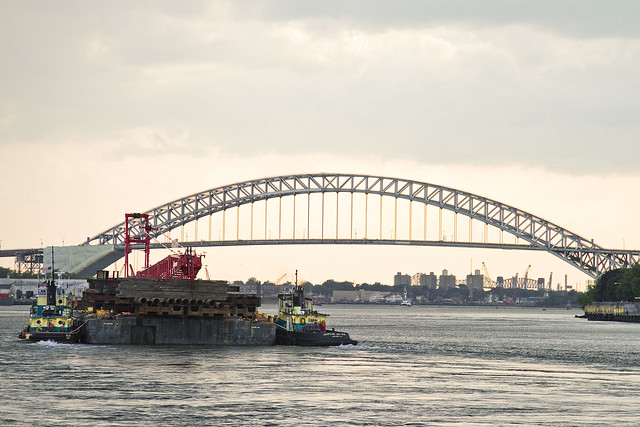
– photo by Mitch Waxman
This Maritime Sunday posting presents the crossing of the Kill Van Kull by two tugs of the Coastline Marine Towing Corporation. They are moving a crane barge from points unknown to some destination at the Port Elizabeth Newark complex. Said shots were captured while onboard a Working Harbor Committee expedition during the summer of 2012. As you can see, it was a dark and stormy night.
from coastlinemarinetowing.com
Coastline Marine Towing has been serving the New York-Metro Harbors and US Eastern Seaboard for 20 years. We provide experienced crew and vessels that are ready to accommodate the logistics of your marine project.

– photo by Mitch Waxman
Little information is available on the tug Ireland, although a friend of mine asserts that it’s a 1940 vintage vessel. It did not display radio call sign information on its hull, which would have aided me in discerning its past and capabilities. The radio call sign, for maritime vessels, performs the same function which a license plate does for motor vehicles.
from workingharbor.com
Whether it’s a single barge, a group of barges made up as a single unit, or a vessel, when being moved by a tugboat, it’s called the “tow” (singular). A tug can move a tow in one of three different ways:
- Astern – The tug pulls the tow via a tow line from the stern of the tug. This is common for ocean towing but less used in confined harbors as it may be difficult to keep the tow from swinging side to side.
- Pushing – The tug ties off behind the tow, and pushes it forward. This provides a greater deal of control compared to towing astern.
- Alongside (on the hip) – The tug ties up alongside the tow, typically aft of the midpoint of the tow. This method also provides a good deal of control.

– photo by Mitch Waxman
The capabilities of google are confounded when a search term like “Tug Ireland” is offered to it. Lacking syntax, the algorithms of the search giant deliver a cogent result describing the coastal towing capabilities of a European nation state rather than those which would define and encapsulate the history of a single tugboat. Nevertheless, a hearty Maritime Sunday shout out is sent to both the faraway coast of an Emerald Island and to the crew of a singular tugboat alike.
also from workingharbor.com
Port refers to the left hand side of a vessel as you face forward and starboard refers to the right hand side. Before the rudder was invented (by the Chinese), boats and ships were steered by means of a steering board. Since most people are right handed, it was customary to mount the steering board on the right hand side of the ship. This, the right hand side became know as the “steering board” side, which was eventually shortened to “starboard” side, and this term is still in use today.
terrific fatigue

– photo by Mitch Waxman
That’s the Bayonne Bridge, mentioned a couple of times this week, spanning the busy Kill Van Kull. The last “regular” Working Harbor Committee excursion of the year was recently enacted, and we encountered sometimes heavy weather and an overcast sky which laid down a pall of preternatural darkness upon the harbor. The air itself was thick with fog and mist, and many were the times which I needed to clear my lens of condensates.

– photo by Mitch Waxman
Denizens of the harbor used to such visual occlusion, the working vessels and tugs kept to their normal routines. Hushed intonations have been offered to your humble narrator in the past suggesting that a suite of electronics are commonly found onboard these machines. These esoteric devices neutralize the need for direct line of sight, allowing the operator to remotely sense the environment around them.

– photo by Mitch Waxman
The shadowed shoreline observed in these shots is the so called “Chemical Coast” of New Jersey. The name was earned in an earlier century, when Bayonne was famed for its mastery of colorant and dye manufacture, before the oil industry arrived with the Rockefellers.
desolate shore

– photo by Mitch Waxman
As mentioned in yesterday’s posting, a few friends and I made it a point to experience the Bayonne Bridge a few weeks back and walk over the pedestrian walkway. Our reasoning was that since the construction project which will “rekajigger” the roadway is beginning quite soon, access to this point of view will be denied to pedestrians for some time and we had better go while the getting was good. Hence…

– photo by Mitch Waxman
The bridge seems absurdly high, much more than its actual height suggests. This is largely due to the low lying shorelines which comprise the surrounding terrain, which are a vast tidal floodplain reclaimed by landfill techniques from the swampy marshlands which nature intended. One or two members of our small party found themselves suffering the effects of vertigo, but luckily your humble narrator was not one of them. My paranoid fantasies allow little room for other psychological complaints to crowd in.

– photo by Mitch Waxman
Attempts at “getting artsy fartsy” with the camera were what occupied me, and along the way envy for the unique perspectives captured by the daring bridge photographer Dave Frieder crawled into my mind. If you don’t know Frieder’s work, you should. He made a career of climbing the bridges of New York City (and beyond) and captured extraordinary images while doing so. He is also quite the expert on bridge engineering.

– photo by Mitch Waxman
There is true beauty in the arch component of the Bayonne Bridge, one can visualize the lines of force moving through the steel. Othmar Amman, who designed the bridge, often allowed the structural elements of his work to remain visible. Before him, engineers would be compelled to erect facades of masonry or cement to encase the steel, but he liked to let it all hang out.

– photo by Mitch Waxman
Looking to the west, and New Jersey, one may observe the gargantuan Port Elizabeth Newark dock complex which serves as one of the main engines of the Port of New York. Gantry cranes and stacked shipping containers obscure Newark Airport behind it. Beyond lies the continent, and the United States.

– photo by Mitch Waxman
To the east is witnessed the city state which lies off the coast of America, the shining city. The Kill Van Kull is the body of water spanned by the Bayonne Bridge, a tidal strait which connects the port facilities to the west with ocean going traffic. The Kill has been discussed thoroughly here at your Newtown Pentacle, and a section of its landward side on Staten Island is actually the subject of a walking tour (offered below) which I conduct for the Working Harbor Committee. The Staten Island side of the Kill is “The North Shore” and the Jersey side is called “The Chemical Coast”.

– photo by Mitch Waxman
Some work on the bridge has already begun, as evinced by the construction aprons being installed. The initial phases of things involve the removal of generations of lead based paint which protect the structure from corrosion. In our environmentally and politically correct age, such material is anathema, and must be removed. Discussion of the EPA administered site on the Staten Island side which is polluted with Uranium, of course, will be kept to a minimum.

– photo by Mitch Waxman
Slouching downward toward Bayonne, those lines of force I mentioned earlier dance within the steel. Not pictured, incidentally, are the many bits of signage installed along the walkway advising the citizenry against suicide. Were my only choices for residence New Jersey or… Staten Island, despondency might set in, but one cannot believe that either is “that bad”. Since the City keeps the suicide counts for individual bridges quiet, I can’t provide any insight on this, but is the Bayonne Bridge a favorite spot for such activity?

– photo by Mitch Waxman
Fully ensconced on the New Jersey side, the roadway betrays its destination via signage. Morningstar Rd. seems to be innocently named, but upon seeing the sign, I could not help but think of two things. First- the Morningstar in occultist circles is Venus, and Second- Morningstar is the last name of the transmogrified archangel Lucifer. Perhaps those anti suicide signs are more prosaic than I thought. Does the Bayonne Bridge quietly connect to some outer borough road to hell?

– photo by Mitch Waxman
Bayonne Bridge as seen from the New Jersey side, as our little party entered the unknown country of Bayonne in search of a diner. Luckily New Jersey is lousy with such establishments, although there is a significant difference in the meaning of “sloppy joe” over there. The NYC sloppy joe is what the rest of America would call a “loose meat sandwich”, whereas in NJ it’s a three layered affair which involves turkey breast, cole slaw, and russian dressing- amongst other things.
Also- Upcoming tours…

for an expanded description of the October 13th Kill Van Kull tour, please click here

for an expanded description of the October 20th Newtown Creek tour, please click here
belching aperture

– photo by Mitch Waxman
This Maritime Sunday, a psychologically overwhelmed and physically exhausted narrator presents to you the little Miss Yvette tug, as it motors down the Kill Van Kull. That’s… Staten Island… in the background, and the red, black, and blue tarp witnessed back there is part of a road salt operation called “Atlantic Salt”.

– photo by Mitch Waxman
Call sign WDE7815, Miss Yvette is not a terribly large or fast tug- with a maximum recorded speed of 7.8 knots (9mph) and a length of some 22 meters (roughly 72 feet). She is owned and operated by the Sterling Equipment company, and was built in 1975. An “inland tug”, Miss Yvette boasts a 1200 HP twin screw drive, and is 106 gross tons.
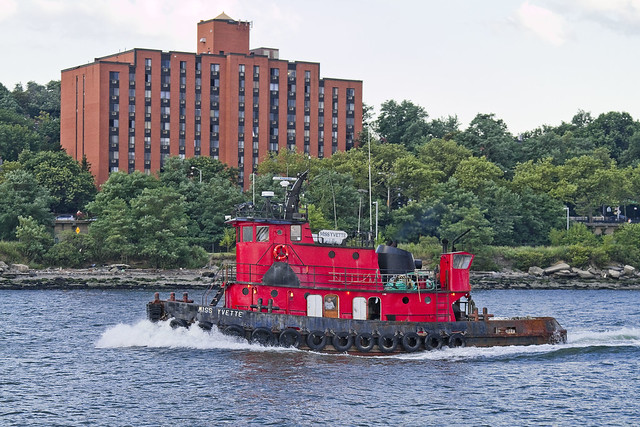
– photo by Mitch Waxman
She used to be blue and white, having spent some of her career with Hallan Marine, but is a proud scarlet these days. These shots were captured while onboard a Working Harbor Committee trip to the Port of Newark Elizabeth, just a few weeks ago.
perils faced

– photo by Mitch Waxman
Simple of mind, your humble narrator is always overjoyed when a previously unrecorded Tug passes in front of me. This time around, it’s the Mary Alice operated by Donjon Towing. Extensive operations performed by the corporations boats upon my beloved Newtown Creek have been discussed frequently at this, your Newtown Pentacle, and usage of the search box at the upper right hand corner of this page will reveal many of them to those who typed “Donjon” into it’s text field.

– photo by Mitch Waxman
If horses could swim well, it would take 3,000 of them to equal the output of this Tug’s engines, which drive the hundred foot long and 40 foot high boat through the Kill Van Kull along with its barge. A home town girl, Mary Alice was built in 1974.

– photo by Mitch Waxman
As she passed me by, the comical windmill generator in Jersey- rising over the oil tanks- came into view. For a while, I’ve been wondering if it was put there to provide comic relief to, or just taunt, the petrochemical companies located on the Kill Van Kull. That’s this week’s Maritime Sunday, Lords and Ladies.


 The Newtown Pentacle