Posts Tagged ‘Long Island City’
overtones of
Another random series of shots, in today’s post.

– photo by Mitch Waxman
Over in Greenpoint, a line of empty taxis parked on Provost Street, across the street from the sewer plant.
It’s actually meant to be pronounced as “Provoost” despite being spelled as “Provost.” The Provosts were one of the original five families of Greenpoint, along with the Bennets, Calyers, Praas, and Messeroles. These five Dutch families dominated Greenpoint politically for nearly two centuries, owned most of the land, and only began to recede into history when Neziah Bliss married into the Messerole clan. Bliss laid out the modern street grid, erected the first bridges over Bushwick and Newtown Creeks, and is the father of the modern community.

– photo by Mitch Waxman
The IND R train entering into Queens Plaza. Queens Plaza’s IND service opened for business on August 19th in 1933, but back then there was only express service between Manhattan and Queens. It wasn’t until 1955 when the 60th street tunnel opened that the Queens local trains began to travel back and forth into the Shining City. I work on getting this shot every time I’m there, and you have to time it just right to catch an arc flash that the train sets off as it comes to the station tracks grade.

– photo by Mitch Waxman
It’s amazing how many manhole cover types there are, a subject which has been discussed endlessly at this – your Newtown Pentacle. The story of municipal consolidation can be read in the screeds embossed onto these iron discs, and the one pictured above was once the property of the “Bureau of Water and Sewers” which is now part of the NYC DEP and can be observed at the border of Sunnyside and Blissville in Queens.

– photo by Mitch Waxman
This is a “Brooklyn Department of City Works” access cover, which was found back in Greenpoint. DCW is also now a part of the consolidated DEP.
– photo by Mitch Waxman
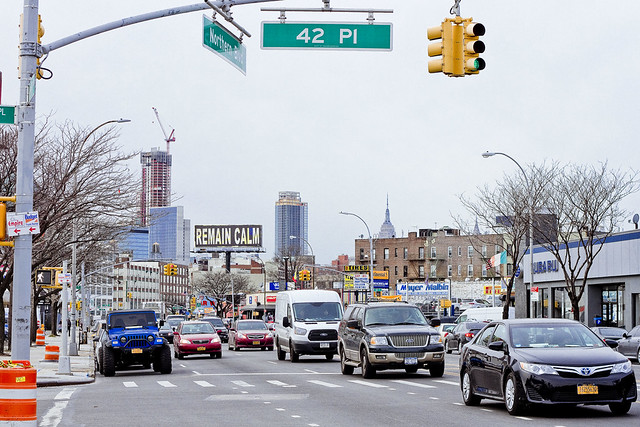
Back in Queens, on the “carridor” of Northern Blvd., a puzzling bit of signage has emerged on one of the enormous advertising bill boards found on the corner of 38th street. The easterly facing side says “Stay Calm” with a screed reading “-Peter.”

– photo by Mitch Waxman
The westerly facing side says “Don’t Panic,” and also has the “-Peter” signature. Dictionary definitions are superimposed on the block print messaging, this one bears the definition of courage. I’ve looked around for what these signs are meant to be selling or saying, but haven’t been able to find out much. If anybody knows what’s up with these messages, please share in the comments.
Either way, they are reminiscent of the sort of things Rowdy Roddy Piper observed in the John Carpenter film “They Live.”

– photo by Mitch Waxman
A gorgeous bit of hand painted signage adorns the back of a NYCHA emergency truck back in Greenpoint, and is pictured above.
“follow” me on Twitter- @newtownpentacle
negative impact
Credos, declarations, statements on the street – in Today’s Post.

– photo by Mitch Waxman
Whilst wandering about, your humble narrator likes to take note of the various missives and graffitos encountered. Most of the graffiti you see are “tags” left behind by “writers” which indicate mainly that they have been there before you. There’s also the “art” types who do renderings and or complex paintings. You’ve also got the gang stuff, which is meant as either provocation or an announcement of territorial preeminence. My favorites are the credos, seeming attempts to liberate the minds of those who read them. Often, these credos are placed in highly visible locations, what the graffiti community would refer to as “a good wall.”
The shot above is from 48th street in Sunnyside, along the LIRR overhead tracks. This particular writer has been quite busy in the recent past.

– photo by Mitch Waxman
A similar typographic style and brand of rhetoric has been appearing all over the study area which I call the Newtown Pentacle in recent months. The messaging above is found in Queens Plaza, and my presumption of its authorship is that it’s the same as the missive in the first shot.

– photo by Mitch Waxman
Probably not the same graffiti enthusiast, but this less than monumental declaration was recently witnessed on Jackson Avenue nearby the Court Square subway station.

– photo by Mitch Waxman
In Astoria, nearby Steinway Street’s intersection with Broadway, this messaging appeared one morning in the late autumn. Again, I believe, it’s the work of the person(s) featured in shots 1&2.

– photo by Mitch Waxman
Over at Socrates Sculpture Garden, this polemic was observed on a lamp post during the summer, but you’ll always find a whole lot of “artsy fartsy” graffiti near the institution.

– photo by Mitch Waxman
Back in Sunnyside, on 48th street near Skillman, a more permanent sort of scrawl was observed which mirrors the sentiment of the block printed missives found along the LIRR tracks, in Astoria, and Queens Plaza.
It’s not quite as eloquent, but there you are.
“follow” me on Twitter- @newtownpentacle
is where
Is there anyplace smellier than the IND station at Queens Plaza?
– photo by Mitch Waxman
Stumbling home through the dark recently, a humble narrator found himself at Queens Plaza, waiting for the R or M to arrive and carry his stinking carcass back to Astoria. “It seems that I’ve been dead for quite a while, judging by the smell,” thought I. That’s when I realized that it wasn’t the standard “eau d’ jew” which accompanies the end of a period of physical exertion and exercise which I was discerning, rather it was some other reeking horror that was permeating the Subway Platform.
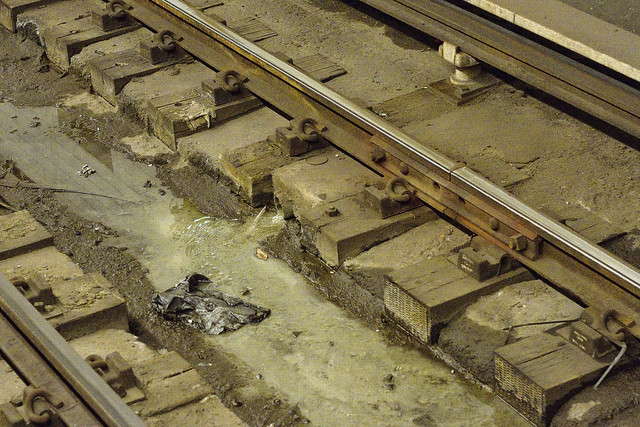
At the end of the platform, or at least the side where the last Queens bound subway car arrives, that I found the source of an odor which I can only describe as Satan’s diarrhea.

– photo by Mitch Waxman
The good news is that the syringe had already separated itself from this bubbling spring of buboes breeding Queens juice, but the smell of it…
Now remember, I’m the Newtown Creek guy. I hang around Sewer Plants, and open drains which carry liquids whose coloration ranges from olive green to cadmium yellow, and am possessed by fond memories of walking amongst the settling and aeration pits of the DEP. When I say an odor is nose hair curling, will wither away plastic, and describe something as having smelled like the dysentery of the Devil itself – pay attention.

– photo by Mitch Waxman
I can guess where this water is coming from, but it would only be a guess. The underground IND Subways in Long Island City are essentially concrete bath tubs which were set into a wetland that was already despoiled by sewage and industrial pollution by the time LIC incorporated in 1870. The subways didn’t come along until the 20th century, of course, but the waterways that flowed through Queens Plaza are still very much present.
One of them was the Dutch Kills tributary of Newtown Creek itself, which flowed across what’s now the Sunnyside Yards and was navigable all the way back to 40th avenue at the corner of Northern Blvd./Jackson Avenue. Just ask the East Side Access guys, they drilled right into it.

– photo by Mitch Waxman
Commuters in Queens who transfer at Queens Plaza, and at the 21st street G station, will tell you about seeing green water spilling out from behind the tile walls and gag a bit trying to describe the smell. In the case of 21st, it’s a different tributary of Newtown Creek – contained into a sewer tunnel – called Jack’s Creek. If you see, or smell the phenomena at Queens Plaza – my bet is that it’s Dutch Kills.
Can I prove this? No. Call it a hunch, or an educated guess by a guy who spends his time on the shorelines of Dutch Kills’s extant path who can recognize its particular pungency from a half mile away.

– photo by Mitch Waxman
Who can guess, all there is, that might be buried down there?
“follow” me on Twitter- @newtownpentacle
excellent notion
Water Pollution can actually be quite lovely.

– photo by Mitch Waxman
The shot above was captured before the cold waste section of the year descended upon us all, with its crappy light and chill air. It depicts the Borden Avenue Bridge in Long Island City, which spans Newtown Creek’s Dutch Kills tributary. You’re looking west in this one, and you can just make out the Empire State Building over in the Shining City of Manhattan on the horizon.
The following shots aren’t at the level or perspective of the water, instead they were captured recently from the deck of the Borden Avenue Bridge itself.

– photo by Mitch Waxman
Knowing the sort of things I know isn’t pleasant. I’ve actually had some casual training in recognizing the various things you’ll notice on the surface of Newtown Creek. Your humble narrator can distinguish between fresh petroleum and old, the difference being the sort of “sheen” which it effervesces.
Saying that, this olive colored snot pulling along on the tepid currents of Dutch Kills may – or may not – be petroleum.

– photo by Mitch Waxman
If it is petroleum, it’s probably a subaqueous deposit of historical pollution which has worked its way up to the surface having become “moussed” on its way and has formed a sort of aerated foam. It can also be grease, or something that floated out of the open sewers found along Dutch Kills. Heck, it can be a whole series of unpleasant things, only a chemist would be able to tell you for sure.
Whatever it is, it’s fairly interesting from a visual point of view – no?

– photo by Mitch Waxman
Y’know, we’re moving into an era in which the Newtown Creek will be cleaned up and many of its environmental issues are going to be sorted out. I’m terrified by this, as the place is going to end up being “all niced up,” which will make it boring as heck. I’ll miss the oil sheens, condoms, dead rats – all the variegated crap which is defined as “floatables.”
I guess there’s always Luyster Creek, or Anable Basin, or the Kill Van Kull… luckily, there’s a long list of polluted waterways and future superfund sites here in the City of Greater New York which are splendidly filthy.
“follow” me on Twitter- @newtownpentacle
cracked vision
Like the cops, you can never find a Taxi when you need one.

– photo by Mitch Waxman
With great interest has a humble narrator been following the dire news which the owners of Taxi fleets have been opining concerning the state of their industry. The first dagger in their hearts were the Boro Cabs – the now familiar fleets of green Taxi’s which are generally operated by independent owners which are forbidden from picking up passengers in Manhattan but can freely ply their trade in the other four boroughs. For one such as myself, the Boro Cabs have been a boon, as I seldom use a cab in the City, but often find myself short of time and needing to move between Greenpoint and LIC in a hurry.
The metered trip, combined with a guarantee that gear allowing the use of a debit or credit card in lieu of cash is onboard and in working condition, have vastly improved hiring a car in the outer boroughs and curtailed the old system of illegal street hails for private car services. The gypsy cab guys would always size you up and try to hit you with an outlandish fee for a trip of a mile or two (any further than that and I’m on the train or bus, yo). Boro Cabs are a giant “yes” check mark on the Michael Bloomberg Mayorality’s “How’d I do” list, IMHO.

– photo by Mitch Waxman
I’ve always been interested in the Taxi business. A favorite Uncle actually drove a Checker Cab, having bought his medallion with his discharge money from the military after WW2. Tales of driving a cab in New York were always gladly related, and as I grew up in a fairly suburban and automobile centric part of Brooklyn (the Canarsie/Flatlands/Old Mill Basin section) there were lots of people I knew who plied the trade. Two close friends of my parents were dispatchers at a taxi company that transformed itself into a corporate “black car” business in the 1980’s as well. My next door neighbor Charlie, he drove a taxi. I even had a couple of friends during college who paid off their tuition by driving cabs on a four p.m. to four a.m. shift. A humble narrator is… shall we say… familiar with the industry – at least by association.
A bit of NYC trivia for you: medallion cabs were mandated to be painted yellow back in 1967.
Suffice to say, the Taxi biz prior to the 1980’s wasn’t exactly lucrative, but you’d make a decent wage. Only, that is, if you owned the Cab’s medallion and the car itself. If not, and all you had was a hack license, you had to work for one of the Fleets, and then as now – you got screwed daily.

– photo by Mitch Waxman
There’s 62,000 yellow cabs in NYC, and according to the 2000 Census, some 82% of the drivers were foreign born.
Notorious scoundrels whose business practices and treatment of its labor pool are reminiscent of the sort of stuff you’d read about in Upton Sinclair’s “The Jungle,” the Taxi fleets are essentially holding corporations with deep pockets that would instantly bid as high as they need to whenever one of the limited number of taxi medallions comes up for sail. They can afford to pay whatever it takes, and roughly half of all the medallions in the City are in the hands of just a few wealthy people. Wealthy people who make a lot of campaign donations.
Good honest graft, as it was known, has always ensured that they’d be able control and rig the game they played via political connections. Additionally… well, let’s just say that this used to be an all cash business which operated in a version of New York City that was fictionalizationed in films like Donnie Brasco and Goodfellas. There’s a reason why news stands, candy stores with comics racks, and coffee shops used to exist too. Cash businesses were good for business.

– photo by Mitch Waxman
In the late 70’s, real estate in what is now called Chelsea and Soho began to heat up and the real gangsters from Wall Street and the Upper East Side were involved. The Taxi fleets which used to operate out of these post industrial neighborhoods were priced out of their traditional homes. A migration began to Long Island City and North Brooklyn, where most of the fleets are based today. The Bronx was never a good choice, although one or two yards are there, as it was considered too far from Midtown Manhattan. LIC, in particular, was a perfect spot, with the Queensboro Bridge and Midtown Tunnel close by to allow a fleet’s quick trip to the happy hunting grounds of midtown.
An all cash business, and one which trafficked in small denominations for that matter, was welcomed by the unofficial economy hereabouts as well. Large specimens of currency could easily be exchanged for “clean” money. Not saying that’s what happened, by the way, but that’s what I’ve been told. I’ve always been told, by a truly odd but direly serious fellow, that he was “working for the United Nations on combatting the gray aliens” so grains of salt are always offered on heresay.

– photo by Mitch Waxman
Like my uncle, a pretty good number of the old Checker drivers seemed to be of the Jewish ethnicity. Always a working class job, “outer borough ethnic white guy” was the fellow who drove a cab when I was a kid. Sort of fellow who said things like “terlet” and “boid.” Despite their abundant populations, there seemed to be few Black or Puerto Rican drivers, as I remember it, until the late 70’s and early 80’s.
Presumptive discrimination ended sometime in the middle 1980’s. That’s when the Taxi industry seemed to turn over its entire workforce (it’s also about when my Uncle retired so it might have been a generational thing) and nearly every cab driver seemed to be from the subcontinent. Indians were replaced within a few years by Pakistanis, who have recently begun to be phased out in favor of Spanish speakers from Central and South America. Industry veterans point to this sort of ethnic turnover claiming that it’s all about union busting, and committed in the name of finding new groups of immigrants willing to drive a cab for a few dollars less per shift than the previous generation. Modern day cab drivers have described a pretty miserable set of rules and conditions to me as set down by the fleet owners – which includes a twist on the old “one minute late, you’re docked an hour’s pay” practices – the sort of thing that went out of style in the 1930’s. That’s the reason why you can’t get a cab between three and four in the afternoon – they have to get back to base and exchange the cab with another driver, and if a minute late…
Uber, Lyft, and the rest of the new taxi services have put a serious dent in the yellow cab business recently. The price of Taxi medallions has actually fallen for the first time ever. Again, half of all medallions are in the hands of a few. This is the latest dagger in the Fleet owner’s collective heart, and they’ve used all of their influence to combat the new competitors. As it happens, many of the drivers for these new services are their former employees. Just like the green Boro Cabs, I’ve found these new services to be efficacious. I’ve also noticed that parked in and around the Fleet lots, there are a lot of obviously not road ready cabs on display sans medallions. The Fleets have actually responded to the competition, it would be noted, by creating their own smart phone apps to compete with the new players. They’ve also continued to happily buy up any medallions that become available, the price of which continues to plummet due to the arrival of Uber and the others – they say.
The Fleet owners are fairly disagreeable people, I am told. Mayor Bloomberg is reported to have been particularly peeved by them – “Bloomberg famously told one of the industry’s more notorious barons that he would “destroy” his “ fucking industry” upon leaving office” as reported by Capital New York.
If business was really as bad as claimed, wouldn’t these cars we see parked on the street be actual ready to work models, rather than dinged up models missing stickers and trimmings? If things are as dire as they are meant to be, wouldn’t the Fleet owners be selling – rather than buying – medallions?
“follow” me on Twitter- @newtownpentacle


 The Newtown Pentacle