Posts Tagged ‘Long Island City’
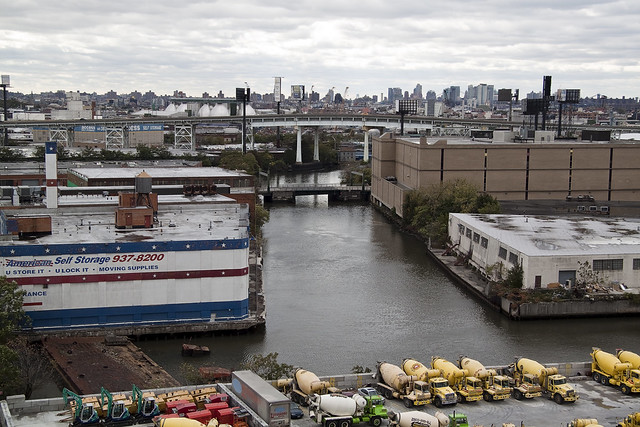
squat creatures

– photo by Mitch Waxman
An interesting conversation with someone who had just moved into the Long Island City area, whom I met at the after party for the recent Forgotten NY “2nd Saturday” Skillman avenue walking tour, involved the environmental and health consequences of living so close to Newtown Creek and the heavy infrastructure around LIC.
She was part of that group often referred to in a denigrating manner by area wags as “tower people”, and desperate to describe her new neighborhood as “not that bad”- she began making references to far off catastrophic environmental situations. Delicate turf for one such as myself, whose taciturn visage and brusque “matter of fact” mannerisms have never proven popular in polite circles- and extra hazardous as it involves Newtown Creek.
from wikipedia
Long Island City station was built on June 26, 1854, and was rebuilt seven times during the 19th Century. On December 18, 1902, both the two-story station building, and an office building owned by the LIRR burned down. The station was rebuilt on April 26, 1903, and was electrified on June 16, 1910.
Before the East River Tunnels were built, the Long Island City station served as the terminus for Manhattan-bound passengers from Long Island, who took ferries to the East Side of Manhattan. The passenger ferry service was abandoned on March 3, 1925, although freight was carried by car floats (see Gantry Plaza State Park) to and from Manhattan until the middle twentieth century.

– photo by Mitch Waxman
The specific structure she dwells in is a newly realized and daring escapade which sits directly next to the Midtown Tunnel and the Pulaski Bridge, and is only a few blocks from the Newtown Creek. On the next corner one may find one of the Belmont Tunnels which carries both 7 train and Long Island Railroad to Manhattan, and the LIRR main line tracks weave through the area as well. She described the experience of living in this new building as fantastic, but overhearing your humble narrator as he proselytizes and promotes awareness of the Newtown Creek, grew increasingly uneasy as she heard an alternate description of her new home.
This is not my intention, nor what I intend when discussing the Creek and it’s environs in public.
from newtownpentacle posting of June 10, 2009
In the late 1860′s, Newtown Township was being run, politically, by a group of country hicks from eastern Long Island who wouldn’t know a good deal if it bit them on the bottom. All the sweat and blood being shed in Hunter’s Point, and along Newtown Creek- servicing the exploding populations of the two cities (Brooklyn and especially Manhattan)- it was the East River’s taxes that were building elaborate courthouses and paving roadways (in Jamaica, Queens and other unimaginably eastward points)- but what were these “New Men of industry” getting back from Newtown Township?
Was it those baronial Dutch farmers from Elmhurst who built the ironclad Monitors that redefined naval warfare? Was it they who had set up the casino riverboats, and a Turtle Bay to Hunters point ferry service to bring in the rubes, when Manhattan outlawed card rooms and horse betting parlors? Did those cloud watchers and pig farmers build the greatest and most productive shipyards in the entire world on Newtown Creek, or was it men like Cord Meyer and Daniel Pratt? The entrepreneurial explosion of the industrial revolution, the future, was happening right now on the East River and especially on the Newtown Creek, notLong Island Sound or Jamaica Bay.
These farmers from Flushing were standing in the way of progress, and holding on to an agrarian way of life that the railroad was obviously going to destroy. Besides, all the farm goods on Long Island would still have to go through the docks in Hunters Point and Astoria on their way to Manhattan anyway. The shores of Newtown Creek were bulkheaded and straightened by Newtown Township in 1868 in an effort to boost navigability.
In 1870- the leading men of the communities of Astoria, Ravenswood, Blissville, Sunnyside, Dutch Kills, Bowery Bay, and Middleton combined their considerable political patronage and their vast fortunes together and formed Long Island City. The population of the new city didn’t quite number 10,000, but the great unwashed- like we modern multitudes- were just along for the ride.
All this was far more than the men who owned and operated the 800 pound gorilla, also known as the Long Island Rail Road, could have asked for.
Industrialists and gangsters all over the new city vied for position on the train tracks, waiting for the iron road to lead the world directly to their door.

– photo by Mitch Waxman
Here’s the thing… I can’t lie to the LIC Tower people about the history of the place and the leave behinds in the ground and water that are extant still, but by the same token, don’t want to breathe fire in their direction either. Attempts were made to explain her new role not as some mere resident of LIC, but as an actual stakeholder in it’s future. Careful shepherding by the actual community, rather than some external agency, is what LIC needs. Burying ones head in the sand works badly for Ostriches, and worse for primates.
She didn’t see it that way and insisted that things weren’t so bad around these parts, and that proximity to the admittedly excellent Sweetleaf Coffee shop trumped other concerns.
We laughed.
from ny1.com
Residents of a building in Long Island City, Queens say they are near their wits’ end over the noise from train engines that idle all day in a nearby yard, and want the MTA to put the brakes on it. Borough reporter Ruschell Boone filed the following report.
For some Long Island City residents, the sound of idling train engines plow through their day.
“I’m not here to observe it all day. I wouldn’t want to be here five days a week,” said resident Mark Goetz.
“It’s really horrible. I mean, like I wake up to this noise every morning,” said resident Lillian Marchena.
Marchena’s apartment is directly across the street from the Long Island Rail Road rail yard. She says residents have been complaining for years about the diesel engine trains that sit idling during the day.
“It’s actually gotten a little bit better from the beginning when I first moved in, but it’s still a big problem,” she said.
Over the last two years, the LIRR has turned off some of the engines during the day and placed some trains in other parts of the rail yard as part of a compromise, but some residents said the noise is starting to increase again.
“From 7:30 in the morning ’til 5:30 at night, Monday through Friday,” said Community Board 2 Chairman Joe Conley.
It is a harsh reality for new residents moving to the once-industrial area. The rail yard has been there for more than 100 years, but residents want the diesel engines turned off during the day.

– photo by Mitch Waxman
The Greenpoint side of the Newtown Creek is actually a hotbed of neighborhood activism, which is reflected by the abundance of grant money funding community projects there. Greenpoint of course, is a multi generational community, whose population is largely anchored in place and possessed of an “institutional memory” that remembers the sins of the past. The Queens side, not so much.
A not so funny joke I tell is: the borough motto should be “welcome to Queens, go fuck yourself“.
The reason it’s not funny is that it’s largely true, and something as simple as a blizzard or a blackout will concretize that rather quickly. It’s also why our neighborhoods are viewed as transient way stations on the way east by the elites of Manhattan, and it is something that needs to addressed, should we desire to see the “American Style” of government continue throughout the 21st century.
The trains and the Creek and the commuter traffic and the noise, you see, are not going to be leaving the scene anytime soon and frankly- compared to a hundred years ago, things are just grand.
from the 1898 “NEW AMERICAN SUPPLEMENT TO THE LATEST EDITION OF THE ENCYCLOPEDIAE BRITANNICA A” STANDARD WORK OF REFERENCE IN ART, LITERATURE, SCIENCE. HISTORY, GEOGRAPHY, COMMERCE, BIOGRAPHY, DISCOVERY AND INVENTION EDITED UNDER THE PERSONAL SUPERVISION OF DAY OTIS KELLOGG, D.D. -courtesy Google Books”
LONG ISLAND CITY, a city of New York, separated from Brooklyn by Newtown Creek, with Hunter’s Point as its southwestern portion. It is the terminus of the Long Island and the Flushing and North Side railroad. It has large oil-refineries, sulphuric-acid factories, and many other large and important manufacturing establishments.
Blissville, now incorporated within the city limits, on Newtown Creek, is the seat of large distilleries, and of factories for compressed yeast, fertilizers, etc.
Astoria, the northwestern portion of Long Island City, contains carpet and piano factories, and many good residences.
The part of the city called Ravenswood contains also many handsome residences, Long Island City has an extensive front along the East River, Newtown Creek and Long Island Sound, Newtown Creek being navigable at this point.
The city has water-works, gas and electriclight plants and street-railways. The public schools have an enrollment of over six thousand pupils. Both Jamaica and Long Island City claim to be the county capital, each having several county buildings. Population of the city 1890, 30,506.
Magic Lantern Show

– photo by Mitch Waxman
It is needless to say, of course, is that my magic lantern is digital. In the dawn of the age of photography, journeyman shooters would travel all around the world, or to corners of the City which the genteel upper crust would eschew- and capture images of titillating subjects for the entertainment and evangelization of the moneyed classes who would otherwise never encounter such things. Jacob Riis and Matthew Brady come to mind, and whereas your humble narrator would never allow himself to invoke those names for fear of the vast hubris it would call crashing down about my ears, a belief nevertheless persists around Newtown Pentacle HQ that such an exhibition can still find a modern audience.

– photo by Mitch Waxman
Just under an hour long, this Magic Lantern Show about Newtown Creek is personally narrated, and transports the viewer to every corner of the Newtown Creek- every tributary and street end, on the water and above it, and is presented in the idiosyncratic and off beat manner which has become familiar to regular readers of this- your Newtown Pentacle. It attempts to explain certain core questions in under an hour which have been repeatedly presented to me over the last couple of years, and the entire talk is illustrated with both my photography and historical researches and documents:
- What exactly do you mean by the “Newtown Pentacle”?
- When did the Newtown Creek begin to matter?
- Why should I care, how does the Newtown Creek affect me, as I live in Manhattan?
- Where exactly is this place?
- Who is responsible for this mess, and exactly who is it that’s going to clean it up?
- How can I get involved and help my community revitalize and or restore the Newtown Creek?
– photo by Mitch Waxman
The entire evening will cost you a mere sawbuck, or $5 as it’s referred to in modernity (and I’m not altogether certain what the deal is if you’re already a GAHS member, you’d be best served by checking in with them), and will be presented at the Greater Astoria Historical Society on June 6th, 2011 at 7p.m. I’d love to see you there, and there will be a question and answer period after the show, in which I’ll endeavor to respond to any random question from the audience. Luckily, GAHS will be there, should my knowledge fall short. Come one, come all.
Believe it or not, this still isn’t the BIG announcement. Await with baited breath the next thrilling installment of this- your Newtown Pentacle.
Back on the job…

– photo by Mitch Waxman
A reminder is offered today to those interested in spending this Saturday in the company of Mr. Kevin Walsh of Forgotten-NY.com to follow this link. A photographers dream, this journey will begin at an ancient train station…

– photo by Mitch Waxman
…move past a gargantuan railhead with sky flung monuments to a prior age of industrial dominance providing a backdrop…

– photo by Mitch Waxman
…and conclude in a pastoral setting on the sunny side of a vast hill. All of this in quite a short distance, with expert narration guaranteed and wry and often pithy observations promised. Your humble narrator will be coming along as well…
For more on the trip, visit this Newtown Pentacle link from a couple of days ago- “Things to do“.
Sorry for the short post, tremendously swamped with detail at the moment, but a major announcement is coming tomorrow.
Things To Do!!!

– photo by Mitch Waxman
Mr. Kevin Walsh, supreme and unyielding webmaster of the intrepid Forgotten-NY.com will be teaming up with Richard Melnick of the Greater Astoria Historical Society for a walking tour of Skillman Avenue, a street which begins in Long Island City at 49th avenue and ends in Woodside at Roosevelt Avenue. Your humble narrator will be along for the trip, and has been busy producing the snazzy collateral booklet for the trip, and folks- this one is a visual feast.
Photography enthusiasts will find themselves especially pleased, as will the general antiquarian community, as we move through a fast moving and epic landscape crowded with the sky flung monumental relics of an industrial revolution.
Trace the history of Queens from a civil war era rail road station, stagger through the mighty Degnon Terminal, marvel at the titan Sunnyside Yards, and experience the pastoral glories of entering the Sunnyside- all in under 3 miles on Saturday, April 16th at 11:30AM.

– photo by Mitch Waxman
The price of this tour, and one just might think of it as tuition, for time spent with Mr. Walsh and Mr. Melnick often leaves one with the sense of having attended a scholarly dissertation- will be $25. This relative pittance, however, includes the price of an informative and handsome BW booklet written by Mr. Walsh and illustrated with photography whose odd style would be familiar to regular readers of this- your Newtown Pentacle.
The intended route is detailed here, or visit Forgotten-NY’s tour page here.
As mentioned, Mr. Melnick of the Greater Astoria Historical Society will be assisting Mr. Walsh, and has vouchsafed a discount of some 20% for the existing members of his esteemed group, bringing the price to a mere $20.
pounding and piping

– photo by Mitch Waxman
Ahh, the return of warmth and a fortuitous angling of the burning thermonuclear eye of god itself has resulted in a vast series of walks, which form something of a survey when viewed homologously. Temperatures may continue to underwhelm, but the glorious light which distinguishes the western coast of Queens has woken from its hibernation, and so has your humble narrator.
A shabby juggernaut once more scuttles forth!
from wikipedia
Long Island City station was built on June 26, 1854, and was rebuilt seven times during the 19th Century. On December 18, 1902, both the two-story station building, and an office building owned by the LIRR were burned down in a fire. The station was rebuilt on April 26, 1903, and was electrified on June 16, 1910.
Before the East River Tunnels were built, the Long Island City station served as the terminus for Manhattan-bound passengers from Long Island, who would then connect to a ferry to the East Side of Manhattan. The passenger ferry service was abandoned on March 3, 1925, although freight was carried by car floats (see Gantry Plaza State Park) to and from Manhattan until the middle twentieth century. Today ferry service is operated by New York Water Taxi.

– photo by Mitch Waxman
Experimentation with the digital image, from both the capture and the processing angles, resumes.
To wit, “single image HDR”, images- wherein (non photography people can just skip over this part) a single raw image is rendered 1 stop higher and then lower than the metered exposure and then combined in photoshop to highlight the “sweet spot” from all three iterations. Garish, the images nevertheless reveal a wide range of shadow detail and highlight compression otherwise unattainable in a single exposure. A digital image, indeed.
from wikipedia
The Main Line is a rail line owned and operated by the Long Island Rail Road in the U.S. state of New York. It begins in Long Island City and runs directly across the middle of Long Island, terminating in Greenport approximately 95 miles (153 km) from its starting point. Along the way, five branches diverge from the Main Line. Eastern portions of the Main Line are also identified by branch names. These branches, in order from west to east, are:
- Port Washington Branch (at Wood Interlocking in Woodside, Queens)
- Hempstead Branch (at Queens Interlocking along the Queens/Nassau County border)
- Oyster Bay Branch (at Nassau Interlocking in Mineola)
- Port Jefferson Branch (at Divide Interlocking in Hicksville)
- Ronkonkoma Branch – name given to the Main Line east of Hicksville
- Central Branch (at Beth Interlocking at Bethpage) – a single track with no stations, connecting the Main Line to the Montauk Branch
- Greenport Branch – name given to the non-electrified Main Line east of Ronkonkoma

– photo by Mitch Waxman
Highly “monkeyed around with”, there’s just something about these HDR shots which draws me in- but of course, your humble narrator was once a comic book artist and is naturally drawn toward these sorts of primary colorscapes. This section of the megalopolis could easily be called “Gotham” rather than “Long Island” City.
I would be remiss if the arrts-arrchives pages of historic photos and deep historical insight weren’t linked out to, so click here and here and here. These are VERY cool pages, and worth your time.


 The Newtown Pentacle