Posts Tagged ‘Long Island City’
Frozen Calvary

– photo by Mitch Waxman
This was the scene on Friday at Calvary Cemetery. A minimum of 3-4 feet of ice and snow was apparent, and although the hard working grounds crew had cleared the Boundary Road and created certain obvious pathways to recent interments, access to to vast tracts of the place was impossible.
Happy Candlemas

– photo by Mitch Waxman
The wheel of the year turns and turns, and the foul weather being suffered by the Lords and Ladies of the Pentacle this day is actually a good thing- for it means that the hag Cailleach Bheur sleeps rather than gathering more firewood to outlast the winter. As is the case with several of these ancient calendrical milestones (November 1st for instance), February 2nd seems to be one of those special dates on which things just seem to happen.
Today, after all, is the anniversary of New Amsterdam gaining “municipal rights” from its degenerate Dutch masters in 1653– the day that a colony became incorporated as “The City” and the seedling megalopolis was established.
from wikipedia
Candlemas occurs 39 days after Christmas.
Traditionally the Western term “Candlemas” (or Candle Mass) referred to the practice whereby a priest on February 2 blessed beeswax candles for use throughout the year, some of which were distributed to the faithful for use in the home. In Poland the feast is called Święto Matki Bożej Gromnicznej (Święto, “Holiday” + Matka Boska, “Mother of God” + Gromnica, “Thunder”). This name refers to the candles that are blessed on this day and called gromnicy, since these candles are lit during (thunder) storms and placed in windows to ward off the storm.
Within the Roman Catholic Church, since the liturgical reforms of the Second Vatican Council, this feast has been referred to as the Feast of Presentation of the Lord, with references to candles and the purification of Mary de-emphasised in favor of the Prophecy of Simeon the Righteous. Pope John Paul II connected the feast day with the renewal of religious vows.
According to over eight centuries of tradition, the swaddling clothes that baby Jesus wore during the presentation at the Temple are kept in Dubrovnik Cathedral, Croatia.

– photo by Mitch Waxman
Today is the day that the Germans finally threw in the towel at Stalingrad in 1943, the anniversary of the opening of Grand Central Terminal in 1913, and the day that Sid Vicious died in 1979.
It’s also Groundhog day, of course, which is the modern enactment of certain more… ancient rites.
from wikipedia
Imbolc (also Imbolg or Oimelc), or St Brigid’s Day (Scots Gaelic Là Fhèill Brìghde, Irish Lá Fhéile Bríde, the feast day of St. Brigid), is an Irish festival marking the beginning of spring. Most commonly it is celebrated on February 1 or 2 (or February 12, according to the Old Calendar), which falls halfway between the Winter Solstice and the Spring Equinox in the northern hemisphere.
The festival was observed in Gaelic Ireland during the Middle Ages. Reference to Imbolc is made in Irish mythology, in the Tochmarc Emire of the Ulster Cycle. Imbolc was one of the four cross-quarter days referred to in Irish mythology, the others being Beltane, Lughnasadh and Samhain. It has been suggested that it was originally a pagan festival associated with the goddess Brigid, who was later Christianised as St. Brigid.
In the 20th century, Imbolc was resurrected as a religious festival in Neopaganism, specifically in Wicca, Neo-druidry and Celtic reconstructionism.
an odd impulse

The Sidewalk, Barnett Avenue, Sunnyside – photo by Mitch Waxman
Apologies for recent silences are offered, for your humble narrator has found vexing distractions and urgent tasks consuming all available time. Additionally, winter has just exposed its fangs earnestly and the computer monitor lit days are blending together precipitously, causing concern that the brink of a certain madness is upon me- Cabin Fever, by name.
It feels as if one hasn’t ventured further than a block from the rented rooms in months, and the soiled sameness of all that piled snow out there just refrigerates the soul.
This long, cold, and dark time is being spent on late night historical and antiquarian researches you see, and during these sojourns into the atavist lore of ancient Newtown- certain intonations of scandal and an obscure vein of information have birthed intriguing theories about certain… things… mentioned which might still lie extant and uncommented today.
Accordingly, at my earliest opportunity, an agenda and course is set and off I will march. The purest desperation, however, drew me out onto the streets the other day.
I didn’t stray far from the Village of Astoria, merely crossing the Hunters Point, Newtown, and Flushing Turnpike, umm… I meant Northern Blvd… and never really got too far from the house as it was really way too cold out.
I’m all ‘effed up.

– photo by Mitch Waxman
A post titled “Lurking… in fear- or Astoria to Calvary, part 2” was published on August 19th of 2009, and the various features and attractions of this enigmatic stretch of road were detailed. What I didn’t talk about is that 37th Avenue is a remnant of earlier times, severed from its destination by modernity and the titan Sunnyside Yards. Hazy internet images of ancient maps hint that either “Dutch Kills Road” or “Payntar Avenue” might underlay or lie very close to the present day road’s course. If correct, this was the borderline between the Second (Blissville) and Fourth (Astoria) Wards which I was walking. This is more than an angle between neighborhoods, friends, this is an actual political boundary which doesn’t exist in modernity but nevertheless explains the presence of expanses of industrial sites near this theoretical boundary.
It’s in the angles between neighborhoods where one finds the outsider churches, the uncommented prayer circles, and other odd gatherings of initiates. It’s also where the Cats are.

– photo by Mitch Waxman
As always, the cats of Queens remind one to look for those things that you may have overlooked due to dross senses and inattention, as their race has always enjoyed certain sensitivities which are well beyond the limited range of men. Whether it be the curiously polydactyl tabbies around the Newtown Creek or the jet black blood line that dominates at Dutch Kills, one should always follow the advice of the Cats.
The one pictured in the shot above lunged at some bird, then stared at me, and turned its head back toward the direction I was walking. Dutifully, I twisted on my heels and saw…

– photo by Mitch Waxman
This gated entry point is one of the 37th Avenue portals to the NYC S.E.M./Signals Street Light Yard, a facility which stores and sorts various bits of street furniture and fittings- such as lamp posts, for instance. In warmer times, this entire fence line is encased in a thorny vine whose fruit is a foul smelling purple-red berry. The edge of an evidently large facility, it seems seldom travelled by men, but shows all signs of serving as a protected haven for the many cats observed around it.
The shattered column base stored here, however, I haven’t noticed before (although- it may well have been here- just overgrown with vegetation).

– photo by Mitch Waxman
Something about this object is familiar to me, and its identity eludes me, although my thoughts keep drifting toward mental catalogs of midtown Manhattan transportation centers. Grand Central perhaps?

– photo by Mitch Waxman
Simple observations of the object reveal it to be metallic, and designed to exhibit a cuprous patina. Were it composed of copper or white bronze, as it is designed to appear, this would be a small fortune sitting out in the snow (from a scrap metal point of view). Sculptural ornamentation and overall design suggest “City beautiful” or “Beaux Arts” era design to me, but it is difficult at best to discern such things from an object divorced of its overall and proper setting.

– photo by Mitch Waxman
Its presence at the NYC S.E.M./Signals Street Light Yard would also suggest that it’s some sort of ornamental base for a street light, but I can’t imagine where in Queens it would go. Most of what I’ve observed, in western Queens at least, is that this borough follows modernist and heroic design principals of Art Nouveau or Deco- think about the Grand Central Parkway and the Triborough approaches, the Queens Library, Flushing Meadow Park, even the Borough Hall for examples. What remains of historic Queens Plaza are the only examples of “City Beautiful” I’m aware of in the borough.

– photo by Mitch Waxman
The column base itself is of a degenerate heterogeneity, combining “egg and dart” ornaments with ionic volutes and acanthus or papyrus leaf motif. Its multiple parts and central hollows further suggest that it is meant to act as the base of some electrical lighting apparatus.
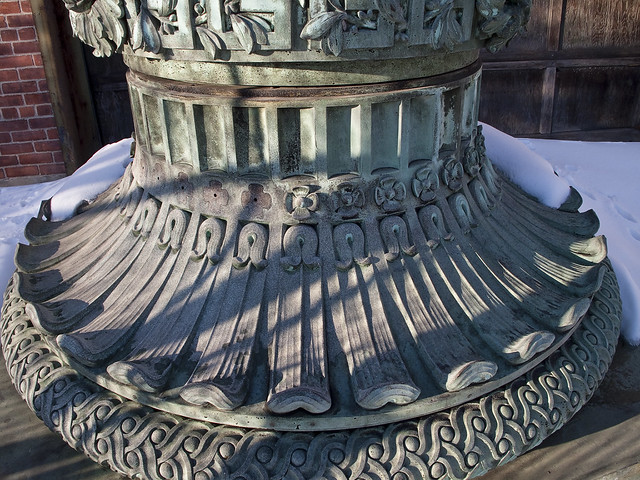
– photo by Mitch Waxman
So, Lords and Ladies- Any ideas? Anyone out there recognize this object? My instinct and observations suggest it’s a product of either the late 19th or early 20th centuries, but frankly- I’m stumped.
hovering above

– photo by Mitch Waxman
Recent business called for me to visit the facilities of a commercial printer which has established its physical plant in part of the former Degnon complex near Dutch Kills, which explains how and why I found myself on Monday morning enduring the single digit temperatures which made the day remarkable.
What was fascinating to the shivering photographer, lost in private reverie upon Hunters Point Avenue, was the realization that when it’s cold enough- the exhausts of our city’s power generating system are actually and entirely visible.

– photo by Mitch Waxman
Normally, when temperatures are in the average seasonal mean, there might be a few hundred feet of exhaust visibly extant as it emanates. In extreme cold, however, one can observe long streams of heated gas pulsing upward at seemingly titanic pressure. Manmade clouds, these vertical columns retain integrity against horizontal wind shear until they achieve great height, and begin to disseminate into the swift currents of air which swirl about and over New York Harbor.

– photo by Mitch Waxman
It is Western Queens which is the workshop of New York City, – you cannot have the Shining City of Manhattan without a Great Machine, a Newtown Creek, or a Big Allis.
Where transformer farms abound- usually at the edge of a residency zone-, an omnipresent electrical hum is detected, and all attempts to use otherwise reliable headphones with a portable music player result in static shocks and an odd crackling sound is present in the earbud monitors.

– photo by Mitch Waxman
The chimney in the shot above is actually located at Roosevelt Island, some distance from my location near the 7 train and LIRR station on Hunters Point Avenue (about 2 blocks from the Pulaski Bridge). My understanding is that the gas it is emitting is actually waste steam generated from CONED‘s consolidated generating system at Big Allis, and it is included in this post purely for the extreme altitude of its projection, which- to my eye- looks to be 3 to 4 times the height of Queensboro’s highest point.

– photo by Mitch Waxman
Rounding the corner from Hunters Point (or 49th Avenue) onto 21st street, the dragon herself comes into view.
Wait… what was that? Dragon? Exaggerating again, making mountains from molehills again? Check out this NYTimes.com piece which displays a graphic “heat map” of air pollution in NYC which originates in this PDF from NYC.gov. Notice that brown area of specific density in the upper left corner of Queens?
That’s Big Allis.

– photo by Mitch Waxman
What I find interesting in these photos of vast agglutinations of heat and gas being propelled at high pressure into the atmosphere is not that they exist, or that the plumes of Big Allis rise beyond visibility to the undoubted mile high vaults of the sky.
The remarkable thing about the 6-8 degree (fahrenheit) temperature of the surrounding air is that one can clearly observe what is normally a largely invisible phenomena- due to condensation and the interaction between hot gas and cold air.

– photo by Mitch Waxman
The far off plume in the shot above is rising from Astoria, where the shuttered Charles Polleti Power Plant shares a large industrial compound with six smaller and quite active ones. Astoria carries quite a load for the rest of the City, from a power generating point of view, with prerequisite tales of high childhood asthma rates and unusual concentrations of lung disease.
Luckily enough, the State of New York just approved an upgrade and expansion of one of those Power Plants on the northern rim of fabled Astoria. The NYPost.com report on that may be accessed here.
Project Firebox 19

– photo by Mitch Waxman
Decapitated, this firebox on Skillman Avenue and Honeywell Street has long been severed from its designed functionality. I’m told by certain knowledgeable sources that you simply cannot remove the stump of an alarm box from its appointed spot, as the circuitry which governs the entire system will be affected by its absence rendering the surrounding neighborhood’s chain of Fireboxes blind to urgent cries of imminent immolation.
This firebox, however, finds a new utility for the needs of the few – or in this case the one- as opposed to the many it once protected, for your humble narrator routinely uses the dinner plate sized platter which crowns it as a makeshift camera platform when photographing the titan Sunnyside Yard with its backdrop of the shield wall of that Shining City which squats squamously across the River of Sound.


 The Newtown Pentacle