Posts Tagged ‘Long Island City’
vapour soaked
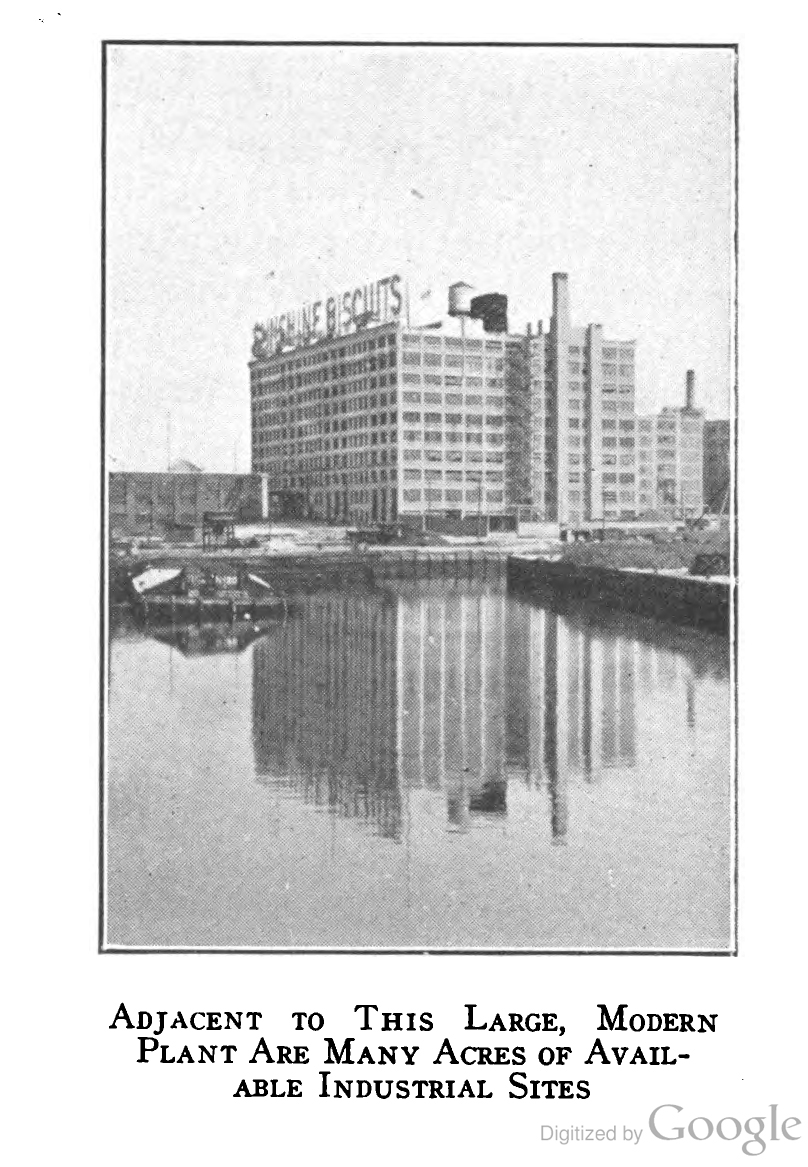
– photo from “The Newtown Creek industrial district of New York City By Merchants’ Association of New York. Industrial Bureau, 1921”, courtesy Google Books
My weird obsession with recreating very old photographs once again turns toward Dutch Kills, this time it’s looking to the end of the Degnon Terminal barge turning basin toward LaGuardia Community College’s building C- which was the former Sunshine Biscuits or Loose Wiles Bakery.
The shot above was captured in 1921 or thereabouts, and the ones below from 2011.

– photo by Mitch Waxman
An interesting parallell to this shot is the one presented at the end of the “Hunters Point Avenue Bridge Centennial, Dec. 11” posting from December 3rd in 2009, which presents the inverse viewpoint of today’s.
That shot was obtained from a 7th floor window of the building, on the wall with the red detailing, 3rd window from the left some four score and ten years or approximately 24,855 days later than the original and focused on the spot where these were shot.

– photo by Mitch Waxman
This is the uncropped version, showing Dutch Kills just around sunset, on February 17th, 2011 from the deck of the Hunters Point Avenue Bridge.
of stout body
Ok, just one more frozen Calvary post… and apologies for the sparse presentations this week, a dear friend of the Pentacle has been hospitalized and I’ve been spending a good amount of time visiting with and attempting to take some of the load off of the immediate family. Such is the price of true fealty and companionship, this duty to “be there” when the good times stop. I’m no “good time charlie”, after all.

– photo by Mitch Waxman
These shots are from the same walk through the ice at Calvary Cemetery discussed during a couple of last week’s transmissions . On the lookout for animal tracks (I’ll find that damned Coyote), I discovered these curious prints etching back and forth through the crusty ice and deep snow.
from wikipedia
In 1847, faced with cholera epidemics and a shortage of burial grounds in Manhattan, the New York State Legislature passed the Rural Cemetery Act authorizing nonprofit corporations to operate commercial cemeteries. Old St. Patrick’s Cathedral trustees had purchased land in Maspeth in 1846, and this land was used to develop Calvary Cemetery. The first burial in Calvary Cemetery was in 1848 and by 1852 there were 50 burials a day, half of them the Irish poor under seven years of age.
The original division of the cemetery, now known as First Calvary or Old Calvary, was filled by 1867. The Archdiocese of New York expanded the area of the cemetery, adding more sections, and by the 1990s there were nearly 3 million burials in Calvary Cemetery.

– photo by Mitch Waxman
Childhood fantasy blossomed in my thoughts, and despite the obviousness of these being bird tracks, I entertained certain vague memories of Spring Heel Jack and other Dickensian bogeymen. Imagine if there were some monopodal mystery hopping about the place, thought an idiot in a filthy black raincoat while standing in knee deep frozen precipitants at an ancient cemetery in Queens.
from wikipedia
Spring Heeled Jack (also Springheel Jack, Spring-heel Jack, etc.) is a character from English folklore said to have existed during the Victorian era and able to jump extraordinarily high. The first claimed sighting of Spring Heeled Jack that is known occurred in 1837. Later alleged sightings were reported all over England, from London up to Sheffield and Liverpool, but they were especially prevalent in suburban London and later in the Midlands and Scotland.
Many theories have been proposed to ascertain the nature and identity of Spring Heeled Jack. The urban legend of Spring Heeled Jack gained immense popularity in its time due to the tales of his bizarre appearance and ability to make extraordinary leaps, to the point where he became the topic of several works of fiction.
Spring Heeled Jack was described by people claiming to have seen him as having a terrifying and frightful appearance, with diabolical physiognomy, clawed hands, and eyes that “resembled red balls of fire”. One report claimed that, beneath a black cloak, he wore a helmet and a tight-fitting white garment like an “oilskin”. Many stories also mention a “Devil-like” aspect. Spring Heeled Jack was said to be tall and thin, with the appearance of a gentleman, and capable of making great leaps. Several reports mention that he could breathe out blue and white flames and that he wore sharp metallic claws at his fingertips. At least two people claimed that he was able to speak comprehensible English.

– photo by Mitch Waxman
Inexpert, I clumsily followed the tracks, moving in my typically arthritic, lurching, and uneven winter scuttle. By this point, the specie which had left its mark behind was clearly avian, and quite obviously a water bird of some sort.
from wikipedia
Anatidae is the biological family that includes ducks, geese and swans. The family has a cosmopolitan distribution, occurring on all the world’s continents except Antarctica and on most of the world’s islands and island groups. These are birds that are adapted through evolution for swimming, floating on the water surface, and in some cases diving in at least shallow water. (The Magpie Goose is no longer considered to be part of the Anatidae, but is placed in its own family Anseranatidae.) The family contains around 146 species in 40 genera. They are generally herbivorous, and are monogamous breeders. A number of species undertake annual migrations. A few species have been domesticated for agriculture, and many others are hunted for food and recreation. Five species have become extinct since 1600, and many more are threatened with extinction.

– photo by Mitch Waxman
Three toes and webbed at that, this was no Spring Heeled entity… I recognized what shared my walk through Calvary that cold day… And then they appeared…
from wikipedia
6-8 living species of black geese are known. In addition, one species has been described from subfossil remains found in the Hawaiian Islands, where it became extinct in prehistoric times. Another undescribed prehistoric species from the Big Island of Hawai‘i was extremely large and flightless; it is tentatively assigned to this genus due to being very peculiar. It is fairly certain that at least another species of this genus awaits discovery on the Big Island, judging from the facts that at least one species of Branta was found on every major Hawaiian island, and that remains of such birds have not been intentionally searched for on the Big Island.

– photo by Mitch Waxman
Several Canada Geese appeared at the top of a hill, quietly picking at the ice. Copious deposits of their feces were observed as well- but not pictured as to insure against the delicate sensibilities of the Lords and Ladies of the Newtown Pentacle being offended.
from wikipedia
This species is native to North America. It breeds in Canada and the northern United States in a variety of habitats. Its nest is usually located in an elevated area near water such as streams, lakes, ponds and sometimes on a beaver lodge. Its eggs are laid in a shallow depression lined with plant material and down. The Great Lakes region maintains a very large population of Canada Geese.
By the early 20th century, over-hunting and loss of habitat in the late 19th century and early 20th century had resulted in a serious decline in the numbers of this bird in its native range. The Giant Canada Goose subspecies was believed to be extinct in the 1950s until, in 1962, a small flock was discovered wintering in Rochester, Minnesota, by Harold Hanson of the Illinois Natural History Survey. With improved game laws and habitat recreation and preservation programs, their populations have recovered in most of their range, although some local populations, especially of the subspecies occidentalis, may still be declining.
In recent years, Canada Geese populations in some areas have grown substantially, so much so that many consider them pests (for their droppings, the bacteria in their droppings, noise and confrontational behavior). This problem is partially due to the removal of natural predators and an abundance of safe, man-made bodies of water (such as on golf courses, public parks and beaches, and in planned communities).

– photo by Mitch Waxman
Often are such Geese observed here at First Calvary, even during the summer. It’s odd, alongside the maligned Newtown Creek and within the walls of New york’s ancient burying ground, that there exists a sort of nature preserve amongst the tomb legions.
from a 2009 nytimes.com report:
All commercial airplane engines are required to pass a “bird strike” test before they can be certified for use. Engine manufacturers, including CFM International, which produced the engines on the US Airways Airbus A320 involved in Thursday’s sudden landing, test the engines physically and through computer simulation.
In the physical tests, the engines are revved to full power inside a test facility and absorb various kinds of birds, from those the size of sparrows to those the size of herons, one at a time. (The birds are already dead.) The engines also ingest multiple birds meant to simulate a collision with a flock, said Matthew Perra, a spokesman for the engine manufacturer Pratt & Whitney.
To pass the test, engines must keep operating after the collision, maintaining enough power to take off, fly around the airport and land the plane safely, he said. That is because a jet with two engines has to be able to take off on 50 percent power
a ghastly plot
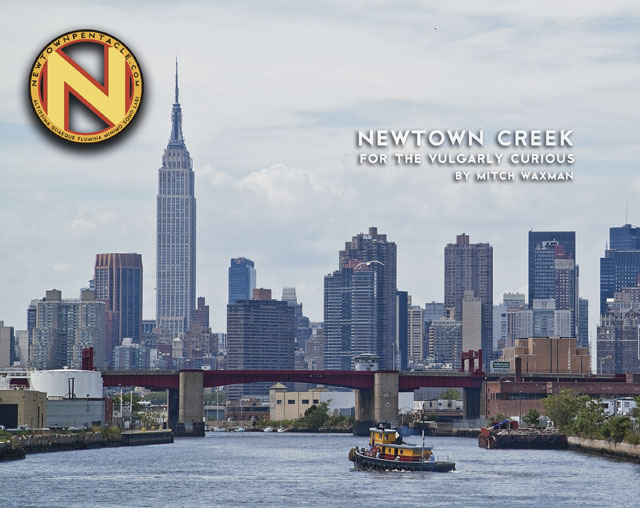
“Newtown Creek for the Vulgarly Curious” is a fully annotated 68 page, full-color journey from the mouth of Newtown Creek at the East River all the way back to the heart of darkness at English Kills, with photos and text by Mitch Waxman.
Check out the preview of the book at lulu.com, which is handling printing and order fulfillment, by clicking here.
Every book sold contributes directly to the material support and continuance of this, your Newtown Pentacle.
reticence shown

– photo by Mitch Waxman
I fear that I’ve become quite focused on Calvary Cemetery again. Recent caches of primary sources have been discovered which have all but confirmed certain hypothetical precepts, and illumined certain unimagined parameters to my studies. As yellowed maps and time blasted books have passed before my startled eyes, dawning realizations about the structure which underlies the place torment my curiosity.
Allow me to explain…

– photo by Mitch Waxman
Newtown Creek guy, that’s me- part of the history crowd from Queens- harmless.
The history part is what I’m interested in, and everything I’ve read or witnessed around the Newtown Creek indicates that while First Calvary Cemetery was incorporated in 1848- when the first recorded interment took place (more on that in a later post)– an interval of roughly 5-10 years preceded the beginning of an era which saw as many as 20 funerals conducted during a single day. Immigration patterns can explain this, of course, but the primary sources which have been consulted describe something else.

– photo by Mitch Waxman
It’s the sewers.
Two interesting leads have presented themselves, the first having led to:
The Rosary Magazine, in a report from 1908, via Google Books, offers this snippet:
On November 11, Archbishop Farley of New York dedicated a new mortuary chapel which was recently erected under the title of St. Callistus in Calvary Cemetery, Long Island. The Mass on the occasion was sung by Mgr. Lavelle and the sermon preached by Mgr. Mooney. The new structure will serve the double purpose of chapel and mausoleum. Below the chapel floor there is a crypt containing one hundred and fourteen vaults, in which hereafter will be buried the priests of the New York Archdiocese. The idea of such a building was first conceived by Archbishop Farley some four years ago. The structure is quite an imposing one, built of granite and Saracenic in its style of architecture. It is ninety-six feet long and sixty-four feet wide. The auditorium will accommodate two hundred and fifty persons. Surmounting the dome is a fine figure of the risen Christ, designed by Miss Melro Beatrice Wilson. When finished the total cost of the building will approximate $200,000. The building was designed by Raymond F. Almirall.
Here’s the cutaway architect drawing, courtesy again- Google Books:
Long time readers will remember that the Chapel has been previously profiled at this- your Newtown Pentacle- in the post “scenes familiar, and loved“.

– photo by Mitch Waxman
The catacombs beneath the Calvary Cemetery Chapel are fairly old news to long time readers, but… back to those sewers.
The second interesting nugget that I’ve turned up recently is (other than fascinating references to an excommunicated and controversial 19th century Catholic priest named McGlynn) that there seems to have been a legal issue settled by the State of New York which involved the removal of tens of thousands of tons of Calvary topsoil, and it’s eventual disposition on Catholic owned farms in Jamaica which aroused and infuriated the largely Protestant agricultural community of Newtown. This topsoil was removed “during the building of Calvary Cemetery, with its modern sewerage system”.
The building…

– photo by Mitch Waxman
I haven’t screwed the lid down on this one yet, so I’m not sharing links on this, but- the various sources I’m working on have opened up the reality that the hill of Laurels is in fact engineered ground. Discussions of enormous underground culverts and diversion channels for water, titan work forces, and a decade long struggle to turn the marshy waste land around the Newtown Creek into the well drained and immaculately landscaped structure we know today have consumed me- and driven Our Lady of the Pentacle to near madness.
Who can guess, all there is, that might be buried down there?
weird lyric

– photo by Mitch Waxman
After having fallen into a hole earlier in the day, and suffering from a torn knee and possibly fractured finger, your humble narrator nevertheless opted to end the day with a walk through Calvary Cemetery.
A miscalculation on my part was made by this decision, as the cemetery itself was encased in several feet of rain and ice polished snow. Never one to display good sense or reason, the encircling boundary road (which was quite clear, no doubt due to the expert ministrations of the groundskeeping crew) was avoided and a cross section path through the frozen substrate was embarked upon.
At the end of this difficult perambulation, however, I was rewarded by the company of a bird of prey (which I believe to be a juvenile Red Tail Hawk).
from wikipedia
The Red-tailed Hawk is carnivorous, and an opportunistic feeder. Its diet is mainly small mammals, but it also includes birds and reptiles. Prey varies with regional and seasonal availability, but usually centers on rodents, comprising up to 85% of a hawk’s diet.Additional prey (listed by descending likelihood of predation) include lagomorphs, shrews, bats, snakes, waterfowl, fish, crustaceans and insects. Prey range in size from beetles to White-tailed Jackrabbits, which are double the weight of most Red-tails. In captivity in winter, an average Red-tail will eat about 135 g (4-5 oz) daily.
The Red-tailed Hawk hunts primarily from an elevated perch site, swooping down from a perch to seize prey, catching birds while flying, or pursuing prey on the ground from a low flight.

– photo by Mitch Waxman
The bird was a good fifty feet above me, perched on the statuary crowning one of those mighty obelisks which typify the older and grander sections of the vast polyandrion that men call First Calvary. It seemed to be gazing at the shield wall of Manhattan- the Shining City.
The particular locale within the cemetery itself has been observed in past visits to support a population of “groundling burrowers“, any one of which would provide a good meal to the predator during these lean months of winter. Knowing that predators can sense weakness and injury at a distance, I began to carefully back away owing to my profound physical cowardice.
What if it smelled the blood trickling down my leg due to the wound incurred at the knee of my skinvelope, caused when I fell in that hole?
from animals.nationalgeographic.com
These birds of prey are also known as buzzard hawks and red hawks. By any name, they are keen-eyed and efficient hunters. Red-tails prefer open areas, such as fields or deserts, with high perching places nearby from which they can watch for prey. But these birds are adaptable and also dwell in mountains and tropical rain forests. Hawks have even embraced human habitats. They often perch on telephone poles and take advantage of the open spaces along the roadside to spot and seize mice, ground squirrels, rabbits, reptiles, or other prey.
Breeding season initiates a spectacular sequence of aerial acrobatics. Hawk pairs fly in large circles and gain great height before the male plunges into a deep dive and subsequent steep climb back to circling height. Later, the birds grab hold of one another with their talons and fall spiraling towards earth.

– photo by Mitch Waxman
In the past, I’ve mentioned that the grounds of First Calvary serve as an oasis to heterogenous forms of both migratory and quite native life forms. The “groundling burrowers” are here (as mentioned), and birds often use the arboretum as a way station on their long seasonal journeys. There are dogs and cats here, of course, and second hand rumor has suggested that Opossum, Raccoon, and other more esoteric forms of life exist within the stout iron gates.
This is the first time I’ve spotted a raptor here, though.
It was just last month that a photographer named Marcelo Barrera managed to get a shot of a Coyote in Calvary, check out the NYPost.com story here.

– photo by Mitch Waxman
It’s actually interesting that a Red Tail chose to roost here, in that psychic cauldron of squashed hope and severed ambition known as First Calvary.
Aboriginal tribesmen prized the feathers of these birds for use in ritual, and even today- the plumage of Red Tail Hawks fall under the jurisdiction of the “Eagle Feather Law“. Apparently, for those who believe in something, the presence of such a Hawk in a cemetery would be quite a profound experience.
I’d also point out that “hawk’s gifts” in the quotation below would indicate madness and megalomania if manifested in a primate, and would make great PR copy to describe a politician. As proof of this, the second quote replaces references to “hawk” with the name of the Mayor (just as an example).
from shamanicjourney.com
The hawk’s gifts include clear sightedness, being observant, long distance memory, messages from the universe, guardianship, recalling past lives, courage, wisdom, illumination, seeing the bigger picture, creativity, truth, experience, wise use of opportunities, overcoming problems, magic, focus.
Hawk is associated with the number 14, with the tarot card Temperance. The Temperance card represents the teaching of higher expressions of psychic ability and vision.
The Hawk represents a messenger in the Native American culture. It often shows up in our life when we need to pay attention to the subtle messages found around us, and from those we come into contact with. As with all messages received, it is important to recognise the messages underlying truth. We will be taught to be observant and also pay attention to what we may overlook. This could mean a talent we aren’t using, a gift or unexpected help for which we haven’t shown our gratitude for, or a message from the Universe. As there are so many hawk varieties, the messages vary and can affect all levels of our psyche.
Hawks are the protectors and visionaries of the Air. They hold the key to higher levels of consciousness. This power animal enables us to awakens vision and inspires a creative life purpose. Having Hawk as power animal means your life will be filled with responsibility, because Hawk people seek the overall view. You will most probably be aware of omens and spirit messages.
modified version
Michael Bloomberg’s gifts include clear sightedness, being observant, long distance memory, messages from the universe, guardianship, recalling past lives, courage, wisdom, illumination, seeing the bigger picture, creativity, truth, experience, wise use of opportunities, overcoming problems, magic, focus.
Michael Bloomberg is associated with the number 14, with the tarot card Temperance. The Temperance card represents the teaching of higher expressions of psychic ability and vision.
Michael Bloomberg represents a messenger in the Native American culture…

– photo by Mitch Waxman
Being scientifically minded, of course, your humble narrator rejects such fantastic interpretations of the birds presence here. A cigar, after all, is just a cigar. I would point out that a visit to “The City Birder” will reveal several spottings of similar animals all around the megalopolis, and you’ll find a few “things to do” in their recent “upcoming nature trips” posting.
The NYTimes presented this piece in 2007, which discusses the presence of Red Tail Hawks in another garden cemetery- Greenwood in Brooklyn

– photo by Mitch Waxman
Despite the great discomfort caused by my injuries, immense difficulty was found in trying to leave Calvary Cemetery on Sunday afternoon. Social obligation, however, drew me ineluctably back to Astoria to attend a party- during which a televised tournament of some kind would be exhibited that held special significance to others in my peer group.
Happily, some number of photographs of First Calvary blanketed in winter colors were captured, many of which will be gathered into future postings of this- your Newtown Pentacle.


 The Newtown Pentacle