Posts Tagged ‘Manhattan’
time worn

– photo by Mitch Waxman
One hundred and twenty nine years ago- on May 30, 1883- 12 people were killed and 35 wounded upon the Brooklyn Bridge in what would best be described as constituting a personal nightmare scenario to your humble narrator. I’ve never liked crowds, and shy away from congested areas where a sudden panic might carry me toward apotheosis randomly. Surely this is born of an experience in racially polarized South Brooklyn back in the early 1980’s when I found myself swept in the surge of a small race riot while onboard a bus.
from nytimes.com
A woman fell down the wooden steps at the end of the New-York approach to the Brooklyn bridge yesterday afternoon while the pathway was crowded with thousands of men, women, and children walking and passing one another. As she lost her footing another woman screamed, and the throng behind crowded forward so rapidly that those at the top of the steps were pushed over and fell in a heap.

– photo by Mitch Waxman
Weak, poorly developed physically, and given to panic- a young narrator watched with growing horror as a group of “Cugenes” (slang for Italian kids in my old hood) approached the Bushwick bound B78 bus intent on ferreting out a certain African American youth with whom they had a conflict. The Cugenes come onto the bus swinging, and as tribal affiliations ruled the day- the pushing started. I found myself a helpless and unwilling cork bobbing on a sea of witless hatred, an experience which has stayed with me to this day.
from wikipedia
The Brooklyn Bridge is one of the oldest suspension bridges in the United States. Completed in 1883, it connects the New York City boroughs of Manhattan and Brooklyn by spanning the East River. With a main span of 1,595.5 feet (486.3 m), it was the longest suspension bridge in the world from its opening until 1903, and the first steel-wire suspension bridge.
Originally referred to as the New York and Brooklyn Bridge and as the East River Bridge, it was dubbed the Brooklyn Bridge, a name from an earlier January 25, 1867 letter to the editor of the Brooklyn Daily Eagle, and formally so named by the city government in 1915. Since its opening, it has become an icon of New York City, and was designated a National Historic Landmark in 1964 and a National Historic Civil Engineering Landmark in 1972.

– photo by Mitch Waxman
Unending nightmares of such situations guide me to this day, and one is quite phobic about being trapped within a crowd without egress or a clear pathway of escape. I think it’s part of the reason that places like Times Square fill me with nameless dread, and I prefer the concrete desolations of the sparsely populated Newtown Creek.
I’m all ‘effed up.
from chroniclingamerica.loc.gov
A terrible disaster occurred yesterday afternoon on tho East River Bridge, by which twelve persons lost their lives and a great many others were injured more or less seriously. While there were no less than 15,000 persons on the Bridge, a blockade was formed on the footpath at the head of a flight of steps nine feet high extending from the masonry above the anchorage to the first iron truss, the same place at which blockades of people have occurred heretofore. A panic followed the pushing and struggling in which men and women tried to free themselves from the crowd. In the midst of this rush, started, it is thought by a gang of roughs, either thoughtlessly or with mischievous intent, several persons were carried over the edge of the steps. They fell on the landing and at the foot of the stairs, ethers stumbled on them, and more than forty persons were trampled underfoot by the panic-stricken multitude.
rustic words

– photo by Mitch Waxman
Recoiling from recent company and time spent amongst the Manhattan elites, your humble narrator retreats into one of his little hobbies, locating and attempting identification of the various hatches observed to be adorning the pavement while aimlessly wandering through the megalopolis.
Contact with the landed gentry and officialdom of that tarted up island on the Hudson often reminds one of the jiggling jowls, legendary flatuence, and debased self obsession of those outrageous and decadent baronial lords found in eighteenth century Germany- resulting in and causing class rage to bubble up within this kid from working class Brooklyn.
from wirednewyork.com
The Manhole Cover Lady maintains an air of mystery. She lives alone in a studio apartment, where her files and photographs — “highly organized,” she says — leave no room for pets. She declines to reveal her age, which is about 50, because she sees herself as “ageless.” She also does not want her borough of origin made public. “Just say I’m a native New Yorker,” she says.
But she makes no secret of her crusade to save the ancient manhole covers, coal-chute covers and vault covers that dapple the city surface by the hundreds of thousands, some of them still-active portals to the netherworld. She estimates that a good 10 percent of the 400 covers featured in her book — “Designs Underfoot: The Art of Manhole Covers in New York City” — have already been paved over or tossed away since its publication in April.

– photo by Mitch Waxman
Thin skinned, opinionated, and -by all accounts- at least half mad, I often react to stimuli in uncommon ways.
For example: having dinner at an otherwise elegant and top notch U.S. Parks lodge restaurant on the rim of the Grand Canyon with the long suffering “Our Lady of the Pentacle” a few years ago, the evenings entertainment drove me into similar turf. A quartet of Native American dancers were presented, including two children. Now, this was obviously a “show biz” family which was likely earning good coin for the gig, but I found the scenario of having these Indian kids dancing for a roomful of pale faced conquerors uncomfortable at best.
Frankly, the analogy that came to mind was that this was a minstrel show, or a bunch of Jewish kids dancing merrily to entertain the Nazis. As mentioned, my world is strangely colored, and filtered through a strange and often disturbingly dark glass.
from wikipedia
Hasty generalization is a logical fallacy of faulty generalization by reaching an inductive generalization based on insufficient evidence — essentially making a hasty conclusion without considering all of the variables. In statistics, it may involve basing broad conclusions regarding the statistics of a survey from a small sample group that fails to sufficiently represent an entire population. Its opposite fallacy is called slothful induction, or denying the logical conclusion of an inductive argument (e.g. “it was just a coincidence”).
Context is also relevant; in mathematics, the Pólya conjecture is true for numbers less than 906,150,257, but fails for this number. Assuming something to be true for all numbers when it has been shown for over 906 million cases would not generally be considered hasty, but in mathematics a statement remains a conjecture until it is shown to be universally true.
Hasty generalization can also be a basis for racist beliefs and prejudices, in which inferences regarding a large group is based upon knowledge of only a small sample size of that group.

– photo by Mitch Waxman
Oddly enough, or logically, every inhabitant of the corridors of power wants to tell me what Newtown Creek is like- followed by their grandiose plans for it. They throw around buzzwords like sustainable, or “green”, peppering their conversation with dire prognostications about climate change and rising sea levels. Cocktail party environmentalists all, few of them have ever visited the watershed and would rather die than visit Queens, let alone Brooklyn.
To the elites of Manhattan, the population and geographic centers of New York City matter little, as long as whatever they flush or throw away disappears reliably down the drain.
from wikipedia
A cognitive bias describes a replicable pattern in perceptual distortion, inaccurate judgment, illogical interpretation, or what is broadly called irrationality. They are the result of distortions in the human mind that always lead to the same pattern of poor judgment, often triggered by a particular situation. Identifying “poor judgment,” or more precisely, a “deviation in judgment,” requires a standard for comparison, i.e. “good judgment”. In scientific investigations of cognitive bias, the source of “good judgment” is that of people outside the situation hypothesized to cause the poor judgment, or, if possible, a set of independently verifiable facts. The existence of most of the particular cognitive biases listed below has been verified empirically in psychology experiments.
Cognitive biases are influenced by evolution and natural selection pressure. Some are presumably adaptive and beneficial, for example, because they lead to more effective actions in given contexts or enable faster decisions, when faster decisions are of greater value for reproductive success and survival. Others presumably result from a lack of appropriate mental mechanisms, i.e. a general fault in human brain structure, from the misapplication of a mechanism that is adaptive (beneficial) under different circumstances, or simply from noisy mental processes.
mighty dome

– photo by Mitch Waxman
Queensboro beckons as always, when business in the Shining City calls. It is best not to muse about Friday the 13th of April, which is one of those special dates which have been remarked upon in the past at this- your Newtown Pentacle, rather than engage in simple triskaidekaphobia. Simply put, there are certain dates on the calendar during which momentous events just seem to cluster. Births, deaths, the fall of empires. For instance, in 1204 AD, Crusaders conquered Constantinople, eradicating the joy which the date had brought to the citizenry of the Eastern Roman Empire (the Romoloi, as they would have called themselves) as the anniversary of the death of a legendary King of the Bulgars and implacable enemy of the second Rome- Krum the Horrible- who died in 814 AD.
from wikipedia
While Nikephoros I and his army pillaged and plundered the Bulgarian capital, Krum mobilized as many soldiers as possible, giving weapons even to peasants and women. This army was assembled in the mountain passes to intercept the Byzantines as they return to Constantinople. At dawn on July 26 the Bulgarians managed to trap the retreating Nikephorus in the Vărbica pass. The Byzantine army was wiped out in the ensuing battle and Nikephorus was killed, while his son Staurakios was carried to safety by the imperial bodyguard after receiving a paralyzing wound to the neck. It is said that Krum had the Emperor’s skull lined with silver and used it as a drinking cup.

– photo by Mitch Waxman
This is the birthday of Thomas Jefferson and Butch Cassidy, and the traditional New Years day in Laos, Cambodia, and Thailand- referred to as Chaul Chnam Thmey in Khmer, Songkan in Laotian, and Songran in Thai. Additionally, this is the anniversary of an oxygen tank exploding on the Apollo 13 spacecraft in 1970, while enroute to the moon.
from wikipedia
Apollo 13 was the seventh manned mission in the American Apollo space program and the third intended to land on the Moon. The craft was launched on April 11, 1970, at 13:13 CST from the Kennedy Space Center, Florida, but the lunar landing was aborted after an oxygen tank exploded two days later, crippling the service module upon which the Command Module depended. Despite great hardship caused by limited power, loss of cabin heat, shortage of potable water, and the critical need to jury-rig the carbon dioxide removal system, the crew returned safely to Earth on April 17.

– photo by Mitch Waxman
Handel’s Messiah was performed for the first time in 1742, Fort Sumter surrendered to Confederate forces in 1861, starting the American Civil War. All of this, and lots more, happened on April 13th, which in 2012 falls on a Friday. None of these events though, explain the crude cruciform graffiti recently observed on the Queensboro Bridge pedestrian walkway.
from wikipedia
The Queensboro Bridge is a double cantilever bridge, as it has two cantilever spans, one over the channel on each side of Roosevelt Island. The bridge does not have suspended spans, so the cantilever arm from each side reaches to the mid-point of the span. The lengths of its five spans and approaches are as follows:
- Manhattan to Roosevelt Island span length (cantilever): 1,182 ft (360 m)
- Roosevelt Island span length: 630 ft (190 m)
- Roosevelt Island to Queens span length (cantilever): 984 ft (300 m)
- Side span lengths: 469 and 459 ft (143 and 140 m)
- Total length between anchorages: 3,724 ft (1,135 m)
- Total length including approaches: 7,449 ft (2,270 m)

– photo by Mitch Waxman
Perhaps the folks in the Shining City know something about what might be lurking in Western Queens, scuttling about in the night, and have opted to install wards and sigils on the crossing to keep it out of Manhattan.
from wikipedia
The term sigil derives from the Latin sigillum, meaning “seal”, though it may also be related to the Hebrew סגולה (segula meaning “word, action, or item of spiritual effect, talisman”). The current use of the term is derived from Renaissance magic, which was in turn inspired by the magical traditions of antiquity.
In medieval ceremonial magic, the term sigil was commonly used to refer to occult signs which represented various angels and demons which the magician might summon. The magical training books called grimoires often listed pages of such sigils. A particularly well-known list is in The Lesser Key of Solomon, in which the sigils of the 72 princes of the hierarchy of hell are given for the magician’s use. Such sigils were considered to be the equivalent of the true name of the spirit and thus granted the magician a measure of control over the beings.
primitive ruins
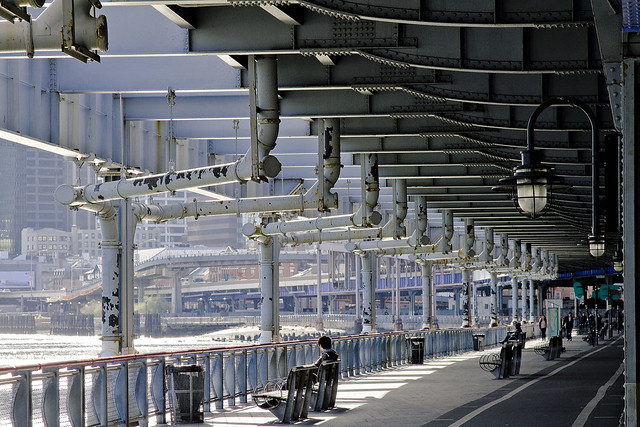
– photo by Mitch Waxman
Recent business brought me to Manhattan, and an opportunity to walk along the East River while moving downtown presented itself. A spectacular promenade has recently emerged along the coast of the Shining City, much of which is unfortunately cement. Shiny and new, the sections above Corlears Hook made me a little nervous, as if one had wandered into an architect’s drawing populated by spandex wearing fitness models riding bicycles and running determinedly. Downtown, between East River Bridge Two and One (Manhattan and Brooklyn) this waterfront parkland was just grungy and old enough to feel lived in, by ordinary folk.

– photo by Mitch Waxman
It is difficult to complain about these open air trottoirs, which allow the citizenry a chance to gaze at the splendors of the harbor, especially given what these areas were like a mere 20-30 years ago. Trash strewn and off limits, New York had left its waterfront to rot away. The great shame of it all, and this is where the kvetching and Monday morning quarterbacking comes in, is that the infrastructure of docks and wharfs which literally made New York great is gone- never to return. Once something becomes a park, it is virtually impossible for it to return to other usage. No ship will be arriving here ever again.

– photo by Mitch Waxman
It’s the way of things, of course, and long ago was it decided that maritime interests were unimportant to Manhattan. So few are the docks on the island nowadays that it is scantly possible to find a berth. Word has it that the various waterfront vision plans include the usage of “temporary” or “floating” docks at some point in the future, but the days when a ship could unexpectedly arrive in the City- laden with some mysterious cargo from the south seas- seem to be over.
chill currents

– photo by Mitch Waxman
Gaze in terror at the ice breaking tug Morro Bay, stalwart arm of the United States Coast Guard, as it maneuvers about the Hudson River. In terror that is, if you mean harm to the mariners or coastlines of the United States. It is maritime Sunday at the Newtown Pentacle once more, and this time around it’s a Coast Guard vessel in the spotlight.
from uscg.mil
USCGC MORRO BAY (WTGB-106)
Abstract
The USCGC MORRO BAY was commissioned 28 March 1981 at the Reserve Training Center in Yorktown, VA and served here until 1998. The MORRO BAY was the sixth of her kind in the Coast Guard. While stationed at Training Center, the MORRO BAY was involved in training and operations on the Chesapeake Bay. The MORRO BAY is currently home ported in New London, CT.
Ship’s History
The 140-foot Bay-class Cutters are state of the art icebreakers used primarily for domestic ice breaking duties. They are named after American Bays and are stationed mainly in Northeast U.S. and Great Lakes. Although specifically desinged for ice breaking duties, they also perform law enforcement, environmental protection, search & rescue operations and support for aids to navigation activities.
WTGBs use a low-pressure-air hull lubrication or bubbler system that forces air and water between the hull and ice. This system improves icebreaking capabilities by reducing resistance against the hull, reducing horsepower requirements.

– photo by Mitch Waxman
While researching this post, an interesting factoid about the Coast Guard emerged: the hull colors of Coast Guard vessels indicate their missions. Black hull- aids to navigation, White hull- maritime law enforcement and other safety-at-sea missions, Red hull- icebreaking.
Who knew?
Of course, the “Response Boat Medium” and “Response Boat Small”– both “SafeBoats“- are orange hulled, but the color scheme indications I found at the Coast Guard website do not discuss this hue.
from uscg.mil
The 140-foot Bay-class Cutters are state of the art icebreakers used primarily for domestic ice breaking duties. They are named after American Bays and are stationed mainly in Northeast U.S. and Great Lakes.
140-foot WTGBs in Service:
- BISCAYNE BAY (WTGB 104) St. Ignace, MI
- BRISTOL BAY* (WTGB 102) Detroit, MI
- KATMAI BAY (WTGB 101) Sault Ste. Marie, MI
- MOBILE BAY* (WTGB 103) Sturgeon Bay, WI
- NEAH BAY (WTGB 105) Cleveland, OH
- MORRO BAY (WTGB 106) New London, CT
- PENOBSCOT BAY (WTGB 107) Bayonne, NJ
- STURGEON BAY (WTGB 109) Bayonne, NJ
- THUNDER BAY (WTGB 108) Rockland, ME

– photo by Mitch Waxman
The Morro Bay, like all members of its class, looks smart and sound. An attractive boat, it nevertheless looks pretty fast and capable. These shots were taken at the Metropolitan Water Alliance’s “Heroes of the Harbor” gala last fall, where Morro Bay was performing the sort of political or parade duty which occupies its time during warm weather. During the cold months, it’s tasked with weightier matters, as a front line warrior battling the winter, and as a life line for stranded mariners.
Greetings to the crew, a hearty thanks is offered for their service, sacrifice, and skill. Stay safe, and hopefully we’ll see you in the City again when it warms up.
from wikipedia
The United States Coast Guard (USCG) is a branch of the United States Armed Forces and one of the seven U.S. uniformed services. The Coast Guard is a maritime, military, multi-mission service unique among the US military branches for having a maritime law enforcement mission (with jurisdiction in both domestic and international waters) and a federal regulatory agency mission as part of its mission set. It operates under the Department of Homeland Security during peacetime, and can be transferred to the Department of the Navy by the President at any time, or by Congress during time of war.
Founded by Alexander Hamilton as the Revenue Cutter Service on 4 August 1790, it is the United States’ oldest continuous seagoing service. As of August 2009 the Coast Guard had approximately 42,000 men and women on active duty, 7,500 reservists, 30,000 auxiliarists, and 7,700 full-time civilian employees.


 The Newtown Pentacle