Posts Tagged ‘Maritime Sunday’
massing around
“follow” me on Twitter at @newtownpentacle

– photo by Mitch Waxman
An arrangement was made to meet up with some of my North Brooklyn chums to hash around a few ideas and discuss the news of the day at the thankfully reopened Ashbox restaurant in Greenpoint. A bit early for the assignation, your humble narrator drifted down to the street end, and former bulkhead of the Vernon Avenue Bridge, whereupon the Iron Wolf motored by.
from seawolfmarine.net
TUG: IRON WOLF (SINGLE SCREW) 450 HP, COASTWISE, MODEL BOW, HAWSWER TUG

– photo by Mitch Waxman
Long have I wished that my parents had been avid motorcyclists and named me Iron Wolf, but alas. In fact, anything even remotely canid would satisfy this urge, but this could have resulted in my name being “Laddie”, “Butch”, or “Spot.” Iron Wolf sounds like a metal band from the early 1980’s, the sort that would have headlined at L’Amour’s over in Bay Ridge.
from tugboatenthusiastsociety.org
Name: IRON WOLF,
- O/N: 0653661
- Tug, Length: 50
- Width: 16.7
- HP: 400
- Built Year: 1983
- Built At: New Bedford, Ma.
- Builder: Bear Marine Service
- Home Port: New York, NY

– photo by Mitch Waxman
All I could find online about Iron Wolf was terse, straight to the point, and in “all caps.” I suppose that’s appropriate. IF YOU NAME SOMETHING IRON WOLF, YOU SHOULD USE ALL CAPS TO DESCRIBE IT. TERSE GREETINGS AND A MARITIME SUNDAY SHOUT OUT TO THE IRON WOLF. WELCOME TO NEWTOWN CREEK.
from wikipedia
A tugboat (tug) is a boat that maneuvers vessels by pushing or towing them. Tugs move vessels that either should not move themselves, such as ships in a crowded harbor or a narrow canal, or those that cannot move by themselves, such as barges, disabled ships, log rafts, or oil platforms. Tugboats are powerful for their size and strongly built, and some are ocean-going.
Also:
Remember that event in the fall which got cancelled due to Hurricane Sandy?
The “Up the Creek” Magic Lantern Show presented by the Obscura Society NYC is back on at Observatory.
Click here or the image below for more information and tickets.

shared obeisances
“follow” me on Twitter at @newtownpentacle

– photo by Mitch Waxman
On this Maritime Sunday, witness the struggles of the Thomas D. Witte tug as it manages a barge into place on the lamentable Newtown Creek. That’s the City’s “Newtown Creek Dock”, tenanted by the mill of the titanic SimsMetal operation.

– photo by Mitch Waxman
In a distant era, this locale was the home of the LIRR’s infamous Manure Dock, where a 30 foot high pile of the stuff would have awaited disposition to agricultural clients further east. Recycling, it seems, has a centuried history along the Newtown Creek.

– photo by Mitch Waxman
The narrowness of the great canal creates a series of issues for tug and barge combinations along the Newtown Creek and always has. There used to be a specialist company, Newtown Creek Towing, which was located nearby the Vernon Avenue Bridge.
A hearty Maritime Sunday shout out to DonJon towing and the crew of the Thomas D. Witte is offered.
Also:
Remember that event in the fall which got cancelled due to Hurricane Sandy?
The “Up the Creek” Magic Lantern Show presented by the Obscura Society NYC is back on at Observatory.
Click here or the image below for more information and tickets.
sizable rift
“follow” me on Twitter at @newtownpentacle
– photo by Mitch Waxman
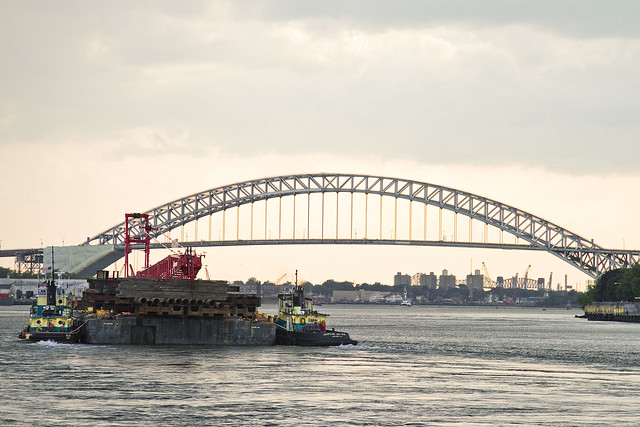
This Maritime Sunday posting presents the crossing of the Kill Van Kull by two tugs of the Coastline Marine Towing Corporation. They are moving a crane barge from points unknown to some destination at the Port Elizabeth Newark complex. Said shots were captured while onboard a Working Harbor Committee expedition during the summer of 2012. As you can see, it was a dark and stormy night.
from coastlinemarinetowing.com
Coastline Marine Towing has been serving the New York-Metro Harbors and US Eastern Seaboard for 20 years. We provide experienced crew and vessels that are ready to accommodate the logistics of your marine project.

– photo by Mitch Waxman
Little information is available on the tug Ireland, although a friend of mine asserts that it’s a 1940 vintage vessel. It did not display radio call sign information on its hull, which would have aided me in discerning its past and capabilities. The radio call sign, for maritime vessels, performs the same function which a license plate does for motor vehicles.
from workingharbor.com
Whether it’s a single barge, a group of barges made up as a single unit, or a vessel, when being moved by a tugboat, it’s called the “tow” (singular). A tug can move a tow in one of three different ways:
- Astern – The tug pulls the tow via a tow line from the stern of the tug. This is common for ocean towing but less used in confined harbors as it may be difficult to keep the tow from swinging side to side.
- Pushing – The tug ties off behind the tow, and pushes it forward. This provides a greater deal of control compared to towing astern.
- Alongside (on the hip) – The tug ties up alongside the tow, typically aft of the midpoint of the tow. This method also provides a good deal of control.

– photo by Mitch Waxman
The capabilities of google are confounded when a search term like “Tug Ireland” is offered to it. Lacking syntax, the algorithms of the search giant deliver a cogent result describing the coastal towing capabilities of a European nation state rather than those which would define and encapsulate the history of a single tugboat. Nevertheless, a hearty Maritime Sunday shout out is sent to both the faraway coast of an Emerald Island and to the crew of a singular tugboat alike.
also from workingharbor.com
Port refers to the left hand side of a vessel as you face forward and starboard refers to the right hand side. Before the rudder was invented (by the Chinese), boats and ships were steered by means of a steering board. Since most people are right handed, it was customary to mount the steering board on the right hand side of the ship. This, the right hand side became know as the “steering board” side, which was eventually shortened to “starboard” side, and this term is still in use today.
caravan route
“follow” me on Twitter at @newtownpentacle

– photo by Mitch Waxman
From the 2010 archives emerge these shots, depicting employees of the estimable Moran company displaying their knowledge of applied physics.
The two tugs, Turecamo Girls and Marie J. Turecamo, work in concert against the tidal forces of the East River and the inertia of a loaded cargo ship. The mathematics of what is going on in these photos would be staggering to work out, but the Tug crews prefer not to over think things and “just get it done”.

– photo by Mitch Waxman
Maritime professionals live in a somewhat four dimensional world. It’s not necessarily about the “X, Y, and Z” axes of your current position, rather its how those three factors will contribute to your situation as you move through space over time. Where you’re headed and how fast you are moving is rather more important than where you are now. As mentioned above- applied physics.

– photo by Mitch Waxman
Imagine it, coordinating the position of hundreds of tons of steel blindly, as it is simultaneously affected by tide and wind. Your goal is to move the thing into a precise position with a tolerance of less than a foot or two of the dock, and the effort needs to be seamlessly performed not just by you but by a partner vessel working in concert. This maritime sunday, your humble narrator is overwhelmed just thinking about the calculations of the forces at work.
closer point

– photo by Mitch Waxman
Witness, if you dare, the estimable Anthony L. Miller workboat conducting the employees and contractors of the Federal Environmental Protection Agency across the languid waters of the Newtown Creek. The workboat designation is apt, as this small vessel maintained and operated by the always busy Millers Launch company on Staten Island is purpose driven.

– photo by Mitch Waxman
Workboat is a fairly broad class of commercial vessel designation. Omnivorous, these boats will sometimes be utilized to ferry a relief crew or supplies to a waiting vessel. Other times, it will be engaged as a platform from which to conduct and facilitate the designs of a contract charter. Too small for anything but rudimentary towing, these workboats can be seen all over the harbor.

– photo by Mitch Waxman
Technically, Anthony L. Miller is a 32 foot “Utility Boom Boat” possessed of a 420 HP engine. It is equipped with a tow bit, is water jet-propelled, has shallow water capabilities, has a davit with electric winch, and an enclosed heated cabin. It has a top speed of 25 knots, and an aluminum hull. A hearty Maritime Sunday shout out is sent to its cast and crew.


 The Newtown Pentacle