Posts Tagged ‘New York City’
yellow rays

– photo by Mitch Waxman
Recorded recently in the neighborhood of Dutch Kills, not the waterway but the neighborhood which the waterway once flowed into. It’s confusing, as the waterway is often cited or mentioned in these postings and is “way over there” from the perspective of the neighborhood- which is found between Ravenswood, the East River, and Astoria. Large hotels are on the rise in the area, and there’s a whole lot of construction underway. For street artists, this is a bit of a playground.

– photo by Mitch Waxman
Personally, this is my kind of stuff. Garish in color and whimsical, not like the dark sarcasm and obviate ideations often observed in Brooklyn. Moreover, where one would expect to find elaborate renderings of “tags”, figurative cartooning trumps.

– photo by Mitch Waxman
A fairly even temper hangs about the brow of a humble narrator today, and this splash of color is much appreciated by this withering shadow.
primitive ruins
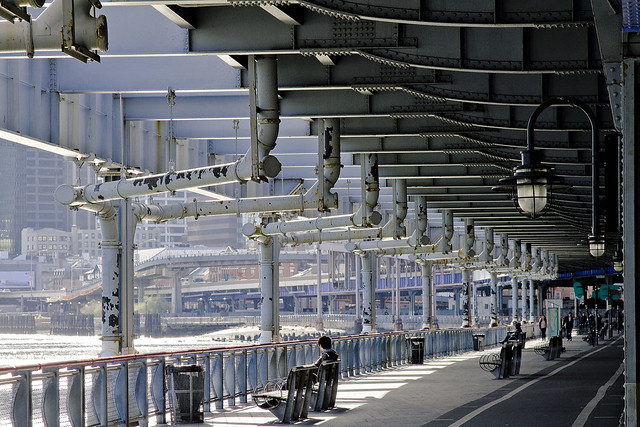
– photo by Mitch Waxman
Recent business brought me to Manhattan, and an opportunity to walk along the East River while moving downtown presented itself. A spectacular promenade has recently emerged along the coast of the Shining City, much of which is unfortunately cement. Shiny and new, the sections above Corlears Hook made me a little nervous, as if one had wandered into an architect’s drawing populated by spandex wearing fitness models riding bicycles and running determinedly. Downtown, between East River Bridge Two and One (Manhattan and Brooklyn) this waterfront parkland was just grungy and old enough to feel lived in, by ordinary folk.

– photo by Mitch Waxman
It is difficult to complain about these open air trottoirs, which allow the citizenry a chance to gaze at the splendors of the harbor, especially given what these areas were like a mere 20-30 years ago. Trash strewn and off limits, New York had left its waterfront to rot away. The great shame of it all, and this is where the kvetching and Monday morning quarterbacking comes in, is that the infrastructure of docks and wharfs which literally made New York great is gone- never to return. Once something becomes a park, it is virtually impossible for it to return to other usage. No ship will be arriving here ever again.

– photo by Mitch Waxman
It’s the way of things, of course, and long ago was it decided that maritime interests were unimportant to Manhattan. So few are the docks on the island nowadays that it is scantly possible to find a berth. Word has it that the various waterfront vision plans include the usage of “temporary” or “floating” docks at some point in the future, but the days when a ship could unexpectedly arrive in the City- laden with some mysterious cargo from the south seas- seem to be over.
Veneralia

– photo by Mitch Waxman
Technically speaking, this post is day late and a dollar short, as the holiday of Veneralia was traditionally observed by the Romans on April 1. Given the prankster traditions of our modern culture that revolve around the date, however, it was decided to run an acknowledgement of the holiday today- if the story of Troy has taught us anything, it’s “Don’t mess around with the Goddess of Love”.
from wikipedia
Venus was offered official (state-sponsored) cult in certain festivals of the Roman calendar. Her sacred month was April (Latin Mensis Aprilis) which Roman etymologists understood to derive from aperire, “to open,” with reference to the springtime opening of trees and flowers.
Veneralia (April 1) was held in honour of Venus Verticordia (“Venus the Changer of Hearts”), and Fortuna Virilis (Virile or strong Good Fortune), whose cult was probably by far the older of the two. Venus Verticordia was invented in 220 BC, during the last tears of Rome’s Punic Wars, in response to advice from a Sibylline oracle, when a series of prodigies was taken to signify divine displeasure at sexual offenses among Romans of every category and class, including several men and three Vestal Virgins.

– photo by Mitch Waxman
Veneration… the very root of the word comes from her name, this Roman deity named Venus. She wore many hats, and was worshipped in several aspects. The one which we at Newtown Pentacle HQ revere is the personification of Venus Cloacina, goddess of the main drain. Myrtle adorns the entranceway to that ceremonial room with ceramic tiles which we maintain, and rhyming prayers will be offered before a porcelain altar.
from wikipedia
In Roman mythology, Cloacina (Latin, cloaca: “sewer” or “drain”) was the goddess who presided over the Cloaca Maxima (“Great Drain”), the main trunk of the system of sewers in Rome. She was originally derived from Etruscan mythology. The Cloaca Maxima said to be begun by one of Rome’s Etruscan kings, Tarquinius Priscus, and finished by another, Tarquinius Superbus.
Titus Tatius, who reigned with Romulus, erected a statue to Cloacina as the spirit of the “Great Drain”. As well as controlling sewers, she was also a protector of sexual intercourse in marriage. Despite her Etruscan origins, she later became identified with Venus.

– photo by Mitch Waxman
Towering above the lowest point of New York City in Greenpoint, at the bottom of a geologic soup bowl (as it were), is the greatest temple of this goddess. If fancy strikes, as you drive along the BQE or traverse the streets of our ancient neighborhoods, remember to offer the ancient prayer:
“O Cloacina, Goddess of this place,
Look on thy suppliants with a smiling face.
Soft, yet cohesive let their offerings flow,
Not rashly swift nor insolently slow.
– courtesy sewerhistory.org
ALSO:

Your humble narrator will be narrating humbly at this year’s Obscura Day event on April 28th, leading a walking tour of Dutch Kills. The tour is already a third booked up, and as I’m just announcing it, grab your tickets while you can.
“Found less than one mile from the East River, Dutch Kills is home to four movable (and one fixed span) bridges, including one of only two retractible bridges remaining in New York City. Dutch Kills is considered to be the central artery of industrial Long Island City and is ringed with enormous factory buildings, titan rail yards — it’s where the industrial revolution actually happened. Bring your camera, as the tour will be revealing an incredible landscape along this section of the troubled Newtown Creek Watershed.”
For tickets and full details, click here :
obscuraday.com/events/thirteen-steps-dutch-kills-newtown-creek-exploration
outward course

– photo by Mitch Waxman
The Kimberly Poling was observed recently, as it headed west along the infamous Newtown Creek, and has sailed directly into Maritime Sunday at this- your Newtown Pentacle. The tug is owned by Poling and Cutler, and we recently examined one of their other tugs on this self same stretch of the Creek- the Crystal Cutler.
The name of the game in the shipping industry is to never transport an empty container. As such- after disgorging the petroleum cargo carried by its fuel barge to Newtown Creek, the Kimberly Poling took on another load for transport.
from marcon.com
Marcon International, Inc. is pleased to announce the sale of the US Flag Twin Screw Tug “Jaguar” from Mobro Marine, Inc. to P&C Kimberly Poling, LLC. “Jaguar” was built by Main Iron Works in 1994. She measures 105′ LOA x 34′ beam x 15′ depth. The vessel is powered by two EMD 12-645E2 main engines, producing 3000 total BHP at 900 RPM. Reintjes gears drive two 93″ x 91″ fixed pitch propellers in kort nozzles producing an estimated 40 tons bollard pull. The vessel is fitted with fully air-conditioned accommodations for 7 crew in 4 cabins. “Jaguar” will work for her new owners in the US Northeast. Marcon acted as sole broker in the transaction.

– photo by Mitch Waxman
Within the double walled steel tanks of the fuel barge, which is the Edwin A Poling by the way, can be found several thousand gallons of Diet Coca Cola, no doubt pumped in from the Coca Cola bottling plant on 58th street in Maspeth.
Carbonated beverages can be quite volatile when subjected to the rolling waves of the open harbor and as such precautions must be observed. The Captain of the Kimberly Poling must personally ensure that there are no “Mentos” brand mints onboard, for instance.
Founded in 1995, Poling Cutler began operations near the time the former Poling Transportation went out of business.
The Founders of the new company were Ed Poling, whose grandfather started the former Poling company, and Gary Cutler who spent years working in the financial world before getting involved in Marine Transportation.

– photo by Mitch Waxman
The “Dr. Pepper drama”, which played out over three days off the coast of Nassau Island during the winter of 1997- known as the “Bahamian Belch”- is still quite fresh in the mind of the maritime community. Accordingly, Coast Guard penalties for the improper transportation of and off loading of all soft drinks are quite severe.
The barge is most likely bound for Staten Island, which has been experiencing extreme shortages of the stuff since the spring of 2010.
Newtown Creek was designated a Significant Maritime and Industrial Area (SMIA) in the NYC Department of City Planning ‘s 1992 Comprehensive Waterfront Plan for its characteristic clusters of industrial businesses and water-dependent uses. In the 2010 update of this plan, Vision 2020, Newtown Creek maintains its place as New York City’s largest SMIA in terms of both land area and employment. After losing half its jobs from 1992 to 2008, the number of jobs in Newtown Creek SMIA grew by nearly 1,400 (totaling 15,000 jobs) from 2000 to 2008.

– photo by Mitch Waxman
The carbonation of the cargo is causative rather than coincidental as to why the barge is riding so high in the water, as the frothy action of the pressurized bubbles in the beverage buoy it up. The Maritime Shipping Association sees this sector of the business expanding exponentially and demand for the diet drink doubling within the decade.
It is good to know, on this the 1st of April, that the thirst of Staten Islanders will be satiated.
from wikipedia
Diet Coke (also known as Diet Coca-Cola, Coca-Cola light or Coke Light) is a sugar-free soft drink produced and distributed by The Coca-Cola Company. It was first introduced in the United States on August 9, 1982, as the first new brand since 1886 to use the Coca-Cola trademark. The product quickly overtook the soft drink Tab in sales.
Diet Coke was sweetened with aspartame after the sweetener became available in the United States in 1983; to save money, this was originally in a blend with saccharin. After Diet Rite cola advertised its 100 percent use of aspartame, and the manufacturer of NutraSweet (then, G.D. Searle & Company) warned that the NutraSweet trademark would not be made available to a blend of sweeteners, Coca-Cola switched the formula to 100 percent NutraSweet. Diet Coke from fountain dispensers still contains some saccharin to extend shelf life.
aerial ocean

– photo by Mitch Waxman
Just a short one today, some of the interesting odds and ends observed during my travels over the last few weeks. The shot above is from 58th rd. in Maspeth, once known as the Maspeth Plank road and paved with crushed oyster shells. It led to Furman’s Island, a notorious spit of muddy land that was legendary in its time for the offensive industries located there.

– photo by Mitch Waxman
This curious collection of women’s shoes, singles not pairs, was spotted on Provost in Greenpoint, Brooklyn. The mind boggles at where the mated shoes might have been dumped, but these are found on the street named for one of the “OG’s” – the Original Greenpointers. They were named Provoost rather than Provost, of course, but Dutch words seldom translate unscathed into english.

– photo by Mitch Waxman
Also in Greenpoint, this time nearby Manhattan Avenue. Manhattan is a double wide street because there was a street car or Trolley line that ran down it, which broke off from the East River to Calvary line which plied Greenpoint Avenue. The Manhattan Avenue line went over the Vernon Avenue Bridge and connected with Long Island City. The street art or graffiti depicted in this shot is signed “Mara” and a humble narrator is glad that some of the conclusions I’ve drawn about Newtown Creek are seemingly being noticed by others.


