Posts Tagged ‘New York City’
disquieting effect

– photo by Mitch Waxman
There’s a strange and seemingly shunned house not far from either Queens Plaza or Court Square, a hidden relict on 43rd and Crescent which is shadowed by the Megalith. Intriguing, it’s a fairly old structure located at 25-01 43rd Avenue which is not long for this- or any other- world.

– photo by Mitch Waxman
The Department of Finance Building Classification for this lot is “V1-VACANT LAND”.
Don’t get me wrong- I’m not advocating for this structure to be saved or its owner’s plans for it to be thwarted in any way or even obliquely commenting on the rapid transformations and shocking scale of the “New Queens Plaza”– this isn’t one of those posts. Neither is it an extensive peeling back of hidden lore or sinister revelations.
Like a lot of things these days- it isn’t good, or bad- it just is.
The place does seem pretty “shunned” though.

– photo by Mitch Waxman
What’s surprising about this little building, a clapboard scatterdash, is that it’s here at all. It’s obviously destined to be swept away, may already be gone frankly, as I haven’t been down this direction in better than a month. The enormous broom of economic inevitability is sweeping through the neighborhood and replacing the idiosyncratic and odd with the generic and corporate, and structures like these have no place here any more.

– photo by Mitch Waxman
Enormous fencings, the modern kind which block the intentions of curious eyes, have been thrown up around the place. The process of clearance will eradicate traces of the former habitation, and since my self appointed mission is one of documentation, a point was made of finding a hole in said fencings large enough to fit a camera lens into. My dslr is too stout for such missions, but luckily the ever reliable Canon G10 continues to be part of my carry around kit.

– photo by Mitch Waxman
The late model car half buried in debris and detritus behind this condemned and seemingly abandoned house witnessed in this product of the G10, however, makes me wonder exactly how long and why this property has been so astonishingly shunned.
Project Firebox 17

– photo by Mitch Waxman
The hinterlands found along Kingsland Avenue in Brooklyn, as it slouches roughly toward the Kosciuszko Bridge, are a concrete fascination. The locale is typified by guardian canines and hurtling security fences, whose extant borders reveal heavy industry and streets literally collapsing from the concomitant truck traffic they have endured for over a century. This shot dates back to 2007, when I first learned that the FDNY and its masters in the City government consider these alarm boxes a nuisance and I began a dedicated effort to record as many of them as still stand.
for silver
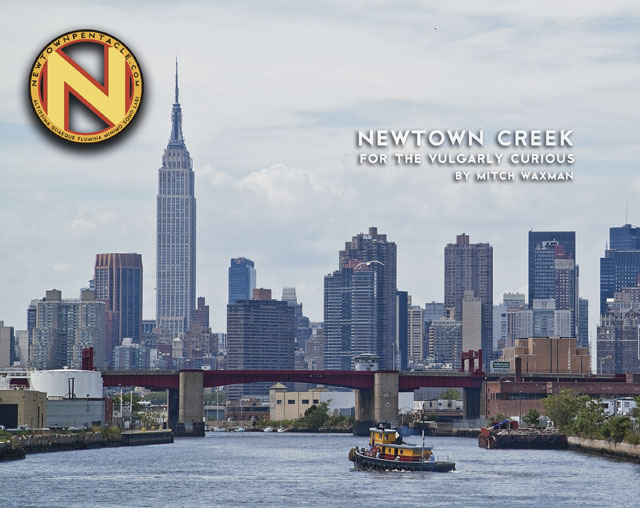
“Newtown Creek for the Vulgarly Curious” is a fully annotated 68 page, full-color journey from the mouth of Newtown Creek at the East River all the way back to the heart of darkness at English Kills, with photos and text by Mitch Waxman.
Check out the preview of the book at lulu.com, which is handling printing and order fulfillment, by clicking here.
Every book sold contributes directly to the material support and continuance of this, your Newtown Pentacle.
marble glories

– photo by Mitch Waxman
A favored aphorism amongst Occultists is “as above, so below”, a saying attributed to having been coined by Hermes Trismegistis and recorded upon the legendary Kitab Sirr al-Asrar (aka Smaragdine Table, Tabula Smaragdina) or Emerald Tablet.
Such thoughts and sayings often trouble a humble narrator when traveling across the emerald devastations of First Calvary Cemetery here in Queens. The arabic origin of the word Ghoul (ghul) notwithstanding, the term seems appropriate to describe one such as myself, “a person who delights in the macabre.”– although I’m proud to say that (as of yet) I’ve never robbed a grave, drank human blood, or eaten a small child- which are other trademarks of the legendarily abhorrent and undead creatures.
Life has taught me to never say “never” however.
ghoul [guːl]n
- a malevolent spirit or ghost
- a person interested in morbid or disgusting things
- a person who robs graves
- (Myth & Legend / Non-European Myth & Legend) (in Muslim legend) an evil demon thought to eat human bodies, either stolen corpses or children
[from Arabic ghūl, from ghāla he seized]

– photo by Mitch Waxman
All ‘effed up, one of the things which tortures me in those moments before sleep comes is “why am I so fascinated by graveyards?”.
Is it some sort of pretentious “Memento mori” artsy fartsy thing, or is there something motivating me that lies deeply buried and hidden in the polyandrion of ideation which defines my thoughts? When these photos were shot, I was indeed “searching for (the name that must never be spoken again)” but as often happens to me in this place, my concentration began to fray and tear in the manner of an overburdened rope. Imaginings and fantastic notions march into your mind here, and on this day, I became convinced that I heard grunting sounds rising from the soil.
As above, so below- and as your humble narrator was walking the gentle landscaping of Calvary, enjoying the bright emanations of that burning thermonuclear eye of god itself- were unknown counterparts mirroring my movements in some subterrane grotto?
from wikipedia
Ideas of reference and delusions of reference involve people having a belief or perception that irrelevant, unrelated or innocuous phenomena in the world refer to them directly or have special personal significance. In psychiatry, delusions of reference form part of the diagnostic criteria for psychotic illnesses such as schizophrenia, delusional disorder, or bipolar disorder during the elevated stages of mania.

– photo by Mitch Waxman
As a believer in nothing but the hydrogen bomb (the very existence and functionality of which proves the sterile Einsteinian worldview of the universe, as espoused by Physicist and Mathematician alike, as valid and true. How many angels, or neutrinos, can dance on the head of a pin- indeed), I fancy myself a student of debased and superstitious folklore nevertheless. Revenants, Dybbuks, Dhampirs, and Vrykolakas enter my thoughts when I move through these lonely places during my vast solitudes.
Apotropaic devices are absent from my coterie of gadgets and cameras, and whatever dark and cthonic powers may be extant and watching would perceive me as defenseless. Part of the reason I only go to this place during the brightly lit hours of the day, I suppose.
from wikipedia
In Hindu folklore, the vetala is an evil spirit who haunts cemeteries and takes demonic possession of corpses. They make their displeasure known by troubling humans. They can drive people mad, kill children, and cause miscarriages, but also guard villages.
They are hostile spirits of the dead trapped in the ‘twilight zone’ between life and afterlife. These creatures can be repelled by the chanting of holy mantras. One can free them from their ghostly existence by performing their funerary rites. Being unaffected by the laws of space and time, they have an uncanny knowledge about the past, present, and future and a deep insight into human nature. Therefore many sorcerers seek to capture them and turn them into slaves.

– photo by Mitch Waxman
Of course, this is a Roman Catholic cemetery, which suggests that the multitudes who lie here were sealed off- magickly- by the sacrament of “Extreme Unction” from suffering such macabre experiences as walking about the earth seeking living victims in some post mortem half life. The heritage of the Catholics extends back through time to the Dagon devotees of Syria and the tomb worshipping Etruscans, and the Romans spent enough time in Egypt and North Africa to have picked up and incorporated many of the Magicks they found into the syncretic system of beliefs and rites known as and inherited by modernity as Catholicism. The mysteries of the church are many, and varied, and more has been forgotten or lost over the centuries than any single lifetime can recover.
Who can guess, all there is, that might be buried down there?
from wikipedia
Magick is an Early Modern English spelling for magic, used in works such as the 1651 translation of De Occulta Philosophia, Three Books of Occult Philosophy, or Of Magick. The British occultist Aleister Crowley, chose the spelling to differentiate the occult from stage magic and defined it as “the science and art of causing change to occur in conformity with the will”, including both “mundane” acts of will as well as ritual magic. Crowley claimed that “it is theoretically possible to cause in any object any change of which that object is capable by nature”. John Symonds and Kenneth Grant attach a deeper occult significance to this preference.
Crowley saw magick as the essential method for a person to reach true understanding of the self and to act according to one’s True Will, which he saw as the reconciliation “between free will and destiny.”
Since the time of Crowley’s writing about magick, many different spiritual and occult traditions have adopted the K spelling, but some have redefined what it means to some degree. For some modern occultists, it refers strictly to paranormal magic, which involves influencing events and physical phenomena by supernatural, mystical, or paranormal means.

– photo by Mitch Waxman
As above, so below. The full quotation, as translated into english from a latin translation of the original Arabic by Isaac Newton (whose groundbreaking work- particularly “De motu corporum in gyrum”- sets the stage for the later realization of the Einsteinian viewpoint, the Hydrogen Bomb, and our modern world of space going craft, jet travel, and deep sea exploration) goes:
“That which is below is like that which is above that which is above is like that which is below to do the miracles of one only thing.”
from wikipedia
The Liber de Causis was a philosophical work attributed to Aristotle that became popular in the Middle Ages, first in Arabic and Islamic countries and later in the Latin West. The real authorship remains a mystery, but most of the content is taken from Proclus’ Elements of Theology. This was first noticed by Thomas Aquinas, following William of Moerbeke’s translation of the works of Proclus into Latin.
The original title in Arabic was Kitāb ul-īḍāḥ li-Arisţūţālis fi’l-khayri’l-maḥd, “The book of Aristotle’s explanation of the pure good”. The title Liber de Causis came into use following the translation into Latin by Gerard of Cremona.
Project Firebox 15

– photo by Mitch Waxman
The seldom trammeled but often traversed intersection of Skillman Avenue, 43rd Avenue, and 32nd Place alongside the titan Sunnyside Yard is home to this wounded veteran. Here’s a google maps “street view” shot of it in happier times.
A cursory examination of the nycfire.net forums has at last revealed a discussion of the prevailing logic governing the odd numbering system which codifies the alarm boxes, and discusses why you’ll often see the base and stump of an alarm box left in place years after the actual alarm has been removed. Check it out here.


