Posts Tagged ‘New York City’
gentle manner

Combined Sewer Outfall BB-013, from the Pulaski Bridge – photo by Mitch Waxman
To begin- I warn you- this post will most likely “gross you out”.
In 1674, Boyle said: “I have often suspected, that there may be in the Air some yet more latent Qualities or Powers differing enough from all these, and principally due to the Substantial Parts or Ingredients, whereof it consists. For this is not as many imagine a simple and elementary body, but a confused aggregate of ‘effluviums’ from such differing bodies, that, though they all agree in constituting by their minuteness and various motions one great mass of fluid matter, yet perhaps there is scarce a more heterogeneous body in the world”.
When the pithy observation was recorded, “effluviums” were the central notion behind the miasmatic theory of disease.

CSO Outfall NC-077, Maspeth Creek, discharges 288.7M gallons per year into English Kills – photo by Mitch Waxman
The viewpoint of the learned classes in prior ages held that when certain noxious vapors produced by a mingling of soil with that standing water typically found about marsh, swamp, and sewer- then mixed with the cool night air- form so called miasmas (which is an ancient greek for pollution, I’m told).

CSO Outfall NC-077, Maspeth Creek, Tier 2 outfall – photo by Mitch Waxman
These miasmas- or “epidemic influences”- were believed to be the cause of Cholera and Typhus– and all the other plagues which would one day scythe through the crowded 18th and 19th century cities of the Industrial Revolution.
Vitruvius, in the 1st century BCE, said: “For when the morning breezes blow toward the town at sunrise, if they bring with them mist from marshes and, mingled with the mist, the poisonous breath of creatures of the marshes to be wafted into the bodies of the inhabitants, they will make the site unhealthy.”

CSO Outfall NC-077, Maspeth Creek, Ranked 25 out of over 400 in terms of volume – photo by Mitch Waxman
The air produced by, in, and around a sewer is typically an aerosol of whatever liquid solution might be floating through it. Hydroden sulfide, carbon dioxide, methane, ammonia and a host of other constituent compounds mingle and form what is generically known as “Sewer Gas”. Typically, this gas has the sulfurous smell commonly associated with rotten eggs. Otherwise lacking and poor, the average human’s sense of smell can discern this odor when its concentration in the surrounding air is minor- which speaks to an evolutionary quirk.
Obviously- our ancestors who could not detect this aerosol, or miasma, died off while while those who could detect them passed on these sensitivities on to future generations.

CSO Outfall BB-026, Dutch Kills – photo by Mitch Waxman
If you suffer from Obsessive Compulsive Disorder, this would probably be a good time to stop reading this post, incidentally. Things are about to get ugly.
As an example- When a toilet is flushed, and there is scientific evidence to back this, a plume of microscopic droplets- an aerosol– erupts from the water. These droplets carry microbes and virus particles, which then settle on surfaces around the commode facilitating the “surface to hand to mouth” vector of infection. Modern plumbing does its best to minimize this bioaerosol in the house, but routine antimicrobial maintenance with bleach and other chemicals is necessary to sterilize the potential infections which might otherwise occur.
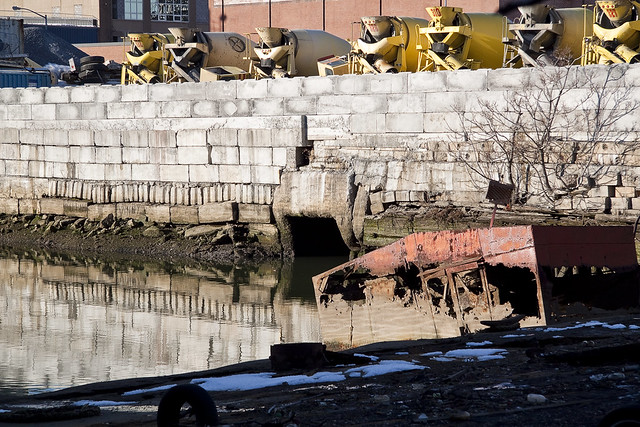
CSO Outfall BB-026, Dutch Kills – photo by Mitch Waxman
Of course, these cleaning chemicals- along with non neutralized microbes- end up in the wastewater flow, and make their way into the sewers… just like the petroleum products, volatile organic chemicals, and everything else that the human hive produces… where they swirl about beneath the streets and follow gravity to low lying areas. A properly designed system intercepts these waters, but in the case of a “CSO”, a lot of the poison makes it into the mud.

CSO Outfall BB-026, Dutch Kills – photo by Mitch Waxman
A classic example of a bacterium whose spread is defined by such aerosol dissemination is Legionella, but heavy metals and other contaminants may also find a pathway into the human body via such aerosols (let’s just call it vapor or fog). Additionally, fibers of toxic manmade substances- Asbestos for instance- are left behind during evaporation. Such deposits are then picked up on the wind, as are the dusty remains of the putrescent particulates which escape treatment by wastewater industries like the Newtown Creek Wastewater Treatment plant in Greenpoint or the Bowery Bay facility in Astoria.
During heavy rain events, some untreated sewage reaches the rivers, but a large percentage of it- the lion’s share- oozes out from the bulkheads of that assassination of joy called the Newtown Creek.

CSO Outfall NCB-632 – photo by Mitch Waxman
The Newtown Creek and its tributaries are indeed waterways, but no one ever discusses this plume of disease and contamination in the air. Fingers are pointed at certain chimneys and infamous underground lakes of petroleum and chemicals, heated discussions of when it might be safe to kayak or swim in the water are offered by interested parties, and odd admissions that there are some who actually fish in and consume the catch from these waters (which according to the EPA, are offering this catch for sale in area restaurants) both shock and titillate area wags- but what about the miasmas?

CSO Outfall NCB-632 – photo by Mitch Waxman
The sewer system of New York City is a composite beast, marrying together the municipal infrastructure of multiple communities into a single system. The cities of Brooklyn, Queens, and Manhattan (the historically agrarian and until modernity- lightly populated – Bronx has almost always been ruled over by Manhattan) each had their own standard, staring elevation, and set of regulations governing the sewers.
This NYTimes.com article from 2008 discusses recent attempts to consolidate and digitize the municipal record, and make sense out of the byzantine network of pipes which underlie the city.

CSO Outfall NCB-632 – photo by Mitch Waxman
Who can guess, all there is, that might be buried down there?
Who can speculate, all there is, which might be wafting out from these deep channels of filth and what strange aerosols are carried upon the gentle breeze- here in the Newtown Pentacle?
Scenes from a Snowpocalypse
– photos by Mitch Waxman
The recent and much commented on Blizzard of December 28, 2010- which we in the frozen zone of Astoria refer to as “The Snowpocalypse”- produced many memorable moments around the ancient village. Made especially clear was that the internet, designed to withstand a nuclear attack, has become vulnerable to seasonal weather in the hands of corporate stewards such as Time Warner Cable.
Here’s a few photos of the experience, and notice the Daily News Truck- which was stuck in the middle of 44th street from 4:30 AM to 11PM and was finally towed out by a block long hydraulic chain. The auto in the second to last shot zipped up the block- the wrong way- and got stuck into the very spot that the truck was in. Some of these shots are unforgivably grainy, as they were captured at extremely high iso speeds.
Incidentally, the iPhone shot of the truck being towed finally out is here.
of antique workmanship

– photo from “King’s views of New York City, A.D.1903” a public domain ebook courtesy Google Books

– photo by Mitch Waxman
Perusing the catalogs of historic photos which I routinely harvest from antiquarian sources such as the “google books” service over the holidays, I came across this image of the Stern Brothers store on 23rd street between 5th and 6th avenues in a 1903 photo survey of New York. For one reason or another, I’ve spent a lot of time marching up and down 23rd street and have always been curious about the structure (which currently houses a largish “Home Depot”).
from wikipedia
Stern Brothers was founded in 1867 by Issac, Louis and Benjamin Stern, sons of German Jewish immigrants. In 1867 they began selling dry goods in Buffalo, New York. From these humble beginnings the Stern Brothers became an important merchandising family in New York City.
In 1868 they moved to New York City and opened a one room store at 367 Sixth Avenue. In 1877 the store was again relocated to larger quarters at 110 West 23rd. Street. Outgrowing the store at 110 West 23rd. Street, Stern Brothers erected a new structure at the same location which became the new flagship store in 1878. It was noted for its cast-iron facade at 32 to 36 West 23rd. Street & 23 to 35 West 22nd. Street.
The building was designed by Henry Fernbach. It was enlarged according to a design by W.M. Schickel in 1892. The enormous, six story building was executed in the Renaissance Revival style. W.M. Schinckel’s typically 19th. century addition tripled the dimensions of the original structure on the eastern portion of the site. The tall central section of this addition animates the long and delicately detailed facade. The company’s monogram is still located above the central arch. (This structure is still in use today. The first floor houses a Home Depot, while the upper floors are showrooms.) The entire Sterns family worked in this store, which carried both luxury goods and merchandise the working classes. It was an elegant store noted for its fashionable clothes. Ladies from all over the city came to Stern Brothers for their Paris fashions. This enterprise was distinguished by its elegant door men in top hats and the generous and friendly service of the Sterns themselves.

A “longer” version of the same subject – photo by Mitch Waxman
On Tuesday, on my way to a client’s office on 23rd street to pick up a job, I made it a point of trying to find a similar vantage point to the one in the historic photo- although the 1903 version is clearly shot from the elevated landing of a staircase, or perhaps, the first story window of some long gone structure.
What remains in Manahattan these days is corporatized, commercialized, bland, and privatized- who would blame these stalwart titans of economic might for shunning and denying the requests of some shabby man with a camera who is unprofitably seeking the past?
the stinking shallows

– photo by Mitch Waxman
As mentioned in yesterday’s posting, aimless wandering around the Dutch Kills tributary of Newtown Creek was how your humble narrator spent Monday afternoon. The stealthy ones… let’s just call them Cats… pointed me in this direction, and low tide was observed.
Strewn, the 29th street roadside coast of the canal is a favored location for illegal dumping of both construction debris and putrescent garbage- which- when combined with the stagnant conditions which are typical of this water and factoring the recent snow melt…
-let’s just say that the smell here is a tangible and seemingly sentient thing.

– photo by Mitch Waxman
It was low tide when I stood there, my attentions drawn to exposed sediments and that curiously decayed steel which composes the hull of a long stranded barge- both of which are remarkable. Casting my lens around, I noticed the sickly trees adorning the filth bearing shore and began thinking about the posting “a creeping run” which was presented here- at your Newtown Pentacle- just days ago.
Hyperbolic, the post pondered the presence of organochemical mutagens in the water, swirling about in that vast cocktail of industrial runoff– whose whispered effects have been studied only as individual constituents rather than “in solution” or “in concert”- not just here, but all along that cautionary tale known as the Newtown Creek.
The trees.

– photo by Mitch Waxman
Let me state three things here…
first- “simulacra” is a term I use to describe the appearance to the human eye of patterns in organic and random shapes. Certain contrasts in entirely random shapes might suggest a “man in the moon” or a “dragon in the clouds” or “Jesus on a pancake” or “Allah’s name inside an apple” or any of the usual visual coincidences experienced by people when confronted with a well done puppet or artistically wrought doll. It’s the way our eyes and brains work, ultimately. I don’t know what other people call it, but that’s what is meant when I say it.
second- I’m a professional photo retoucher in the New York City advertising world, and routine tasks call for me to create composite images which blend multiple exposures into a single illusory image (as well as taking the mustaches off the pretty ladies). This is the creation of a lie in photographic form, featuring distortions of anatomy and removal of a subjective series of perceived flaws in the subject matter. One of the tricks of the trade is understanding how to manipulate that sense of “simulacra”. In other words, I am quite capable of faking something, photographically speaking.
third- As a statement of principle and duty to the record- the photos which occur during these postings are unaltered except for color and exposure correction and sharpening. Whenever it’s a “trick image” like an “HDR” or “stitched panorama” or “tilt shift”- I endeavor to label it as such.
The Trees.
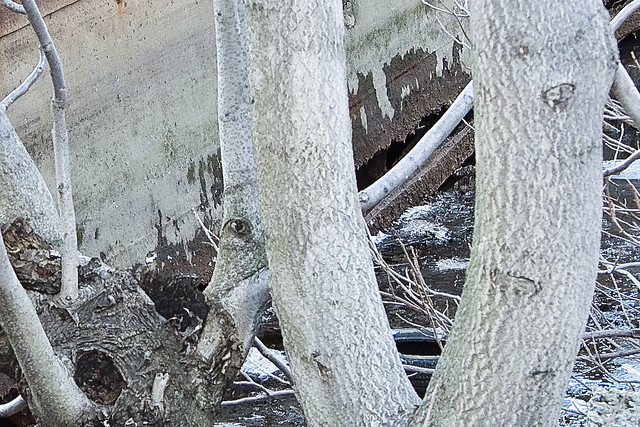
– photo by Mitch Waxman
This shot is un-messed around with, a simulacra caused by a broken branch or a parasitic infection… it must be…
For even around the malignant Dutch Kills…
Even when deeply sunken roots are drinking in some mutagenic stew of petroleum byproducts, sewage borne pharmaceutical runoff, and unmentionable organocoppers…
Even in these unmentionable and shunned waste meadows of the Creekland…
The Trees…
The Trees… are not meant to have eyes.
a creeping run

– photo by Mitch Waxman
Of late, when staring into the occluded depths of those waters which line the littoral rim of western Queens and north Brooklyn, ones’ fancies dwell on exactly what it might be that could be down there.
While my wild speculations and bizarre imaginings are fixed upon robotic submersibles and benthic monstrosities, the reality of those things which dwell below the sun kissed surface is vast. Great and metropolitan, the community of flora and fauna which underlies the harbor know nothing of political boundaries, and spread into every available crevice.
also from nycedc.com
Two separate but intermingled benthic invertebrate subcommunities have been identified in the East River on the basis of sediment hardness (Hazen and Sawyer 1983).
The hard substrate community is characterized by organisms that are either firmly attached to rocks and other hard objects (e.g., mussels or barnacles) or that build or live in tubes. Other species of polychaetes and amphipods also occur on the hard bottom surfaces, and several species utilize the East River’s hard bottoms and rapid currents by colonizing the abandoned tubes or shells of other species. The soft substrate community occurs in the more protected areas within the East River where detritus, clay, silt, and sand have accumulated in shallow, lower velocity areas near piers and pilings. Common soft substrate organisms include oligochaete worms, the soft-shelled clam Mya arenaria, and a variety of flatworms, nemerteans, polychaetes, and crustaceans (Hazen and Sawyer 1985).

– photo by Mitch Waxman
These creatures, which flip and flop and crawl through the contamination and filth at the bottom- a sort of natural selection is at work which will only allow those that might thrive in such a chemically complex environment to multiply and dominate their individual niches. Said niches, mind you, very well might be a sewer pipe, pier, or a masonry seawall concealing long forgotten chemical tanks and pipelines.
One wonders… Darwinian theory states that these environmentally catastrophic chemicals loosed in our waters are acting in a selective manner- weeding out the so called weak in favor of the so called strong, and if so- what might be evolving that can thrive in Benzene or other Petroleum products?
from nycedc.com
The hard substrate community is characterized by organisms that are either firmly attached to rocks and other hard objects (e.g., mussels or barnacles) or that build or live in tubes. Other species of polychaetes and amphipods also occur on the hard bottom surfaces, and several species utilize the East River’s hard bottoms and rapid currents by colonizing the abandoned tubes or shells of other species. The soft substrate community occurs in the more protected areas within the East River where detritus, clay, silt, and sand have accumulated in shallow, lower velocity areas near piers and pilings. Common soft substrate organisms include oligochaete worms, the soft-shelled clam Mya arenaria, and a variety of flatworms, nemerteans, polychaetes, and crustaceans (Hazen and Sawyer 1985).
In 2003, DSNY conducted field studies for the marine transfer station sites (MTS) as part of the environmental evaluation of the New York City Comprehensive Solid Waste Management Plan (DSNY 2005). Streblospio benedicti (oligochaete) was the most abundant infaunal macroinvertebrate collected in the bottom sediment of Newtown Creek near the Greenpoint MTS, with a density of 80,000 individuals per square meter. The dominant epifaunal macroinvertebrates included Corophium insidiosum (amphipods), Molgula manhattensis (sea grape), and Polydora species (polychaete worms), as well as hydrozoans, and mud and algal film. All of these organisms are tolerant of degraded environments.

– photo by Mitch Waxman
Will the future consider this barrage of environmental stressors- the PCB’s and VOC’s and PAH’s and TPH and all the rest- to have been an attempt at some kind of selective breeding- or will their children just take for granted whatever debased life is witnessed in the water in the same way that we think Cows and Chickens somehow resemble their progenitors?
Rapid environmental change leads to catastrophic extinction events, but the altered environment favors those who are left behind with little or no competition. Look at the odd species of chemosynthesizing bacteria that thrive around deep sea vents, or the bizarre Archaea speciations for examples of such specialization and deviation from the orthodox cycles of more wholesome life.
Who can guess what it is, that might be breeding down there, in the methanogenic waters of the cuprous Newtown Creek?
from epa.gov
EPA conducted an Expanded Site Investigation (ESI) of Newtown Creek in 2009 as part of the Hazard Ranking System scoring process for NPL listing under Superfund. Based on the ESI, which was focused on Newtown Creek itself and not its tributaries, EPA concluded that metals, volatile organic compounds, and semi-volatile organic compounds (including polycyclic aromatic hydrocarbons and polychlorinated biphenyls) were present in Creek sediments at elevated concentrations. The variety and distribution of the detected contaminants suggests that they originated from a variety of sources. Previous environmental investigations of Newtown Creek, or specific portions of the Creek, also disclosed that sediments in Newtown Creek are contaminated by a wide variety of hazardous substances. Environmental investigations of upland parcels adjacent to or nearby the Creek have disclosed contamination of those parcels by hazardous substances similar to hazardous substances found in sediments in Newtown Creek.

– photo by Mitch Waxman
Certain components of the liquid (English Kills is pictured above, but the water quality all along the Newtown Creek displays disturbingly heterogeneous qualities) found in Newtown Creek (the Anilines and Bromines in particular, but all the base analogs which might alter genetic structure are extant in the depths) are known to be mutagens.
A mutagen, incidentally, doesn’t simply give you cancer, nor does it turn you into an X-Man- it garbles genetic reproduction and causes errors to appear in DNA by chemically substituting one molecule for another. It turns “Newtown Creek” into “Newton Cweerk” as replication errors occur, and can ultimately spawn entirely new species over the course of a few generations.
Umm… mutagens also do cause cancer.
from The Eastern District of Brooklyn By Eugene L. Armbruster, via google books
BEYOND THE NEWTOWN CREEK
In the olden times the lands on both sides of Newtown Creek were most intimately connected. County lines were unknown, the creeks were dividing lines between the several plantations, for the reason that lands near a creek were taken up in preference to others, and the creeks were used in place of roads to transport the produce of the farms to the river, and thus it was made possible to reach the fort on Manhattan Island.
The territory along the Newtown Creek, as far as “Old Calvary Cemetery” and along the East River to a point about where the river is now crossed by the Queensboro bridge and following the line of the bridge past the plaza, was known as Dutch Kills. On the other side of Old Calvary was a settlement of men from New England and, therefore, named English Kills. The Dutch Kills and the English Kills, as well as the rest of the out-plantations along the East River, were settlements politically independent of each other and subject only to the Director-General and Council at Manhattan Island, but became some time later parts of the town of Newtown.

– photo by Mitch Waxman
Organochemistry is a subject I failed in high school, as my mathematic abilities are underdeveloped and weak. A layman’s understanding, however, is still able to conceive of certain possibilities and potentialities which can occur in the industrial witches brew of pharmaceuticals, sewage, and chemical pollution which swirls along the slime coating the Newtown Creek’s bed. There is 20 feet of the worst stuff imaginable down there, along with those blind things which wriggle about in the so called “Black Mayonnaise”. What will be found when the Federal authorities begin their work in earnest is enough to make me shudder.
Another disconcerting observation are the little bits of sawed bone and scraps of flesh I’ve been noticing along area pathways of late- all within 100 feet of the waterline- a new and enigmatic horror, here in the Newtown Pentacle.
from nytimes.com
Long Island City is in trouble, and fully 2,000 of her citizens are almost staring death in the face. The explanation is simple. Along the line of Jackson-avenue and Newtown Creek are several bone-boiling, fertilizer, and bad-smell factories which make no pretense of conforming to sanitary laws and regulations.


