Posts Tagged ‘newtown creek’
Tales of Calvary 9- A Pale Enthusiast

– photo by Mitch Waxman
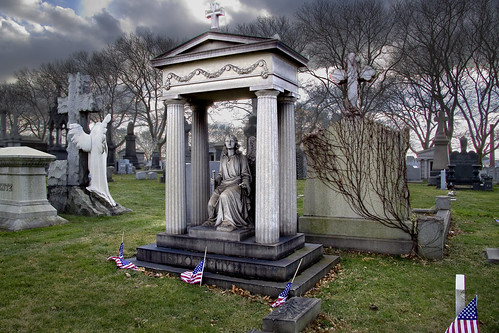
Amateurish and lazy explorations of Calvary Cemetery and the Greater Newtown Pentacle, with associated blog postings foisted upon an unsuspecting public and amplified by a never ending barrage of self promoting debasements of all that is true, have revealed many strange things to your humble narrator, and by extension- to you my gentle lords and ladies of Newtown. Today, the Doherty monument in First Calvary gets its turn. There is nothing “odd” about the monument, in fact the reason I call attention to the thing is the supernal beauty of its working. This is one uncanny bit of carving, and unfortunately these photos do not do it justice (still adjusting to the new camera).
Art school faculty, turtlenecked and smoking french cigarettes, would probably describe it as “Sophia, goddess of wisdom- in the form of a christian angel, sitting within a Roman structure, crowned by a cross- representing an agglutination of civilized democratic-christian progress advancing since the time of the Greeks and the Roman Republic and ultimately manifested as The United States. The angel casts her eye skyward, vigilant, with a sword in her hand. A pacific and expectant expression suggests the nearness of the second coming and resurrection of the dead.”
Such imperious and hyperbolic thinking was very much in vogue in the years between 1900 and the first World War.

– photo by Mitch Waxman
Eugene Doherty and his wife Mary J. Doherty are buried here. Their headstones have bas reliefs of palm fronds draped across them. The little flags are planted at the graves of military veterans in New York Cemeteries on national holidays to honor their service. I found no evidence of Doherty serving in the military, but that probably just means I didn’t know where to look.
After all- I’m just some ‘effed up lunatic who spends his spare time scuttling around trash dumps, toxic waste sites, and cemeteries who gets his kicks bad mouthing the past- Right?
– photo by Mitch Waxman
Mr. Doherty, it seems, was a man of some reknown. He was a leading member of the Irish community on both sides of the Newtown Creek, and stood shoulder to shoulder in prestige alongside Battle-Ax Gleason in the eyes of his countrymen.
A manufacturer of rubber, Doherty specialized in the sort of material demanded by “turn of the 20th century” Dentists for the manufacture of dentures. His heavily advertised (see sample at bottom) Samson Rubber was a standard component for the manufacture of false teeth. The factory, incorporated as Eugene Doherty Rubber Works, Inc., was located at 110 and 112 Kent Avenue which is in Greenpoint (or Williamsburg, depending on whether or not you’re trying to hard sell a building).
rubber, from wikipedia
The major commercial source of natural rubber latex is the Para rubber tree (Hevea brasiliensis), a member of the spurge family, Euphorbiaceae. This is largely because it responds to wounding by producing more latex.
Other plants containing latex include Gutta-Percha (Palaquium gutta),[1] rubber fig (Ficus elastica), Panama rubber tree (Castilla elastica), spurges (Euphorbia spp.), lettuce, common dandelion (Taraxacum officinale), Russian dandelion (Taraxacum kok-saghyz), Scorzonera (tau-saghyz), and Guayule (Parthenium argentatum). Although these have not been major sources of rubber, Germany attempted to use some of these during World War II when it was cut off from rubber supplies. These attempts were later supplanted by the development of synthetic rubbers. To distinguish the tree-obtained version of natural rubber from the synthetic version, the term gum rubber is sometimes used.
A neat image of the the Doherty Rubber Works building late in its heyday (1920) can be found at trainweb.org, if you can believe anything I say, and they have a great description of the whole scene in context here. I warn you though, you’re going to learn about the Brooklyn Eastern District Terminal!
Also, in a completely unrelated coincidence, NAG is located at 110 Kent in modernity. Here’s the place on a google map, click “streetview” to compare to the 1920 shot above

– photo by Mitch Waxman
Eugene Doherty died in 1906, his wife Mary in 1914. Luckily for Mary, the denture business was a lucrative one, and her years of mourning were spent in material comfort. At her death, she bequeathed the staggering sum of $621,148 to her heirs.
$621,148 in 1914, mind you, and federal income tax had just become a reality in 1913. That’s at least $10,000,000 in modern coine.

– photo by Mitch Waxman
Life sized, if you’re a 5 foot tall woman, the statue itself is disarming and has weathered existence in the corrosive atmospheric miasmas extant about the nearby Newtown Creek for 94 years, only losing a thumb. The colour, oddly, doesn’t stain sanctified Calvary. Xanthian skill representative of true artistry went into the shaping of this stone, but I haven’t been able to find the name of the sculptor in public record.
If you see it, stand close and look into its eyes, then leave when the chills begin. Whatever you do, don’t look back over your shoulder at it afterwards, lest an adjusted hand hold on the sword, or the impression that the angle of its head has shifted might be seen. Remain an observer- in Calvary- ever the pale enthusiast- ever an Outsider.
Hey, you never know what you’re going to find at Calvary Cemetery.
Also, just as a note- today, January 13th, is Clark Ashton Smith’s birthday, and St. Knut’s Day as well.
Eugene Doherty Rubber Inc. - Late 19th/Early 20th century Advertising
In the cold waste 2

from Vernon Blvd., Queensboro – photo by Mitch Waxman
Despite fingertips bleached to parchment white by biting wind and polar conditions, the cold waste beckons, and your humble narrator perseveres.
The relict shores of Ravenswood’s 3rd world persist in atavist glory at Vernon Blvd. and 44th drive, near the Gordon Triangle, which is what passes for a city park in this stronghold of the Oligarchs.
Brutal realities confront one here, 1 and 2 family homes still can be found, abutting vast victorian mill buildings converted to warehouse duty in the early 20th century. Fingerprints, left by the fattened digits of the masters, greasily smear across the neighborhood- every “available” sign on a relict warehouse is a signal of avarice and intent.

Taxis parked – photo by Mitch Waxman
At 46th avenue, the brick horizon opens, and a glimpse of the shining city is offered. Soon, this viewpoint and vantage will be occluded by yet another high rise spire, a warehouse offered to white collar laborers. Where will the unwashed who cook- and clean- and build- live and work when this 3rd world is gone- ground beneath the jeweled heel of progress?
The children of these new residents- where will they play and go to school? What will happen to the fragile infrastructure of 19th century streets, where wounds to the modern asphalt reveal victorian cobblestones? Why is the municipality not requiring the construction of new subway stations and schools, or at least sewers, from these Oligarchs for the rapacious profits they will garner from these grand projects?

Soil remediation tent – photo by Mitch Waxman
All the poisons in the mud will leach out, in the end.
The parable is exemplified at Anable Basin, at 5th street, where a second attempt at remediating the industrial history and unmentioned past of Ravenswood and Hunters Point is underway. This extant of the QueensWest development, whose previous metastasizes eradicated the historic district between the LIRR powerhouse and the LIRR Gantry docks, is troubled by environmental concerns that have postponed the plans of the masters.
Lessons learned there have been incorporated by the municipal chamberlins and chancellors, to avoid such expensive delays in a newer and larger project called Queens South just beginning at Hunters Point.

Megalopolis and Brownfield – photo by Mitch Waxman
Home sweet hell, New York City, the vast human hive.
The cement goddess is mother and home, school and prison, always a battleground- it produces children who are survivalist predators. When we walk the earth, New Yorkers are tigers amongst simpler peoples who didn’t have to endure living with… other New Yorkers.
There is a mind set amongst the rich in New York, and there always has been, that the poor can be saved by example- by having the poor live “as we do”. All of the afflictions of poverty can be alleviated- if not cured. Progressive Reformer or New Law Tenement or Urban Renewal or Gentrification or Upzoning, call it what you want- but Caesar is building the new Roman slums in an entirely inorganic fashion. This neighborhood used to be an industrial center, and then a junkyard, and that’s the reason why the ground is poison.
The industrial revolution happened. Here.

Testing Wells- May 30, 2009 – photo by Mitch Waxman
I am not a fan of vertical tower dwellings whose price of entry is designed to bring a non homologous population into an existing ethnic neighborhood as I can predict what will happen a generation or two from now, but I don’t own the land.
True ownership allows untrammeled discretion- if I own a car, I can set it on fire if I wanted to. If I own a house, I can knock out all the walls if I wanted to. If I could erect a forty story statue of my little dog Zuzu directly across the river from the United Nations building- that would robotically defend the city against giant Cat or Squirrel attack of course- it would be my business- because its my property. Why, though, would the City of New York instead encourage me to build an apartment house on a contaminated site instead of accepting the nature of the place and dedicating it to some acceptable usage? Could it just be the installation of a certain demographic and tax bracket into an overwhelmingly low and middle income neighborhood would benefit the status quo over in Manhattan?
Again, I’m just some guy, who doesn’t own anything. They’re rich guys, and in modern America, rich means you’re right- so what does it matter what I think?

Waste Barrels- June 29, 2009 – photo by Mitch Waxman
I’ve been haunting this place for a while.
Fascinating little project they have going on, which has actually activated some community activism amongst the new residents of Long Island City- the Tower People. Not bad folks these Tower People, on the whole, despite being a denigrated group referred to with smirks and winks by long time LIC’ers. Degreed and lettered professionals on the whole, they are a legion of bankers and lawyers who exist in the warren shadows of Manhattan’s financial district and turbulent midtown by day, but they turn Long Island City from a neighborhood into a dormitory.
A narrow enough lensing of the past can create causality from coincidence, but if you think that Battery Park City or Jersey City is city planning at its best, you’re going to love the new Long Island City.

Brownfield Work Site – photo by Mitch Waxman
The only buy-in for the community at large to enjoy are the production of riverfront parklands, which are remarkable, from which you may admire Manhattan while ignoring Queens stretching out behind you.
A recent article found at Queenscrap describes the cost of maintaining NYC parks at an astounding $10,000 per acre. Using this metric, Calvary Cemetery would need to raise $720,000 per year for groundskeeping, the average suburban golf course would have yearly expenditures measured in the millions, and a midwestern farm would incur costs in the tens of millions to maintain their lands let alone harvest them. I do believe that the journalists out there should take a close look at the Parks Dept. if this number is accurate. Just to be clear, as acreage is an old fashioned measurement not used commonly in the urban setting, that’s a square which is 208 feet and 8 inches on a side. The riverfront parks associated with Queens West will cost as much as $100,000 per acre.

Brownfield Work Site – photo by Mitch Waxman
9.5 acres, and owned by Rockrose Development (which has recently transformed itself into another corporate entity), this is the future home of four residential towers. As of April 2008, some 80,000 tons of contaminants had been removed from the site at a cost of $31 million. Standard Oil sited an oil refinery here in the 1860’s, and the soil is contaminated with Benzene, Petroleum Distillates, and volatile organic chemicals whose detected presence – in trace amounts- would cause the regular NYFD to evacuate and call in their HAZMAT teams.
Additionally, generations of untreated sewage and industrial pollution swirl and mix with the water table of the East River in the deeply cold gravels and blackened mud beneath the place. Sources also reveal that the “clean fill” being used to replace the contaminated substrates that were removed in the remediation process emanates from the tunnel being bored out from under the East River by the “East Side Access” project.
Who can guess, what it is, that still may lie hidden down there?

Brownfield Work Site – photo by Mitch Waxman
All the poisons in the mud will leach out, in the end.
Mt Zion 6- Crystal Oblivion

– photo by Mitch Waxman
Awakening from the dead faint which had ended my ruminations on those oppressions suffered by both Jew and Roma in a war torn exemplar of peasant ignorance and malign oligarchy which is the European Peninsula, your humble narrator noticed the gloaming of late afternoon settling upon the centenarian graveyard and realized that one way or another- an escape must be hazarded from the oblivion of Mount Zion cemetery if I ever desired to return to the yellow brick lanes of Astoria.

– photo by Mitch Waxman
The curious singsong chant of those odd children had stopped, and echoing along the tombstones was the sound of wholesome and cheerful laughing. From my vantage, I could discern that the first group of children were fleeing from a second, whose colorful clothing and raven hair marked them as the picturesque crowd I had spotted earlier on 53rd avenue. The flabby jowled, unblinking, scaly group of youths which had been tormenting me- and whose apparent leader was a girl carrying a curiously polydactyl cat whose aspect “I did not like”- were running off in the direction of that stygian cataract called the Newtown Creek.

– photo by Mitch Waxman
Regaining my composure, I realized that I had found the highest spot in Zion, and watched as the group of dark haired and festively adorned children jeered the fleeing “others”. I turned for a moment, looking south toward Brooklyn, along the gates of a Sanitation Dept. Garbage truck depot. This is a lonely spot, tragic and shunned.

– photo by Mitch Waxman
Populated by graves of children, often stillborn, this is the highest point of elevation in Mt. Zion by my estimation. I resolved to make my way for the gates, and felt an eerie tiredness take over me. Cemeteries are uncomfortable places not because of the omnipresent reminders of mortality, but because they remind us that anonymity is the ultimate fate of nearly all of us.

– photo by Mitch Waxman
All they were, and had done, and built- the ultimate meaning of themselves- led to centuried silence and the anonymity of the tomb. I’ve been asking myself, lately, why I’ve been so compelled to spend my time with them, instead of amongst the living. A lot of wise old jewish grandmothers are buried here, and my own would say that this recent pursuit is “no good for you, go see a movie instead”.
She also told me, when I told her I intended to follow a career in visual arts, that “all I wanted was to be a bum in the village with a needle in my arm”.

– photo by Mitch Waxman
Mission Statements – 1 – Breaking character
One of my quasi mystical opinions is that by telling a story, transmitting the lore of civilization from one generation to another, you keep the subject of the story alive- in a sense. We know the story of Beowulf, and Christ, and Churchill. In my ham handed and alliterative patois of pop cultural imagery and historical allusion, this notion of “telling the hero’s story” (with the “hero” being the working class) is part of my motivation behind these explorations. In a sense, I fancy myself as C-3PO telling the story of Luke and Leia to the Ewoks.

– photo by Mitch Waxman
Mission Statements – 2 – Horns and Dilemmas
A vast and shining monument to future archaeology is what I see the Cemetery Belt of western Queens and North Brooklyn as, awaiting the end of living memory and improved imaging technology. Vast dilemmas of conscience often plague me as I make the “selects” from the hundreds of shots I’ll gather at just one of the many locations explored at the Newtown Pentacle. That’s an identifiable face, or corporate trademark, or the ridiculous laws which require the owner of a skyscraper to approve the publication of an image of their structure. The graveyard stuff is touchy, and I attempt to only show graves of those who died well out of “living memory”, which is a flexible topic for me.

– photo by Mitch Waxman
Mission Statements – 3 – Contradictions and Logic
Problematic, because it’s self defined, my “living memory” concept is roughly this- if the stone is older than the second world war- I consider it fair game and part of the public record. Saying that, if you’ve seen a gravestone of a relative in one of my shots that you’d really rather not have public, contact me and it’s pulled (I’m not a dick)- just know that the shot was chosen for either its odd qualities or historical significance (like the O’Brien monument in Old Calvary), or because it’s a beautiful piece of sculpture that was chosen to illustrate the esthetic or political milieu of an era I’m trying to describe. Any editorial implications of the accompanying quoted references (from abc.com, in italics) or “humble narrator” copy should be discarded as the product of a sick, cowardly, and weary man who is “all ‘effed up”. No one will visit my grave, Lords and Ladies of Newtown, except to gloat and defecate.
I also never trespass, enter onto Railroad properties uninvited, or use transportation of any kind other than my feet when I’m out on one of my little missions. Kissing the right posterior and being “nice” offers tremendous access to these places, “legally”, and brings insight and opportunity. Why make trouble?

– photo by Mitch Waxman
Back to the post:
When I passed out of the ancient cemetery, through the western section’s gates, I saw that group of gaily dressed children who had chased off those menacingly mutant urchins that had caused me to faint three times as I hid in the shadows of this garden of obelisks.
One of the oddest moments of the day occurred when a waste hauler’s truck sped down Maurice Avenue at top speed, occluding my view of them for a few seconds, during which they disappeared. Puzzled, I scuttled back to the waiting arms of Astoria, and the entire way I thought I heard the creaking agony of wooden carriage wheels.
Mt Zion 4- A Lurid Shimmering of Pale Light

– photo by Mitch Waxman
Befuddled by the sing song chantie evinced by those horrible children, in whose frog like faces your humble narrator found some nameless dread and whose terrible attention initiated his flight into sylvan Mount Zion, I wandered in a haze of unknowable panic through the 72 acre graveyard. Notions of familiar aspect- the smiling face of “our Lady of the Pentacle”, the friendly greeting of my little dog- Zuzu- kept me grounded and allowed me to ignore some of the macabre details of the landscape. Crazed, however, my racing thoughts began to tangentially ruminate…
from wikipedia
Kevura, or burial, should take place as soon as possible after death. The Torah requires burial as soon as possible, even for executed criminals. This means that burial will usually take place on the same day as death, or, if not possible, the next day. Some Reform and other congregations delay burial to allow more time for far-flung family to come to the funeral and participate in the other post-burial rituals.
The traditional practice may have originated from the fact that Israel was, and is, a country with a hot climate. In Biblical times, there were few ways of keeping the dead body from decomposing. Not only would this be generally undesirable, but allowing the dead body of any person to decompose would be showing that person great disrespect. Decomposition would have occurred especially quickly in Israel due to the constant heat. Thus, the custom of burying the body as soon as possible. (Although the practice of embalming and mummification had advanced to a high level in Egypt, this, too, is considered disrespectful, since it involves a great deal of manipulation and the removal of bodily organs.) In addition, respect for the dead can be seen from many examples in the Torah and Tanakh. For example, one of the last events in the Torah is the death of Moses when God himself buries him: “[God] buried him in the depression in the land of Moab, opposite Beth Peor. No man knows the place that he was buried, even to this day.” (Deuteronomy 34:6)

– photo by Mitch Waxman
My eyes shot from side to side, the tombstones led me to a fortified enclosure, and half remembered minutiae nervously filled my mind…
The tiny stones, often adorned with a lamb, are the graves of children.
Vulnerable to a host of infections which have been conquered by modern science (at least in the west), the large families characteristic of the pre World War 2 era were an insurance policy for a bloodline’s future in a world without antibiotics. Don’t forget, even the son of an American President died in 1862, most likely from Typhoid fever after drinking tainted water. As late as 1963, the son of John Kennedy died from a disease whose mortality is reduced to 15% in modernity. In my own family- Great Grandmother had 13 children, of which only 7 survived to adulthood. Of the 7 survivors- all of whom emigrated to the United States prior to 1920, all of their children (with the exception of one gruesome early death due to a malfunctioning boat propellor) lived into -at least- their late 60’s, and almost all of their grand kids are still around. In the developing world, infant mortality figures are consistent, however, with the larger experience of historical record as represented at Mount Zion.
from wikipedia
Some have a custom to visit the cemetery on fast days (Shulchan Aruch Orach Chayim 559:10) and before Rosh Hashanah and Yom Kippur (581:4, 605), when possible, and for a Yahrzeit. During the first year the grave may be visited on the shloshim, and the yartzeit.
Even when visiting Jewish graves of someone that the visitor never knew, he or she may place a small stone at the graveside. This shows that someone visited the graveside, and represents permanence. Leaving flowers is not a traditional Jewish practice. Another reason for leaving stones is tending the grave. In Biblical times, gravestones were not used; graves were marked with mounds of stones, so by placing (or replacing) them, one perpetuated the existence of the site. This was also helpful for Cohanim, who needed to avoid spiritual impurity that could be passed on by corpses/graves.

– photo by Mitch Waxman
Trapped in a thanatic trance… eternally staring ceramic eyes accusing me… if only those nightmare children would stop their singing…
Many of the older headstones at Mount Zion, whose creeds list the age of the deceased, indicate a world where life was short. Men dropped off in their middle 40’s and 50’s with a few remarkable individuals who survived into their 60’s. Women were either longer lived- no doubt due to the domestic captivity they suffered which insulated them from the dangerous industrial milieu that typified the manufacturing and agricultural occupations of the males- or died in childbirth (leading cause of female mortality throughout recorded history) due to septic conditions or uncontrollable bleeding.
It cannot be stressed enough, how different the lives of these generations were from our own- and whatever its flaws are- that our age represents something wonderful, unique, and unheralded in the rich pageant of human history.
from wikipedia
Odor, color changes, and bloating of the body during decomposition are the results of putrefaction. The lower part of the abdomen turns green due to bacteria activity in the cecum. Bacteria break down hemoglobin into sulfhemoglobin which causes the green color change. A formation of gases enters the abdomen which forces liquids and feces out of the body. The gases also enter the neck and face, causing swelling of the mouth, lips, and tongue. Due to this swelling and misconfiguration of the face, identification of the body can be difficult. Bacteria also enter the venous system causing blood to hemolyze. This leads to the formation of red streaks along the veins. This color soon changes to green, through a process known as marbelization. It can be seen on the shoulders, chest and shoulder area, and thighs. The skin can develop blisters containing serous fluid. The skin also becomes fragile, leading to skin slippage, making it difficult to move a body. Body hair comes off easily. The color change of the discoloration from green to brown marks the transition of the early stage of putrefaction to the advanced decompositional stages.
During the putrefaction stage of decomposition the majority of insect activity again comes from members of the Calliphoridae family, and includes Formicidae, Muscidae, Sphaeroceridae, Silphidae, Lepidoptera, Hymenoptera, Sarcophagidae, Histeridae, Staphylinidae, Phalangida, Piophilidae, Araneae, Sepsidae, and Phoridae. As with the fresh stage of decomposition if the body is on the ground or buried in soil there is also considerable insect activity by the soil-inhabiting arthropods.

– photo by Mitch Waxman
The generations born after Napoleon and after the American Civil War- with their legendary corruption, abhorrent wars of genocide, and brutal subjugation of the ancient East- conversely built the edifice of Modernity. The “system”- university education, compulsory literacy, sewer systems, municipal projects of great scope, the elevation of law and finance over heredity and martial prowess, universal suffrage, the corporations. They are the ones who built it, their kids and grandchildren proved it’s efficacy in the second thirty years war (ww1 and ww2), their great grandkids rebelled against it. We are the ones who live in what’s left of it.
from wikipedia
After the body goes through the bloating stage it begins the black putrefaction stage. At this point the body cavity ruptures, the abdominal gases escape and the body darkens from its greenish color. These activities allow for a greater invasion of scavengers, and insect activity increases greatly. This stage ends as the bones become apparent, which can take anywhere from 10 to 20 days after death depending on region and temperature. This period is also dependent on the degree to which the body is exposed.
During the black putrefaction stage of decomposition, insects that can be found living in the body are Calliphoridae larvae, Staphylinidae, Histeridae, Gamasid mites, Ptomaphila, Trichopterygidae, Piophilid larvae, Parasitic wasps, Staphylinid larvae, Trichopterygid larvae, Histerid larvae, Ptomaphila larvae, Dermestes, Tyroglyphid mites, Tineid larvae, and the Dermestes larvae. Some insects can also be found living in the soil around the body such as Isopoda, Collembola, Dermaptera, Formicidae, Pseudoscorpiones, Araneae, Plectochetos, Acari, Pauropoda, Symphyla, Geophilidae, and Protura. The types of insects will differ based on where the body is, although Diptera larvae can be found feeding on the body in almost all cases.
After the body goes through the bloating stage it begins the black putrefaction stage. At this point the body cavity ruptures, the abdominal gases escape and the body darkens from its greenish color. These activities allow for a greater invasion of scavengers, and insect activity increases greatly. This stage ends as the bones become apparent, which can take anywhere from 10 to 20 days after death depending on region and temperature. This period is also dependent on the degree to which the body is exposed.During the black putrefaction stage of decomposition, insects that can be found living in the body are Calliphoridae larvae, Staphylinidae, Histeridae, Gamasid mites, Ptomaphila, Trichopterygidae, Piophilid larvae, Parasitic wasps, Staphylinid larvae, Trichopterygid larvae, Histerid larvae, Ptomaphila larvae, Dermestes, Tyroglyphid mites, Tineid larvae, and the Dermestes larvae. Some insects can also be found living in the soil around the body such as Isopoda, Collembola, Dermaptera, Formicidae, Pseudoscorpiones, Araneae, Plectochetos, Acari, Pauropoda, Symphyla, Geophilidae, and Protura. The types of insects will differ based on where the body is, although Diptera larvae can be found feeding on the body in almost all cases.

– photo by Mitch Waxman
An industrial complex, the purveyors of doomsday tell us that the world is ending, and we greedily consume the news. Our society is failing, and will collapse soon.
A mythology of the “good old days” pervades and poisons, dividing populations over semantic points. A foreign enemy, barbarian savages devoid of mercy, threaten us. Our children are running wild, dispossessed of religious scruple or moral code. All that stands on the line between chaos and order are a self appointed few, lettered oligarchs whose accumen and opinion is never questioned. This environment of fear, a pervasive political meme, is false. It is also quite ancient, as the text above describes Constantinople.
Tonight, both a functional and statistical number of human beings will have food in their bellies when they go to sleep, as opposed to yesterday. More women will survive childbirth today than yesterday. Even the operatic tragedy of modern times, which is the AIDS epidemic in Sub Saharan Africa, is a disease- ultimately- of relative affluence and OVERpopulation. Corpus Mundi, things are not as bad as they seem to be, gentle readers. There’s a lot of bad, but as compared to even a mere 80 years ago, there’s also good.
from wikipedia
After the early putrefaction and black putrefaction phases have taken place, the body begins mummification, in which the body begins to dry out. The human carcass is first mummified, and then goes through adipocere formation. Adipocere (grave wax) formation refers to the loss of body odor and the formation of a cheesy appearance on the cadaver. Mummification is considered a post-active stage because there is less definite distinction between changes and they are indicated by reduced skin, cartilage, and bone. Mummification is also indicated when all of the internal organs are lost due to insect activity.
Insects that can be found on the body during mummification include most of the same insects as in putrefaction stage, but also include Acarina, Nitidulidae, Cleridae, Dermestes caninus, and Trogidae. The main soil-inhabiting arthropods include Dermaptera and Formicidae.

– photo by Mitch Waxman
The leading cause of death in the United States in the first decade of this 21st century is Heart Disease, followed by various forms of Cancer. Your humble narrator has some small experience with the first and has resigned himself to the inevitability of the second, as he lives on a continent where Nuclear Testing was conducted.
note:
If all the Atomic tests are considered together when calculating radiation exposure to the civilian population of North America, a full scale nuclear war might as well have been fought here, and the bell curve of nuclear testing lays neatly into the rates of cancer experienced 25-30 years later. Tourist groups may visit the Frenchman Flats testing site- a “national sacrifice zone” for excursions amongst the cratered sites of Atomic detonations, I’d rather drink a glass of that queerly coloured effluviam which flows lugubriously through a crucible of dictatorial capitalism called the Newtown Creek.
Congenital illness, which medicine hasn’t figured out how to deal with -yet- notwithstanding, that which kills you these days is not an infected mosquito bite- or any of the leading causes of death in the 19th century- Pneumonia, Tuberculosis, and Diarrhea – instead its eating too much of the wrong food… which is plentiful.
Back in 1900, life expectancy was 49. Heart Disease was almost the number 4 killer, and strokes were number 5.
Number 5 is “accidents”, today. Life expectancy is almost 80.
from wikipedia
When the last of the soft-tissue has been removed from the body, the final stage of decomposition, skeletonization, occurs. This stage encompasses the deterioration of skeletal remains, and is the longest of the decomposition processes. Skeletonization differs markedly from the previous stages, not only in length, but in the deterioration process itself.
The strength and durability of bone stems from the unique protein-mineral bond present in skeletal formation. Consequently, changes to skeletal remains, known as bone diagenesis, occur at a substantially slower rate than stages of soft-tissue breakdown. As the protein-mineral bond weakens after death, however, the organic protein begins to leach away, leaving behind only the mineral composition. Unlike soft-tissue decomposition, which is influenced mainly by temperature and oxygen levels, the process of bone breakdown is more highly dependent on soil type and pH, along with presence of groundwater. However, temperature can be a contributing factor, as higher temperature leads the protein in bones to break down more rapidly. If buried, remains decay faster in acidic-based soils rather than alkaline. Bones left in areas of high moisture content also decay at a faster rate. The water leaches out skeletal minerals, which corrodes the bone, and leads to bone disintegration.
At the dry decay stage commonly found insects include Sphaeroceridae, Acarina, Nitidulidae, Cleridae, Dermestes caninus, Trogidae, Tyroglyphid mites, and the Tineid larvae. The soil-inhabiting arthropods are Collembola, Dermaptera, Heteroptera, Coleoptera and their larvae, parasitic Hymenoptera, Formicidae, Diptera larvae, Pseudoscorpiones, Aranae, Plectochetos, Acari, Pauropoda, Symphyla, Geophilidae, Protura, and Aphididae.

– photo by Mitch Waxman
Still lost in those wild reveries as described above, I found myself moving ever higher in elevation. A significant and curious declination is found in Mount Zion, and as one nears the western edge of the cemetery- near the 58th street side- it becomes obvious. This was an excellent instinct which I followed, as the distance from both Maurice and 54th avenues eliminated the malefic influence of the bizarre children’s song.
Another group of children, wholesome looking urchins whose appearance was a marked contrast to that malign gathering on Maurice Avenue, appeared along the fences. They were dark and wholesome in aspect, with masses of wild black curls. Colorfully dressed, they were laughing cheerfully as they ran back and away from the vast iron gates along 53rd avenue. An odd chemical scent hung in the air and seeking a fresh breeze, I penetrated further westward.
from wikipedia
As practiced in the funeral homes of the Western World (notably North America), embalming uses several steps. Modern embalming techniques are not the result of a single practitioner, but rather the accumulation of many decades, even centuries, of research, trial and error, and invention. A standardized version follows below, but variation on techniques is very common.
The deceased is placed on the mortuary table in the supine anatomical position with the head elevated by a head block. The first step in embalming is to check that the individual is in fact deceased, and then verify the identity of the body (normally via wrist or leg tags). At this point embalmers commonly perform basic tests for signs of death, noting things such as clouded-over corneas, lividity, and rigor mortis or by simply attempting to palpate a pulse in the carotid or radial artery. In modern times people awakening on the preparation table is largely the province of horror fiction and urban myth. Any clothing on the corpse is removed and set aside and any personal effect such as jewelry is inventoried. A modesty cloth is sometimes placed over the genitalia. The corpse is washed in disinfectant and germicidal solutions. During this process the embalmer bends, flexes and massages the arms and legs to relieve rigor mortis. The eyes are posed using an eye cap that keeps them shut and in the proper expression. The mouth may be closed via suturing with a needle and ligature, using an adhesive, or by setting a wire into the maxilla and mandible with a needle injector, a specialized device most commonly utilized in North America and unique to mortuary practice. Care is taken to make the expression look as relaxed and natural as possible and ideally a recent photograph of the deceased while still living is used as a template. The process of closing the mouth, eyes, shaving, etc is collectively known as setting the features.

– photo by Mitch Waxman
The aforementioned change in elevation is a morrain feature, whose glaciated sculpting endowed this corner of the Newtown Pentacle with a marshy and swamped character, in its aboriginal form. These were once -what modernity would define as- wetlands, or as the 19th century would define it- waste lands. A muddy filtration system for the Newtown Creek and part of its aquifier, these were once prime hunting grounds for Indian and Dutchman alike.
from wikipedia
Embalming chemicals are a variety of preservatives, sanitising and disinfectant agents and additives used in modern embalming to temporarily prevent decomposition and restore a natural appearance for viewing a body after death. A mixture of these chemicals is known as embalming fluid and is used to preserve deceased (dead) individuals, sometimes only until the funeral, other times indefinitely.
Typically embalming fluid contains a mixture of formaldehyde, methanol, ethanol and other solvents. The formaldehyde content generally ranges from 5 to 29 percent and the ethanol content may range from 9 to 56 percent.
In the United States alone, enough embalming fluid is buried every year to fill eight Olympic-size pools or about 20 million liters.

– photo by Mitch Waxman
That’s when another of my “very bad ideas” came to the fore, when I wondered what it is that might be lurking down there, in the wormy mud of the Newtown Pentacle.
all but one of these links lead to wikipedia, and express just a little bit of the chemical recipe that produces an anaerobic broth like that found in the Newtown Creek
Putrescine (sometimes spelled putrescin) is an organic chemical compound NH2(CH2)4NH2 (1,4-diaminobutane or butanediamine). It is related to cadaverine; both are produced by the breakdown of amino acids in living and dead organisms and both are toxic in large doses.
Cadaverine is a foul-smelling molecule produced by protein hydrolysis during putrefaction of animal tissue. Cadaverine is a toxic diamine with the formula NH2(CH2)5NH2, which is similar to putrescine. Cadaverine is also known by the names 1,5-pentanediamine and pentamethylenediamine.
The industrial form of Putrescine is produced using hydrogen cyanide and a compund called Acrylonitrile, which is on the EPA’s list of Volatile Organic Compounds– or VOC’s. As long time readers will recall, VOC’s are amongst the primary pollutants fouling the waters of a nearby cautionary tale called the Newtown Creek.
Mt Zion 3- threading precipitous lanes

– photo by Mitch Waxman
Awakening from my “very bad idea” induced faint, here on Path Number 13 in Mount Zion cemetery, your humble narrator was buoyed by the fact that only one hour of his life was lost to that timidity and cowardice with which he is cursed. A quick scan of the Maurice Avenue fences revealed that the sinister (and possibly mutant) children were still gathered along the rusted balustrade forming the cemetery’s border- were they waiting for me to quit this hallowed ground that they seemed to be unable to step upon? They were dancing in a circle around that girl with the hatefully polydactyl cat.
from wikipedia
Syncope (pronounced /ˈsɪŋkəpi/) is the medical term for fainting, a sudden, usually temporary, loss of consciousness generally caused by insufficient oxygen in the brain either through cerebral hypoxia or through hypotension, but possibly for other reasons. Typical symptoms progress through dizziness, clamminess of the skin, a dimming of vision or brownout, possibly tinnitus, complete loss of vision, weakness of limbs to physical collapse. These symptoms falling short of complete collapse, or a fall down, may be referred to as a syncoptic episode.

– photo by Mitch Waxman
Scuttling disgracefully away from their view, I left Path 13 and picked my way across an avenue of graves which formed the only connection between the widely placed pavement walkways. Walking along the loathsome egress of the plots themselves and while trying to forget about the menace represented by the children, whose disgusting and icthyan appearance caused my flight into this place, my attentions were drawn by the faces of those who have passed beyond the veil.
from wikipedia
Paranoid personality disorder is a psychiatric diagnosis characterized by paranoia and a pervasive, long-standing suspiciousness and generalized mistrust of others.
Those with the condition are hypersensitive, are easily slighted, and habitually relate to the world by vigilant scanning of the environment for clues or suggestions to validate their prejudicial ideas or biases. They tend to be guarded and suspicious and have quite constricted emotional lives. Their incapacity for meaningful emotional involvement and the general pattern of isolated withdrawal often lend a quality of schizoid isolation to their life experience.

– photo by Mitch Waxman
The “PC” sticker indicates “perpetual care”, a funerary industrial complex term that indicates a contracted schedule of groundskeeping and monument maintenance has been arranged by the bereaved. Ostensibly, this contract plays out over the rest of human history, or as long as the cemetery operation continues. Upstate New York, especially in the “burned over district“, has seen dozens of cemetery organizations go out of business in the last 50-100 years. Abandoned, as in many cases the townships let alone the actual congregation no longer exist due to the westward migration of populations during the 19th and 20th centuries- these graveyards became dumping grounds, suffered adolescent vandalism, and went feral. Worse, they become altars for unclean rites, animal torture, and in some cases- tomb desecration. Luckily, the rural cemeteries of Queens are still going concerns, and NYPD hushes up such matters.
from wikipedia
The psychiatrist Kurt Schneider (1887–1967) listed the forms of psychotic symptoms that he thought distinguished schizophrenia from other psychotic disorders. These are called first-rank symptoms or Schneider’s first-rank symptoms, and they include delusions of being controlled by an external force; the belief that thoughts are being inserted into or withdrawn from one’s conscious mind; the belief that one’s thoughts are being broadcast to other people; and hearing hallucinatory voices that comment on one’s thoughts or actions or that have a conversation with other hallucinated voices. Although they have significantly contributed to the current diagnostic criteria, the specificity of first-rank symptoms has been questioned. A review of the diagnostic studies conducted between 1970 and 2005 found that these studies allow neither a reconfirmation nor a rejection of Schneider’s claims, and suggested that first-rank symptoms be de-emphasized in future revisions of diagnostic systems.

– photo by Mitch Waxman
Haunting ceramics adorn many markers in Mount Zion. A vogue in funerary architecture, which is making a modern comeback via laser etched digital portraits, the heavily retouched images are almost always studio portraits and not representative of the final countenance of the deceased- these are not death masks. A fellow ghoulish spectator and commenter who calls himself Sorabji produces encyclopedic photographic collections of these markers across the Cemetery Belt, and formed a thorough and profound catalog of them- click here for Sorabji‘s gallery of shadows.
from wikipedia
The Diagnostic and Statistical Manual of Mental Disorders fourth edition, DSM IV-TR, a widely used manual for diagnosing mental disorders, defines schizotypal personality disorder (in Axis II Cluster A) as:[2]
A pervasive pattern of social and interpersonal deficits marked by acute discomfort with, and reduced capacity for, close relationships as well as by cognitive or perceptual distortions and eccentricities of behavior, beginning by early adulthood and present in a variety of contexts, as indicated by five (or more) of the following:
- Ideas of reference (excluding delusions of reference)
- Odd beliefs or magical thinking that influences behavior and is inconsistent with subcultural norms (e.g., superstitiousness, bizarre fantasies or preoccupations)
- Unusual perceptual experiences, including bodily illusions
- Odd thinking and speech (e.g., vague, circumstantial, metaphorical, overelaborate, or stereotyped)
- Suspiciousness or paranoid ideation
- Inappropriate or constricted affect
- Behavior or appearance that is odd, eccentric, or peculiar
- Lack of close friends or confidants other than first-degree relatives
- Social anxiety that tends to be associated with paranoid fears rather than negative judgments about self.

– photo by Mitch Waxman
Like some aged and arthritic goat, I scattered my steps widely while crossing the plantation of marble. The grounds in these older sections are rife with collapsing vaults, teetering headstones of 8 feet or more, and disturbing subsidence. The evidence of a thriving vegetable ecosystem is everywhere, and during the fall and early winter (when these shots were taken) the thorny underbrush assumes a sinister and skeletal tone. Often- lateral progress was cut off by a congestion of stones and vine strangled trees, egress offered only by a sickeningly subsided depression in the center of a burial plot. The journey, however, brings you into a golden age of typography and poster design.
from wikipedia
A Limited Symptom Attack (LSA), also referred to as a Limited Symptom Panic Attack (LPA), is a milder, less comprehensive panic attack with fewer than 4 panic related symptoms being experienced (APA 1994). For example, a sudden episode of intense dizziness or trembling accompanied by fear that something terrible is about to happen. Many people with panic disorder have a mixture of full blown and limited symptom attacks. LSAs often manifest in anxiety disorders, phobias, panic disorder and agoraphobia. However, experiencing a LSA is not necessarily indicative of mental illness. Often persons recovering from and/or being treated for panic attacks and panic disorder will experience LSAs.

– photo by Mitch Waxman
1929, when Mr. Wiener- pictured above- died (unfortunately, I could find NOTHING on this enigmatic fellow) was one of those moments in history that replaced one view of the world with another- just like 1974 or 2001.
On August 10, the Stock Market Crash that began the Great Depression hadn’t happened yet, that would be in October. Neither had the Hebron Riots, which were the kindling of what would become the Israel/Palestine conflagration. It would be the end of August when the crushing Young Plan of reparations for World War 1 were enacted, in which the interests of the United States were represented by J.P. Morgan, whose provisions set Germany on a course toward World War 2. It would be November, after a total global annular eclipse on All-Saints Day, that saw the opening of The Museum of Modern Art with its lunatic futurism, and the aerial navigation of the fabled South Pole and its lunar Mountains of Madness by the redoubtable Admiral Byrd and the intrepid Floyd Bennett. It’s would only be 2 weeks until Yasser Arafat was born.
from wikipedia
Phobophobia is mainly linked with internal predispositions. It is developed by the unconscious mind which is linked to an event in which phobia was experienced with emotional trauma and stress, which are closely linked to anxiety disorders and by forgetting and recalling the initiating trauma. Phobophobia might develop from other phobias, in which the intense anxiety and panic caused by the phobia might lead to fearing the phobia itself, which triggers phobophobia before actually experiencing the other phobia. The extreme fear towards the other phobia might lead to make believe the patient that his condition can develop into something worse, intensifying the effects of the other phobia by fearing it. Also, phobophobia can be developed when anxiety disorders are not treated, creating an extreme predisposition to other phobias. The development of phobophobia can also be attributed to characteristics of the patient itself, such as phylogenetic influence, the prepotency of certain stimuli, individual genetic inheritance, age incidence, sex incidence, personality background, cultural influence inside and outside the family, physiological variables and biochemical factors. Phobophobia shares the symptoms of many other anxiety disorders, more specifically panic attacks and generalized anxiety disorder:
- Dizziness
- Heart Pounding
- Sweating
- Slight paresthesia
- Tension
- Hyperventilation
- Angst
- Faintness
- Avoidance

– photo by Mitch Waxman
The voices of those odd children were heard, repeating some sort of rhyming chant whose exact philology I could not make out due to the constant noise of nearby industry and highway. All that could be cogently reported was a syllabic eee-orrre… or was it eee-ahhh? At any rate, the rhythm of their chantie was identical to the “ring around the rosie” nursery mantra of the english speaking world. The reptilian complexion of the children was mirrored in the gull like voices with which they sang. Its melody affected me, and your humble narrator became befuddled…
from wikipedia
Many have associated the poem with the Great Plague of London in 1665, or with earlier outbreaks of bubonic plague in England. Interpreters of the rhyme before World War II make no mention of this; by 1951, however, it seems to have become well established as an explanation for the form of the rhyme that had become standard in the United Kingdom. Peter and Iona Opie remark: “The invariable sneezing and falling down in modern English versions have given would-be origin finders the opportunity to say that the rhyme dates back to the Great Plague. A rosy rash, they allege, was a symptom of the plague, posies of herbs were carried as protection, sneezing was a final fatal symptom , and ‘all fall down’ was exactly what happened.”


