Posts Tagged ‘newtown creek’
Tales of Calvary 11- Keegan and Locust Hill

– photo by Mitch Waxman
The monument to Charles Keegan is a familiar one to those who visit First Calvary Cemetery with any regularity. Close to the gates on Greenpoint Avenue, one does not need to penetrate too deeply into the viridian devastations of the place to find it. Keegan was a firefighter, a Foreman of Hook and Ladder No. 4 who was killed during the pursuit of his duties on the 15th of September in 1882 at the conjunction of Meeker Avenue and the loathsome Newtown Creek.
nytimes.com has an article on the Locust Hill Refinery Fire, which presents the grisly details of that night and describes the tragic death of both Keegan and Captain Stuart Duane (whose death counts as one of the most horrible exits from this mortal coil I’ve ever encountered)

– photo by Mitch Waxman
Before the night was over and the vast fire contained, oil barges set aflame by the terrific explosions and spreading flames had been carried all the way to the Penny Bridge, which ended up being consumed itself by fire. The far larger Standard Oil works up the Creek were protected from this spreading conflagration by an ad hoc boom deployed by Firefighters across the Creek, said boom was composed of empty barges and logs. The entire blaze began when lightning struck the petroleum reservoir tanks of Sone & Fleming at the Locust Hill Refinery sparking a fire which spread insidiously across the 18th ward, during a severe thunderstorm.
arrts-arrchives.com has many fascinating images for the antiquarian community to marvel over, but of interest for readers of this posting will be this shot from 1852 (that’s the Newtown Creek, kids, see Calvary in the upper right corner- click image for a larger view at the arrts-archives.com site) showing the Penny Bridge that was burned away.


– photo by Mitch Waxman
By 1929, the independent oil companies around the Newtown Creek were absorbed by the Standard Oil Trust, parent of the modern Exxon and Mobil corporations. Standard Oil, of course was the guilty party concerning the Greenpoint Oil Spill.
William DONALD, proprietor of the Locust Hill Oil Works, where the fire originated, testified that when he reached the fire he saw the only way to save anything was to draw off the oil. By five o’clock in the morning one-half had been drawn off. About twenty minutes later the tank boiled over and filled the yard with burning oil. KEEGAN was near the tank at the time, with several men employed in the works and some firemen. They ran and escaped except KEEGAN, whom the witness afterwards heard was missing. There was about six hundred barrels of crude oil in the tank.
Siderodromophobia

– photo by Mitch Waxman
This is another of those posts where someone will say “so, a train went by, huh? wow”, so let’s just get that right out of the way- Jan 20, Pulaski Bridge. So, tongue firmly in cheek, today’s session of the Newtown Pentacle…
Thankfully- as the nytimes.com site re-presents the reportage found in an AP feed instead of reporting on it themselves – it seems the psychiatric industrial complex is nearing the completion of the latest iteration of their operators manual for “normal” minds, called the DSM-5. All ‘effed up, your humble narrator has in the past detailed the multitudes of phobias, syndromes, and disorders which he falls victim to on a daily basis, and looks forward to the new volume which will offer the promise of even more vaguely defined and loosely described psychological states to hypochondriacally self diagnose and cling to.
from wikipedia
The DSM-IV-TR states, because it is produced for the completion of Federal legislative mandates, its use by people without clinical training can lead to inappropriate application of its contents. Appropriate use of the diagnostic criteria is said to require extensive clinical training, and its contents “cannot simply be applied in a cookbook fashion”. The APA notes diagnostic labels are primarily for use as a “convenient shorthand” among professionals. The DSM advises laypersons should consult the DSM only to obtain information, not to make diagnoses, and people who may have a mental disorder should be referred to psychological counseling or treatment. Further, a shared diagnosis/label may have different etiologies (causes) or require different treatments; the DSM contains no information regarding treatment or cause for this reason. The range of the DSM represents an extensive scope of psychiatric and psychological issues or conditions, and it is not exclusive to what may be considered “illnesses”.

– photo by Mitch Waxman
The DSM-4 has provided me with endless hours of enjoyment, allowing me to embrace the fullness of just how crazy I actually am. Regarded as a feckless quisling (I am the #1 and 2 hits at google for this term!) and physical coward, such a collection of “very bad ideas” is a treasure trove of joy to which I can ascribe every quirk of personality or failing of character to, a series of nails to hammer into my flesh. Luckily, the psycho net is broadly cast with a fine mesh- so I’ll have a lot of company in the mad ward. Especially when the enormous number of Newtown Pentacle readers who also suffer from Siderodromophobia reel away from their computers in horror after witnessing this posting.
Personality Disorder Not Otherwise Specified
This category is for disorders of personality functioning that do not meet criteria for any specific Personality Disorder. An example is the presence of features of more than one specific Personality Disorder that do not meet the full criteria for any one Personality Disorder (“mixed personality”), but that together cause clinically significant distress or impairment in one or more important areas of functioning (e.g., social or occupational). This category can also be used when the clinician judges that a specific Personality Disorder that is not included in the Classification is appropriate. Examples include depressive personality disorder and passive-aggressive personality disorder (see Appendix B in DSM-IVTR for suggested research criteria).

– photo by Mitch Waxman
For a while, I’ve been entertaining “Agoraphobia Without a History of Panic Disorder” but I really do enjoy being outside- scuttling in a fugue state along these Newtown streets beneath the burning thermonuclear eye of god itself in my filthy black raincoat while avoiding others and satisfying my suspicious notions which only I can see and reporting my findings here in vague, metaphorical, and overelaborate language. This doesn’t strictly adhere to AGWAHOPD.
I also really like “Avoidant personality disorder” for its self loathing, mistrust, and hypersensitivity to criticism. I do have a thin skin, after all, but lately- I’m leaning “schizotypal personality disorder”, baby. SPD, yo.
Schizotypal personality disorder, from wikipedia
A disorder characterized by eccentric behaviour and anomalies of thinking and affect which resemble those seen in schizophrenia, though no definite and characteristic schizophrenic anomalies have occurred at any stage. There is no dominant or typical disturbance, but any of the following may be present:
- inappropriate or constricted affect (the individual appears cold and aloof);
- behaviour or appearance that is odd, eccentric, or peculiar;
- poor rapport with others and a tendency to social withdrawal;
- odd beliefs or magical thinking, influencing behaviour and inconsistent with subcultural norms;
- suspiciousness or paranoid ideas;
- obsessive ruminations without inner resistance, often with dysmorphophobic, sexual or aggressive contents;
- unusual perceptual experiences including somatosensory (bodily) or other illusions, depersonalization or derealization;
- vague, circumstantial, metaphorical, overelaborate, or stereotyped thinking, manifested by odd speech or in other ways, without gross incoherence;
- occasional transient quasi-psychotic episodes with intense illusions, auditory or other hallucinations, and delusion-like ideas, usually occurring without external provocation.

– photo by Mitch Waxman
Man, that’s me! Point by point! Psych!
I don’t know why I’m so happy, though, it sounds like a nightmare.
Nightmare disorder, from wikipedia
Nightmare disorder, or dream anxiety disorder, is a sleep disorder characterized by frequent nightmares. The nightmares, which often portray the individual in a situation that jeopardizes their life or personal safety, usually occur during the second half of the sleeping process, called the REM stage. Though such nightmares occur within many people, those with nightmare disorder experience them with a greater frequency. The disorder’s DSM-IV number is 307.47.
affordable housing development on Borden Avenue

– photo by Mitch Waxman
Let me state outright, and at the very start of this post- that the individual discussed here surely must be the toughest person in Queens. The indomitable “life will not beat me, no matter what” spirit of setting up housekeeping in this particular locale signals an iron resolve. This is the Borden Avenue Bridge, entering its second year of emergency construction, spanning the malefic waters of the Dutch Kills– a tributary of the Newtown Creek.
from wikipedia
Dutch Kills is a sub-division of the larger neighborhood of Long Island City in the New York City borough of Queens. It was a hamlet, named for its navigable tributary of Newtown Creek, that occupied what today is centrally Queensboro Plaza. Dutch Kills was an important road hub during the American Revolutionary War, and the site of a British Army garrison from 1776 to 1783. The area supported farms during the 19th Century, and finally consolidated in 1870 with the villages of Astoria, Ravenswood, Hunters Point, Middletown, Sunnyside and Bowery Bay to form Long Island City.

– photo by Mitch Waxman
Observation over time, for this shack or shanty had been established in the first weeks of construction some 14 months ago, has revealed this fellow (I’ve only seen one man emerge from it, perhaps there are others- I can’t say) to be a “crow”. As explained in the past, the nascent recycling industries along the Newtown Creek purchase scrap metals by the pound, and a street level economy subsists on castaway steel, iron, and copper items scavenged from the surrounding industrial and residential trash. There is a small army of these metal collectors, whose blackened and soiled garments have garnered the nomen “Crows” to themselves. Some are driven by need or malice to steal, and lamp posts stripped of access doors and internal copper wire are a common sight around the area. Reports from area cemeteries also point to this population for the identity of vandals who remove the white bronze and copper ornamentation from their grounds.
from the DOT website on the history of the Borden Avenue Bridge, which spans Dutch Kills.
Borden Avenue is a two-lane local City street in Queens. Borden Avenue runs east-west extending from Second Street at the East River to Greenpoint Avenue. The Borden Avenue Bridge over Dutch Kills is located just south of the Long Island Expressway between 27th Street and Review Avenue in the Sunnyside section of Queens. Borden Avenue Bridge is a retractile type moveable bridge. The general appearance of the bridge remains the same as when it was first opened in 1908. The bridge structure carries a two-lane two-way vehicular roadway with sidewalks on either side. The roadway width is 10.5m and the sidewalks are 2.0 m. The west approach and east approach roadways, which are wider than the bridge roadway, are 15.3m and 13.0m respectively. The bridge provides a horizontal clearance of 14.9m and a vertical clearance in the closed position of 1.2m at MHW and 2.7m at MLW.
As part of the construction of Borden Avenue in 1868, a wooden bridge was built over Dutch Kills. This bridge was later replaced by an iron swing bridge, which was removed in 1906. The current bridge was opened on March 25, 1908 at a cost of $157,606. The deck’s original design consisted of creosote-treated wood blocks, with two trolley tracks in the roadway. Character-defining features of this bridge include the stucco-clad operator’s house, four pairs of rails, and a rock-faced stone retaining wall. The gable-on-hip roof of the operator’s house retains the original clay tile at the upper part. Although alterations have been made, the bridge is a rare survivor of its type and retains sufficient period integrity to convey its historic design significance.
The bridge will be closed for construction through July 2009. In addition, there will be parking restrictions in the vicinity of the bridge from January through July 2009 at all times from 25th Street to 30th Place between Borden Avenue and Hunter’s Point/49th Avenue and from 50th Avenue to 51st Avenue between 27th Street and 25th Street.

– photo by Mitch Waxman
As mentioned, the Crow who has set up housekeeping here surely must have a strong and robust physical constitution. The Dutch Kills is one of the darkest parts of the story of the Newtown Creek, a stagnant and poison patch of murky water which exhibits open sewers. The smell of the Dutch Kills in summer, reminiscent of an aquatic reptile tank in need of a water change, is best described by using the analogy of a rotting Ham sandwich. These are nearly the head waters of the Dutch Kills- located at the end of the “empty corridor“, quite near its junction with the noisome Newtown Creek, but is hardly the worst part of it. Penetrating further back to Hunters Point Avenue and all the way to its ending at 47th avenue and 29th street, near the Degnon Terminal, one experiences the olfactory ragnarok in full (I’ll be taking us back there in a post or two, by the way).
also from the DOT website:
The New York City Department of Transportation is performing emergency repair work on the Borden Avenue Bridge. Contract work commenced in January 2009.
During the initial phase of construction, additional areas of structural deterioration in the bridge abutment were identified which required an expansion of the original contract scope of work. The expanded scope of work required excavation in areas that were previously expected to remain undisturbed.
During the excavation of one of these areas, a pocket of contaminated soil was identified. The contamination was analyzed by an accredited testing laboratory and classified as “contaminated non-hazardous”. As such, it poses no significant health risk to workers or the surrounding community. However, precautionary measures will be taken and every effort is being made to remove and dispose of the contamination quickly, yet safely, within all New York City and State guidelines. The history and nature of the industrial community surrounding the bridge revealed that one or more of the previous users of the industrial waterway is the source of the contamination.

– photo by Mitch Waxman
On the plus side, however, someone has already “homesteaded” this up and coming area. Urban pioneers such as this Crow were the ones who established Williamsburg and DUMBO as residential centers, with shanty villages in the 1980’s. The views in the neighborhood are fantastic, with panoramic city skylines and the noble Empire State Building looming over Borden Avenue. Also, views of area bridges, like the Queens Midtown Expressway elevated section of the LIE directly overhead are spectacular. That’s why this neighborhood, ripe for residential development, is called DULIE (Down Under the Long Island Expressway) around Newtown Pentacle HQ.
from nydailynews.com
THE REOPENING of a Long Island City bridge that was closed for emergency repairs is now being pushed back because of toxic sludge found in the soil around the structure.
The century-old Borden Ave. Bridge, which handled nearly 16,000 vehicles a day before it was shut down, was abruptly closed on Dec. 31 because of structural problems.

– photo by Mitch Waxman
To the north, a spectacular fire recently erased a century old abandoned factory, and the ongoing saga of the Borden Avenue Bridge reconstruction has already cleared away the strip club on the corner- as well as several other area businesses which have somehow survived in this lonely corner of Queens for decades. Borden Avenue begins in Long Island City near Hunters Point, and is a local viaduct carrying vehicle traffic toward Greenpoint Avenue where a cloverleaf of onramps presents the option to entrance either the BQE or LIE which provide southern egress to Brooklyn, and all points east.
from nytimes.com
“Even though it’s not the prettiest bridge, people find beauty in it,” said Sam Schwartz, a transportation consultant and the president of the city’s Bridge Centennial Commission, a nonprofit group whose mission is to celebrate six New York bridges that are about a century old. He described the bridge’s retractile feature as “very elegant.”
The Borden Avenue Bridge has not displayed its elegance much lately, however. Commercial marine traffic along Dutch Kills is highly diminished; the bridge last opened for a passing vessel in 2005.
The Transportation Department estimated the cost to stabilize the abutment at $14 million, or, if the wall had to be rebuilt, at $37 million.

– photo by Mitch Waxman
The vast majority of the population in this section of Queens- bordering Blissville, Tower Town at Hunters Point, and Laurel Hill- are “just passing through” on the elevated highway some 10 stories above the putrefaction of the Dutch Kills. The blighting effect of the Borden Avenue Bridge reconstruction has had no small effect on area businesses, which are dependent on trade from passing trucks and cars seeking a shortcut from the Midtown Tunnel traffic flowing out of Manhattan nearby the Pulaski Bridge. It has also created a barrier between the Hunters Point neighborhood and the vastness of Queens. Such disruptive traffic flow would have been anathema to the builder of the Bridge, Edward Byrne.
from wikipedia
Edward Byrne began his civil engineering career in 1886 with the New York City Aqueduct Commission on the construction of the Croton Water Supply System. It is of interest that on this project he met Robert Ridgway, who also was destined to become a distinguished engineer and an outstanding civil servant.
From 1889 to the close of 1897, Byrne worked on highways and bridges for the old Department of Public Works of New York City.
On January 1, 1898, he joined the Department of Bridges and began a striking and noteworthy service which ended in November, 1933, with his resignation from the position of Chief Engineer of the Department of Plant and Structures (the successor of the Bridge Department), in order to assume the duties of Chief Engineer of the Triborough Bridge. His thirty-six years of service in the Department of Bridges, and its successor, the Department of Plant and Structures, may be divided into two periods.
1898-1911
During this period, he was in charge of bridge construction and maintenance, supervizing the construction of the Willis Avenue Bridge over the Harlem River, the Vernon Avenue Bridge, the Borden Avenue and Hunters Point Bridges over Dutch Kills, and the old bridge over Flushing River.
Shoosh… Be Very Quiet… I’m hunting rabbits…

– photo by Mitch Waxman
Hunting for the elusive gravesite of a man called Gilman, one frigid afternoon spent within the 365 acres of First Calvary Cemetery proved the existence here of a race of burrowing things- mud caked groundlings with glowing red eyes.
Somewhere, nearby I would suspect, is a subterranean warren kept warm by the swarming masses of their hairless and blind progeny. Squirming, these sweaty holes dug into the frozen graveyard force the adults to brave the bright dangers of the surface world to forage.
from wikipedia:
The lagomorphs are the members of the taxonomic order Lagomorpha, of which there are two families, the Leporidae (hares and rabbits), and the Ochotonidae (pikas). The name of the order is derived from the Greek lagos (λαγος, “hare”) and morphē (μορφή, “form”).
Though these mammals can resemble rodents (order Rodentia), and were classified as a superfamily in that order until the early twentieth century, they have since been considered a separate order. For a time it was common to consider the lagomorphs only distant relatives of the rodents, to whom they merely bore a superficial resemblance.
The earliest fossil lagomorphs, such as Eurymylus, come from eastern Asia, and date to the late Paleocene or early Eocene. The leporids first appear in the late Eocene, and rapidly spread throughout the northern hemisphere; they show a trend towards increasingly long hind limbs as the modern leaping gait developed. The pikas appear somewhat later, in the Oligocene of eastern Asia.

– photo by Mitch Waxman
Prey by nature, the foragers are fast and smart and alert. The gods of the sky, the claws of the stealth demons, the brutal agonies of the dog- all are found on the surface. Designed to eat the ruggose fibers of grass and seed, quickly and as much as possible in one go, they are swift and nervous. Fed on the morbid nutrition offered up by the loam of Calvary Cemetery, the glowing red eyes of these burrowers scan constantly for danger.
from wikipedia:
The rabbit lives in many areas around the world. Rabbits live in groups, and the best known species, the European rabbit lives in underground burrows, or rabbit holes. A group of burrows is called a warren. Meadows, woods, forests, thickets, and grasslands are areas in which rabbits live. They also inhabit deserts and wetlands. More than half the world’s rabbit population resides in North America. They also live in Europe, India, Sumatra, Japan, and parts of Africa. The European rabbit has been introduced to many places around the world.

– photo by Mitch Waxman
Merely a part of some vast ecosystem occluded by the marble and sorrow, these burrowers are prized game for the higher mammals and avian predators which frequent the bulkheaded shorelines of the Newtown Creek. It is difficult, with modern eyes, to imagine the world of the unspoiled Creek.
Once, this was part of a rich swampy marshland, and abundant game and wildlife drew sportsmen from the great cities of Brooklyn and Manhattan for hunting and fishing to the rural extants of the Newtown Creek. Nearby, aboriginal tribes of Lenape (the Maspeatche) made their camps near Mt. Zion cemetery and when the europeans came- great hunting lodges and hotels were erected along its banks to service the tourist trade from the two island cities. That was before the industries, before the Rural Cemeteries Act, and before the 800 pound gorilla came to town.
from wikipedia:
Jugged Hare (known as civet de lièvre in France), is a whole hare, cut into pieces, marinated and cooked with red wine and juniper berries in a tall jug that stands in a pan of water. It traditionally is served with the hare’s blood (or the blood is added right at the very end of the cooking process) and Port wine.
Jugged Hare is described in the influential 18th century cookbook, The Art of Cookery by Hannah Glasse, with a recipe titled, “A Jugged Hare,” that begins, “Cut it into little pieces, lard them here and there….” The recipe goes on to describe cooking the pieces of hare in water in a jug that it set within a bath of boiling water to cook for three hours. Beginning in the nineteenth century, Glasse has been widely credited with having started the recipe with the words “First, catch your hare,” as in this citation. This attribution is apocryphal.

– photo by Mitch Waxman
Your humble narrator appreciates the irony that New York City’s nature preserves are entirely accidental. The nearby Ridgewood Reservoir, an eidelon of municipal malfeasance and neglect, has transformed into a significant bird sanctuary and houses a teeming ecosystem ranging from rodent to raptor. The cemeteries of Queens similarly house a niche ecology, providing a refuge for ghoulish reprobates and rabbit alike. Some effort has been made at finding a scientific sampling of biota at these locations, but if it exists, my meager skills at the art of detection have been unable to uncover such data.
for a third person perspective on how my encounter with this manifest avatar of the Lepus specie went, please click here- its pretty much the way that the whole thing “went down”.
Tales of Calvary 10- The Hatch

– photo by Mitch Waxman
Your humble narrator, amongst other failings, has a certain preference for the grandiose statuary of the late 19th and early 20th century at First Calvary Cemetery here in Queens. Baroque expressions such as these appeal to the comic book fan in me, looking for all the world like a Jack Kirby or Jim Steranko rendering. One half expects a concrete angel to… well, I stray…
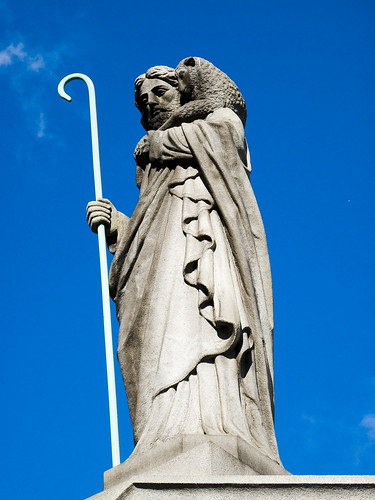
– photo by Mitch Waxman
The southern section of First Calvary, found atop the cyclopean masonry observed on Review Avenue, offers glimpses of the Newtown Creek and panoramic views of industrial Brooklyn. Framing the open horizon of marshy western Queens and the forges of Brooklyn is the Kosciuszko Bridge, heroically carrying a vehicular river called the Brooklyn Queens Expressway over the infamous cataract. The elevation of these walls is actually quite high, an arcing and non euclidean structure which must be 2 to 3 stories at its apogee.
Am I overestimating? Check out this shot from the “street level” declination, aimed at the downward slope from halfway down Review Ave.–
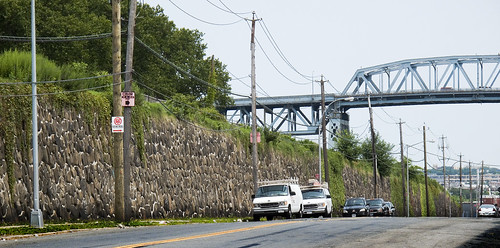
And the shots below are from the other side of it, the topside of the wall.

– photo by Mitch Waxman
You won’t find the grandiose tombs or obsequious monuments to the famous on this side of First Calvary. This is where the “regular people” are buried- in their multitudes- in neatly defined rows of plots. The northwestern sections of Calvary, where the main gates are, and the northeastern- along Laurel Hill Blvd.- (both “High Ground”) are where you can find the princes of the 19th century city. Here, along Review Avenue, is where the middle and working class rest.

– photo by Mitch Waxman
My reasons for coming to this section must remain hidden, for now, suffice to say that I am still hunting for the grave of a man named Gilman (see “Tales of Calvary 7” for more speculation on this mysterious merchant from Massachusetts). Enjoying the relative quiet, I noticed one of the concrete pillboxes which I’ve also alluded to in earlier posts. These structures are all over Calvary, are often padlocked, and have aroused no small amount of curiosity in your humble narrator.

– photo by Mitch Waxman
Several conjectures -an access point to buried family mausoleums, a storage unit for groundskeepers, some sort of equipment shed- have assailed me as I observed these structures with their heavy iron lids and stout cement construction. An avid devotee of the macabre, I’ve often wondered aloud about just what is is that may be down there.

– photo by Mitch Waxman
This particular structure, as you can see, had been left unlocked. In fact, its heavy lid was just resting on the cement and its hinges had long ago stopped functioning.

– photo by Mitch Waxman
Nudging the lid back a few inches, a better than six foot drop was observed, which put its bottom some 4 feet below the surface as observed in the shot above. I activated the camera flash and illuminated quite a bit of airborne dust when the camera performed its intended action. As you can see, there were two modern shopping carts and part of a lamp down there. Puzzling- not for being trash, but… for… why, how, when, etc. You’d expect shovels or spades, but shopping carts and a lamp?

– photo by Mitch Waxman
Were I still the youthful and robust physical specimen I once was, I might have more to say about this, as I would have entered the yawning mystery for a closer look. However, as an aged physical coward and feckless quisling given to emotional stupor and irrational panic, the miasmal odor of the open hatch drove me backwards and I nearly passed into one of my episodes. Fighting off a faint, I labored to close the heavy lid and made for the Penny Bridge gates found on Laurel Hill Blvd. to escape the implications of that smell, which reminded me of an aquarium in need of filtration.
What can it be, that might be down there?


