Posts Tagged ‘newtown creek’
rolled down
Down with the night, yo.

– photo by Mitch Waxman
As opined yesterday, the wrought iron fence posts of First Calvary Cemetery are just the right size to stick a camera lens through. In that prior post wherein my keen observational prowess was offered, focus was given to the estimable Kosciuszcko Bridge project, while today’s set of images are a few night shots of the cemetery itself. Unless you are an absolute fanatical maniac on the subject of eating carrots or half Kryptonian, these shots are just a smidge broader than the perceptual range of human vision. The light sources are environmental, incidentally.
All I saw, with the naked eye as it were, was a silhouette of the cemetery against the skyline of the Shining City to the west.

– photo by Mitch Waxman
There were a few examples of the long exposures one returned to HQ with, wherein the camera’s sensitivity to light was enhanced in different ways, which rendered out as sort of cartoonish, and overexposed the lit up Manhattan skyline into a white blob. Saying that, I was able to reclaim an excruciating amount of detail from the shadowed areas but the images were in “the uncanny valley,” meaning that they looked utterly fake and overtly “digital.”
You can’t put a landscape picture of Calvary Cemetery up on the web without some recognizable part of the skyline in it, as a note.

– photo by Mitch Waxman
On Laurel Hill Blvd., here at the angle between Industrial Maspeth and Blissville, however – if you “go wide” the section of Manhattan between the Battery and 57th street can all be captured in one shot.
“follow” me on Twitter- @newtownpentacle
long miles
Borden Avenue Bridge and environs, in today’s post.

– photo by Mitch Waxman
There have been three Borden Avenue Bridges, the first being a wooden draw bridge that opened when Borden Avenue was created in 1868. It was replaced by an iron swing bridge which was demolished in 1906, and the modern day retractile bridge was opened on the 25th of March in 1908. It cost $157, 606 to build in 1908. That would be $4,365,073 in modern money, adjusted for inflation.
A bargain, no?

– photo by Mitch Waxman
Borden Avenue Bridge is one of only two retractile bridges in NYC, the other one being the infinestimal Carroll Street Bridge over the Gowanus Canal. This specie of movable bridge is actually quite common in other cities, notably Chicago.
Chicago ain’t got a view like the one above though, I’d wager.

– photo by Mitch Waxman
To the south of Borden Avenue, one might notice the two railroad bridges spanning Dutch Kills – Cabin M and DB Cabin. The latter carries traffic for the Lower Montauk Branch of the LIRR from the Wheelspur to Blissville Yards, all of which which are mainly used for freight these days. Cabin M connects to the Montauk Cutoff, a now severed connection to the Sunnyside Yards and the LIRR Main Line tracks.
Just beyond the two rail bridges is the main body of Newtown Creek.
– photo by Mitch Waxman
Dutch Kills itself, in this area around the Borden Avenue Bridge, is stagnant and choked with wind blown garbage. A tepid current in the water creates a vertical rather than horizontal flow pattern, which factors into the accretion of sediments on the bottom. These sediment beds, which are found across the entire Newtown Creek watershed and represent a centuries long cross section of industrial and municipal pollution, are the reason that the Creek and its tributaries are a superfund site.
At low tide, mounds of this material become exposed to the air.

– photo by Mitch Waxman
For many years, there was a shanty dwelling here, occupied by some unknown entity. Hurricane Sandy ended that tenancy.

– photo by Mitch Waxman
My chosen path next carried me eastwards on Borden Avenue, away from my beloved Creek and deeper into the post industrial landscape of Long Island City. The concrete devastations were calling to me.
“follow” me on Twitter- @newtownpentacle
quietly slipped
After dark peregrinations about the Newtown Creek.

– photo by Mitch Waxman
That’s the Hunters Point Avenue Bridge pictured above, a centuried single bascule drawbridge. Your humble narrator was actually a Parade Marshal for the centennial celebration, back in 2010. The first Hunters Point Avenue Bridge, which sat on roughly the same spot, was erected in 1874 and was made of wood. It opened and closed thanks to a mule walking on a turntable. The modern bridge is the property of the NYC Department of Transportation, and the agency has been working on the span since last summer, repairing and upgrading electronics which were damaged by Hurricane Sandy back in 2012.
The water it overflies is the Dutch Kills Tributary of the Newtown Creek, which branches off of the main waterway about 3/4 of a mile from the East River. Dutch Kills itself, in its modern incarnation, is about 3/4 of a mile long. It once ran all the way through the modern day Sunnyside Yards and fed into a marsh/swamp which would have been centered at 29th street and Jackson Avenue in LIC. That’s just before the elevated Subway breaks off to the North along 31st street and Jackson widens to become Northern Blvd.

– photo by Mitch Waxman
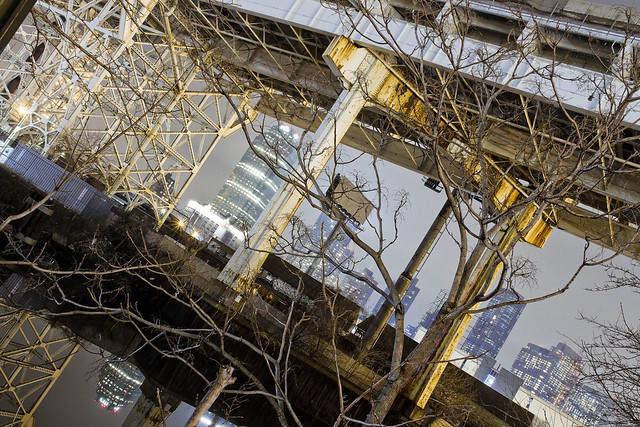
Over the years, one has spent a considerable amount of time along the canalized shorelines of Dutch Kills. There’s a mega structure crossing it, the truss carrying the Long Island Expressway some one hundred and six feet over the water.
November 15th of 1940 is when this section of the LIE opened, and the “high speed road” carries vehicle traffic first to the Queens Midtown Tunnel and then into Manhattan.

– photo by Mitch Waxman
Looking to the north/west, the turning basin of Dutch Kills and the remains of the Degnon Terminal.
A turning basin is an engineered section of a waterway shaped to allow an articulated tugboat and barge egress to rotate and turn around. The Degnon Terminal offered ship to rail connections back in the early 20th century, and cargo could be loaded or unloaded onto a terminal railway or onto freight cars of the Long Island Railroad for delivery to extant points.
– photo by Mitch Waxman
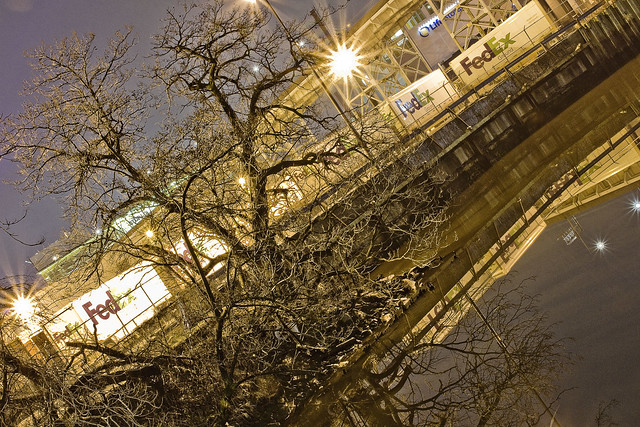
On the east side of Dutch Kills, the FedEx people have a large shipping depot that squats squamously. A LEED certified facility, the FedEx property nevertheless logarithmically magnifies the number of trucks worming through traffic to LIC every day from Kennedy Airport.
Semi trucks carry FedEx cargo here from the airport, delivery vans carry it out to their end customers.

– photo by Mitch Waxman
When these shots were captured, the air was terribly still. Without any sort of atmospheric perturbence, the tepid currents of Dutch Kills’ fluids barely register as a ripple on the surface.
Last time I checked, the LIE carried about 90,000 vehicle trips a day in this section (called the Queens Midtown Expressway), which translates out to around 32 million vehicles annually. The drains on the LIE are not connected to the City’s sewer system and instead drain directly into Dutch Kills. At least there’s some current, I guess.

– photo by Mitch Waxman
My path next carried the camera south to Borden Avenue.
The street dates back to 1868, when it was built as a plank road through the swamps surrounding Dutch Kills. It got its name in a traditional fashion for the 19th century, named for where it was going. It used to be the pathway to the Borden Dairy farm up the hill in Maspeth, and was constructed to allow easy egress for fresh milk to travel to market in Manhattan and beyond.
“follow” me on Twitter- @newtownpentacle
inimical oddity
Darkness continues.

– photo by Mitch Waxman
It rained all day on Sunday, whereupon a non precipitatating mist set itself up in the atmosphere during the evening hours. Given my recent fascination with wandering about the darkened Newtown Creek watershed in such conditions, a humble narrator strapped on the camera kit and debarked HQ for Long Island City. My target for this photo excursion was a section of the waterway found in Long Island City, specifically the Dutch Kills tributary.
Pictured above, looking across Skillman Avenue and the “A section” of the Sunnyside Yards towards Jackson Avenue and the Sapphire Megalith.

– photo by Mitch Waxman
A decade ago, one used to refer to this area as “Lonely Island City” since you’d seldom see anything other than a stray or lost human back here. The “zone” around the Degnon Terminal was largely deserted until recent years, when the Real Estate Industrial complex began to construct large dwellings on former industrial land along Jackson Avenue and elsewhere in LIC. All of a sudden, the humans began to appear back here.
Where can a guy go to be alone with his thoughts in Western Queens these days? Always somewhat nocturnal, a humble narrator’s solution to the presence of the human horde has simply been to shift my schedule a bit. This causes loved ones no end of worry, me wandering about in the darkness all by my lonesome.

– photo by Mitch Waxman
You’re never unobserved or truly alone in Long Island City, it should be mentioned.
In the cupola of the Sapphire Megalith, there is an impossible thing which cannot exist that is always watching you with an unblinking three lobed burning eye, after all. It hungers for profit and employs an army of acolytes to do its bidding.

– photo by Mitch Waxman
Additionally certain precautions are taken, including the usage of a reflective construction worker’s vest which is roughly worn over the filthy black raincoat. Last week, in the comments, somebody asked if I carry a firearm when I’m out at night shooting to protect myself from malign passerby who might want to rough me up in pursuance of stealing my camera or emptying my pockets. I don’t.
Were a stranger to strike me, filth and disease would crawl up their arm causing them to collapse into a pile of mouldering meat and rotting bone. That’s what I’m packing – plague and death are the horsemen I ride with.

– photo by Mitch Waxman
Atmospherically, everything was pretty much what I hoped it would be when leaving Astoria for points south and west. The mists and clouds were largely at high altitude, and only ribbons of fog were present at ground level.
My plan for the evening was to spend only a few hours wandering about, but I actually ended up being out for nearly six hours, whereupon I returned to HQ and developed the shots I had captured. One didn’t get to bed until about five in the morning, hence the late post you’re reading right now.

– photo by Mitch Waxman
One did not experience any missing time, as a note, I was working the whole time. If I was abducted by a UFO, I’m certain that shots of it would have been on my camera card when I got home. Pictured above is 29th street along the Dutch Kills turning basin, looking back at the gargantuan complex of residential luxury buildings erected within the last decade in the Court Square area of LIC.
The thing in the Megalith has won.
“follow” me on Twitter- @newtownpentacle
scarcely be
The world is an increasingly scary place, stay home.

– photo by Mitch Waxman
Sunday nights, and in particular the hours directly before the midnight boundary with Monday is breached, are the only time that the Newtown Creek industrial zone slows down and takes a breath. For a few hours the constant river of vehicular traffic, industrial activity, and omnipresent noise ebb. Any other day or time, and you literally would not have the thirty seconds required for some of these night shots at the Grand Street Bridge to be recorded, due to the vibrations of passing traffic shaking and cavitating the 115 old swing bridge.
The shot above looks southwards towards Brooklyn.

– photo by Mitch Waxman
Looking roughly westward, you can see the glowing eidolon known as the new Kosciuszcko Bridge about a mile away, the crane district of Maspeth on the right, and the English Kills tributary of Newtown Creek’s intersection with the main waterway and the East Branch tributary at center and left. At the bottom of the shot, in the unnaturally green waters of the East Branch, a tepid current was pulsing out from under the bridge which was – from an olfactory point of view – obviously carrying sewage towards the main stem of the Creek.
As a note, the water is lit up at the bottom of the shot by the street lamps of the Grand Street Bridge.

– photo by Mitch Waxman
As intoned in a previous posting, concern about just how bright the light from the new Kosciuszcko Bridge is has been a subject of conversation of late – and more than once – amongst the Newtown Creek crowd. Light pollution, as it’s known, is meant to confuse the heck out of migratory birds. There’s actually initiatives at the “big” environmental groups to get Manhattan office buildings to dim their lights during certain times of the year in response. Given that Newtown Creek is part of the Atlantic flyover migratory route… well… who the hell cares – it’s Queens.
I guess we’re just going to wait and see what sort of evidentiary observations emerge regarding its effect.

– photo by Mitch Waxman
Newtown Pentacle HQ is about two miles away from where the new K bridge crosses the water, and I can see this pillar of purple light punching into the clouds from there. I’ve seen reports on social media outlets proclaiming “lights in the sky” from Bushwick and Vinegar Hill and even Manhattan. Nobody in Queens can be bothered to pick up the phone and call either 311 or 911, as somebody else will do it or they just don’t want to get involved. Admittedly, these reports were offered by people who thought they were seeing UFO’s, but…
Just saying… if I don’t know what something is and it’s flying, it’s a UFO. I’d suggest an Internet rabbit hole term for you to follow, by the way, which are “USO” or “unknown submersible objects.” Seriously, google that. Hours of fun.

– photo by Mitch Waxman
Personally, I’ve always gravitated towards more home grown and provable horror. Like the mugger gang that used to operate at the Brooklyn side of the bridge back in the 1910’s, using black jacks and billy clubs to induce unconsciousness in their victims. After emptying the stricken of the contents of their pockets, the gang would toss them into the creek. This is the 1903 version of the Grand Street Bridge pictured above, which the gang is associated with. This bridge replaced earlier models, as discussed in this post.
In 1896, the cops found a Catholic priest name Leonard Syczek floating in the water alongside the 1890 version of the bridge, and wearing the sort of full ceremonial vestments required for conducting a Mass. There’s a story there which has never been fully revealed to me, but I suspect some sort of exorcism related tale will emerge eventually. Or, at least I hope one will.

– photo by Mitch Waxman
Due to my weird imaginings and remembered tales, a growing state of panic set in and I realized that one of my spells was coming on. Drops and spikes in cerebral dopamine levels began to occur, and suddenly I had to pee really bad. My feet grew cold, my nose flushed full with snot, and a single tear formed in my left eye bitterly.
While composure was still mine, a phone app was engaged, and a driver was dispatched to shepherd me back to a place where doors can be firmly locked and vouchsafed against the outside world. I left my shoes in the hallway that night, lest I track something in which I had picked up along the banks of the Newtown Creek on a foggy and unusually warm night in February.
“follow” me on Twitter- @newtownpentacle


 The Newtown Pentacle