Posts Tagged ‘photowalk’
Project Firebox 36

– photo by Mitch Waxman
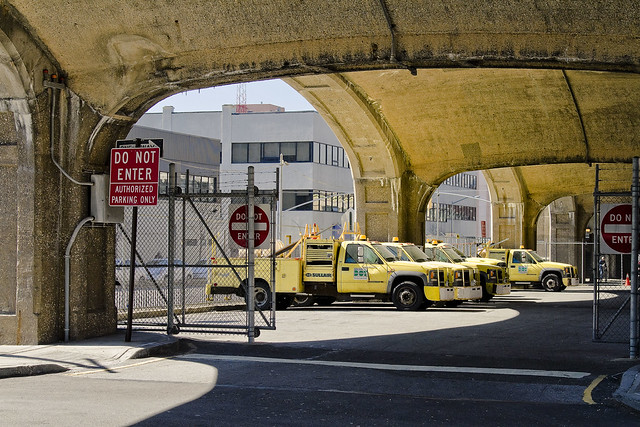
This sun kissed scarlet sentinel of the public trust is stationed at Queens Plaza South, alongside the fabulous Queensboro bridge. In the storied past, this crimson crier witnessed less than savory activities, but that was the old Queens Plaza. Modernity has brought a certain solemnity to its days, yet it stands at the ready should the presence of certain men and women, who travel in big red trucks, be required.
habitual secretiveness

– photo by Mitch Waxman
DUKBO, on the Brooklyn side of that parable laden river of urban neglect called the Newtown Creek, is an industrial zone which most New Yorkers wouldn’t want to acknowledge ownership of. The particular stretch which is focused on today is not long for this world, as the replacement of the Kosciuszko Bridge will obliterate these streets from the map when construction begins in 2014.

– photo by Mitch Waxman
Owing to the impermanence of this area, and the certain doom it will enjoy, your humble narrator has been making it a point to divert my path into its shadowed corridors and record what might exist here. As mentioned to many, one of the goals of this- your Newtown Pentacle- is to leave behind some sort of record of what the Creeklands were before the massive changes wrought by Superfund, the Kosciuszko Bridge replacement, and all the other mega projects planned for the area begin.
It is, in my opinion, important to have the realities of this place reported on by a source not affiliated with commercial or governmental interests, and to allow some future researcher to witness the inheritances of the past as they were at the start of this century. The paucity of documentation about Newtown Creek at the start of the 20th century are a major impediment to studying its history.
That’s my “elevator speech”, by the way.

– photo by Mitch Waxman
Of course, the specific focus of today’s posting has little to do with history, rather it’s the utter immolation suffered by this vehicle (refer to a Newtown Pentacle post of January 4, 2012 titled “Old School 2” for context). It seems that DUKBO continues to be a great place to ditch an unwanted vehicle, and the complete destruction of this automobile speaks to a considerable interval between ignition and the intervention of the NYFD.

– photo by Mitch Waxman
That’s an assumption, by the way, based on the absolute destruction of the vehicle interior. The absence of doors, engine hood, and other usual amenities found on modern cars (not present lying in some heap on the sidewalk) suggests that the vehicle was probably stripped, abandoned, and torched- but that is another assumption. Both of these are wide interpretations born of having grown up in South Brooklyn during the 1980’s, a time when an epidemic of car thefts and vehicular arson ran rampant and vehicles in similar condition would regularly be encountered along the Belt Parkway and its service roads.
Kids in my neighborhood became very familiar with the difference between “an accident” and an “on purpose”.

– photo by Mitch Waxman
Can’t blame NYFD for not getting to it in time for anything else than extinguishing the husk, as this is the middle of nowhere and residential housing is quite distant in any direction. At night, this a ghost town, with shuttered businesses and truck lots, and little or no traffic. Who can guess what transpires here, in the dead of night amidst the darkness of DUKBO?

– photo by Mitch Waxman
If you’re missing what looks like a mid size SUV or perhaps a minivan, this corner in DUKBO seems to be a great place to start looking for what remains of it.
hilltop pavement

– photo by Mitch Waxman
It is not impossible that your humble narrator was conceived in the back seat of a car like the one pictured above, observed recently on Northern Boulevard here in Astoria- or at least I hope I was. A 1966 Ford Mustang, lovingly cared for, and sporting the sort of style which defined the industrial supremacy of American auto manufacturing in the 20th century.
from Wikipedia
The first-generation Ford Mustang is the original pony car, manufactured by Ford Motor Company from 1964 until 1973.
It was initially introduced as a hardtop and convertible with the fastback version put on sale the following year. At the time of its introduction, the Mustang, sharing its underpinnings with the Falcon, was slotted into a compact car segment.

– photo by Mitch Waxman
From nearly every perspective, whether it be safety or fuel economy or pure comfort- a modern car is preferable in a straight comparison to a vintage ride like this one. However, if you’ve never felt the volcanic rumble of a 1960’s muscle car starting up, or been pressed back into the seat by the acceleration…
from themustangsource.com
Not much changed for Mustang in 1966. The grille design changed a bit–the 1966 models had the running pony inside the corral free-floating on horizontal grille bars. The side trim was slightly revised and a restyled gas cap completed the exterior changes.
On the interior, the instrument panel was redesigned with five round gauges, replacing the panel borrowed from the Ford Falcon for previous model years. Ford broke the 1,000,000 Mustang mark in 1966–18 months after its introduction. To celebrate, Ford released the Sprint 200 Mustang. They were mechanically identical to other six-cylinder Mustangs, but had a chrome air cleaner and a special engine decal which read “Mustang powered Sprint 200.”

– photo by Mitch Waxman
Few cars are as iconic as the early Mustangs, there’s the GTO and Trans Am of course, but the Mustang just screams rock and roll. Driving this car without “The Doors” playing would just be a crime.
from dmv.ny.gov
Standard series historical plates for passenger or commercial vehicles display either:
- a five-digit number followed by the letters HX (for example, 99999HX), or
- the letters HX followed by a five-digit number (for example, HX22222).
- Standard series historical motorcycle plates display the letters HM followed by three numbers.
Personalized Historical plates for any historical vehicle or historical motorcycle are now available. For an additional fee, registrants can order personalized letter/number combinations of up to eight characters (includes spaces and/or a silhouette of New York State) or 6 characters/spaces (no state silhouette available) for a motorcycle. Personalized Historical plates have the word “HISTORICAL” along the bottom of the plate.

– photo by Mitch Waxman
The dashboard exhibits classic form over function, with scores of knobs and sharp edges that would cut you to ribbons in an accident. This isn’t the design of modernity, overly concerned with what could happen, rather this is a can of Budweiser between your legs and a pack of Marlboro Red on the dash kind of design. Braggadocio on wheels, the chariot of a youthful culture manufactured before everything went so terribly askew.
Compare to the modern variant here: ford.com/cars/mustang/
concealed fires

– photo by Mitch Waxman
A few interesting photos adorn today’s posting, progeny of the prodigious amount of exploration a humble narrator has been occupied with for the last couple of weeks. There are so many great things “in the works” which haven’t been publicly announced yet, and which I’m bursting at the seams to tell you about, that I’m all a twitter.
2012 promises to be one of the great years for you to see and experience the Newtown Creek for yourself, as the early stages of several walking and boat tours are in the works.
– photo by Mitch Waxman
In the last two weeks, I’ve walked the entire creek in pursuance of one of these projects, which will be finalized and made public quite soon. I’ve worn out a pair of shoes, and shot literally thousands of photos for this project. My path has carried me from Bushwick to Long Island City and Greenpoint to Maspeth.
I’ve dodged trucks and trains, violated perhaps three separate sets of legal restrictions, and encountered a vast coterie of characters both malign and inspirational.

– photo by Mitch Waxman
Within the next couple of weeks, announcements of many, many public events will begin. Meanwhile, the concrete devastations of Western Queens and the oil choked sands of North Brooklyn have been catalogued and categorized, concatenated and containerized.
It’s going to be a great summer.
raptured vision

– photo by Mitch Waxman
My habit is to be early to appointments, public meetings, or gatherings. On this particular day, a Newtown Creek Alliance meeting was set to occur in hoary Greenpoint at the modern Newtown Creek Wastewater Treatment Plant, and a humble narrator decided to make use of being better than an hour early by strolling through the engineered hillocks of First Calvary Cemetery here in Queens.
Late afternoon was giving way to sunset, and my path took me from the secondary gates near the former Penny Bridge toward the main entrance at Greenpoint Avenue.

– photo by Mitch Waxman
Unlike many of my sojourns around the place, no goal governed my steps- I wasn’t “looking for someone”. Instead, a peaceful and contemplative mood governed my steps and allowance was made for serendipity. That’s the spire of St. Raphael’s on Greenpoint Avenue in the distance, by the way.
Amongst the marble and granite, however, a surprising monument was discovered.

– photo by Mitch Waxman
Weathered and unmarked, this anonymous cruciform was found. Appearing to be a wooden cross with white bronze worked onto its surface, it was frankly a stunning moment for me to discover this artifact here. Partially because of its modest and quite staid appearance- understatement and tasteful discretion hardly define the monuments at Calvary- but mostly because of the incredible value that the metal would bring to the Crows (metal collectors and scrappers) who harvest such materials for sale to the scrap industry.
It was stunning to find such a thing can remain hidden in this place which has suffered so much from their attentions.


