Posts Tagged ‘photowalk’
sense of pursuit

– photo by Mitch Waxman
Oh boy, I’m all ‘effed up…
Just the other day, while innocently searching through Calvary Cemetery for a certain interment (wholly separate from the one described yesterday), your humble narrator must have suffered some sort of seizure. That would explain the malign paranoia which suddenly infected and disordered my thoughts, birthing a desire to move to a more populated section of the ancient villages for the sake of safety alone. The last time misgivings such as these came upon me was during a November 2009 trip to hoary Mt. Zion, when I was menaced by a certain group of children and their curiously polydactyl feline.
As always, it was a rambling walk-that half dogtrot/half stumble which I call scuttling- that had brought me to the place, and handicapped any chance of escape or avoidance of those extant dangers encountered in the Newtown Pentacle.
As always, solitude and otherness and massive vulnerability were my companions. As always, your humble narrator- physical coward, feckless quisling, and the least of men…
As always, an Outsider.
from wikipedia
The World Health Organization’s ICD-10 lists avoidant personality disorder as (F60.6) Anxious (avoidant) personality disorder.
It is characterized by at least four of the following:
- persistent and pervasive feelings of tension and apprehension;
- belief that one is socially inept, personally unappealing, or inferior to others;
- excessive preoccupation with being criticized or rejected in social situations;
- unwillingness to become involved with people unless certain of being liked;
- restrictions in lifestyle because of need to have physical security;
- avoidance of social or occupational activities that involve significant interpersonal contact because of fear of criticism, disapproval, or rejection.
Associated features may include hypersensitivity to rejection and criticism.

– photo by Mitch Waxman
It was just a trick of the light- the shadow of some statue distorting through thickly polarized prescription sunglasses.
Often, when the brain cannot make sense of; or is overwhelmed by a flood of sensory information; it will perform a sort of short hand during the processing of visual or auditory observation. That’s why kids see dragons in the clouds, and representations of cultic deities are often presented as having spontaneously appeared on foodstuffs. It’s the way the organ functions– using pattern recognition.
That’s why, as my steps hurriedly swept over and through Calvary’s dusty desolations, I chose to ignore that shadowy and peripheral shape which seemed to be dogging my progress and declared it to just be an hallucination. If only it didn’t seem to be the same shape- everywhere I went- there it was- ducking around a tombstone or slipping around a tree.
One observance in particular upset my delicate equilibrium, and forced me to ingest a dosage of the esoteric prescription drugs which my doctors advise consumption of whenever one of “my spells” comes upon me.
Light headed from the medications, the abyssal potions were useless- and your humble narrator was thunderstruck- consumed by cowardice and shock.
from wikipedia
Blasphemous thoughts are a common component of OCD, documented throughout history; notable religious figures such as Martin Luther and St. Ignatius were known to be tormented by intrusive, blasphemous or religious thoughts and urges. Martin Luther had urges to curse God and Jesus, and was obsessed with images of “the Devil’s behind”. St. Ignatius had numerous obsessions, including the fear of stepping on pieces of straw forming a cross, fearing that it showed disrespect to Christ. A study of 50 patients with a primary diagnosis of obsessive-compulsive disorder found that 40% had religious and blasphemous thoughts and doubts—a higher number than the 38% who had the obsessional thoughts related to dirt and contamination more commonly associated with OCD. One study suggests that content of intrusive thoughts may vary depending on culture, and that blasphemous thoughts may be more common in men than in women.
According to Fred Penzel, a New York psychologist, some common religious obsessions and intrusive thoughts are:
-
- sexual thoughts about God, saints, and religious figures such as Mary
- bad thoughts or images during prayer or meditation
- thoughts of being possessed
- fears of sinning or breaking a religious law or performing a ritual incorrectly
- fears of omitting prayers or reciting them incorrectly
- repetitive and intrusive blasphemous thoughts
- urges or impulses to say blasphemous words or commit blasphemous acts during religious services.

– photo by Mitch Waxman
Shaken, and stirred as well- transit from the cemetery into the surrounding “once upon a time” hamlet called Blissville was accomplished by crossing Greenpoint Avenue at Gale Avenue and a hurried flight was carried out along the concrete of Borden Avenue. Two sets of footprints were carved into the sooty deposits which distinguish the walkways of the ancient village, and the second one sure wasn’t Jesus…
In shattered automotive glass and an occasional plate glass window, notice was additionally made of a skirting movement just at the edges of perception. As mentioned- my cognition was altered by the pharmaceutical remedies offered and prescribed by my concerned doctors, but something odd really did seem to be following me.
Before long, I found myself at Hunters Point in Long Island City by the East River… but we’ll be talking about that in a few days…
I had decided that if this specter insisted on stalking me, it was in for one mighty long walk…
more tomorrow…
from wikipedia
A hallucination may occur in a person in a state of good mental and physical health, even in the apparent absence of a transient trigger factor such as fatigue, intoxication or sensory deprivation.
It is not widely recognized that hallucinatory experiences are not merely the prerogative of those suffering from mental illness, or normal people in abnormal states, but that they occur spontaneously in a significant proportion of the normal population, when in good health and not undergoing particular stress or other abnormal circumstance.
The evidence for this statement has been accumulating for more than a century. Studies of hallucinatory experience in the sane go back to 1886 and the early work of the Society for Psychical Research, which suggested approximately 10% of the population had experienced at least one hallucinatory episode in the course of their life. More recent studies have validated these findings; the precise incidence found varies with the nature of the episode and the criteria of ‘hallucination’ adopted, but the basic finding is now well-supported.
first, Calvary

– photo by Mitch Waxman
Woe to that New Yorker who achieves our common societal goal, which is being always at the head of a long queue- first in line.
There isn’t much I can tell you about Esther Ennis, an Irish immigrant, other than she was the very first person buried in Calvary Cemetery in 1848. Intonations and rumors of a broken heart followed her to the grave, which seem to allude to a love affair gone wrong and conjure lurid fantasies of the port city of New York in the 1840’s. Unfortunately, no primary sources have emerged that discuss the young (for our modern era) woman.
On August 4, 1848, the new cemetery called Calvary Cemetery received its first interment, one Esther ENNIS. The purchase of this parcel of land and the acquisition over the years of over two hundred additional acres, enabled Calvary Cemetery to support the needs of most Catholics in the Archdiocese, especially in the New York City area.

– photo by Mitch Waxman
Quite obviously, this isn’t the original grave marker, its style and typography betray a 20th century vintage, and your humble narrator would wager that it was carved sometime in the 1920-1970 time period based on style and material. A half remembered and impossible to locate report from some forgotten publication once revealed that an Irish organization like the Hibernians (or was it a Catholic Charity of some stripe?) made it their business to place this marker on the presumed gravesite in Section 1 in First Calvary, but it doesn’t seem to have made it online so I may not supply a link to you- lords and ladies.
Regardless, this is one of Calvary Cemetery’s proverbial “needles in a haystack locations“, and is one easily bypassed by casual visitors to the great polyandrion.
from nytimes.com, an article from 1884 about Calvary’s first grave digger, John McCann
“Thirty-six years ago yesterday the first body was interred in Calvary Cemetery,” said John McCann, gatekeeper at the main entrance to the cemetery yesterday afternoon. “Yes, Sir, I remember it well. It was the body of Esther Ennis, a handsome looking Irish girl, who …

– photo by Mitch Waxman
The Manhattan address demarcated on the stone is 139 Clinton Street, which, presuming that the addresses on Clinton Street conform to the same logic as they did in 1848, should be here.
The following is one of the stitched panorama images which always present themselves awkwardly due to their odd shape. It’s an attempt to display the absolute magnitude of this spot, and the explosive growth of Calvary Cemetery from this exact location.
Project Firebox 22

– photo by Mitch Waxman
Queen’s very own Broadway, as it slouches roughly uphill from the East River at Hallets Cove, transverses Woodside on its way to the exotic and hill defined locale of Jackson Heights and beyond. Home to a variegated sampling of the human infestation, the neighborhood’s residents largely hail from the tropical courts of Asia who are comfortably vouchsafed against immolation by this solitary sentinel located at the confluent junction of 35th avenue and 63rd street.
Broadway, of course, eventually transitions into and becomes Grand Avenue at Queens Blvd. in Elmhurst, whose right of way carries the unsuspecting pedestrian toward an eventual meeting with the loathsome Newtown Creek and infinite Brooklyn.
shadowed lips

– photo by Mitch Waxman
The fairly excellent Watercourses blog presents this post on Sunswick Creek, a waterbody which once existed here in Astoria, and still runs to the East River through manmade corridors deep below the modern streets. No, really. Watercourses has been down there and has photos! More importantly, the post also carries two maps from the 1870’s which show the early street plan of Astoria.
You’ll notice, on the 2nd one, a “Ridge St.” and a “Camelia St.”. The road running between them is Broadway, and at its intersection with Vernon Ave. the latter takes a wicked hook and becomes Sunswick Creek XXX (at this moment, it remains obfuscated to me whether this is a street or avenue or road, I think I can hear somebody at Greater Astoria Historic Society sighing right now).
This bit of geographic reckoning, of course, is simplified by saying- “Stevens Est.” = Costco, and that weird mouth of the creek is Socrates Sculpture Garden, and these photos were shot just beyond where that little dock shape is, between the “n” and second “s” in Sunswick. (I also wanted to send a shout out to Watercourses. Well Done!)
Whew!

– photo by Mitch Waxman
According to certain sources, two aboriginals named Shawestcont and Erramorhar (as witnessed by their cohorts Warchan and Kethcanaparan) sold much of what we know as Astoria (but which they called Sintsinck) to William Hallett (who was similarly accompanied by a company of witnesses and countrymen) on August 1, 1664- which is how the place got its name.
For a more complete view of highlights from Hallets Cove, and Sunswick Creek- check out this Newtown Pentacle post from February of 2010, and the “The Horrors of Hallet’s Cove“ from June of 2009.
The very fact that temperatures have risen once again to the point at which the atmosphere can sustain water in a liquid state, by the way, is a font of joy for your humble narrator- as walking the East River shoreline is once more possible for both man and duck. Which means that a winter’s worth of book research can finally be explored materially.
Whew!
I’ll be that weirdo in the dirty black raincoat you might spy scuttling along the waterfront…
these realms

– photo by Mitch Waxman
Occasion called for me to meet up with Our Lady of the Pentacle deep in the far eastern (from the perspective of Astoria, at least) neighborhood of Flushing over the last weekend. The obviate path would demand navigating and enduring the exquisite ironies visited upon the hapless weekend customer of the MTA here in western Queens, and though my patience was thin- my wallet is thinner so a cab was out of the question and… it was a really nice day.
Hence, I walked… and walked… and walked… from Astoria to Flushing.
The master, Kevin Walsh over at Forgotten-NY offered a “slice” of Roosevelt Avenue in 2008

– photo by Mitch Waxman
This isn’t one of the “deep history” or “occluded past” kind of posts by the way- it’s more a series of surface observations made on a very long walk.
Roosevelt Avenue is a very, very interesting place and not just because of the elevated subway tracks which dominate its experience. Roosevelt starts off at the East River in Brooklyn as “Greenpoint Avenue” and transforms into “Roosevelt” as it hurtles over Queens Blvd and ultimately ending at Northern Blvd. way out in Flushing.
My route out of Astoria followed Broadway southeasterly toward Jackson Heights, and then East on Roosevelt.
The inestimable and inexhaustable Mr. Walsh of Forgotten-NY presented a post detailing the Woodside to Greenpoint side of things, which be accessed here

– photo by Mitch Waxman
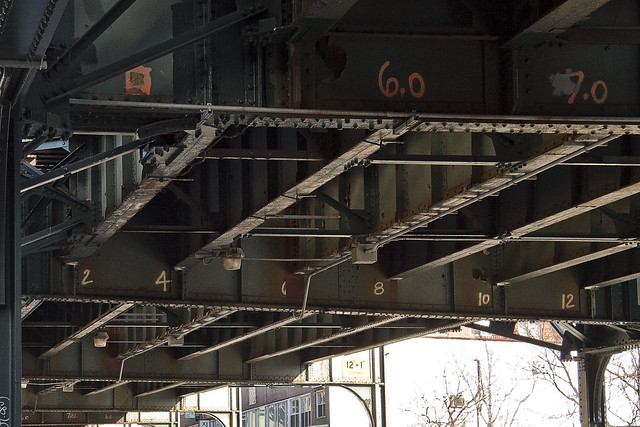
Aforementioned, the elevated tracks of the 7 line really do make you understand why Manhattan tore down its elevated tracks as soon as it was feasible. Loud, the structure is a shadowy and dripping mess, providing a home to what must be entire nations of pigeons. Sidewalk and crosswalk intersections resemble the mad excesses of certain Abstract Expressionist painters popular during the 20th century, and the vast structure dominates and demands an oppressive pall over the street.
The Woodside section of Roosevelt Avenue was given a short and sweet “once-over” a while back in this May of 2010 posting, at this, your Newtown Pentacle.
Additionally, the Flushing River just beyond Roosevelt Avenue was explored from the water in this November 2009 posting, and intriguing municipal machinery was observed along Roosevelt Avenue at Flushing’s Corona Yard in this posting from February of 2010.
– photo by Mitch Waxman
Roosevelt Avenue, and a few of the neighborhoods it passes through are a subject of much conversation amongst area wags. The whole stretch is home to such a vast agglutination of nationalities and ethnicities, representing what seems like a statistical sampling of every variation which the planetary human infestation might take, that it’s hard to say exactly who lives here.
In the section between Woodside and Flushing though, a LOT of people speak Spanish.

– photo by Mitch Waxman
There’s a lot of controversy surrounding these neighborhoods, with long time Queens residents pointing accusing fingers and offering dire prophecies for the future of the borough based on the presumed moral and legal failings of this new population. The spanish speaking community has exploded in the last decade along Roosevelt Avenue, growing by an astounding estimation of 450% since the last Census. That number, of course, is the official one. There is probably a larger number of people extant, but hazy immigration patterns and reticent newcomers leery of government officials contribute to a less than full accounting.
I can tell you from observation, however, that the economic doldrums affecting other commercial streets (like Steinway Street in Astoria, for instance) in the so called “more affluent” sections of Queens does not seem to be affecting this area.

– photo by Mitch Waxman
Perhaps its because the folks who live here will do just about anything they can to make a few bucks, often working multiple shifts, starting work at a lumber yard in the morning and busing a table in a restaurant at night for instance. A buddy of mine lives around here who came to New York from Ecuador, allows himself only 4 hours of sleep a day at the dormitory like and quite illegal rooming house which serves as his address in Corona. He’s sending money back home when he can, and trying to save what he has left over to do “something” with when opportunity presents itself to him.
I’m not going to gloss over the crime and gang life that is here, it’s just that I don’t know too much about it, and thankfully haven’t had any experience with that side of these neighborhoods.

– photo by Mitch Waxman
The newer buildings you see along Roosevelt Avenue are slapdash affairs, and would seem to fit the term “Queenscrap” coined by our friends over at the blog of the same name. The charming early 20th century detached 2 and 3 story homes which were familiar to multiple generations of…
What is the term for Queens natives anyway? Is it “Queensites” or “Queensipolitans” or “Queensicans” or something? If you’re from Brooklyn or Manhattan it’s “ites”, but what about Queens?
At any rate, the newer structures have one governing principle, and it’s that form follows function. The function seems to be a desire to use every square inch of the property lot and build to maximum height allowable by zoning regulations (and often beyond all law). In a lot where one or possibly two families historically declared their address, there can be as many as 10 or 12 today.

– photo by Mitch Waxman
The effect that this huge surge in population has had on area institutions like schools and hospitals has been profound. The usual problems arising from urban life are compounded by the fact that these are a “working class” group of people- often the so called “working poor”, who suffer from a well known and commented upon series of cultural “Gotcha’s” as it is- many amplified by speaking a different language and differing expectations for the future than those born to the culture they’ve joined.
The largely “middle class” (and often college trained) population of surrounding neighborhoods sneer at the Roosevelt Avenue corridor as being populated by illegal immigrants, call everyone here the “Mexicans“; the males of which are all gangsters- and accusing their women as scheming to spawn “anchor babies” in order to guarantee citizenship in “El Norte” and then allowing their lawless spawn to run wild in the streets. It’s blatant, more than a little racist, and I hear it all the time- even from sources you wouldn’t expect. One neighbor recently opined that “mexicans shit in the street”.
And that’s crap, Lords and Ladies. I’m tired of hearing it, frankly, and that’s what this post is really about.

– photo by Mitch Waxman
In no uncertain terms, understand this- what the “Lower East Side” and “Five Points” were to the Irish, Italians, Germans, and Jews 125 years ago is what Roosevelt Avenue is to this “immigrant wave”. As you’re reading this, a future President of the United States is eating Churros in her baby carriage somewhere on Roosevelt Avenue around 100th street. A Supreme Court Justice is kicking a ball around with a future incarnation of Al Capone in some dusty lot near Linden Park. Roosevelt Avenue is where America is being retooled, and you can safely watch it happening from the sidewalk, while the cowboys and arabs draw down on each other in the cool dusty air of some faraway land.
For reasons I can’t really attribute, the necessity of saying this out loud and in public is important to me.

– photo by Mitch Waxman
Running late, it was decided that to save a few steps and cut through Flushing Meadow Corona Park instead of continuing down Roosevelt Avenue, and I was forced to make a right turn instead of my usual left. Some interesting sights were had, which will be discussed and presented in some future (and less grandstandlingly Progressive!) posting of this- your Newtown Pentacle.


