Posts Tagged ‘Pickman’
mounting eagerness
Man, I’ve barely mentioned my beloved Creek lately.

– photo by Mitch Waxman
Yesterday, business took me to Red Hook’s Erie Basin, a trip which turned out to be abortive as that which I went to photograph would not be available until next week. Having a free afternoon, unexpectedly, one decided to walk home to Astoria. Shots from the journey are being processed, but your humble narrator found himself all along the river, and everywhere from Brooklyn Bridge park to The Navy Yard. My back started to ache in Williamsburg, and discretion being the better part of valor, I cut the walk off at Metropolitan and Roebling. Not bad for my first serious perambulation of 2014, but I am badly out of shape after a hibernation forced by incessant ice and snow.

– photo by Mitch Waxman
Vast soliloquy governed my thoughts on the walk, and a realization that I havent been spending much time on the Newtown Creek- personally and at this blog – in the last few months left me thunderstruck. Accordingly, pictured above is the DB Cabin rail bridge, spanning Dutch Kills, which carries LIRR Montauk branch traffic. DB Cabin hasn’t been opened since 2002, as its motors are non functional. Accordingly, Dutch Kills is an industrial canal which cannot accept anything larger than a rowboat, and that’s only at low tide. There are those who would like to throw this inheritance away, and turn it into some sort of bullheaded swampland, but that’s something that sounds good at cocktail parties. They forget about Mosquitos, and jobs for those beyond their clique, and that M1 zones are for industry – not water sports or bird watching.

– photo by Mitch Waxman
This bridge frustrates me as I’ve never gotten a decent shot of a train crossing it. There’s another rail bridge at English Kills which has stymied my desires in similar fashion over the years, but its just a matter of time until I get both. That’s the thing about me and my beloved Creek – I ain’t going nowhere. There are some who wish I would just fall in and disappear into the black mayonnaise, probably due to my brash nature and overwhelmingly unwholesome aspect, but they can go jump in the East River and swim to Manhattan to beg the Mayor for a job for all I care.

– photo by Mitch Waxman
Newtown Creek is the subject of much speculation, discussion, and debate. All over the world – architects, planners, and engineers sniff at the air and smell a giant bucket of Federal money about to spent here. They anxiously twist their hands trying to conceive of some angle by which their pet projects can be shoehorned into the Superfund process. They forget that this is the home of industry, which must be encouraged to not just stay here, but to reinvest in Brooklyn and Queens – albeit in a manner which is less destructive to the processes of human and animal life along the waterway. You can have both.
Also, all bets are off, and your Newtown Pentacle is back in session.
“follow” me on Twitter- @newtownpentacle
approaching triumph
Infrastructure pornography, gratuitous and forbidding, in today’s post.
Also, I’ll be at Brooklyn Brainery on February 27th presenting “the Newtown Creek Magic Lantern Show.”

– photo by Mitch Waxman
Gaze upon the terrible scale of the Verrazano Narrows Bridge, connecting Brooklyn with… Staten Island… Bridges are on my mind today, especially the ones that connect Long Island with other extant land masses scattered about the archipelago.
Today will be just a lot of photos, and your humble narrator will be taking advantage of the short interval of warmth offered today. Out and about, looking at things- that’s me.
from wikipedia
The bridge is owned by the City of New York and operated by MTA Bridges and Tunnels, an affiliate agency of the Metropolitan Transportation Authority. Interstate 278 passes over the bridge, connecting the Staten Island Expressway with the Gowanus Expressway and the Belt Parkway. The Verrazano, along with the other three major Staten Island bridges, created a new way for commuters and travelers to reach Brooklyn, Long Island, and Manhattan by car from New Jersey.
The bridge was the last great public works project in New York City overseen by Robert Moses, the New York State Parks Commissioner and head of the Triborough Bridge and Tunnel Authority, who had long desired the bridge as a means of completing the expressway system which was itself largely the result of his efforts. The bridge was also the last project designed by Chief Engineer Othmar Ammann…

– photo by Mitch Waxman
East River Bridge #1, or East River Suspension Bridge #1, or Brooklyn Bridge from Brooklyn.
from nyc.gov
The Brooklyn Bridge opened in 1883. At the time, it was the longest suspension bridge. It has been designated a National Historic Landmark by the National Park Service, and a New York City Landmark by the Landmarks Preservation Commission.

– photo by Mitch Waxman
East River Bridge #3, or Manhattan Bridge, from the water.
from nyc.gov
The youngest of the three DOT East River suspension bridges, construction began on October 1, 1901. The bridge opened to traffic on December 31, 1909 and completed in 1910. The Bridge’s total length is 5,780 feet from abutment to abutment at the lower level; and 6,090 feet on the upper roadways from portal to portal. Its main span length is 1,470 feet long and each of its four cables is 3,224 feet long. The Bridge was designed by Leon Moisseiff (1872-1943)…

– photo by Mitch Waxman
East River Bridge #2, Williamsburg Bridge, from Manhattan.
from nyc.gov
When it opened in 1903, the Williamsburg Bridge was the longest suspension bridge in the world, with a span of 1600 feet and a total length of 7308 feet and the first with all-steel towers. The 310-foot steel towers support four cables, each measuring 18_ inches in diameter and weighing 4,344 tons. In all, nearly 17,500 miles of wire are used in the cables that suspend the bridge 135 feet above the East River. The massive stiffening trusses were designed not only to withstand high winds, but also to support rail traffic on the deck.

– photo by Mitch Waxman
East River Bridge #4, Queensboro Bridge, from Long Island City.
from nyc.gov
The bridge was constructed between 1901 and 1909 and was opened to the traffic on June 18, 1909. A collaboration between the bridge engineer Gustav Lindenthal (1850-1935) and architect Henry Hornbostel, the main bridge is 3,725 feet long, the longest of the East River Bridges. The overall length of the bridge including the Manhattan and Queens approaches is 7,449 feet.
The site is an ideal location for a bridge as Roosevelt Island provides a convenient footing for the piers. Seventy-five thousand tons of steel went into the original bridge and its approaches. Its original cost was about $18 million, including $4.6 million for land. At the time of completion, it was not only the longest cantilever bridge in the United States, but also was designed for heavier loads than any other bridges.

– photo by Mitch Waxman
Welfare Island, aka Roosevelt Island Bridge, from Roosevelt Island looking towards Queens.
from nyc.gov
The Roosevelt Island Bridge is a tower drive, vertical lift, movable bridge across the East Channel of the East River between the borough of Queens and Roosevelt Island, New York City. The span length is 418 feet. It was known as the Welfare Island Bridge when it was first opened to traffic in 1955.

– photo by Mitch Waxman
Triborough Bridge, aka Robert F Kennedy Bridge, from Astoria, Queens.
from wikipedia
Construction began on Black Friday in 1929, but soon the Triborough project’s outlook began to look bleak. Othmar Ammann, who had collapsed the original design’s two-deck roadway into one, requiring lighter towers, and thus, lighter piers, saving $10 million on the towers alone, was enlisted again to help guide the project. Using New Deal money, it was resurrected in the early 1930s by Robert Moses, who created the Triborough Bridge Authority to fund, build and operate it. The completed structure was opened to traffic on July 11, 1936.
The total cost of the bridge was more than $60 million, one of the largest public works projects of the Great Depression, more expensive even than the Hoover Dam. The structure used concrete from factories from Maine to Mississippi. To make the formwork for pouring the concrete, a whole forest on the Pacific Coast was cut down.

– photo by Mitch Waxman
Hell Gate Bridge, also from Astoria, Queens.
from wikipedia
The Hell Gate Bridge (originally the New York Connecting Railroad Bridge or The East River Arch Bridge) is a 1,017-foot (310 m)[3] steel through arch railroad bridge in New York City. The bridge crosses the Hell Gate, a strait of the East River, between Astoria, Queens and Wards Island in Manhattan.
The bridge is the largest of three bridges that form the Hell Gate complex. An inverted bowstring truss bridge with four 300-foot (91.4 m) spans crosses the Little Hell Gate (now filled in); and a 350-foot (106.7 m) fixed truss bridge crosses the Bronx Kill (now narrowed by fill). Together with approaches, the bridges are more than 17,000 feet (3.2 mi; 5.2 km) long.
“follow” me on Twitter- @newtownpentacle
inscribed thereon
A visit with the god of America.

– photo by Mitch Waxman
Brazen and gilt, this representation of the American Augustus is appropriately found at the N.Y. Grand Lodge of the Free and Accepted Masons on 23rd street in Mahattan. It adorns a library room, and honors a significant member of that centuried secret society.
The founder of our nation, as General Washington is known, enjoyed a lifestyle that could only be maintained by a subjugate army of slaves. I’d like to believe that he would be resistant to having his birthday celebrated with a crass and consumerist bacchanal, as he’d be embarrassed by it – but as I’m a non-slaver, it’s difficult for me to imagine the mindset of the “founding fathers” and walk a mile in their proverbial moccasins.
from wikipedia
Titled Washington’s Birthday, the federal holiday was originally implemented by the United States Congress in 1880 for government offices in the District of Columbia (20 Stat. 277) and expanded in 1885 to include all federal offices (23 Stat. 516). As the first federal holiday to honor an American citizen, the holiday was celebrated on Washington’s actual birthday, February 22. On 1 January 1971, the federal holiday was shifted to the third Monday in February by the Uniform Monday Holiday Act. This date places it between February 15 and 21, which makes the name “Washington’s Birthday” a misnomer, since it never lands on Washington’s actual birthday, February 22. A draft of the Uniform Holidays Bill of 1968 would have renamed the holiday to Presidents’ Day to honor the birthdays of both Washington and Lincoln, but this proposal failed in committee and the bill as voted on and signed into law on 28 June 1968, kept the name Washington’s Birthday.

– photo by Mitch Waxman
The General died badly, but everybody does that, and one such as myself doesn’t shed tears for a dead slave master even if they did accomplish a lot at their day jobs. Unfortunately, for a fellow so immersed in the “Enlightenment” and who was very much a rationalist and a logician – he thought the answer to illness was exsanguination (which was how his slaves were “cured” of ailments as well). His doctors bled him to death, but the holiday today is about his birth, not his death. This compound holiday (Washington and Lincoln’s birthdays are celebrated coterminously) was offered to the nation, as of 1968, as it was determined that there were too many Monday holidays in February and it was getting in the way of business. I’ve often thought we should celebrate a Monday holiday which specifically mentions the subjugation and forced generational labor of millions, but there you go.
from wikipedia
On Thursday, December 12, 1799, Washington spent several hours inspecting his plantation on horseback, in snow, hail, and freezing rain—later that evening eating his supper without changing from his wet clothes.
That Friday he awoke with a severe sore throat and became increasingly hoarse as the day progressed, yet still rode out in the heavy snow, marking trees on the estate that he wanted cut. Sometime around 3 a.m. that Saturday, he suddenly awoke with severe difficulty breathing and almost completely unable to speak or swallow. A firm believer in bloodletting, a standard medical practice of that era which he had used to treat various ailments of enslaved Africans on his plantation, he ordered estate overseer Albin Rawlins to remove half a pint of his blood.
A total of three physicians were sent for, including Washington’s personal physician Dr. James Craik along with Dr. Gustavus Brown and Dr. Elisha Dick. Craik and Brown thought that Washington had what they diagnosed as “quinsey” or “quincy”, while Dick, the younger man, thought the condition was more serious or a “violent inflammation of the throat”. By the time the three physicians had finished their treatments and bloodletting of the President, there had been a massive volume of blood loss—half or more of his total blood content being removed over the course of just a few hours.
Recognizing that the bloodletting and other treatments were failing, Dr. Dick proposed performing an emergency tracheotomy, a procedure that few American physicians were familiar with at the time, as a last-ditch effort to save Washington’s life; but the other two doctors rejected this proposal.
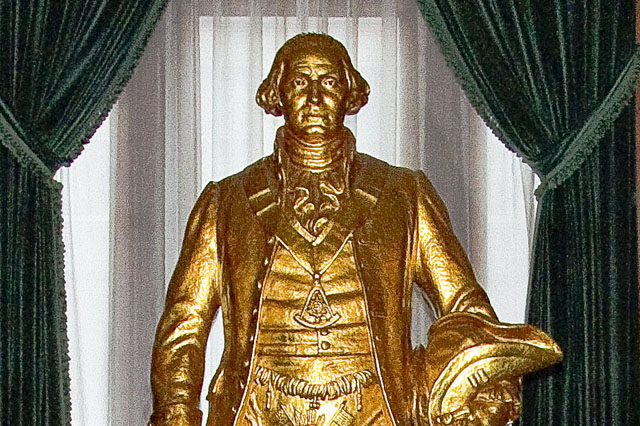
– photo by Mitch Waxman
One of my little fantasies is the one where I magically pluck General Washington from the back of his horse and draw him into our future to witness that which has been wrought in his name. He gets introduced to the imperial majesty of present day America in this fugue of mine, and witnesses not just the modern military might but the relative luxury (compared to his era) and civil treatment that even the basest members of our society can and do expect. I suspect that the General would be shocked at the size and reach of a standing military which operates out of 900 military bases in 150 countries. I don’t think he’d be surprised that the slaves had been freed and offered citizenship, nor the lousy treatment they’d received. More shocking to him would be the relative importance and status of France and almighty England, which were the Americas of their time.
Of course, that was before an American God came along who did the work of the Great Architect of the Universe.
from wikipedia
Washington was initiated into Freemasonry in 1752. He had a high regard for the Masonic Order and often praised it, but he seldom attended lodge meetings. He was attracted by the movement’s dedication to the Enlightenment principles of rationality, reason and fraternalism; the American lodges did not share the anti-clerical perspective that made the European lodges so controversial. In 1777, a convention of Virginia lodges recommended Washington to be the Grand Master of the newly established Grand Lodge of Virginia; however, Washington declined, due to his necessity to lead the Continental Army at a critical stage, and because he had never been installed as Master or Warden of a lodge, he did not consider it Masonically legal to serve as Grand Master. In 1788, Washington, with his personal consent, was named Master in the Virginia charter of Alexandria Lodge No. 22.
“follow” me on Twitter- @newtownpentacle
Magic Lantern Show at Brooklyn Brainery
The Newtown Creek Magic lantern show returns.

– photo by Mitch Waxman
On February 27th, your humble narrator will be narrating humbly at the Brooklyn Brainery – here’s the details. This is the 2014 version of the thing, btw, updated with newly learned information and recently captured images. In the past, this photo presentation and info dump has been offered to political clubs, historical societies, and to the general public at a variety of venues.
Come with?

– photo by Mitch Waxman
Brooklyn Brainery is a swell operation, located in the nice part of Brooklyn nearby Grand Army Plaza and several Subway lines. I’ve worked with them a few times in the last year, doing walking tours, and they’re very cool folks. Also, the space they’re located in is very nice – physical comfort wise and such.
From their website –
We host classes about all sorts of things: from physics to Australian desserts, from HTML to shorthand and just about every nook and cranny in between.
All of our course topics are dreamed up and suggested by you, and our teachers are a group of awesome people from around Brooklyn and the whole city. Anyone can teach–you just need a passion for the topic and a desire to share it with others. We do all the planning, taking care of sign ups, marketing, and materials, so you can focus on the important stuff (teaching, duh).”

– photo by Mitch Waxman
The presentation will be about 2 hours long, with the actual slideshow and talk occupying roughly one and a half hours. What follows will be a Q&A session, wherein questions will be offered that a humble narrator will endeavor to intelligently answer. Brooklyn Brainery is asking $12 for the class.
There are still a few tickets left, so click on through and join the conversation about Newtown Creek on February 27th at 8 p.m.
“follow” me on Twitter- @newtownpentacle
alluded to
All text today from H.P. Lovecraft’s “Azathoth,” courtesy wikisource

– photo by Mitch Waxman
When age fell upon the world, and wonder went out of the minds of men; when grey cities reared to smoky skies tall towers grim and ugly, in whose shadow none might dream of the sun or of Spring’s flowering meads; when learning stripped the Earth of her mantle of beauty and poets sang no more save of twisted phantoms seen with bleared and inward looking eyes; when these things had come to pass, and childish hopes had gone forever, there was a man who traveled out of life on a quest into spaces whither the world’s dreams had fled.

– photo by Mitch Waxman
Of the name and abode of this man little is written, for they were of the waking world only; yet it is said that both were obscure. It is enough to say that he dwelt in a city of high walls where sterile twilight reigned, that he toiled all day among shadow and turmoil, coming home at evening to a room whose one window opened not to open fields and groves but on to a dim court where other windows stared in dull despair. From that casement one might see only walls and windows, except sometimes when one leaned so far out and peered at the small stars that passed. And because mere walls and windows must soon drive a man to madness who dreams and reads much, the dweller in that room used night after night to lean out and peer aloft to glimpse some fragment of things beyond the waking world and the tall cities. After years he began to call the slow sailing stars by name, and to follow them in fancy when they glided regretfully out of sight; till at length his vision opened to many secret vistas whose existance no common eye suspected. And one night a mighty gulf was bridged, and the dream haunted skies swelled down to the lonely watcher’s window to merge with the close air of his room and to make him a part of their fabulous wonder.

– photo by Mitch Waxman
There came to that room wild streams of violet midnight glittering with dust of gold, vortices of dust and fire, swirling out of the ultimate spaces and heavy perfumes from beyond the worlds. Opiate oceans poured there, litten by suns that the eye may never behold and having in their whirlpools strange dolphins and sea-nymphs of unrememberable depths. Noiseless infinity eddied around the dreamer and wafted him away without touching the body that leaned stiffly from the lonely window; and for days not counted in men’s calendars the tides of far spheres that bore him gently to join the course of other cycles that tenderly left him sleeping on a green sunrise shore, a green shore fragrant with lotus blossoms and starred by red camalates…
“follow” me on Twitter- @newtownpentacle


