Posts Tagged ‘Pickman’
abominable iniquity

– photo by Mitch Waxman
The “Psalm 53, verse 3” which is referred to in the graffiti scrawl above, as recently observed, is offered by the King James variant of the Bible as: “Every one of them is gone back: they are altogether become filthy; there is none that does good, no, not one.”
A passing truck blotted out the background of the scene, and although it is a little hard to make out, the writer included an affirmation of love for the christian godhead just below the main credo.
from readersandrootworkers.org
Hoodoo psychic readers, spirit workers and root doctors who recite Psalms on behalf of clients may work with Psalm 53 during altar work and prayers to protect the client from enemies, both known and unknown. If the client is beset by enemies, this Psalm can be used to keep them safe.

– photo by Mitch Waxman
After the truck passed, it becomes- to careful observers- obvious that this lamp post is on Greenpoint Avenue in Brooklyn, and one begins to wonder about an intended contextual meaning for the scrawl.
Just for the heck of it, here’s the way that the whole 53rd Psalm reads, and most biblical scholars indicate that the legendary King David was the author- although most agree that David probably just got credit for it.
To him that presides upon Machalath; an instructive Psalm of David.
- The fool has said in his heart, There is no god. They are corrupt, they have done abominable iniquity; there is none that does good.
- God has looked down from heaven upon the sons of man, to see if there were any that is intelligent, that seeks god.
- Every one is gone back; together are they become corrupt: there is none that does good, not even one.
- Have the workers of iniquity no knowledge, who eat up my people as they eat bread, and call not upon god?
- Then shall they, who had no fear, be greatly afraid; for god will scatter the bones of them that encamp against you; you shall put them to shame, because god has rejected them.
- O that the salvation of Israel were come out of Zion! When god shall bring back the captivity of his people, Jacob shall rejoice, and Israel shall be glad.
from over at bible.cc, where they’ve got a few different interpretations of what these apparent song lyrics mean, as well as differing translations of the thing.
53:1-6 The corruption of man by nature. – This psalm is almost the same as the 14th. The scope of it is to convince us of our sins. God, by the psalmist, here shows us how bad we are, and proves this by his own certain knowledge. He speaks terror to persecutors, the worst of sinners. He speaks encouragement to God’s persecuted people. How comes it that men are so bad?

– photo by Mitch Waxman
As mentioned, this missive adorned a lamp post on Greenpoint Avenue, one which is directly across the street from the high temple of Cloacina, known to most as the Newtown Creek Wastewater Treatment Plant.
One wonders, and more than wonders…
from jamesbradfordpate.wordpress.com
What does “Mahalath” (or, actually, “Machalath”) mean? It could be an instrument, or even a dance, for E.W. Bullinger associates the term with the Hebrew word mecholoth, which refers to dances (Judges 21:21; Psalm 149:3; 150:4), and Bullinger speculates that this Psalm relates to David’s dance after God had brought David through difficulties. Jewish and Christian interpreters have related the term to the Hebrew word machalah, which means “sickness”
foetid darkness

– photo by Mitch Waxman
On Monday the 5th of December, the Newtown Creek Alliance had drawn me from the safety of Astoria to the wild streets of Brooklyn and far off Williamsburg’s Graham Avenue. I decided to walk, as the mists had begun to swirl. When the meeting ended, certain Greenpoint based members of the Alliance offered me a lift as far they were going and I gladly took their offer.That’s how I ended up on the Pulaski Bridge in the middle of an astounding weather event.
In the photo above, what is missing from the shot of Newtown Creek is Manhattan.
from wikipedia
Fog is a collection of water droplets or ice crystals suspended in the air at or near the Earth’s surface. While fog is a type of stratus cloud, the term “fog” is typically distinguished from the more generic term “cloud” in that fog is low-lying, and the moisture in the fog is often generated locally (such as from a nearby body of water, like a lake or the ocean, or from nearby moist ground or marshes).

– photo by Mitch Waxman
Even the nearby spires of Tower Town in Long Island City were obscured, lost in some primal soup. The sound was eerie, as well, and our Lady of The Pentacle (who is British) informs me that her countrymen would often remark that sound doesn’t travel the same way through fog as it does in clear air and great caution should be exercised when moving around in it.

– photo by Mitch Waxman
Looking toward Dutch Kills along Borden Avenue, which trails along the malefic Newtown Creek, the enormous advertising sign mounted upon the “Fresh Direct” facility (which recently was, but I’m not sure if it still is, the nations largest illuminated sign) was creating quite a lightshow in the mist.

– photo by Mitch Waxman
This thing plays through several advertisements for the Internet green grocer, and spotlights key products and offers to passing drivers on the Long Island Expressway, which it towers above. Depending on when in the repeating reel of ads you were, the mist either looked like this…

– photo by Mitch Waxman
…Or like this!

– photo by Mitch Waxman
Additionally, here’s one from earlier in the day, at Maspeth Creek, looking toward the Kosciuszko Bridge.
frightful pull

– photo by Mitch Waxman
During the hot part of the summer of 2011, Kevin Walsh was planning one of his Second Saturday tours, and as your humble narrator had agreed to assemble the tour booklet for the outing- I was along for the ride, which is how I ended up in in Brooklyn (the “lands of my boit”). My mom used to refer to this intersection of Flatbush and Church Avenues at “flatboosh and choich” when I was a kid, spoke in hushed tones about “the shawpping dat uzed to be dere”, and my dad avoided it like the plague because of the traffic.
The highlight of my trip to Brooklyn that day was that I was going to Lovecraft Country.
Here’s what Mr. Kevin Walsh of forgotten-ny said about the place
Flatbush Dutch Reformed has had three incarnations: a wood structure built on orders from Governor General Peter Stuyvesant in 1654, a stone building in 1699, and the current one built from Manhattan schist dating to 1798. The churchyard goes back to the church’s very beginnings and contains stones inscribed in both English and Dutch. Among the many stained glass windows are a few by Louis Comfort Tiffany. The tower contains a clock and bell that are dated 1796, plus a 10-bell chime that was cast by the Meneely Foundry of Troy, N.Y., and installed in 1913.

– photo by Mitch Waxman
For those of you who are not enormous nerds, H.P. Lovecraft was a writer who lived in Brooklyn for awhile, but he always longed for his New England homeland. Weird Fiction was his bag, and his work survived him. H.P was a dedicated long distance walker, and an amateur historian who made the best of his time in New York visiting significant and historically interesting sites all over the City.
“Lovecraft Country” is a fan term for the fictional locations and mythic locales described so vividly by the author, and refers to coastal Massachusetts more often than not. In Brooklyn though, things are real, and so is “Lovecraft Country”.
from wikipedia
Flatbush Dutch Reformed Church Complex, also referred to more simply as the Flatbush Reformed Church, is a historic Dutch Reformed church (now a member of the Reformed Church in America) at 890 Flatbush Avenue and 2101-2103 Kenmore Terrace in Flatbush, Brooklyn, New York. The complex consists of the church, church house, parsonage, and cemetery. The congregation was founded in 1654. The 2 1⁄2-story stone church building was constructed in 1796 and features a stone tower with stone belfry. The stained glass windows are by Tiffany studios and commemorate the descendants of many early settlers of Flatbush. The church house is a 2 1⁄2-story red brick and limestone building. The parsonage is a 2 1⁄2-story wood-frame house moved to its present site in 1918. The cemetery is the last resting place of most of the members of the early Dutch families of Flatbush. The earliest legible grave marker dates to 1754.

– photo by Mitch Waxman
While exploring the place for myself, as Kevin (and Newtown Pentacle’s Far Eastern Correspondent Armstrong) was dying from heat exhaustion and taking cover in the shade of a venerable oak, one thing that gained my attention were the names on the stones. Suydam, Martense… These are character names from some of Lovecraft’s stories. Lovecraft saw evil in New York City, and was terrified by the tight quarters and crowded streets which distinguished the immigrant era. (He was of course, kind of a racist, very much a product of his time- don’t forget how common such tribalism was, and how novel and new the non ethnocentric and very all inclusive “progressive politique and so called meritocracy” is).
Kevin and Armstrong both guzzled water, but I was not parched and required only further explorations.
H.P. Lovecraft said
My coming to New York had been a mistake; for whereas I had looked for poignant wonder and inspiration in the teeming labyrinths of ancient streets that twist endlessly from forgotten courts and squares and waterfronts to courts and squares and waterfronts equally forgotten, and in the Cyclopean modern towers and pinnacles that rise blackly Babylonian under waning moons, I had found instead only a sense of horror and oppression which threatened to master, paralyse, and annihilate me.
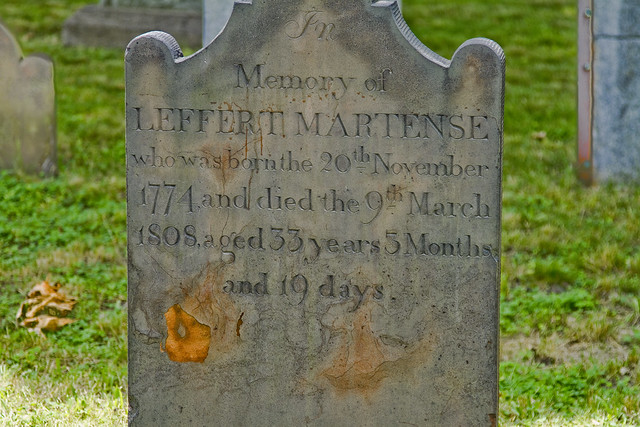
– photo by Mitch Waxman
One of the places which comes up again and again in his writings is this very churchyard, apparently it left quite the impression upon Lovecraft, and inspired his story “The Hound”. He confessed to desecrating this graveyard, incidentally, which is strictly against Newtown Pentacle policy.
This is also why I don’t guzzle water while in graveyards, as such quaffing will inevitably result in the need for urination, which might lead to desecration.
(First Calvary in Queens has two well maintained and world class public lavatories at the entrance gates, btw.)
H.P. Lovecraft was actually here in 1922
On September 16, 1922, Lovecraft toured the Flatbush Reformed Church in Brooklyn with his friend Rheinhart Kleiner, writing about the visit in a letter:
Around the old pile is a hoary churchyard, with internments dating from around 1730 to the middle of the nineteenth century…. From one of the crumbling gravestones–dated 1747–I chipped a small piece to carry away. It lies before me as I write–and ought to suggest some sort of horror-story. I must place it beneath my pillow as I sleep… who can say what thing might not come out of the centuried earth to exact vengeance for his desecrated tomb? And should it come, who can say what it might not resemble?[

– photo by Mitch Waxman
This particular parcel of “Lovecraft Country” has an awful lot of New York City history associated with it, Peter Stuyvesant and the “Degenerate Dutch” and all that. Road extensions of a toll road called Flatbush Avenue past a watch tower… Frankly, the sort of “historian history” which your humble narrator always bolloxes up. I’ve had the pleasure of meeting Rob Schweiger, Brooklyn’s borough historian, and he can offer a far more cogent history of this place than I can. So can the oft mentioned Kevin Walsh.
I can tell you a lot about Newtown Creek and it’s locale, but this part of colonial Brooklyn ain’t my bag.
from “the Lurking Fear”, courtesy hplovecraft.com
No one outside the backwoods had believed these varying and conflicting stories, with their incoherent, extravagant descriptions of the half-glimpsed fiend; yet not a farmer or villager doubted that the Martense mansion was ghoulishly haunted. Local history forbade such a doubt, although no ghostly evidence was ever found by such investigators as had visited the building after some especially vivid tale of the squatters. Grandmothers told strange myths of the Martense spectre; myths concerning the Martense family itself, its queer hereditary dissimilarity of eyes, its long, unnatural annals, and the murder which had cursed it

– photo by Mitch Waxman
I don’t know why I’m always drawn to cemetery trees, a humble narrator will confess, but there’s always something about these vegetable growths fed by an obvious and morbid nutrition. An ominous portent, a spooky resonance, a dissonant note. For some reason, my perception leads me to see shapes in their whorls and crags, shapes which form into recognizable “things”- much like searching for the shape of a dragon in cloud formations.
The scientifically minded call it Pareidolia.
from “The Horror at Red Hook”, courtesy hplovecraft.com
Suydam was a lettered recluse of ancient Dutch family, possessed originally of barely independent means, and inhabiting the spacious but ill-preserved mansion which his grandfather had built in Flatbush when that village was little more than a pleasant group of colonial cottages surrounding the steepled and ivy-clad Reformed Church with its iron-railed yard of Netherlandish gravestones.

– photo by Mitch Waxman
I don’t think I get enough sleep, that’s what it is. It renders me highly suggestible, and perhaps I should drink some more water, and follow Mr. Walsh’s example when visiting “Lovecraft Country“.
from wikipedia
Oneirophrenia is a hallucinatory, dream-like state caused by several conditions such as prolonged sleep deprivation, sensory deprivation, or drugs (such as ibogaine). From the Greek words “ὄνειρο” (oneiro, “dream”) and “φρενός” (phrenos, “mind”). It has some of the characteristics of simple schizophrenia, such as a confusional state and clouding of consciousness, but without presenting the dissociative symptoms which are typical of this disorder.
Persons affected by oneirophrenia have a feeling of dream-like unreality which, in its extreme form, may progress to delusions and hallucinations. Therefore, it is considered a schizophrenia-like acute form of psychosis which remits in about 60% of cases within a period of two years. It is estimated that 50% or more of schizophrenic patients present oneirophrenia at least once.
mighty temples

– photo by Mitch Waxman
The neo gothic handiwork of architect Morrell Smith is hard to miss as one moves about Queens Plaza, and it is known to all as the former Bank of Manhattan Tower. Formerly the tallest structure in the borough of Queens at 14 stories (roughly 210 feet), the 1927 vintage building has since been dwarfed by the Citibank Megalith at Court Square. Smith was a noted architect of the early 20th century and had his hands in more than one landmarked structure in Queens (and Manhattan), and his projects also included the notable Jamaica Savings Bank which is found further east.
Crenellated, its spire carries a clock.

– photo by Mitch Waxman
Personal observation has revealed that these clocks are seldom if ever accurate, and often they do not match up with each other. My understanding, gleaned from municipal and real estate industrial complex propaganda, is that the hidden mechanisms which drive these clocks are undergoing some sort of restoration as is the rest of the building- although specific detail remains elusive. The building itself is another one of the “black holes” in the historical record which distinguish western Queens- a noteworthy structure erected to serve a high profile company sited in a prominent location which is nevertheless relegated to an architectural footnote because its location is outside of Manhattan.

– photo by Mitch Waxman
Your humble narrator acknowledges that, as always, whenever the subject of Queens Plaza and it’s locale comes up one must refer to the hierophants at the Greater Astoria Historical Society– however- one does not wish to stand on the shoulders of others forever and I have resisted making inquiries with them about the place. Unfortunately, independent research has offered little surcease to my curiosity about the clock tower or offered the deeper story and meaning of this building. Rumors of late 20th century bacchanals and Astorian apocrypha about certain rites conducted in its lofty heights during the thunder crazed nights of the the second world war era notwithstanding, there is a dearth of information available for me to share with you about the place. An open call is therefore made to you, Lords and Ladies of Newtown, for any information which might serve to inform your fellow citizenry on this enigmatic structure.
metempsychoses and shudders

– photo by Mitch Waxman
Abjurations of fealty to self interest aside, your humble narrator is suffering some sort of delirium these days. Wandering thoughts and an inability to maintain focus plague my waking hours, and certain hallucinatory visions experienced during the nocturne haunt. Conversation has become difficult to follow or respond to, and paranoid imaginings or unheralded agitations at obviously minor issues color my days with fear, aggression, and anxiety. All I can see lying before me is devastation, hopelessness, and a slouching path leading to destruction.
I’m all ‘effed up.

– photo by Mitch Waxman
Were it possible that I could just be like the humans who infest this great hive, satisfied with loping along the streets whilst spouting colorful aphorisms, pronouncing vainglorious affirmations of personal worth. If only adorning myself with gaudy baubles or tailored garments, reflecting the height of current taste and fashion, could allow surcease from the diabolical internal dialogues which torment and disabuse. Such adolescent fury and desire is unacceptable in an adult, let alone one whose beard has gone white.
The waste meadows are where I belong, their devastating loneliness and abandonment mirror my own.

– photo by Mitch Waxman
Apotheosis finds a home here, along the tributaries of the Newtown Creek. Artifice is struck down by the concretized reality of hubris, and the shape of the future can be discerned in studying the past. Notions such as this force me into a separate form of existence which is ruled by the dark emotions of fear, resentment, and anger. Such is my lot then, to exist as the broken, the barren, and at the dazed and disappointed edge of man’s world.
I must find contentment in my role as Outsider, it would seem.


