Posts Tagged ‘Pickman’
mottled blossoms

– photo by Mitch Waxman
Continuing the “Grand walk” whose beginnings on the Lower East side of Manhattan at St. Patrick’s Old Cathedral were discussed in two prior postings… And as a note, the external shots of the Williamsburg Bridge were photographed on a separate occasion from the afore described narcoleptic perambulation and are included for the sake of “establishing shots”.
I quite obviously didn’t find myself bodily whirling around the Bridge, in the manner of a superhero.
from wikipedia
This bridge and the Manhattan Bridge are the only suspension bridges in New York City that still carry both automobile and rail traffic. In addition to this two-track rail line, connecting the New York City Subway’s BMT Nassau Street Line and BMT Jamaica Line, there were once two sets of trolley tracks.
The Brooklyn landing is between Grand Street and Broadway, which both had ferries at the time. The five ferry routes operated from these landings withered and went out of business by 1908.
The bridge has been under reconstruction since the 1980s, largely to repair damage caused by decades of deferred maintenance. The bridge was completely shut down to motor vehicle traffic and subway trains on April 12, 1988 after inspectors discovered severe corrosion in a floor beam. The cast iron stairway on the Manhattan side, and the steep ramp from Driggs Avenue on the Williamsburg side to the footwalks, were replaced to allow handicapped access in the 1990s.

– photo by Mitch Waxman
Oh- would that I had born capable of such superhuman feats- stronger, more robust of mind and spirit, and not incarnated as the least of men. Were it not my lot to disappoint, discourage, and disabuse myself of opportunities to please others. When I stare in the mirror, an assassin of joy gazes back. I’m all ‘effed up.
Unfortunately, when “one of my states” comes upon me, any notion or pretense I might have of manhood goes out the window and a screeching ape like coward inhabits my mind. Full conviction is evinced that were I magically transported back to the New York City which saw this bridge go up in 1903, I would be consumed by its inmates within minutes.
from nyc.gov
The Williamsburg Bridge has served New York for over 100 years, but in 1988, age, weather, traffic volume increases and deferred maintenance finally caught up with the Bridge and it had to be temporarily closed. At that time, a technical advisory committee formed to decide the fate of the Williamsburg Bridge proposed three options:
- Permanently close the bridge, which would shift traffic through local communities to one of the other already congested East River crossings.
- Build a new bridge, which require locating bridge approaches, possibly through the acquisition of stores and residences. Plus, the existing bridge would still require repairs while the new bridge was being built.
- Repair the existing bridge
Of those three options, the one with the least impact on drivers and local communities was the third. And in 1988, the decision was made to repair the Williamsburg Bridge while keeping it open. The Williamsburg Bridge Reconstruction Project is one of the most ambitious projects undertaken by the New York City Department of Transportation-Division of Bridges.

– photo by Mitch Waxman
The tales of the “Fin de siècle” “Lower East Side” and it’s counterpart communities in Brooklyn, as transmitted by doting grandparents who sought to conceal the darker side of things from their fat American born families, are lost to time.
The New York City of the late 19th and early 20th century was peopled by a specie of predators according to published anecdote and municipal statistic alike, a population hardened and formed by harsh experience and ill fortune. They didn’t emigrate to the United States, they escaped to America.
Routine physical hardship, sickness, and unfairness were their lot upon arriving, and the gentle mannerisms so common to the 21st century were a luxury few could afford.
from Handbook of cost data for contractors and engineers By Halbert Powers Gillette, 1910, courtesy google books
The work here described consisted of sinking two large caissons. 63 x 79 ft. In size on the Brooklyn side of the Williamsburg Bridge to bed rock. In one case 86 ft. and in the other 110 ft below mean high water, filling same with concrete and building masonry piers upon this foundation inside of coffer dams up to elevation plus 23 ft. above M. H. W. All work was done by contract during the years 1897 to 1899.
The caissons were constructed of yellow pine timber at the site of the work, launched, floated Into place and sunk to the river bottom, which was about 55 ft. below M. H. W., by filling them with concrete.
Compressed air was then turned on, and the caissons were sunk to bed rock. The material encountered, consisting of river mud, sand, clay and rock, was excavated either by means of Moran patent material locks or by wet blow out; finally the working chamber was filled with concrete. While the caissons were being sunk, the coffer dams, which were attached to the caissons, were added in order to keep their tops above water, and inside of these coffer dams the masonry piers were built. During the sinking process the masonry was built only In sufficient quantity to give the weight necessary for sinking the caissons. After the caissons were sealed and the air taken off. the shafting and piping were removed, the spaces occupied by them filled with concrete, and the pier carried up to Its final elevation. The coffer dams were then removed.

– photo by Mitch Waxman
The working people, whether they came from Sicilian village or the Jewish Shtetl, understood that America was a choice they made which would have to be lived with. There was no going back, at a time when the new political and economic theory called Capitalism could be best described as “predatory”.
The mills and factories were hellish, but reliably put bills to rest and provided a meager but steady series of meals for their families. The poorest of the poor were in Manhattan, a smoky warren of tenements and factories entirely ringed by the busiest waterfront on Earth. When and if savings were available, the aspiration of every tenement family was to move away and go live in the country- which was Brooklyn or Queens back then.
from Architecture: Volumes 7-8 – Page 104, 1903, courtesy google books
The Mayor appointed a Board of expert Bridge Engineers to examine the new plans, and their approval, together with that of the Municipal Art Commission, having been obtained, the city has accomplished something of which tew municipalities can boast.
Considering the Williamsburg Bridge first, its comparison with the old Brooklvn Bridge suffices to show how7 inartistic and reallv uglv it is, and how graceful and beautiful the older bridge appears. It is interesting to note that professional opinion has severely criticised the appearance of the Williamsburg Bridge, and that the city was willing to, and did, appropriate money to beautify this bridge.
Now, this sort of architectural padding or embellishment is the popular idea of an architect’s function in beautifying an engineering structure. “The bridge is built, happens to be ugly, employ an architect, and add some fancy features.” Or, the engineer makes the design, hands it to the architect to add a lantern or two, makes it fancy, and the artistic conscience of the interested community is at rest. The Williamsburg Bridge can never be made to look well, no matter how much it is padded; its angular lines may possiblv be softened, but that is about all that can be done.

– photo by Mitch Waxman
Remember, the America which so many members of the body politic wistfully pine for was a divided society.
What has always struck your humble narrator comically, however, is that the division was not so simple as we believe in our comfortable and streamlined modernity. Efforts of mid 20th century educators, social reformers, and political factions defined the notion of an America divide that was simply “black or white”.
The reality was that it was the Protestant gentry (of strict Anglo Saxon, or Germanic descent with a pre Civil War arrival date) and everybody else. Even the French were seen as sub human, and you can just forget about what was said about the Irish, Italians, and Jews. In my readings, Eugenics comes up a lot, and those Protestant mission houses in the “Five Points” and “Jewtown” weren’t exactly benign entities- rather they were colonialist appendages of the upper class hoping to create better servants from the lesser breeds.
from Mayor Low’s administration in New York By City Club of New York, 1903, courtesy google books
The general plan of the bridge was adjopted by the East River bridge commission on August 19th, 1896, and filed in the department of public works of each of the two cities. In May, 1897, an amended plan was adopted and filed. The first actual work on the bridge was begun on the Manhattan tower foundation on October 28th, 1896.
The tower foundations on both sides of the river rest on solid rock. The north pier on the Manhattan side sinks to a depth of 56 feet below high water and the south pier 66 feet below high water. On the Brooklyn side the north pier extends to a maximum depth of about 101 feet below high water and the south pier to a maximum depth of about 90 feet below high water. The Manhattan anchorage rests on 3,500 piles driven through clay to a bed of sand overlying the rock. The Brooklyn anchorage rests on natural sand.

– photo by Mitch Waxman
What is interesting to me (and as a son of Brooklyn- beautiful) is the way in which the imperious bourgeois (called the Knickerbocracy at the time) ending up being supplanted in power and position by these lesser breeds.
A combination of luck, hard work, and business acumen resulted in vast fortunes agglutinating amongst the immigrant hordes. The reactionary “establishment” responded with tightened immigration laws, progressive movements whose goal was “slum clearance”, and in the case of the Five Points itself- physical eradication of the neighborhood. The Public Schools were not established out of municipal altruism, rather they were a reaction to the Roman Catholic church offering free education (what would someday be the Parochial Schools) to all who wished to attend, regardless of affiliation.
Contemporary opinion rendered this as a “Papish attempt to inculcate, infiltrate, and infect the Republic with the poisons of Europe”.
also from from Mayor Low’s administration in New York By City Club of New York, 1903, courtesy google books
Transportation on the Williamsburg bridge, especially the movement of trolley cars, will not have to contend with some of the obstacles that now conspire to impede traffic on the Brooklyn bridge. The roadways for vehicles on the Williamsburg bridge will be entirely separated from the railway tracks, both trolley and elevated. This will allow the trolley cars ample space, unobstructed by vehicular traffic. The terminals will also have adequate facilities for the trolley and elevated tracks and passengers, thus avoiding the congestion now witnessed at the Brooklyn bridge terminals.

– photo by Mitch Waxman
By the period which saw the East River bridges rise, the Dutch were largely gone save for a few hold outs from ancient times. The vast majority of their population was either bred out into English lines, or had gone into the west and north. New York was firmly in the hands of the Irish empowered Tammany Hall, and the landlords of the City had realized that they could earn more by illegally subdividing existing housing stock into smaller units called “tenements”.
Manhattan was dangerously overcrowded, and everybody agreed that someone should do something about it.
from The Williamsburg Bridge: an account of the ceremonies attending the formal opening of the structure, December the nineteenth, MDCCCCIII : together with an illustrated historical and descriptive sketch of the enterprise, courtesy google books
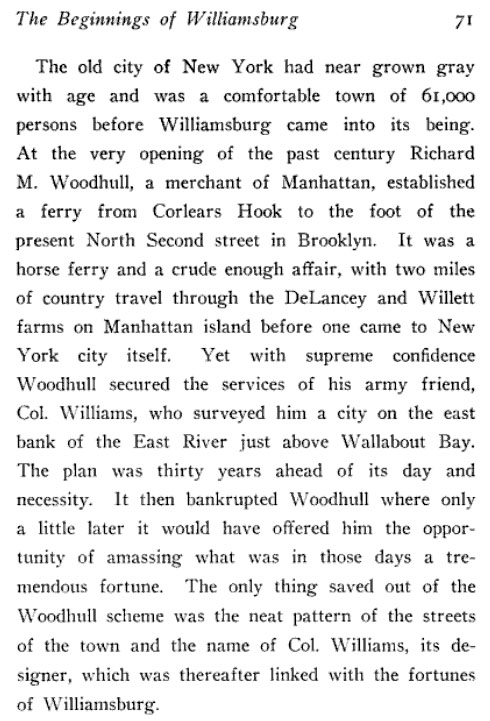

– photo by Mitch Waxman
The Brooklyn Bridge, first of the East River bridges, had proven to be a great generator of wealth on both sides of the river despite it’s outlandish cost and efforts. Modern documents emanating from municipal sources and persoanlly witnessed have referred to the modern day “Williamsburg Bridge Financial Corridor”, an attempt to explain the rejuvenation of the neighborhood from the Bowery to East River along Delancey Street as a direct consequence of the new affluence that current day Williamsburg has come to represent due to its darling status for the Real Estate industry.
In a sense, it was the original “Brooklyn Bridge Financial Corridor” which ultimately put an end to the slums of lower Manhattan, and allowed it’s occupants a chance to escape into Brooklyn. Queens came later, of course.
also from The Williamsburg Bridge: an account of the ceremonies attending the formal opening of the structure, December the nineteenth, MDCCCCIII : together with an illustrated historical and descriptive sketch of the enterprise, courtesy google books
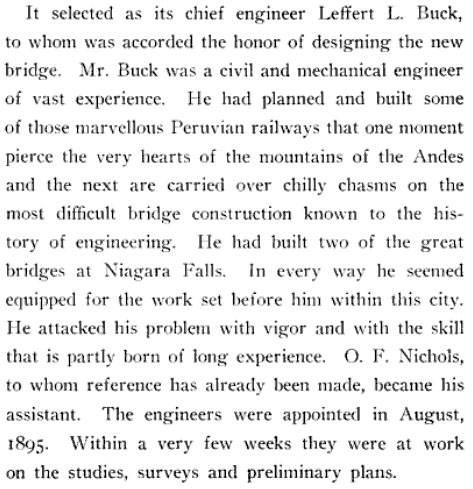

– photo by Mitch Waxman
Prior to the Williamsburg Bridge, there were two scheduled ferries one might utilize to transit from Manhattan to Williamsburg.
One was Robert Fulton’s “Grand Street Ferry”, which crossed between the Brooklyn and Manhattan roads of the same name, and a Houston street ferry made the trip albeit less frequently and with a smaller capacity of passengers. Additionally, hundreds of smaller vessels made the trip carrying some passengers, but mainly shuttling manufactured cargo or agricultural product between the coasts. An unpredictable eddy of currents and inclement weather often stranded passengers on one or the other sides of the river, sometimes for a day or more.
also from The Williamsburg Bridge: an account of the ceremonies attending the formal opening of the structure, December the nineteenth, MDCCCCIII : together with an illustrated historical and descriptive sketch of the enterprise, courtesy google books
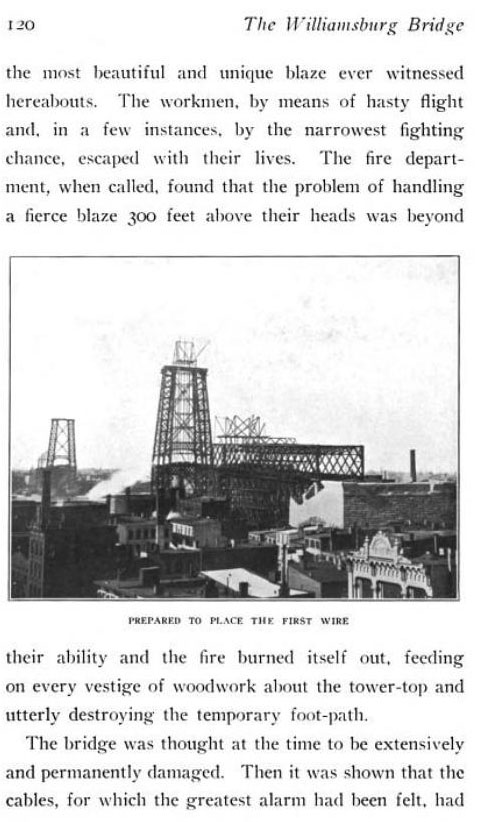

– photo by Mitch Waxman
After the 2nd East River Bridge was completed, Brooklyn’s population began to grow exponentially. Always the junior member of the two great cities on the harbor, it nevertheless absorbed millions while Manhattan began to transform- transmogrify in fact- into the Shining City we know today. Blocks of tenements were cleared away, deep pilings sunk, and the office towers began to rise and scrape the sky. The 3rd and 4th bridges were already underway and discussion of crossing the Narrows was beginning.
Bridge Commissioner Lindenthal commented on the age he lived in as being unique, knowing that the resources to conceptualize and build projects of this size only come along once or twice in the history of any city, and described himself as living in “The Age of Iron”.
also from The Williamsburg Bridge: an account of the ceremonies attending the formal opening of the structure, December the nineteenth, MDCCCCIII : together with an illustrated historical and descriptive sketch of the enterprise, courtesy google books
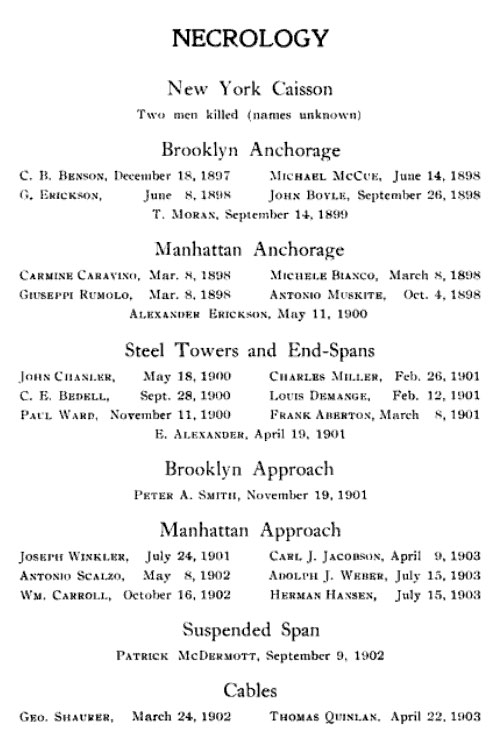

– photo by Mitch Waxman
As mentioned at the beginning of this post, your humble narrator is composed of lesser stuff than most and certainly does not exhibit any of the qualities of iron besides corrosion. While examining the contents of my camera card, which bore hundreds of shots I did not remember taking, my hands began to shake as I saw this familiar scene…
…I had entered the truest place, and the ultimate reality…
…that pole of consciousness and latent possibility which all other locations are mere reflections of…
…the one place where “do or die” actually means something…
from wikipedia
Williamsburg is a neighborhood in the New York City borough of Brooklyn, bordering Greenpoint to the north, Bedford-Stuyvesant to the south, Bushwick to the east and the East River to the west. The neighborhood is part of Brooklyn Community Board 1. The neighborhood is served by the NYPD’s 90th Precinct. In the City Council the western and southern part of the neighborhood is represented by the 33rd District; and the eastern part of the neighborhood is represented by the 34th District.
Many ethnic groups have enclaves within Williamsburg, including Hasidic Jews, Italians, Puerto Ricans, and Dominicans. It is also an influential hub for indie rock, hipster culture, and the local art community, all of which are associated with one of its main thoroughfares, Bedford Avenue. The neighborhood is being redefined by a growing population and the rapid development of housing and retail space.

– photo by Mitch Waxman
…I had come to Infinite Brooklyn…
also from wikipedia
In 1638 the Dutch West India Company first purchased the area’s land from the local Native Americans. In 1661, the company chartered the Town of Boswijck, including land that would later become Williamsburg. After the English takeover of New Netherland in 1664, the town’s name was anglicized to Bushwick. During colonial times, villagers called the area “Bushwick Shore.” This name lasted for about 140 years. Bushwick Shore was cut off from the other villages in Bushwick by Bushwick Creek to the north and by Cripplebush, a region of thick, boggy shrub land which extended from Wallabout Creek to Newtown Creek, to the south and east. Bushwick residents called Bushwick Shore “the Strand.” Farmers and gardeners from the other Bushwick villages sent their goods to Bushwick Shore to be ferried across the East River to New York City for sale via a market at present day Grand Street. Bushwick Shore’s favorable location close to New York City led to the creation of several farming developments. In 1802, real estate speculator Richard M. Woodhull acquired 13 acres (53,000 m²) near what would become Metropolitan Avenue, then North 2nd Street. He had Colonel Jonathan Williams, a U.S. Engineer, survey the property, and named it Williamsburgh (with an h at the end) in his honor. Originally a 13-acre (53,000 m2) development within Bushwick Shore, Williamsburg rapidly expanded during the first half of the nineteenth century and eventually seceded from Bushwick and formed its own independent city.
grotesquely gnarled

– photo by Mitch Waxman
As described in a prior posting– certain anonymous parties had contacted me about- and a meeting at St. Patrick’s Old Cathedral in Manhattan was arranged- to discuss and finally gain possession of information which would lead to a certain location in First Calvary Cemetery which has denied all attempts at discovery.
Arriving at the venerable church early, however, the individual with whom this appointment was arranged arrived with confederates of a seeming rough character, and the notion that I had stumbled into some sort of conspiratorial snare of malign intent terrified me. Your humble narrator fell into “one of my states”, and the scene was fled in a stuporous panic.
Several hours later, when able to recompose myself, it was discovered that the memory card of my camera was nearly full, and this is the second of a series of postings attempting to reconcile the hundreds of photos I found with my episode of “missing time”.
from wikipedia
Missing time is a proposed phenomenon reported by some people in connection with close encounters with UFOs and abduction phenomena. The term missing time refers to a gap in conscious memory relating to a specific period in time. The gap can last from several minutes to several days in length. The memory of what happened during the missing time reported is often recovered through hypnosis or during dreams.

– photo by Mitch Waxman
Based on the series of photos, it is presumed that my route took me down Mulberry on a southern declination, before turning east on Kenmare and ultimately to Delancey. The warren of streets which defy and predate the Manhattan grid, which is two centuries old this year– I would add- have been massively altered from their historic patterns by the attentions of urban planners and DOT engineers since the time of the Bloody Sixth Ward.
Partially, this was to accommodate the “automobile city” of the early 20th century, but no small effort was spared to eliminate the alleyways and so called “courts” which denied easy policing and access by fire and sanitation inspectors in this region of the Shining City.
It was in these courts and alleys that the street gangs of the 19th century were allowed to fester and swell, an offensive and dangerous situation to the progressives and reformers of the post civil war era “City Beautiful”.
from wikipedia
The City Beautiful Movement was a reform philosophy concerning North American architecture and urban planning that flourished during the 1890s and 1900s with the intent of using beautification and monumental grandeur in cities. The philosophy, which was originally associated mainly with Chicago, Detroit, and Washington, D.C. allegedly promoted beauty not for its own sake, but rather to create moral and civic virtue among urban populations. Advocates of the philosophy believed that such beautification could thus promote a harmonious social order that would increase the quality of life.

– photo by Mitch Waxman
My trusty camera seems to have been pointed in the direction of the 2nd of the three East River Bridges to have been erected, which we know as the Williamsburg. 100 years ago, I might have boarded a street car or horse drawn wagon to carry me over the span and boarded it at Bowery and Delancey. Were I cognizant of my surroundings, rather than stumbling in a panic, I might have caught an electric light rail- which is referred to as a “subway”- but instead and inexorably I marched forward into “Jewtown”.
from HOW THE OTHER HALF LIVES By JACOB A. RIIS, courtesy google books
THE tenements grow taller, and the gaps in their ranks close up rapidly as we cross the Bowery and, leaving Chinatown and the Italians behind, invade the Hebrew quarter. Baxter Street, with its interminable rows of old clothes shops and its brigades of pullers-in—nicknamed “the Bay ” in honor, perhaps, of the tars who lay to there after a cruise to stock up their togs, or maybe after the “schooners” of beer plentifully bespoke in that latitude— Bayard Street, with its synagogues and its crowds, gave us a foretaste of it. No need of asking here where we are. The jargon of the street, the signs of the sidewalk, the manner and dress of the people, their unmistakable physiognomy, betray their race at every step. Men with queer skull-caps, venerable beard, and the outlandish long-skirted kaftan of the Russian Jew, elbow the ugliest and the handsomest women in the land. The contrast is startling. The old women are hags; the young, houris. Wives and mothers at sixteen, at thirty they are old. So thoroughly has the chosen people crowded out the Gentiles in the Tenth Ward that, when the great Jewish holidays come around every year, the public schools in the district have practically to close up.

– photo by Mitch Waxman
The politics of modern city dwellers prefers not to attach ethnic sobriquets to neighborhoods where any single population crowds out other mention anymore, but in the 19th century no such prohibition applies. Early subway maps refer to this section of Delancey east of the Bowery as “the Ghetto” for instance. Such description signifies the magnetic appeal of the tenement neighborhood to the vast Yiddish speaking populations which made good their escape from the “the Pale” in the 19th century.
These largely weren’t the Orthodox Jews of today, of course, as the Hasidic and Lubavitcher sects – typified by an outdated style of dress and clannish separation from their surrounding environs – are a fairly modern path which only began to gather real steam in the 19th century (just like most fundamentalist religions) and in the 20th century these groups still represent only a tiny fraction of the larger ethnic population.
Instead the majority were religious but secular peasants from the countryside, suddenly finding themselves in New York City living next door to a sophisticated citizen from the Austro Hungarian- or Russian- or Ottoman- empires. It was these transplanted urbanites who founded the Forverts and other Yiddish language newspapers.
from wikipedia
The Forward (Yiddish: פֿאָרווערטס; Forverts), commonly known as The Jewish Daily Forward, is a Jewish-American newspaper published in New York City. The publication began in 1897 as a Yiddish-language daily issued by dissidents from the Socialist Labor Party of Daniel DeLeon. As a privately-owned publication loosely affiliated with the Socialist Party of America, Forverts achieved massive circulation and considerable political influence during the first three decades of the 20th Century. The publication still exists as a weekly news magazine in parallel Yiddish (Yiddish Forward) and English editions (The Jewish Daily Forward).

– photo by Mitch Waxman
The synagogues of Eastern and Southern Europe which have survived into modernity have all the appearances of a fortified house or town, and go to some lengths to blend into the surrounding communities. In the United States, however, the desire to show off and build a palace to the almighty was not limited to the Catholics or Episcopalians. Such aspirations were present amongst the Jews as well.
On the corner of Delancey and Forsyth one may find the former “Forsyth Street Synagogue, Poel Zedek Anshei Illia (Doers of Good, People of Illia)“. In modernity, it serves as a place of worship for the Seventh Day Adventists, which grew out of the millennialist Millerites in the years following the “Great Disappointment” 1844.
from wikipedia
October 22, 1844, that day of great hope and promise, ended like any other day to the disappointment of the Millerites. Both Millerite leaders and followers were left generally bewildered and disillusioned. Responses varied: some Millerites continued to look daily for Christ’s return, others predicted different dates—among them April, July, and October 1845. Some theorized that the world had entered the seventh millennium, the “Great Sabbath”, and that, therefore, the saved should not work. Others acted as children, basing their belief on Jesus’ words in Mark 10:15, “Truly, I say to you, whoever does not receive the kingdom of God like a child shall not enter it.” O. J. D. Pickands used Revelation 14:14-16 to teach that Christ was now sitting on a white cloud, and must be prayed down. Probably the majority however, simply gave up their beliefs and attempted to rebuild their lives. Some members rejoined their previous denominations while a substantial number became Quakers.

– photo by Mitch Waxman
An unknown structure to me, online accounts describe it as having passed from Hebraic hands during the long 20th century decline of the neighborhood and speak of its resurrection when it began to serve as a church to some of modern Christianity’s more charismatic adherents. It is odd to see the Mogen David bisected by the rood outside of the esoteric or gnostic traditions.
Delancey street, I would mention, always figured prominently in the adages and folkloric warnings that my grandmother would hand out when I was a young but already humble narrator. A product of the Pale herself, she found work in America in that jewish garment trade which once flourished here, and even into extreme old age she practiced her craft. She always referred to Delancey and the environs as a home to midwives and fortune tellers (kabbalists) and shmata men.
When queries as to how lucrative the shmata (rag) trade was, and who could possibly need enough rags to keep a merchant employed full time- her response was “vat doz yu tink yu viped yur arse mit? Dere vas no terlet papah beck den”.
from wikipedia
Adventism is a Christian movement which began in the 19th century, in the context of the Second Great Awakening revival in the United States. The name refers to belief in the imminent Second Coming (or “Second Advent”) of Jesus Christ. It was started by William Miller, whose followers became known as Millerites. Today, the largest church within the movement is the Seventh-day Adventist Church.
The Adventist family of churches are regarded today as conservative Protestants. While they hold much in common, their theology differs on whether the intermediate state is unconscious sleep or consciousness, whether the ultimate punishment of the wicked is annihilation or eternal torment, the nature of immortality, whether or not the wicked are resurrected, and whether the sanctuary of Daniel 8 refers to the one in heaven or on earth. The movement has encouraged the examination of the New Testament, leading them to observe the Sabbath.

– photo by Mitch Waxman
Uncertainty exists in my mind as to whether or not my trance induced scuttling and the photographic record thereof bears any kind of narrative thread or not. It would seem that my subject matter and focal point of view remained steady with normal pursuits, chasing esoteric and disabused touchstones of the oft occluded past, and noticing the small details hidden amongst the centuries old tapestry.
One wonders if I might have wandered into this storefront psychic and what Gypsy legend would have been offered. Perhaps I did, but in my trance state, who can venture as to what might have occurred in the moments between photos?
from wikipedia
Romani mythology is the myth, folklore, religion, traditions, and legends of the Romani people (also known as Gypsies). The Romanies are a nomadic culture which originated in India during the Middle Ages. They migrated widely, particularly to Europe. Some legends (particularly from non-Romani peoples) say that certain Romanies are said to have passive psychic powers such as, empathy, precognition, retrocognition, or psychometry. Other legends include the ability to levitate, travel through astral projection by way of meditation, invoke curses or blessings, conjure/channel spirits, and skill with illusion-casting.
Burial: Romanies pushed steel or iron needles into the body’s heart and put pieces of steel in the mouth, over the eyes, ears, and between the fingers. Hawthorn was placed on the legs, or driven through the legs. They would also drive stakes, pour boiling water on the grave, and behead or burn the body. All this preparation was to ward off vampires.
Afterlife: Romanies had a concept of Good and Evil forces. Dead relatives were looked after loyally. The soul enters a world like the world of the living, except that death does not exist. The soul lingers near the body and sometimes wants to live again.

– photo by Mitch Waxman
The River of Sound awaited, and a vast steel span was to be crossed.
Tomorrow is Williamsburg, where Brooklyn’s Grand Street will be attained and the puzzling series of shots found on my camera card will be further explored at this… Your Newtown Pentacle.
from medical-dictionary.thefreedictionary.com
compulsive walking
affected animals walk oblivious to their surroundings. They appear to be blind, walk into objects, headpress against them and stay in this position for long periods, are oblivious to danger and may die of misadventure. They may attempt to climb a wall and fall over backwards. Common causes are hepatic encephalopathy and increased intracranial pressure.
unending steps

– photo by Mitch Waxman
By email, I was contacted by a personage who claimed that the long desired location of a certain interment at First Calvary Cemetery in Queens- the burial site of “he who must not be named“- was in his possession. Further, it was asserted that while anonymity and certain other odd conditions were required, the occluded information so long sought would be mine for the taking.
A meeting was hastily arranged at St. Patrick’s Old Cathedral on Manhattan’s Mulberry street, and your humble narrator scuttled off to the Bloody Sixth Ward and the House of Dagger John.
What greeted me was not to my liking.
from saintpatrickscathedral.org
The recent elevation of New York as an Episcopal see with its own bishop inspired the increasing Catholic population to build the original Cathedral of New York under the name of Ireland’s patron saint, Saint Patrick. The site chosen belonged to the corporation of Saint Peter’s Church and was located on Mulberry Street in lower Manhattan. The cornerstone was laid in June 1809.

– photo by Mitch Waxman
As is habit and curse, an early arrival was attempted and achieved, and a hidden vantage point amongst the venerable pews was attained. The odd fellow who had contacted me described his aspect and appearance accurately, and recognition was instant when he strode confidently into the ancient church. He did not arrive alone, as he had implied in his missives, however.
The disturbing aspect of his companions, leathery creatures best described as men, and the hushed instructions he seemed to be offering them, brought me to a peak of nervous excitedness and a panic set in upon me. Stupidly, I had walked directly into a spiders web, lured in by forbidden fruit.
Had some sort of diabolical plot, hatched by those malign forces whose secretive occupations and desires and unguessed at existence has been inadvertently hinted at and offended by this- your Newtown Pentacle, been set in motion to snare and silence me?
from wikipedia
Until 1830, the Cathedral was the ending place of the annual St. Patrick’s Day parade. After that, it ended on Ann Street at the Church of the Transfiguration, whose pastor, Father Varela, was Cuban, but was a fervent nationalist and the chaplin of the Hibernian Universal Benevolent Society. Eventually, the parade moved uptown to pass in front of the new St. Patrick’s Cathedral.
In 1836, the cathedral was the subject of an attempted sack after tensions between Irish Catholics and anti-Catholic Know-Nothing nativists led to a number of riots and other physical confrontations. The situation worsened when a brain-injured young woman wrote a book telling her “true” story – a Protestant girl who converted to Catholicism, and was then forced by nuns to have sex with priests, with the resulting children being baptized then killed horribly. Despite the book being debunked by a mildly anti-Catholic magazine editor, nativist anger at the story resulted in a decision to attack the cathedral. Loopholes were cut in the church’s outer walls, which had just recently been built, and the building was defended from the rioters with muskets.

– photo by Mitch Waxman
As previously described, vast physical inadequacy and cowardice are my hallmarks. The least of all men, my only recourse is flight, and I seem to have descended into some sort of fugue state.
I remember leaving the sepulchral darkness and unnatural cool of the old Cathedral, but from the moment that the burning thermonuclear eye of god itself shone upon me, it’s a total blank.
My next conscious memory is that of having arrived back at HQ in Astoria some hours later with blistered feet and chafed thighs, and an odd crusty residue around my eyes reminiscent of the dehydrated tears which adorn the occulum of a recently awakened sleeper.
During this multi hour episode, I seem to have been taking hundreds of pictures as I scuttled instinctually and inexorably homeward.
I’ve pieced my somnambulist route together from the shots on my camera card and for some reason, seemed to be subconsciously following an ancient street car route, the one that went to Calvary via Williamsburg as I later scried.
In 1850 a line of two horse stages was running from Grand Street ferry past the Dutch Church on the Old Woodpoint Road out to Newtown. Grape arbors extended from Leonard Street to Humboldt Street.
Martin J. SUYDAM ran a stage from Peck Slip and Grand Street. Ferries through Grand Street and Metropolitan Avenue to Newtown.
The Grand Street and Newtown Railroad Co., was chartered in 1860. At the foot of the street was the office of the Houston Street Ferry Association and later of the Nassau Ferry Co. A long wooden stairway led from the ferry to the American Hotel, latter, #2 & 4, kept by Jackson HICKS.

– photo by Mitch Waxman
Some sort of odd symmetry presents itself, of course, in this dreamt of photowalk. The vast numbers who lie within the emerald devastations of Laurel Hill made the same journey themselves, although most did not take the Williamsburg Bridge- rather a connecting ferry and streetcar line which would have joined some forgotten 19th century Manhattan pierage (near its own Grand Street) with the gentry of Brooklyn. Don’t forget, in the 19th century, Manhattan was a pestilential hell hole of factories and open sewers populated by a starving horde of refugees- Brooklyn was in it’s own golden age.
The Bridge didn’t come along until 1883 after all, and First Calvary was nearly full by then.
I suppose there are and have been worse conditions of life, but if I stopped short of savage life I found it hard to imagine them. I did not exaggerate to myself the squalor that I saw, and I do not exaggerate it to the reader. As I have said, I was so far from sentimentalizing it that I almost immediately reconciled myself to it, as far as its victims were concerned. Still, it was squalor of a kind which, it seemed to me, it could not be possible to outrival anywhere in the life one commonly calls civilized. It is true that the Indians who formerly inhabited this island were no more comfortably lodged in their wigwams of bark and skins than these poor New-Yorkers in their tenements. But the wild men pay no rent, and if they are crowded together upon terms that equally forbid decency and comfort in their shelter, they have the freedom of the forest and the prairie about them; they have the illimitable sky and the whole light of day and the four winds to breathe when they issue into the open air. The New York tenement dwellers, even when they leave their lairs, are still pent in their high-walled streets and inhale a thousand stenches of their own and others’ making. The street, except in snow and rain, is always better than their horrible houses, and it is doubtless because they pass so much of their time in the street that the death rate is so low among them. Perhaps their domiciles can be best likened for darkness and discomfort to the dugouts or sod huts of the settlers on the great plains. But these are only temporary shelters, while the tenement dwellers have no hope of better housing; they have neither the prospect of a happier fortune through their own energy as the settlers have, nor any chance from the humane efforts and teachings of missionaries, like the savages. With the tenement dwellers it is from generation to generation, if not for the individual, then for the class, since no one expects that there will not always be tenement dwellers in New York as long as our present economical conditions endure.

– photo by Mitch Waxman
As evidenced in the shot above, I seem to have proceeded south along Mulberry Street, past the high walls of the Old Cathedral which were erected by Dagger John and the Hibernians to protect the sanctuary from the violent attentions of Nativist rioters during those starry years when this neighborhood was known as “the bloody sixth ward”.
from History of the Second company of the Seventh regiment By Emmons Clark, courtesy google books
The Sixth Ward was noted for its disorderly character, and the frequent skirmishes which took place within its borders, with the consequent black eyes and bloody noses, gave it the well-known sobriquet,—”the Bloody Sixth.” On the first day of the election, in the spring of 1834, it was said that the anti-bank, Democratic, and Irish citizens of the Sixth Ward, had blockaded the polls and prevented the Whigs from voting. On the second day, the Whigs from other districts rallied in large numbers to the Sixth Ward, resolved to break the blockade and give their friends an opportunity to cast their ballots. The result was a series of engagements, in which both parties maintained their positions in the field until the polls closed for the day. A ship, mounted on wheels and adorned with Whig banners, was drawn through the ward, and used to convey voters to the polls, and this insulting invasion of the Democratic stronghold increased the excitement.

– photo by Mitch Waxman
This grand walk carried me, in a seemingly dream like state, through the lower Manhattan neighborhoods known to Dagger John and his compatriots as either “Jewtown” or “the Ghetto”, over the Bridge, into Williamsburg, through Bushwick and then Maspeth in Brooklyn and Queens respectively, into Berlin and then Blissville in the Creeklands, and ultimately Calvary Cemetery itself. Over the next few days, and from the comfort and safety of a well fortified Newtown Pentacle HQ (which sports a cadre of Croatian Varangians dedicated to my health and well being, should these malign forces decide to visit… as well as other… more esoteric defenses) I’ll be presenting the fruits of this journey. As mentioned, I somehow kept shooting the whole way.
from wikipedia
Basil II’s distrust of the native Byzantine guardsmen, whose loyalties often shifted with fatal consequences, as well as the proven loyalty of the Varangians, led him to employ them as his personal bodyguards. This new force became known as the Varangian Guard (Greek: Τάγμα των Βαράγγων, Tágma tōn Varángōn). Over the years, new recruits from Sweden, Denmark, and Norway kept a predominantly Scandinavian cast to the organization until the late 11th century. So many Scandinavians left to enlist in the guard that a medieval Swedish law from Västergötland stated that no one could inherit while staying in “Greece”—the then Scandinavian term for the Byzantine Empire. In the eleventh century, there were also two other European courts that recruited Scandinavians: Kievan Rus’ c. 980–1060 and London 1018–1066 (the Þingalið). Steven Runciman, in The History of the Crusades, noted that by the time of the Emperor Alexios Komnenos, the Byzantine Varangian Guard was largely recruited from Anglo-Saxons and “others who had suffered at the hands of the Vikings and their cousins the Normans”. The Anglo-Saxons and other Germanic peoples shared with the Vikings a tradition of faithful (to death if necessary) oath-bound service, and after the Norman Conquest of England there were many fighting men who had lost their lands and former masters and looked for a living elsewhere.
Additionally, for those who might be interested in a FREE boat tour of Newtown Creek on City of Water Day – which is Saturday, July 16th- this web page bears monitoring.
lined with sorrow

– photo by Mitch Waxman
One of my little phrases, that I bandy about as if I know what I’m talking about, is “Newtown Creek is where the Industrial Revolution actually happened”.
Ruminating on this, literally this morning, I started putting this post together, picking a random and unremarked spot along Newtown Creek (which I had ok photos of, naturally) and shining a light on it. The semi modern history of this spot, an auto impound lot which was a “Gaseteria” facility more recently than it was the Ditmas Oil Terminal, which lies along the English Kills tributary of the Newtown Creek isn’t that hard to find out.
Child’s play, if the child happens to be 40 and change years old, and refers to himself constantly as your “humble narrator”, that is.
from nyc.gov
During the early nineteenth century, the portion of present-day Brooklyn between the village of Williamsburgh and New town Creek was a rural farm area dotted by small settlements. Beginning in the second decade of the nineteenth century, at the time the ferries to Manhattan were initiated, the Williamsburgh and Jamaica Plank Road was established on the route of the present-day Metropolitan Avenue.
Around the same time, the Newtown and Bushwick Turnpike, also known as the North Road to Newtown, was built on the present-day Meeker Avenue. The turnpike crossed Newtown Creek at a site where a ferry had operated since the late 1600s; in 1836 a toll bridge was built which came to be known as the “Penny Bridge” after the fee charged to pedestrians. Bushwick Avenue, which connected with Humboldt Street, was an important north-south route.

– photo by Mitch Waxman
This part of the English Kills canal follows the grid of the surrounding Brooklyn streets and looks nothing like the vernal wonderland of salt marsh and game laden grasses described by the Dutch and so carefully mapped by the English. This is the work of 19th century engineers, who were trying to put nature right, imposing right angles and impossible angles upon the water. It’s not too far from the intersection of Metropolitan and Grand Avenues in East Williamsburg.
It’s also pretty close to where the Bushwick Chemical Works of M. Kalbfleisch & Sons once stood, if it’s not the actual spot.
from “A history of American manufactures from 1608 to 1860” via google books
The Bushwick Chemical Works—M. Kalbfleisch & Sons,
Situated in the Eastern District of Brooklyn, a few miles from New York, are among the most important and extensive Chemical manufactories in the United States. The Works are composed of numerous buildings of various sizes, the largest being from one hundred and sixty to two hundred feet in length, and from sixty to seventy feet in width. Among them is a Glass House and Pottery, in which are made all the Retorts and Bottles used in manufacturing and packing the Acids and other products of the Chemical Department. The whole group of structures, with their extended walls, spacious roofs, and lofty chimneys, covers an area of over five acres, and presents an imposing appearance even at a distance. The interior appointments and equipments are of a character corresponding with the extent of the buildings. One of the chambers, for manufacturing Sulphuric Acid, is two hundred and seventeen feet long by fifty feet wide, no doubt the largest in existence, and is a model in every particular. Among the noticeable objects that attract the attention of visitors, are three Platina Stills, imported from France, at a cost of about fifteen thousand dollars each.
The products of these Works include a great number of those articles recognized as standards in the commerce of the world. Of Sulphuric Acid they have a capacity for producing three hundred thousand pounds weekly, and of Muriatic Acid, about three hundred and fifty carboys weekly.
Besides these, they manufacture Aquafortis, Muriate of Tin, Strong Ox. Muriate Tin, Soda Ash, Aqua Ammonia, Tin Chrystals, Nitrate of Iron, Sulphate of Zinc, and other officinal chemicals. The firm employ constantly from seventy to eighty workmen, for whom they have provided comfortable dwellings in the vicinity of the Works. The Office and Salesrooms are in the City of New York, at the corner of Fulton and Cliff streets.

– photo by Mitch Waxman
Like the precursor of Phelps Dodge over on the Queens side of the Creek (which was known first as Nichols and then as General Chemical) M. Kalbfleisch & Sons manufactured the wonder chemical of the early 19th century- sulfuric acid.
The chemical itself had been around in one form or another for centuries, but its manufacture was the provence of jewelers and alchemists, and its manufacture was a particularly ugly process and produced limited quantities of the stuff. It required large glass or earthenware vessels to distill, which were prone to breakage, which is bad when acid is involved.
One would either burn sulfur and saltpeter along with sodium nitrate and combine the ashes with water, or distill the stuff from a mixture of ferric sulfate and silica. The former mixture is also known as Brimstone, and the latter as Oil of Vitriol to esotericists.
from America’s Successful Men of Affairs , An Encyclopedia of Contemporaneous Biography via google books
MARTIN KALBFLEISCH, chemist, a native of Flushing, Netherlands, born Feb. 8, 1804, died in Brooklyn, N. Y., Feb. 12, 1873. In 1822, the youth sailed to the island of Sumatra, but finding that the Asiatic cholera was raging there, he promptly returned with his ship to Antwerp Thence he went to Havre, France, and spent four years in commercial enterprise. In 1826, he came to the United States with small means but splendid pluck.
In New York city, hard work as a clerk and chemist brought him a little money and, in 1835, he started a manufactory of colors and chemicals in Harlem. After several changes of location, the business, which had prospered under his energetic management, was finally moved to Metropolitan Avenue in Brooklyn.
The works now occupy eleven acres of ground on Newtown creek.
Mr. Kalbfleisch was a man of clear head, strong common sense and ability. He served in various public offices in Brooklyn and was elected Mayor in 1861. In 1862, his fellow citizens sent him to Congress and in 1867 and 1871 again made him Mayor.
Later, they offered him the nomination for Governor of the State on the same ticket with Horace Greeley.
In 1854, he was married to Elizabeth Harvey. Eleven children were born to them: Elizabeth W., wife of Robert Robinson; Frederick W. Kalbfleisch; Helen M., wife of Rodney Thursby; Edward L. G., Charles H., Albert M., and Franklin H. Kalbfleisch; Josephine M. L., wife of Robert S. Fleet; Isabella G., wife of James E. Weaver; and John and George Kalbfleisch.
He retired from business in 1868 in favor of his sons, who thereupon organized the firm of Martin Kalbfleisch’s Sons, which controlled the business until 1886.

– photo by Mitch Waxman
The sulfuric acid part of the industrial revolution started when a fellow in Great Britain named Roebuck figured out that he could produce the stuff by the pound, and then the ton, using an innovative series of lead tanks to distill the acid. The method spread and evolved, and even today, sulfuric acid accounts for nearly 40% of total U.S. chemical industry volume output.
Manufacture of sulfuric acid has advanced considerably, of course, since the days of M. Kalbfleisch & Sons. The company itself seems to have suffered a premature decline, due to mismanagement (and I’ve found hints of some sort of Standard Oil interference with it as well but nothing I could back up). The fellow who got the property in receivership was a manufacturer of electrical glass, the sort of material you see on high tension wire connections.
Who can guess, all there is, that might be buried down there?
from A history of the city of Brooklyn, By Henry Reed Stiles via google books
betwixt the horns

– photo by Mitch Waxman
Call me paranoid, but the Fireboat Three Forty Three seems to be following me around. Everywhere I go these days, there it is. Has anyone ever been stalked by a crewed ship on its shakedown cruise?
Perhaps.
from wikipedia
140-foot, 500-ton, $27 million dollar boat will be the country’s largest fireboat with a maximum speed of 18 knots. The Three Forty Three will provide the FDNY with the latest technology available for Marine vessels, including the capability of pumping 50,000 gallons of water per minute; nearly 30,000 gallons more than its predecessor. The need for this increased pumping capacity was graphically displayed as FDNY’s existing fireboats supplied the only water available for many days after the September 11, 2001 attack on the World Trade Center. However, the technological advances of these new boats do not end there. The boat’s original design by Robert Allan Ltd. of Vancouver, B.C. will catapult FDNY’s Marine Division into the 21st century and beyond.
Because of the very real threat of additional terrorist attacks after 9/11, the boats will also be capable of protecting firefighters from Chemical, Biological, Radiological, Nuclear agents (CBRN). While performing in any of these hostile environments, the crew will be protected in a pressurized area that will also have its air supply filtered by special charcoal and HEPA filters. Assistance on the design of the CBRN system was provided by engineers from the U.S. military’s Joint Program Executive Office for Chemical and Biological Defense and Naval Sea Systems Command. United States Navy.

– photo by Mitch Waxman
Day two of a particularly interesting summer cold, and as you’re reading this (assuming it’s daylight) your humble narrator is most likely aboard a Circle Line and talking on the microphone describing the sights and hidden meanings of NY Harbor to a group of 700 Octa, Nona, and Centenarians.
Such odd moments in life are, of course, owed to the Working Harbor Committee and the Borough President of Manhattan, who makes money available for his constituents in nursing homes to “get out for a day”.
from mbpo.org
Scott M. Stringer, a native New Yorker, is the 26th Manhattan Borough President.
Since taking office at the start of 2006, he has dedicated himself to making Manhattan more affordable, livable…and breathable – preserving the sense of neighborhood for the 1.6 million residents of what is best known as a world capital of culture and commerce.
The foundation for much of the borough president’s work is the change he’s brought to Manhattan’s community boards. Energizing these formal institutions of neighborhood democracy was a top priority of Stringer’s upon becoming borough president. A new merit selection process, combined with an infusion of badly needed resources – such as dedicating to each board a graduate student from the city’s architecture and planning schools – has served to strengthen the voice of Manhattan’s neighborhoods in debates over city planning.

– photo by Mitch Waxman
It was actually a recent Working Harbor trip, this time a program for kids in which representatives of certain maritime organizations like Coast Guard and Port Authority commune with a group of “city kids” onboard a boat, which had brought me to the Hudson on the day these shots were taken. The goal is to introduce to them the idea of a career on the harbor, something not often considered in the wilds of central Brooklyn or Queens.
Another maritime engagement would require me to be at South Street Seaport in the evening, and I had a few hours to kill so I decided to walk from 42nd street to South Street the long way, around the Battery.
from wikipedia
Battery Park is a 25-acre (10 hectare) public park located at the Battery, the southern tip of Manhattan Island in New York City, facing New York Harbor. The Battery is named for artillery batteries that were positioned there in the city’s early years in order to protect the settlement behind them. At the north end of the park is Castle Clinton, the often re-purposed last remnant of the defensive works that inspired the name of the park; Pier A, formerly a fireboat station; and Hope Garden, a memorial to AIDS victims. At the other end is Battery Gardens restaurant, next to the United States Coast Guard Battery Building. Along the waterfront, ferries depart for the Statue of Liberty and Ellis Island, and there is also a New York Water Taxi stop. The park is also the site of the East Coast Memorial which commemorates U.S. servicemen who died in coastal waters of the western Atlantic Ocean during World War II, and several other memorials.
To the northwest of the park lies Battery Park City, a planned community built on landfill in the 1970s and 80s, which includes Robert F. Wagner Park and the Battery Park City Promenade. Together with Hudson River Park, a system of greenspaces, bikeways and promenades now extend up the Hudson shoreline. A bikeway might be built through the park that will connect the Hudson River and East River parts of the Manhattan Waterfront Greenway. Across State Street to the northeast stands the old U.S. Customs House, now used as a branch of the National Museum of the American Indian and the district U.S. Bankruptcy Court. Peter Minuit Plaza abuts the southeast end of the park, directly in front of the South Ferry Terminal of the Staten Island Ferry.

– photo by Mitch Waxman
In planning my route, however, I forgot to factor in the Freedom Tower and the 911 site, which is something I normally avoid like the plague. As a rule, I stay away from this subject, don’t discuss my dead friends who were Port Authority cops or Fire Fighters, and don’t engage in conversational speculation about the event with either the “Truthers” or the conspiracists.
On the other hand, I think that naming a Fireboat “Three Forty Three” is extremely appropriate while the term “Freedom Tower” is just silly and smacks of bad comic book writing.
from wikipedia
One World Trade Center (1 World Trade Center), more simply known as 1 WTC and formerly known as the Freedom Tower, is the lead building of the new World Trade Center complex in Lower Manhattan in New York City. The tower will be located in the northwest corner of the World Trade Center site, and will occupy the location where the original 8-story 6 World Trade Center once stood. The north side of the tower runs between the intersection of Vesey and West streets on the northwest and the intersection of Vesey and Washington streets on the northeast, with the site of the original North Tower/1 WTC offset to the southeast. Construction on below-ground utility relocations, footings, and foundations for the building began on April 27, 2006. On March 30, 2009, the Port Authority confirmed that the building will be known by its legal name of ‘One World Trade Center’, rather than the colloquial name ‘Freedom Tower’. Upon completion, One World Trade Center will be the tallest building in the United States, standing at a height of 1,776 feet (541.3 m), and among the tallest buildings in the world. It will be taller than the Empire State Building, and will be completed by the beginning of 2014.


