Posts Tagged ‘Pickman’
singular caravan

– photo by Mitch Waxman
The odd ways and methods of thought which your humble narrator exhibits mystify even himself. Walking down Laurel Hill Blvd. one fine day, and upon observing that most mundane and usual of creatures- the Squirrel- I realized that near total ignorance of the studied actuality of the animal was mine.
This happens to me often, sometimes it’s a foodstuff- like honey for instance. “How does one produce Honey industrially?” (which I’ve mentioned before), or “How, exactly, is Jell-O made?”. The latter case, incidentally, produced an answer so horrible and pregnant with latent disgust that I haven’t eaten the stuff since.
If you enjoy gelatin desserts, don’t ever, EVER try to find out. It’s not what you think it is, and the simplest thing to say is that the process for producing the stuff was invented in the 19th century at Newtown Creek…
from wikipedia
The living squirrels are divided into 5 subfamilies, with about 50 genera and nearly 280 species. The oldest squirrel fossil, Hesperopetes, dates back to the Chadronian (Late Eocene, about 40 – 35 million years ago), and is similar to modern flying squirrels.
During the latest Eocene to the Miocene, there were a variety of squirrels which cannot be assigned with certainty to any living lineage. At least some of these probably were variants of the oldest, basal “proto-squirrels” (in the sense that they lacked the full range of living squirrels’ autapomorphies). The distribution and diversity of such ancient and ancestral forms suggests that the squirrels as a group might have originated in North America.
Apart from these sometimes little-known fossil forms, the phylogeny of the living squirrels is fairly straightforward. There are three main lineages, one comprising the Ratufinae (Oriental giant squirrels). These contain a mere handful of living species in tropical Asia. The Neotropical Pygmy Squirrel of tropical South America is the sole living member of the Sciurillinae. The third lineage is by far the largest and contains all other subfamilies; it has a near-cosmopolitan distribution. This further supports the hypothesis that the common ancestor of all squirrels living and fossil lived in North America, as these three most ancient lineages seem to have radiated from there – if squirrels had originated in Eurasia for example, one would expect quite ancient lineages in Africa, but African squirrels seem to be of more recent origin.
The main group of squirrels also can be split up in three, which yields the remaining subfamilies. The Sciurinae contains the flying squirrels (Pteromyini) and the Sciurini, which among others contains the American tree squirrels; the former have often been considered a separate subfamily but are now seen as a tribe of the Sciurinae. The pine squirrels (Tamiasciurus) on the other hand are usually included with the main tree squirrel lineage, but appear to be about as distinct as the flying squirrels; hence they are sometimes considered a distinct tribe, Tamiasciurini.

– photo by Mitch Waxman
These sort of questions are not good ones to ask, as often the answers present casual barbarism and bloody reality in a matter of fact fashion, and such information blackens the heart and calcifies the mind. Would it aid me, in any way whatsoever, to find out that there might have been some carnivorous Ice Age Squirrel the size of a Buffalo or something? Would it not in fact, be somewhat wiser to apply the limited intellect and time left to me on this mortal coil in pursuit of acquiring the sort of skills which would allow me to gather and hoard material wealth to myself?
Perhaps I could apply my time to more fruitful pursuits than those already explored, apply for and attain some sort of professional license and become a realtor or exterminator or something? Perhaps some novel combination of the two would be possible, and certainly more useful than spending an entire day thinking about common urban rodents.
from wikipedia
Squirrels are generally intelligent and persistent animals. In residential neighborhoods, they are notorious for discovering clever methods to circumvent obstacles in order to eat out of bird feeders. Tree squirrels also create minor annoyances by digging in planting pots and flower beds to pull out bulbs which they chew on, to either bury or recover seeds and nuts, and for building nests within human domiciles, including attics and basements. Squirrels use their keen sense of smell to locate buried nuts and can dig extensive holes in the process. Birds, especially crows, will sometimes watch a squirrel bury a nut, then dig it up as soon as the squirrel leaves. Although they are expert climbers, and primarily arboreal, squirrels also thrive in urban environments, where they have adapted to humans.

– photo by Mitch Waxman
Alas, this fascination for the obscure and bizarre marks me, as always… an Outsider… condemned to feel at home only amongst the tomb legions.
from wikipedia
In Norse mythology, Ratatoskr (Old Norse, generally considered “drill-tooth” or “bore-tooth”) is a squirrel who runs up and down the world tree Yggdrasil to carry messages between the unnamed eagle, perched atop Yggdrasil, and the wyrm Níðhöggr, who dwells beneath one of the three roots of the tree. Ratatoskr is attested in the Poetic Edda, compiled in the 13th century from earlier traditional sources, and the Prose Edda, written in the 13th century by Snorri Sturluson. Scholars have proposed theories about the implications of the squirrel.
Ratatosk is the squirrel who there shall run
On the ash-tree Yggdrasil;
From above the words of the eagle he bears,
And tells them to Nithhogg beneath.
confines of our kingdom
“Newtown Creek for the Vulgarly Curious” is a fully annotated 68 page, full-color journey from the mouth of Newtown Creek at the East River all the way back to the heart of darkness at English Kills, with photos and text by Mitch Waxman.
Check out the preview of the book at lulu.com, which is handling printing and order fulfillment, by clicking here.
Every book sold contributes directly to the material support and continuance of this, your Newtown Pentacle.
shocking coruscations

– photo by Mitch Waxman
Conversation offered by divers and submarine enthusiasts inform this posting, which like your humble narrator, lingers about at Hells Gate.
Explorations of the occluded depths in this area, as reported, reveal a shattered series of reefs and alluvial boulders underlying this region of the East River. In addition there are depressions found in the sediment here, which form enormous cauldron like holes dropping down into the silt choked darkness, and I am informed that such formations are commonly called “pots” by those familiar with such subaqueous geography. Within these pots might be found a hodge podge of archaeological record, but the strong currents above them form venturi effect vortices within, and any who might enter one are considered to be extraordinarily lucky to exit such a feature intact and alive.
from “Myths and Legends of our Own Land, by Charles M. Skinner” at gutenberg.org
Satan appears to have troubled the early settlers in America almost as grievously as he did the German students. He came in many shapes to many people, and sometimes he met his match. Did he not try to stop old Peter Stuyvesant from rowing through Hell Gate one moonlight night, and did not that tough old soldier put something at his shoulder that Satan thought must be his wooden leg? But it wasn’t a leg: it was a gun, loaded with a silver bullet that had been charged home with prayer. Peter fired and the missile whistled off to Ward’s Island, where three boys found it afterward and swapped it for double handfuls of doughnuts and bulls’ eyes. Incidentally it passed between the devil’s ribs and the fiend exploded with a yell and a smell, the latter of sulphur, to Peter’sblended satisfaction and alarm. And did not the same spirit of evil plague the old women of Massachusetts Bay and craze the French and Spaniards in the South?

– photo by Mitch Waxman
Rumors which have persisted since the advent of European colonization suggest that great treasures might by found in these deep eddies and swirling maelstroms of the underwater grottoes. Famously, the wreck of a British ship called “the Hussar” carried a great fortune and many lives down to the bottom of Hells Gate- and the aboriginal inhabitants of the archipelago related stories of a race of giants who originally inhabited these islands that would cross the river by merely stepping across the rocks. Of course, there used to be a lot more rocks, before the Army Corps of Engineers set off the greatest manmade explosion (until Hiroshima) in history to “assure navigability”.
The effort to clear “flat rock”, “frying pan”, “pot rock”, “Flood Rock”, and “Hallet’s Point Reef” was explored in some detail in a Newtown Pentacle Posting of June 5, 2009- “The River of Sound”, and the enigmatic Hells Gate Bridge and its environs was discussed in some detail in the September 23, 2009 posting “A Bright Passage”.
from “Myths and Legends of our Own Land, by Charles M. Skinner” at gutenberg.org
Back in the days before the Revolution, a negro called Mud Sam, who lived in a cabin at the Battery, New York City, was benighted at about the place where One Hundredth Street now touches East River while waiting there for the tide to take him up the Sound. He beguiled the time by a nap, and, on waking, he started to leave his sleeping place under the trees to regain his boat, when the gleam of a lantern and the sound of voices coming up the bank caused him to shrink back into the shadow.
- At first he thought that he might be dreaming, for Hell Gate was a place of such repute that one might readily have bad dreams there, and the legends of the spot passed quickly through his mind: the skeletons that lived in the wreck on Hen and Chickens and looked out at passing ships with blue lights in the eye-sockets of their skulls;
- the brown fellow, known as “the pirate’s spuke,” that used to cruise up and down the wrathfultorrent, and was snuffed out of sight for some hours by old Peter Stuyvesant with a silver bullet;
- a black-looking scoundrel with a split lip, who used to brattle about the tavern at Corlaer’s Hook, and who tumbled into East River while trying to lug an iron chest aboard of a suspicious craft that had stolen in to shore in a fog.
This latter bogy was often seen riding up Hell Gate a-straddle of that very chest, snapping his fingers at the stars and roaring Bacchanalian odes, just as skipper Onderdonk’s boatswain, who had been buried at sea without prayers, chased the ship for days, sitting on the waves, with his shroud for a sail, and shoving hills of water after the vessel with the plash of his hands.

– photo by Mitch Waxman
A busy industrial corridor in the ominous 21st century, the efforts of engineers have rendered Hell Gate tame and predictable, although one might still observe the occasional spiral eddy and acre wide pools of swirling water near the shorelines on windy days. If one watches carefully, a phastasmagorical plethora of animal forms persists in this part of the river- diving cormorants are common, Birds of Prey are present as are riverine and littoral mammalia, and there are said to be other less well known phyla. Every now and then, one might even encounter a U.F.O. (an Unidentified Floating Object).
Who can guess, after all, what is is that may be hiding down there?
from “HISTORY OF QUEENS COUNTY with illustrations, Portraits & Sketches of Prominent Families and Individuals. New York: W.W. Munsell & Co.; 1882.” at bklyn-genealogy-info.com
Hallett’s purchase at Hell Gate Neck included much of the territory later incorporated as the village of Astoria. The original proprietor lived there to the age of about ninety, and was foremost in many early improvements. He divided his property at that point in 1688 between his sons William and Samuel, the former receiving the lands south of the road Since forming Greenoak Street, St. George’s Place, Welling and Main streets and Newtown avenue, the latter the lands lying north of that road.
It is probable that the Indians who sold Hell Gate Neck to William Hallett were of the Canarsie tribe, a clan of reputed power whose jurisdiction extended over the whole of Kings county, the islands in Hell Gate, and, O’Callaghan says, some part of Newtown. A large tract of land including the southwestern portion of the present city was deeded “to the inhabitants of Newtowne, alias Middleburg,” by Pomwaukon and Roweroenesteo of the above tribe, July 9th 1666.

– photo by Mitch Waxman
Indolent, and quite susceptible to environmental stressors, your humble narrator has commented several times about the odd sonic qualities of this patch of the East River. Mighty Triborough never sleeps, and its steel hums continually. Staccato, the traffic over Hells Gate is no less affecting, but it is just not in the same league as the constant oppression of infrasonic drone emanating from Triborough, or the din of nearby heavy industrial activity on Wards Island.
Here is part of a recording made on May 28th of 2010, directly beneath the Triborough Bridge… using the admittedly poor microphone of an iPhone headset… for your consideration…
from wikipedia
After the war ended, Jaspar Ward and Bartholomew Ward took ownership of the island that later carried their surname. Although a small population had lived on the island since as early as the 17th century, the Ward brothers developed the island more heavily by building a cotton mill and building the first bridge to cross the East River in 1807, connecting the island with Manhattan at 114th Street.
The bridge, paid for by Bartholomew Ward and Philip Milledolar, was a wooden drawbridge. The bridge lasted until 1821, when it was destroyed in a storm.After the bridge was destroyed, the island was largely abandoned until 1840, when the island was transformed into a dumping ground for everything unwanted in New York City. Between 1840 and 1930 the island was used for:
- Burial of hundreds of thousands of bodies relocated from the Madison Square and Bryant Park graveyards.
- The State Emigrant Refuge, a hospital for sick and destitute immigrants, opened in 1847, the biggest hospital complex in the world during the 1850s.
- The New York City Asylum for the Insane, opened around 1863.
- An immigration station from 1860 until the 1892 opening of Ellis Island.
- Manhattan State Hospital, operated by the New York State Department of Mental Hygiene when it took over the immigration and asylum buildings in 1899. With 4,400 patients, it was the largest psychiatric institution in the world. The 1920 census notes that the hospital had a total of 6045 patients. It later became the Manhattan Psychiatric Center.
previous recollections

– photo by Mitch Waxman
Recently, I was obliged to meet up with a couple of guys from Williamsburg when they asked me to guide them through some of the Newtown Creek’s less well known attractions. My pithy reply was that I would be straddling the border of Brooklyn and Queens, and they should just meet me there- at the venerable Grand St. Bridge. I walked there from Astoria in record time, arriving quite a bit earlier than I had anticipated.
Luckily the morning was crisp, my coffee was hot, and the burning thermonuclear eye of god itself was shining strongly- which afforded me with a nice opportunity me to do a little shooting.
Note: I’m never sure how to describe the actual act of photography. Shoot, capture, take- all somewhat violent terms which don’t really fit the action. Sniper techniques do transfer neatly into telephoto work, exhaling while triggering the shutter and all that, but… it’s all rather soldier sounding isn’t it?
from wikipedia
Photography is the process, activity and art of creating still or moving pictures by recording radiation on a radiation-sensitive medium, such as a photographic film, or electronic image sensors. Photography uses foremost radiation in the UV, visible and near-IR spectrum.[1] For common purposes the term light is used instead of radiation. Light reflected or emitted from objects form a real image on a light sensitive area (film or plate) or a FPA pixel array sensor by means of a pin hole or lens in a device known as a camera during a timed exposure. The result on film or plate is a latent image, subsequently developed into a visual image (negative or diapositive). An image on paper base is known as a print. The result on the FPA pixel array sensor is an electrical charge at each pixel which is electronically processed and stored in a computer (raster)-image file for subsequent display or processing. Photography has many uses for business, science, manufacturing (f.i. Photolithography), art, and recreational purposes.
As far as can be ascertained, it was Sir John Herschel in a lecture before the Royal Society of London, on March 14, 1839 who made the word “photography” known to the whole world. But in an article published on February 25 of the same year in a german newspaper called the Vossische Zeitung, Johann von Maedler, a Berlin astronomer, used the word photography already. The word photography is based on the Greek φῶς (photos) “light” and γραφή (graphé) “representation by means of lines” or “drawing”, together meaning “drawing with light”

– photo by Mitch Waxman
Surreal, the waters around the Grand Street Bridge teem with that alien colour which typifies and describes the industrial hinterlands of that annihilation of innocence which is called the Newtown Creek. For an extensive description and history of this spot, a busy automotive and truck crossing in modernity, click the following for the Newtown Pentacle posting “a Grand Journey in DUGSBO”
from nyc.gov
Grand Street is a two-lane local City street in Queens and Kings Counties. Grand Street runs northeast and extends from the Brooklyn Queens Expressway in Brooklyn to Queens Boulevard in Queens. The road is known as Grand Street west of the bridge and Grand Avenue east of the bridge. The bridge is located between Gardner Avenue in Brooklyn and 47th Street in Queens. The Grand Street Bridge is a 69.2m long swing type bridge with a steel truss superstructure. The general appearance of the bridge remains the same as when it was opened in 1903. The bridge provides a channel with a horizontal clearance of 17.7m and a vertical clearance, in the closed position, of 3.0m at MHW and 4.6m at MLW. The bridge structure carries a two-lane two-way vehicular roadway with sidewalks on either side. The roadway width on the bridge is 6.0m and the sidewalks are 1.8m wide. The height restriction is 4.1m. The approach roadways are wider than the bridge roadway. For example, the width of Grand Avenue at the east approach to the bridge (near 47th Street) is 15.11m.
The first bridge on this site, opened in 1875, quickly became dilapidated due to improper maintenance. Its replacement, opened in 1890, was declared by the War Department in 1898 to be “an obstruction to navigation.” Following a thorough study, a plan was adopted in 1899 to improve the bridge and its approaches. The current bridge was opened on February 5, 1903 at a cost of $174,937.

– photo by Mitch Waxman
While pondering the atypical number of 19th century suicides which occurred here, a flock of geese happened along in this so called urban desert and distracted me from my usual morbid soliloquy. They were pecking at the manmade bulkheads, skimming for waterline plant life.
from wikipedia
The Canada Goose was one of the many species described by Linnaeus in his 18th-century work Systema Naturae. It belongs to the Branta genus of geese, which contains species with largely black plumage, distinguishing them from the grey species of the Anser genus. The specific epithet canadensis is a New Latin word meaning “from Canada”. According to the Oxford English Dictionary, the first citation for the ‘Canada Goose’ dates back to 1772. The Cackling Goose was formerly considered to be a set of subspecies of the Canada Goose.

– photo by Mitch Waxman
Nearby was this enormous creature, balancing on one foot . Unfortunately, it wasn’t disposed toward looking my way, despite my best Brooklyn exclamation of “hey, boid, overs here’s”. When a tractor trailer blew by, it suddenly exploded upward.
from wikipedia
New York dialect is predominantly characterized by the following sounds and speech patterns:
Vowels
- The low back chain shift The /ɔ/ vowel sound of words like talk, law, cross, and coffee and the often homophonous /ɔr/ in core and more are tensed and usually raised more than in General American. Labov (1966) describes this pattern as varying on a scale from [ɔ] to [ʊ]. An inglide typically accompanies higher variants giving [oə] or [ʊə]. /ɑ/ in father and /ɑr/ in car are backed, diphthongized, and sometimes rounded to [ɑə] or [ɒə]. The result is that card in New York can be similar to cod in parts of New England. In addition, a subset of words with /ɒ/ as in lot feature a lengthened and diphthongized variant, [ɑə]. This variant may appear before a word final voiced stop, /dʒ/, or /m/ (e.g., cob, cod, cog, lodge, bomb). It also occurs variably before voiced fricatives (e.g., bother), /ʃ/ (e.g., wash), and in the words on, John, and doll (Wells 1982: 514).
- The short-a split There is a class of words, with a historical short-a vowel, including plan, class, and bad, where the historical /æ/ is raised and tensed to an ingliding diphthong of the type [eə] or even [ɪə]. This class is similar to, but larger than, the BATH lexical set, in which Received Pronunciation uses the so-called broad A. Other words, such as plaque, clatter, and bat, retain a lax, low-front [æ], with the result that bad and bat have different vowels. A related (but slightly different) split has occurred in the dialect of Philadelphia. Although the lax and the tense reflexes of /æ/ are separate phonemes in these dialects, their distribution is largely predictable. See Phonemic æ-tensing in the Mid-Atlantic region for more details.
- /oʊ/ as in goat does not undergo fronting; instead, it remains [oʊ]. This groups New York with the “North” class of dialects rather than the “Midland”, in which /oʊ/ is fronted. Relatedly, /uː/ as in goose is not fronted and remains a back vowel [uː] or [ʊu]. This lack of fronting of /oʊ/ and /uː/ also distinguishes New York from nearby Philadelphia. Some speakers have a separate phoneme /ɪu/ in words such as tune, news, duke (historically a separate class). The phonemic status of this vowel is marginal. For example, Labov (1966) reports that New Yorkers may contrast [duː] do with [dɪu] dew though they may also have [dɪu] do. Still, dew is always [dɪu] and never [duː].
- Diphthongs The nucleus of the /aɪ/ diphthong is a back and sometimes rounded vowel [ɑ] or [ɒ] (right as [ɹɑɪt]) and the nucleus of the /aʊ/ diphthong is a front vowel [æ] (rout as [ɹæʊt]). The sociolinguistic evidence (Labov 1966) suggests that both of these developments are active changes. The fronted nucleus in /aʊ/ and the backed nucleus in /aɪ/ are more common among younger speakers, women, and the working and lower middle classes.
- pre-r distinctions New York accents lack most of the mergers before medial /r/ that many other modern American accents possess:
- The vowels in marry [mæri], merry [mɛri], and Mary [meri] ~ [mɛǝri] ~ [mɛri] show either a two- or three-way contrast.
- The vowels in furry /fɜri/ and hurry /hʌri/ are distinct.
- Words like orange, horrible, Florida and forest are pronounced /ɑrəndʒ/ and /fɑrəst/ with the same stressed vowel as pot, not with the same vowel as port as in much of the rest of the United States.
- Merger of /ɜr/ and /ɔɪ/: One of the stereotypes of New York speech is the use of a front-rising diphthong in words with /ɜr/ (e.g., nurse). This stereotype is popularly represented in stock phrases like “toity toid” for thirty-third. The phonetic reality of this variant is near [ɜɪ]. This variant may also appear in words with /ɔɪ/ (e.g., choice), resulting in verse and voice as homophones. The diphthongal variant for /ɜr/ is highly stigmatized. Labov’s data from the mid-1960s indicated the form was recessive then. Only two of his 51 speakers under age 20 used the form as compared with those over age 50 of whom 23 out of 30 used the form. Items with /ɔɪ/ may occur with [ɜr] (e.g., [tɜrlət] toilet), apparently as a result of hypercorrection. Younger New Yorkers (born since about 1950) are likely to use a rhotic [ɜr] in bird even if they use non-rhotic pronunciations of beard, bared, bard, board, boor, and butter.

– photo by Mitch Waxman
Turns out it’s a heron. Go figure, a heron at Newtown Creek.
from wikipedia
The herons are wading birds in the Ardeidae family. There are 64 recognised species in this family. Some are called egrets or bitterns instead of herons. Within the family, all members of the genera Botaurus and Ixobrychus are referred to as bitterns, and—including the Zigzag Heron or Zigzag Bittern—are a monophyletic group within the Ardeidae. However, egrets are not a biologically distinct group from the herons, and tend to be named differently because they are mainly white and/or have decorative plumes. Although egrets have the same build as the larger herons, they tend to be smaller.
The classification of the individual heron/egret species is fraught with difficulty, and there is still no clear consensus about the correct placement of many species into either of the two major genera, Ardea and Egretta. Similarly, the relationship of the genera in the family is not completely resolved. However, one species formerly considered to constitute a separate monotypic family Cochlearidae, the Boat-billed Heron, is now regarded as a member of the Ardeidae.
Although herons resemble birds in some other families, such as the storks, ibises and spoonbills, they differ from these in flying with their necks retracted, not outstretched. They are also one of the bird groups that have powder down.
Some members of this group nest colonially in trees; others, notably the bitterns, use reedbeds.

– photo by Mitch Waxman
That’s it for today, over the weekend I’ll be thrilling you with recent encounters your humble narrator has had with the political class who rule over New York City.
Also, please buy a copy of our book- Newtown Creek, for the vulgarly curious- here. Every copy sold contributes directly to sustaining and maintaining this- your Newtown Pentacle.
from wikipedia
Grand Street is a street in Williamsburg, Brooklyn, New York City, United States. The Grand Street (BMT Canarsie Line) subway station serves the corner of Grand Street and Bushwick Avenue. Crossing English Kills into Queens, Grand Street becomes Grand Avenue, continuing through Maspeth where it is a main shopping street, to Elmhurst. Its northern end is at Queens Boulevard. Broadway continues the thoroughfare north and west.
History
In the 19th century, before the construction of the Williamsburg Bridge, the Grand Street Ferry connected Grand Street, Brooklyn to Grand Street, Manhattan. The Grand Street Line was a streetcar line along the road.
narcotic flowers

– photo by Mitch Waxman
One of the many things which both torment and delight my imaginings is the notion of some foreign plague or hostile bacterium hitching a ride into New York Harbor onboard a ship.
In 1863, the city fathers enacted the “General Quarantine Act” due to similar fears. Political upheavals in Europe and Asia resulted in a lot of people seeking a more peaceful and profitable future and heading to North America. Many of these peasant pilgrims were weakened or crippled by ordeal and famine, and sometimes from an infectious disease. It was feared that if just one plague carrier became lost in the crowded tenements of Manhattan, something “biblical” would ensue, something which anointing the door with lamb’s blood couldn’t help you out with.
If the New Yorkers of 1863 were afraid of something… well, the City’s immune system ain’t what it used to be, y’know…
from tlcarchive.org
In 1864, the commercial avenues of the area were paved with cobblestones which, in turn, provided deep cracks in which refuse collected and rotted. But the streets were “very filthy” with accumulations of manure from the horses that traversed the area, dead dogs, cats and rats, household and vegetable refuse that in winter accumulated to depths of three feet or more. “Garbage boxes,” rarely emptied, overflowed with offal, animal carcasses, and household waste. “Pools” of stagnant water collected in the carcasses of dead animals, and over sewer drains that were generally clogged. “Filth of every kind [were] thrown into the streets, covering their surface, filling the gutters, obstructing the sewer culverts, and sending forth perennial emanations which must generate pestiferous diseases,” reported William Thomas, the Sanitary Inspector for the district. “Drainage is generally imperfect, the courtyards being … below the level of the streets” and “everything is thrown into the street and gutters at all times of the day.” While poorly designed sewers had been installed throughout the region, most of the population depended upon the outdoor “water closets” and privies in the courtyards of the tenement buildings, close to wells used for drinking.

– photo by Mitch Waxman
As early as 1755, the redoubtable stewards of New York Harbor were working on this issue, when an ordinance was passed demanding that all ships seeking entrance to the harbor must first be inspected by physicians and that all ships bearing contagion be quarantined at Bedloe’s Island. Bedloe’s, of course, is known as Liberty Island to modernity. 1795 is the beginning of the paper trail which eventually transmogrifies into the The New York City Department of Public Health and Mental Hygiene, when the first death records are filed for the 718 Yellow Fever victims that died that year. It wasn’t until 1866 that a Metropolitan Board of Health was formed, which was the same year that a Cholera outbreak was controlled by the “Disinfectant Corps” of Dr. Stephen S. Smith.
Tuberculosis, however, accounted for nearly 20% of all deaths in New York City.
from wikipedia
An infectious disease is a clinically evident illness resulting from the presence of pathogenic microbial agents, including pathogenic viruses, pathogenic bacteria, fungi, protozoa, multicellular parasites, and aberrant proteins known as prions. These pathogens are able to cause disease in animals and/or plants. Infectious pathologies are also called communicable diseases or transmissible diseases due to their potential of transmission from one person or species to another by a replicating agent (as opposed to a toxin).
Transmission of an infectious disease may occur through one or more of diverse pathways including physical contact with infected individuals. These infecting agents may also be transmitted through liquids, food, body fluids, contaminated objects, airborne inhalation, or through vector-borne spread. Transmissible diseases which occur through contact with an ill person or their secretions, or objects touched by them, are especially infective, and are sometimes referred to as contagious diseases. Infectious (communicable) diseases which usually require a more specialized route of infection, such as vector transmission, blood or needle transmission, or sexual transmission, are usually not regarded as contagious, and thus are not as amenable to medical quarantine of victims.

– photo by Mitch Waxman
Outbreaks of Cholera in New York City during the 19th century carried staggering death tolls, equivalent statistics for the modern population of 8 million calculate that 100,000 people would be snuffed out by a modern outbreak of the bacterial illness. Modern antibiotics and medical techniques have put reigns on Cholera, but it still ravages the populations of the developing world where such luxuries as sanitary waste water disposal, clean drinking water, and private privy rooms are beyond the reach of most. The class of diseases that keep me up at night though are the hemorrhagic fevers, caused by seemingly demonic entities like the Arenaviridae, Filoviridae, Bunyaviridae, and Flaviviridae families of virii.
from wikipedia
- The Arenaviridae include the viruses responsible for Lassa fever and Argentine, Bolivian, Brazilian and Venezuelan hemorrhagic fevers.
- The Bunyaviridae include the members of the Hantavirus genus that cause hemorrhagic fever with renal syndrome (HFRS), the Crimean-Congo hemorrhagic fever (CCHF) virus from the Nairovirus genus, and the Rift Valley fever (RVF) virus from the Phlebovirus genus.
- The Filoviridae include Ebola and Marburg viruses.
- Finally, the Flaviviridae include dengue, yellow fever, and two viruses in the tick-borne encephalitis group that cause VHF: Omsk hemorrhagic fever virus and Kyasanur Forest disease virus.
- The most recently recognized virus capable of causing hemorrhagic fever is Lujo virus, a new member of the arenaviruses described in 2009 and found in South Africa.

– photo by Mitch Waxman
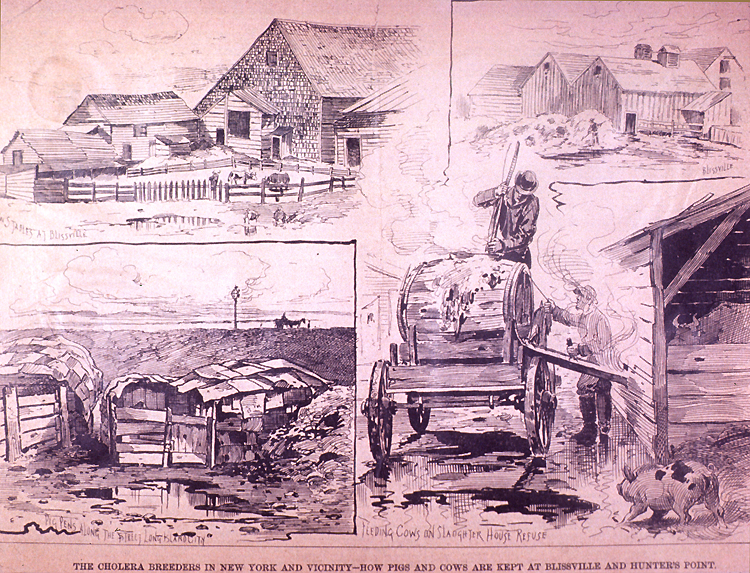
In 1879, conditions around the Hunters Point and Blissville sections of the Newtown Creek were infamous. The distilleries which lined the Queens banks produced a series of waste products, known collectively to the locals as “swill”, which was fed to a sickly group of cows and pigs imprisoned in overcrowded and hellish stables. Pneumonia and open sores were reported by state inspectors, and they intimated that animal waste was observed as mingling with the water in great abundances. The “swill milk” produced by these cattle was, of course, cheaper than more wholesome substitutes and meant for the children of the poor. The situation drew much attention at the time, and there is even an illustrated view of the conditions available at the National Institutes for Health, presented below (click image for full size).
The caption reads “The cholera breeders in New York and vicinity, how pigs and cows are kept at Blissville and Hunter’s Point.”
Who can guess, all there is, that might be buried down there… and what might be waiting to escape from a centuries long quarantine… in the deep sediments of the Newtown Creek?
from epa.gov
EPA conducted an Expanded Site Investigation (ESI) of Newtown Creek in 2009 as part of the Hazard Ranking System scoring process for NPL listing under Superfund. Based on the ESI, which was focused on Newtown Creek itself and not its tributaries, EPA concluded that metals, volatile organic compounds, and semi-volatile organic compounds (including polycyclic aromatic hydrocarbons and polychlorinated biphenyls) were present in Creek sediments at elevated concentrations. The variety and distribution of the detected contaminants suggests that they originated from a variety of sources. Previous environmental investigations of Newtown Creek, or specific portions of the Creek, also disclosed that sediments in Newtown Creek are contaminated by a wide variety of hazardous substances. Environmental investigations of upland parcels adjacent to or nearby the Creek have disclosed contamination of those parcels by hazardous substances similar to hazardous substances found in sediments in Newtown Creek.


