Posts Tagged ‘Queens Plaza’
pitying smiles

– photo by Mitch Waxman
Inveterate pedestrians who frequent the primary arteries of Queens will tell you that are few City streets like Jackson Avenue in Long Island City.
As the ancient thoroughfare slides past the Megalith at Court Square, one might observe- if atmospheric condition and time of day permit- the curious reflections cast by the mirror skin of the towering structure. Not long ago, a member of the cultural intelligentsia named Heidi Neilson published her novel and intriguing “Long Island City Sundial” concept, which describes the inverse of the what you’re seeing above.

– photo by Mitch Waxman
At Queens Plaza, where the first phase of the titan “Gotham Center” construction envisioned by the Tishman Speyer corporation nears completion, I’ve noticed a similarly reflective affect taking place as the burning thermonuclear eye of god itself plays across the polished and curiously curved mirror glass serving as its architectural facade (and curtain wall) which is tangentially similar to that observed at Court Square, just a few blocks away.
As a note, the recent posting “progress” follows the construction of the structure from the ground up and from every corner of the Newtown Pentacle in a slideshow format.

– photo by Mitch Waxman
Queens Plaza is a notoriously difficult environ for the photographer with it’s rich collection of elevated and shadow gathering steel trackways and their cyclopean aspect- it’s dark and dirty and the very air you breathe is a poisonous fume (due, no doubt, to the uncountable number of vehicles transiting it at any given moment). Vast inventories of vehicles, variegated and numerous, move in short bursts as they ache in traffic in order to transit to and from Queensboro.
What the place has always needed, required in fact, is merely better lighting!

– photo by Mitch Waxman
The seamless robe of that gloom and soot and hurried transit which 150 years of breakneck growth hath wrought seems to have finally been rent by the reflective light emanating from the new structure, illuminating the dimly lit and misunderstood bridge plaza. Lighting like this would be too expensive for the ordinary photographer or cinema “Auteur” to manufacture, especially given that at this location, and as the day progresses- the relections follow and present the inverse position of the burning thermonuclear eye of god itself as it rolls across the sky.
I would add that it is extremely uncomfortable to be in the direct path of these reflections or wander into one unexpectedly, as (given the permanent twilight around the rest of Queens Plaza) one’s pupils contract precipitously in the same manner as they might if a sudden camera flash erupted in an otherwise comfortably lit room.

– photo by Mitch Waxman
Strobing, the light returned from the reflective “blue with a hint of green” colored glass of the Gotham Center building is cool in temperature.
Studies in “color psychology” conducted by municipalities all around the world suggest that public area illumination accomplished and designed to utilize the blue frequencies of visible radiation suffer fewer incidents of public disobeyance, misdemeanor and felony incidents, and that other beneficial psychological effects are evidenced. For instance, the Keihin Electric Express Railway Co. of Yokohama (amongst others in Japan) installed blue lights at stations with high numbers of suicide attempts, Glasgow is apparently all about the blues, and the Police in Nara, Japan report a 9% drop in crime under blue lighting.
Perhaps this gigantic soft box in Queens Plaza is actually a mechanism designed to help quiet anticipations of a restive future population? It is meant to house the City’s Department of Health, after all.
This sounds like hippie talk to a humble narrator, however.
with palpitant heart

– photo by Mitch Waxman
Startlingly interesting is the only way to describe the experiences of the preceding year. Attempts have been made to cogently describe and colorfully illustrate the encounters your humble narrator has enjoyed in this 10th year of the millennium. For those of you who have just recently started to read this, your Newtown Pentacle, this is your chance to check out some of the highlights of 2010 (according to me), and for the veteran Lords and Ladies of the Pentacle an opportunity to review.
If you’ll indulge me…
January, 2010- The Abbot

The sort of posting which satisfies me deeply, “The Abbot” monument found at Calvary focused my attentions on certain realities of 19th century New York, and proved my theory that Calvary Cemetery is the single greatest historical resource in Queens. Obviation of my satisfaction with the posting is provided by the admission that I had noticed the stone peripherally, found it interesting, and started shooting it with no idea at all about its meaning. Only at home, when reviewing the photos did the whole story come together. Al Smith is buried at Calvary as well (he’s the fellow who built the skyscraper seen in the night shot at the head of this post) but this paragraph is about January 2010 and Governor Smith’s story was told in 2009.
January, 2010- The Great Machine

Also in January, a pet ideation was advanced, one not of theory but of perception. The notion of the megalopolis figures heavily in my thinking- a concept that sees the eastern seaboard of the United States not as a series of cities, but rather one vast urban zone of varying densities with New York City at the titular center of a web of industry, transport, and agricultural systems. The center of the web has a center itself, which is Manhattan- specifically where it connects to “the Great Machine” of the Queensboro bridge and it’s corollaries.

– photo by Mitch Waxman
February 2010– Affordable Housing Development on Borden Avenue

This post, “Affordable Housing Development on Borden Avenue“, is included in the year end wrap up simply because it ended up being one of the more widely read and commented upon endeavors presented in 2010. Most likely, it was the linking shout out from Queenscrap that made it so, rather than any subjective quality or incisive observation. Homeless camps abound in the Newtown Pentacle, hidden away on seldom trodden lanes and along backwater pathways- in this case it’s alongside the oft delayed construction project at the Borden Avenue Bridge which spans Dutch Kills.
February 2010– horrible and unearthly ululations…

A lot of time was spent in 2010 trying to wrap my head fully around the story of the Newtown Creek (which culminated ultimately in the late October release of the first Newtown Pentacle book- Newtown Creek for the vulgarly curious) and “horrible and unearthly ululations…” was the first of several posts which attempted to boil complicated and obscure snippets of historical lore into a cohesive and accessible form. So much is made of the Greenpoint Oil Spill and the Meeker Avenue Plumes by the legal community, whose hungry jowls slaver and shake at the financial possibilities offered by the EPA’s superfund designation and various court decisions, that the true and terrible wonder of the Newtown Creek is often overlooked. This post and several others of its ilk attempt to present a fuller version of things, and act as reminders that what was may once again be.

– photo by Mitch Waxman
March 2010– The Shadow over Sunnyside

The St. Pat’s Day for All parade in Sunnyside is a yearly event which draws in a citywide coterie of political entities, all desperate for attention and attribution as being friendly to the GLTG members of the electorate. The parades origins are a reaction against the banning of outwardly gay marchers in the RC church’s own St. Patricks day parade in Manhattan. Despite its politically contentious birthing, the Sunnyside parade is actually a fun and light hearted event, and signals the coming of springtime in the Newtown Pentacle. While there principally to get shots of the political master race which rules over us, amongst the crowd I noticed small clots of dire intent armed with ugly signage. Research into this group, which was clearly coordinated and queerly ominous, revealed them to be adherents to a bastardized form of Catholic fundamentalism which has been outlawed and defined as a dangerous cult by several Nation-states. A shadow over Sunnyside indeed.
March 2010– Exhausted
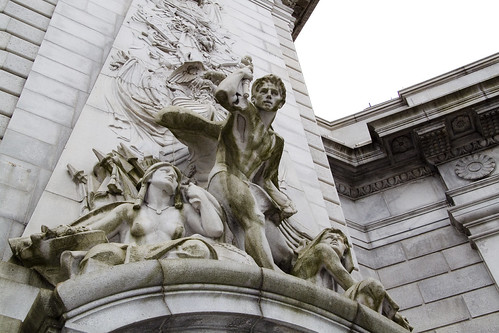
A brighter experience for your humble narrator was the Manhattan Bridge Centennial Time Capsule event, on March 5. Interactions and conversations were enjoyed by the least of men with certain powers and potentates of the City of Greater New York and entry to the interior space of the Manhattan Bridge was obtained. One of the high points of my year, “Exhausted” detailed the embedding of a time capsule in the East River Bridge #2- aka the Manhattan Bridge. Remarkable self control was exercised when I met the DOT Commissioner, Jeanette Sadik-Khan. My sincerest desire was to bend her ear with my alleged wisdom about bike lanes and bridge safety- but self control was ascendent that day and only congratulations were offered to both her and the other staffers at DOT.

– photo by Mitch Waxman
April 2010– City of Marble and Beryl
Odd shenanigans were observed at St. Michael’s Cemetery here in Astoria, which were of a decidedly magickal nature. A ritual site that your humble narrator stumbled across was examined and evidentiary examination suggested that certain third world cults were extant here in the old village of Astoria, conducting midnight bacchanals concurrent with the lunar cycle. “City of Marble and Beryl” was but the first of many moons which witnessed a working of will amongst the desolations of our kind.
April 2010– Searching for Gilman

A good part of 2010 was spent “Searching for Gilman” at First Calvary Cemetery, which I am doing as you are reading this, assuming it’s the start of 2011 whenever you do. Gilman is the source of no small amount of pain and financial hardship around these parts, as your humble narrator has become dangerously obsessive and paranoid around the subject. A psychotic need to find Gilman’s grave torments me, coloring my days and painting my dreams a dull yellow.

– photo by Mitch Waxman
May 2010– the king in yellow, brick
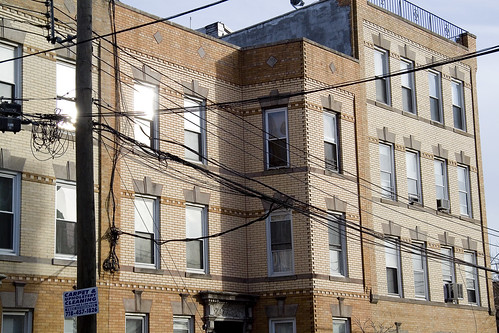
Remiss would be apparent were I to not mention the “Madison Avenue Bridge Centennial” but “the king in yellow, brick” advanced another of my pet theories and served up a fascinating (to me at least) sequence of events and relationships which attempts to explain why those yellow Kreischer bricks are all over the older sections of Queens.
May 2010– after cycles incalculable

“After cycles incalculable” is another one of those perfect posts, from a personal perspective. Wandering around with a friend, which is a disturbing trend which developed over the course of 2010, at Skillman Avenue’s start we observed the Lemuria hatching in concordance with the anniversary of the Roman festival of Lemuralia in Long Island City.

– photo by Mitch Waxman
June 2010– from Hells Gate, loosed upon the world

When I set out on my little walks, there is seldom a destination in mind. Literally wandering, obscure symbols and pseudo occultism guide my steps- I’ll follow a black cat, or merely adopt a roughly heliotropic path using my own shadow as compass. At the very end of May, my feet carried me toward Astoria Park and the notorious section of the East River known as Hells Gate. The odd craft, an “unidentified floating object” if you would, which sped past my lens required more than a small bit of detective work to identify- which was detailed in “from Hells Gate, loosed upon the world“.
June 2010– Gods Gift to Pain

English Kills, which is the logical and modern end of Newtown Creek, is a heavily industrialized and largely anaerobic tributary of the larger waterway and is seldom visited (by me, at least) at its extant. One fine day, while hanging out with another Creek enthusiast (you should not go to this place alone), we decided to enter the largely hidden urban foyer which leads here- despite the fact that we were most likely trespassing- which violates Newtown Pentacle policy. The title of the post- “Gods Gift to Pain” was lifted from an enigmatic and appropriate bit of graffiti observed in this forgotten pace of dissolution and poison.

– photo by Mitch Waxman
The reason for Brooklyn, and Queens- why it was a viable alternative to living in Manhattan in the 19th century was defined by the horrors of tenement life. The grand old buildings with their high ceilings, thick plastered walls, convenient dumbwaiters, and incredibly ornate lobbies- the structures which distinguished and made life desirable in the incalculably distant boroughs, were built as an alternative to the crowded and dangerous tenements of “The City”- especially the warren which was known as the “Five Points“. Additionally, Calvary Cemetery (of particular interest to me, and perhaps, to you) was founded by the parishioners of Old St. Patrick’s Cathedral which is smack dab in the middle of this ancient labyrinth of poverty, crime, and squalor. It was decided that to fully understand what one observes in the remains of the supposed “answer to the problem”, exploration of “the problem” itself is required.
July 2010– Bandits Roost, 2010

Ideal source material for the textural and societal milieu of the Five Points is the admittedly biased “How the Other Half Lives” by 19th century do-gooder Jacob Riis. Speaking the truth that power wants to hear is always a sound move if one considers fiscal realities and historical reputation. Attempts were made to find the modern locale in which Riis shot some of his more famous shots, such as this visit to “Bandits Roost 2010“.
July 2010– The house of Dagger John

Another critical visitation for me, as part of my larger education and study of the early development of the City of Greater New York was occasioned on the day when I went to “The house of Dagger John“. Old St. Patrick’s Cathedral satisfies both my continuing fascination with the counterpoint of sacred and profane in the story of the Megalopolis, and figures largely in the predictions of certain obscure lore which governs the schedule of my researches.

– photo by Mitch Waxman
August 2010– not to harsh anyone’s buzz… but…

August of 2010 brought a posting which garnered a lot of attention, due to curbed.com noticing and linking to it. Simply noticing that a growing proliferation of small boats were berthing illegally at the Vernon Avenue street end, it would be irresponsible of me- given everything that I know about the location not to point out the mortal and existential danger that the operators of these boats were placing themselves in. It’s not even the water, really, its the high pressure natural gas line- the enormous CSO which drains LIC- the omnipresent heavy industrial maritime traffic- which makes the spot so hazardous. Mortal threats were received via email (which I’ve kept private), and the comments thread displayed an angry and accusatory tone. As is the case with all such critique, these comments were presented verbatim- here’s a taste: “i have red your article in which you show a great deal of unger towards me and my friends . i believe that you base your article on many misconceptions that are rooted in a lack of communication”, “Blogger or not, the prudent journalist would make an effort to uncover basic facts before publishing a story full of assumptions”, “are you just the type of little man that tells teacher when the cool kids make you feel inferior. The water is public domain! And according to maritime law it is not illegal to moor a boat as long as it safe and looked after.”, “They are not bothering anyone. And get sick from the canal, come on. They are not living down there as far as I know. Parking your boat in the canal is not going to get them sick! Stop over doing it.” Check out “not to harsh anyone’s buzz… but…“.
August 2010– lively antics

One of the greatest joys of living in Queens are the chance encounters you’ll have with people who hail from the furthest points of the compass, such as this Bouzouki player during another visit to Hells Gate. His “lively antics” added splendor to a brightly lit walk around Astoria.

– photo by Mitch Waxman
September 2010– Lucky Shot

Although veteran photographers caution me against use of this term, I call the photo above my “shot of the year”. The steel structure attached to the bottom of the Brooklyn Bridge was installed as part of a bridge painting and maintenance project, and I was luckily along on a Working Harbor trip just as the sun was setting. Right place, right time, it was a “Lucky Shot“.
September 2010– stronger than fear

The dynamic new Safeboats utilized by NYPD and other entities around the harbor were a frequent subject over several of the Working Harbor expeditions I was lucky enough to attend. The many shapes, colorways, and missions of these quick little patrol boats are a delight to observe- and to those who would work maritime malice upon the metropolis- they are the head of the spear. Check out “stronger than fear“.

– photo by Mitch Waxman
A high of the year was the Newtown Creek Cruise which I had the honor of co-narrating with Bernard Ente on October 24th, of course, but the main topic of conversation amongst the antiquarian and environmental communities of the Newtown Pentacle in October revolved around the EPA’s superfund announcement about Newtown Creek at the very end of September. October is spooky time around these parts, and I spent a little time digging around the area for thrills and chills as well.
October 2010– blurred outlines

As part of series of postings detailing what might be seen in the Brooklyn neighborhood of Greenpoint, “blurred outlines” discusses the alleged appearance of a pyrokinetic at 84 Guernsey Street in January of 1895.
October 2010– scenes familiar, and loved

One of my frequent walks through Calvary Cemetery took me to the curiously empty chapel which enjoys the paramount of Laurel Hill. I will admit that I came here this day seeking two things- one was a likely entrance to a vast subterranean structure which underlies the area- the other was a vain hope that the grave of Gilman might present itself in a section which was, at the time, not terribly familiar to me as I normally stay close to the fringes of the place where the whipporwills wail. I very well might have captured what mass media paranormal media sources describe as a ghost orb in “scenes familiar, and loved“.

– photo by Mitch Waxman
November 2010– peace rests nevermore

One of the goals of this, your Newtown Pentacle, is to provide some sort of documentation about this terrible and wonderful place called the Newtown Creek- and I’m happy to say that I was there when the then Attorney General and Governor Elect Andrew Cuomo announced the settlement of a lawsuit brought by his office on behalf of New York State against Exxon-Mobil which involved the Greenpoint Oil Spill. “Peace rests nevermore” indeed.
November 2010– shocking coruscations

Entertaining maritime folklore from past centuries was offered in “shocking coruscations“, which is told against a series of twilight photos from good old Hells Gate between the two great bridges.

– photo by Mitch Waxman
During the cold, when inclement clime restricts my movements and the black dog nips at my heels, I tend toward shorter postings- and in December of 2010 there were two “Then and Now” postings that really took my fancy. These posts are difficult because of the scarce source material available in the public domain, but fun nevertheless. In my usual fashion “dumb idiot” fashion, I had shot the modern views completely unaware of the original photo. Our friends at the Greater Astoria Historic Society have recently released a book of similar historical views, which is worthy of consideration.
December 2010– Bowery Savings Bank 2010 and 1903

As the title states, this is the iconic shell of a once essential and awesomely powerful institution called the Bowery Savings Bank in Manhattan, with a 1903 photo from a similar perspective.
December 2010– Hunters Point Avenue Bridge Centennial

If you told me a year ago that I’d end up doing a press conference with a United States Congresswoman, I’d have hit you. That’s how I ended up at the Degnon Terminal’s own Sunshine Biscuits (LaGuardia Community College) building though, and by an odd coincidence- found myself standing in nearly the same spot as some unknown photographer did in 1921. This posting was built around the announcement of the “Hunters Point Avenue Bridge Centennial” event.

– photo by Mitch Waxman
Overall, a positive and exciting year, despite the deaths of several members of my family.
For a while, I enjoyed a spot on the board of the nascent Newtown Historical Society as a trustee, which is a position that I’ve had to resign for a variety of personal reasons- but I’d like to thank fellow board members Kevin Walsh, Christina Wilkinson, Steve Garza, and Bob Singleton for an interesting and educational experience. Kevin Walsh of forgotten-ny gets a personal call out, as his support, knowledge, and encouragement has been invaluable. Special thanks also are extended toward Capt. John Doswell and Meg Black of the Working Harbor Committee, all the guys and gals aboard the John J. Harvey fireboat, and everybody else who allowed a piss poor specimen such as myself to come along on adventures. Bernard Ente of the Newtown Creek Alliance, Working Harbor, and others also receives a heartfelt gratitude and shout out from this humble mendicant. Standing on the shoulders of giants is difficult if you suffer from altitude related nosebleeds.
What’s next?
Tell you what, feel like taking a walk?
Meet me at the border of Brooklyn and Queens – bring a camera… and ID… I’ll show you something cool…
Progress
– photos by Mitch Waxman
The growth of the Tishman Speyer Gotham Center building in the new Queens Plaza, from every corner of the Newtown Pentacle.
wholly kaleidoscopic

– photo by Mitch Waxman
Often have the Sunnyside Yards been referred to at this, your Newtown Pentacle, as cyclopean- gargantuan- or titanic.
Perhaps it is just that we New Yorkers are not used to seeing such accumulations of acreage and open sight lines, or just maybe its that the 2-3 stories down surface upon which the tracks are laid down is the actual hardscrabble earth, not the engineered “ground” upon which we walk and drive.
from wikipedia
The yard is owned by Amtrak, but it is also used by New Jersey Transit. The shared tracks of the Long Island Rail Road (LIRR) Main Line and Amtrak’s Northeast Corridor pass along the southern edge of the yard. Plans for the LIRR East Side Access project to build tracks to Grand Central Terminal would have those tracks diverging in the vicinity of, or perhaps through, the Sunnyside Yard.
Northeast of the yard a balloon track (or reverse loop) is used for “U-turning” Amtrak and NJ Transit trains which terminate at Penn Station. Leading eastward near the south side of the yard, this balloon track switches off and turns left under the LIRR/Amtrak tracks, turns left once again, and merges with the Sunnyside yard track to turn the train west toward Penn Station.

– photo by Mitch Waxman
Recently, while moving through Queens Plaza on one of the sultry afternoons which have so far typified the summer of 2010, I found myself at one of the “hidden in plain sight” vantage points by which facility laborers enter and leave the place and the very edge of a high security “homeland security type” area.
During non peak hours, the yard acts as a staging and holding area for various Manhattan bound commuter trains, which is why in the above shot you’re seeing Amtrak parked next to New Jersey Transit and the Long Island Railroad transits through the place on a regular schedule.
from plannyc.org
Sunnyside Yards Platform
The Sunnyside Yards development proposal has been discussed by city planners, developers, and community advocates for decades. The report recommends that builders put between 18,000 and 35,000 housing units on the site, depending on the zoning. There would also be schools, parks land and an interposal transportation facility for the MTA, LIRR, Amtrak and bus service. Some advocates hope the project would include a guarantee of 50 percent affordable housing.
The property, which is owned by Amtrak and is primarily used by New Jersey Transit, is enormous. It runs from Laurel Hill Avenue on the east to Hunters Point Avenue on the west. To put it into perspective, if the property were in Manhattan, it would span 42nd to 59th Street, from Fifth Avenue to Lexington Avenue.

– photo by Mitch Waxman
Built by the Pennsylvania Railroad Company in 1910, at its height the Sunnyside yard had 45 tracks and a capacity of 552 cars. It provides area trains with connections to the New York Connecting Railroad which provides Amtrak and the cargo carriers like CSX access off of Long Island and the New York archipelago over the Hellgate Bridge to the mainland.
from wikipedia
The P32AC-DM locomotive was developed for both Amtrak and Metro-North so it can run off power either generated by the on-board diesel prime mover or collected from a third rail electrification system at 750 volts direct current. The P32AC-DM is rated at 3,200 horsepower (2,390 kW), 2,900 horsepower (2,160 kW) when supplying HEP, and can obtain a maximum speed of 110 mph (177 km/h)

– photo by Mitch Waxman
The yard also serves Amtrak’s Acela service, which is a high speed train line, but this is one of the so called Genesis trains that is pulling forward, one of the work horses of the Northeast Corridor.
from subwaynut.com
The Genesis P32AC-DM are a regional service dual mode locomotive found exclusively on almost every train between New York and Albany (These are Empire Service trains, the Maple Leaf, the Aderondeck, the Ethan Allen Express, and the Lakeshore Limited). This is beacause trains entering Penn Station can not be diesels. The trains use there diesel locomotives throughout the trip from Albany until just near Penn Station when the driver puts the third rail shoe down and uses this, there is no change felt to passengers on board. The train then stops at Penn Station, discharges all regular passengers and then runs light under the east river on the third rail, and into Amtrak’s Sunnyside Yard.
mother of invention

– photo by Mitch Waxman
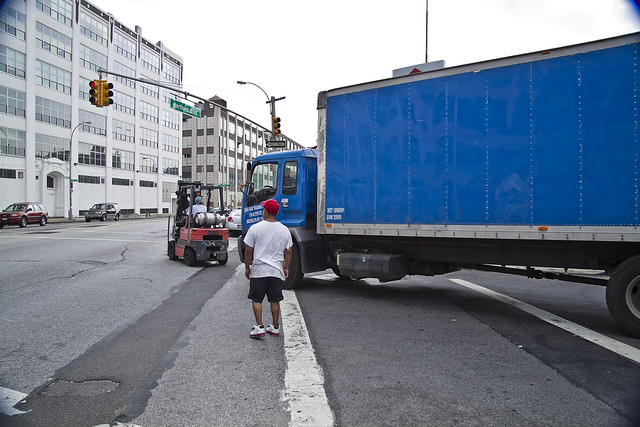
Another recent bit of serendipity experienced during a random walk, this time a bit further down Northern Blvd. and directly across the street from the Standard Motor Products building on 39th street, it seems that the good fellows who operate this largish delivery truck had experienced an unlucky turn when its engine suddenly stranded them. Luckily, they seemed to have a tiny red forklift on board, of a sort which I’ve always heard referred to as a “Bobcat”.
from wikipedia
Forklifts are rated for loads at a specified maximum weight and a specified forward centre of gravity. This information is located on a nameplate provided by the manufacturer, and loads must not exceed these specifications. In many jurisdictions it is illegal to remove or tamper with the nameplate without the permission of the forklift manufacturer.
An important aspect of forklift operation is that most have rear-wheel steering. While this increases maneuverability in tight cornering situations, it differs from a driver’s traditional experience with other wheeled vehicles. While steering, as there is no caster action, it is unnecessary to apply steering force to maintain a constant rate of turn.
Another critical characteristic of the forklift is its instability. The forklift and load must be considered a unit with a continually varying centre of gravity with every movement of the load. A forklift must never negotiate a turn at speed with a raised load, where centrifugal and gravitational forces may combine to cause a disastrous tip-over accident. The forklift are designed with a load limit for the forks which is decreased with fork elevation and undercutting of the load (i.e. load does not butt against the fork “L”). A loading plate for loading reference is usually located on the forklift. A forklift should not be used as a personnel lift without the fitting of specific safety equipment, such as a “cherry picker” or “cage”.

– photo by Mitch Waxman
The inert truck was borrowing its motive power from the smaller and self propelled tool. Its driver clearly seemed embarrassed by all the attention he garnered. Several of us stood on the corners, males all, sporting broad smiles and cheering him on while he waited for a red light to turn. This sort of situation appeals to we men, I don’t know why, but it does.
I was betting on either the inadequate chain just sundering into constituents, or the forklift burning out its transmission before it moved the giant blue vehicle more than a couple of feet.
from wikipedia
A high-tensile chain, also referred to as a transport chain, is a link chain with a high tensile strength used for drawing or securing loads. This type of chain usually consist of broad (thick/heavy) metal, oblong torus-shaped links for high strength. All the links of the chain are usually identical, and on the ends are usually two hooks of the appropriate size and strength to slide easily over one chain link but small enough not let the links slip by. When the ability to grasp the load is required, a slip hook is used.
The chain used for tire chains on tractors and some automobiles for better traction is very similar; usually consisting of the same type of link, especially so for snow chains; however, instead of being a single chain, it is more of a network of interconnected chains with no hooked ends; the size and design of the network depending on the tire it was intended for.

– photo by Mitch Waxman
The signal turned, and that tiny forklift and its driver wouldn’t let anything like the laws of Physics or the limits of engineering stop them from getting the truck moving.
Whom, indeed, says that an ant can’t move a rubber tree plant? Whom?
from wikipedia
They usually range in size 4 to 7 m in length, with smaller or larger sizes existing but being rare in North America. They usually have a garage door-like rear door that rolls up. On some box trucks, the cargo area is accessible from the cab through a small door.
Box trucks are usually used by companies that need to haul appliances or furniture. They are also used as moving trucks which can be rented from companies such as U-Haul or Ryder.
In North America, Ford, Dodge and Chevrolet/GMC have historically been the most common manufacturers of conventional cab/chassis to which various producers (called body builders or upfitters) attach the box that holds cargo. Isuzu, Mitsubishi Fuso and UD/Nissan Diesel have been the most common marketers of cabover-type medium duty cab/chassis used as platforms for box trucks. In North America, these trucks can range from Class 3 to Class 7 (12,500 lb. to 33,000 lb. gross vehicle weight rating, or GVWR).
– photo by Mitch Waxman
The drivers around these parts- borderland and angle between Sunnyside, Astoria, and Dutch Kills- are not exactly a sagacious or patient lot. Normal practice for them is to hit their horns in the quarter second before the traffic light goes from red to green, and to accelerate precipitously in an effort to “beat the lights”. Queens Plaza is nearby, and their probable destination of Manhattan- unlike Queens- is a heavily regulated and well policed thicket of traffic jams. This is their last chance to see the sky.
Well… not for long.
from wikipedia
A gross vehicle weight rating (GVWR) is the maximum allowable total mass of a road vehicle or trailer when loaded – i.e including the weight of the vehicle itself plus fuel, passengers, cargo, and trailer tongue weight.
The difference between gross weight and curb weight is the total passenger and cargo weight capacity of the vehicle. For example, a pickup truck with a curb weight of 4,500 pounds (2,041 kg) might have a cargo capacity of 2,000 pounds (907 kg), meaning it can have a gross weight of 6,500 pounds (2,948 kg) when fully loaded.

– photo by Mitch Waxman
Witness the tenacity and determination of the American workforce- its inchoate improvisations and hazard ridden solutions that keep the machines running no matter what, its complete disregard for official procedure and personal safety -unstoppable, indefatigable, the children of necessity.
from wikipedia
New York State Route 25A (NY 25A) is a New York State highway and the main east–west route for most of the North Shore of Long Island, running from the Queens Midtown Tunnel in the New York City borough of Queens at its western terminus to Calverton in Suffolk County at its eastern end.
Known for its scenic route through decidedly lesser-developed areas such as Brookville, Fort Salonga, Centerport, and the Roslyn Viaduct, 25A begins as 21st Street in Long Island City. As you go farther through 25A, it is then known as Jackson Avenue for a short period and is variously named Northern Boulevard east of Queens Plaza (NY 25), North Hempstead Turnpike, Main Street, Fort Salonga Road, and North Country Road. It merges with NY 25 for approximately 1.5 miles (2.4 km) in Smithtown.


 The Newtown Pentacle