Posts Tagged ‘queens’
the last birthday of the Kosciuszko Bridge
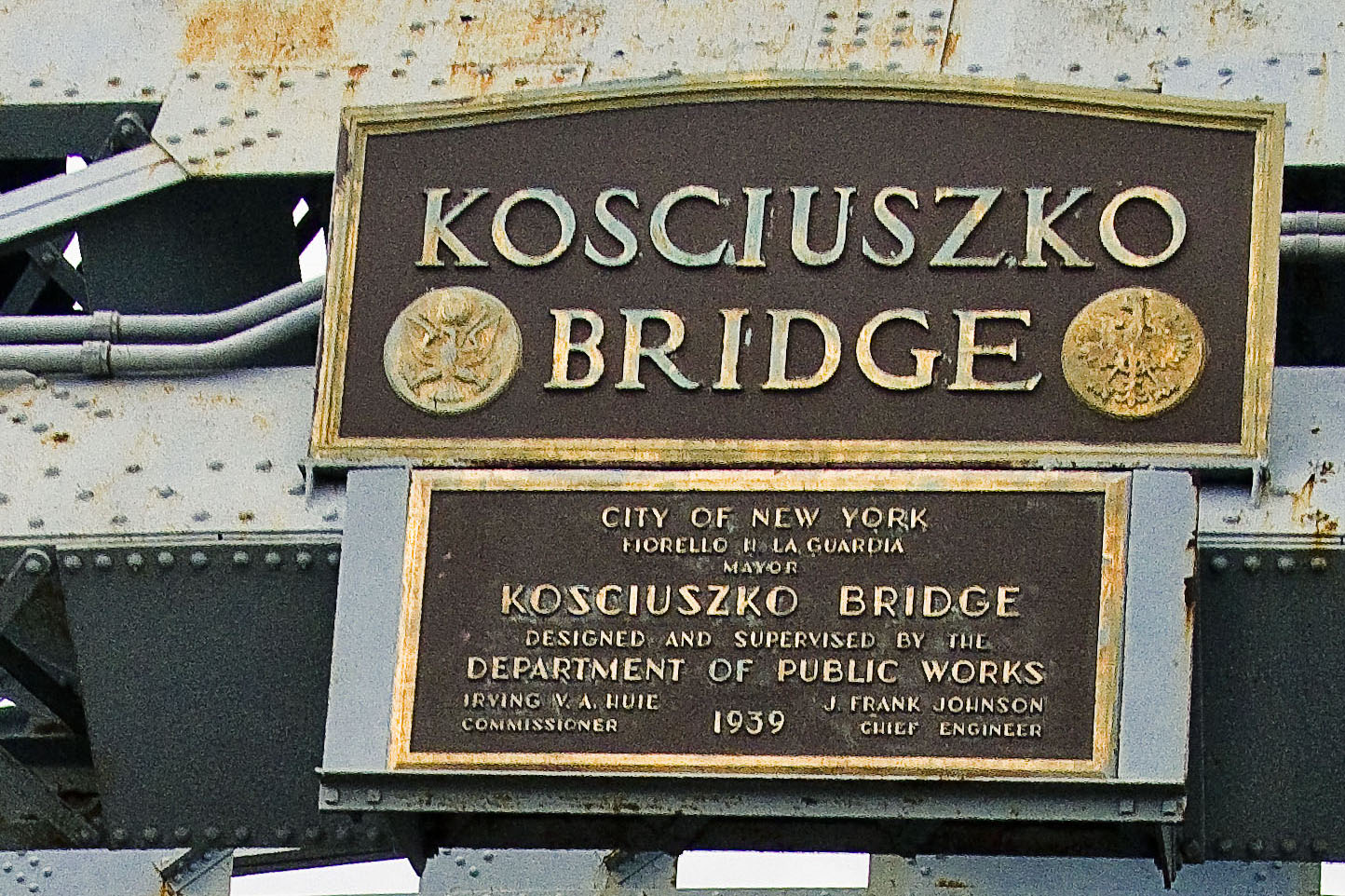
– photo by Mitch Waxman
Oh, the old gray mare, she ain’t what she used to be,
Ain’t what she used to be, ain’t what she used to be.
The old gray mare, she ain’t what she used to be, Many long years ago.
Seventy Three years ago today, the Little Flower cut the ribbon and officially opened the “New Meeker Avenue Bridge” to traffic. The following April in 1940, it was renamed as the Kosciuszko Bridge.
It’s the Night of the Living Dead, by the way. Also, it’s Vulcanalia…
August 23, 1939, image New York City Municipal Archives at nycma.lunaimaging.com

– photo by Arthur J. Foley
According to the Long Island City Star-Journal of August 24th, 1939– the lineup of folks in the shot and action above are described as:
Mayor LaGuardia snips the ribbon which admitted the first autos lo use the lofty new Meeker Avenue Bridge over Newtown Creek in Laurel Hill, at the dedication held yesterday at Laurel Hill Plaza. To the right of the mayor is Acting Borough President John J. Halloran of Queens. To his left is Borough President Raymond V. Ingersoll of Brooklyn. Left of Ingersoll is Frederick J. H. Kracke, who was commissioner of Plant and Structures when that department originated plans for the bridge.

– photo by Mitch Waxman
American Bridge Company and Bethlehem Steel worked on her, along with dozens of other contractors. The Big K was part of what was known as “the Regional Plan”, which also provied the pretext for the erection of the Triborough, Whitestone, Marine Parkway and a slew of other bridges across the archipelago.
July 14, 1939, image New York City Municipal Archives at nycma.lunaimaging.com,

– photo by Arthur J. Foley

– photo by Mitch Waxman
Odds are very good that this is her last birthday, as the “Fast Track” program announced by the Governor will be kick starting the construction of a “Newer Meeker Avenue Bridge”- or perhaps the “Kosciuszko Two”- by the late spring of 2013. She will be gone by 2017, if one were to believe the schedule currently touted by State officials.
June 29, 1939, image New York City Municipal Archives at nycma.lunaimaging.com,

– photo by Joseph Shelderfer

– photo by Mitch Waxman
The historic shots included in this post all link out to the New York City Municipal Archives site, which has famously begun releasing thousands of historic images of the City online. One of the tricks to using the system, I’ve discovered, is knowing what things used to be called. It’s a “streetcar” versus “trolley” kind of thing. We call the former light rail system by the latter name, while those who dwelled in the past used the former.
June 29, 1939, image New York City Municipal Archives at nycma.lunaimaging.com,

– photo by Joseph Shelderfer

– photo by Mitch Waxman
Very little information is available about the construction and planning of the Kosciuszko, but there’s plenty about the New Meeker Avenue Bridge. The Big K was built for two official reasons- first, to provide a link between the multitudes of infinite Brooklyn and the World Fair Grounds in Flushing (Flushing Meadow Corona Park), and secondly to replace the aging swing bridge that spanned Newtown Creek between Meeker Avenue in Brooklyn and Laurel Hill Blvd. in Queens. Unofficially, Robert Moses really wanted to get the Brooklyn Queens Expressway built and this was as good a place as any to start.
August 14, 1939, image New York City Municipal Archives at nycma.lunaimaging.com,

– photo by Arthur J. Foley

– photo by Mitch Waxman
One does look forward to that day in the latter half of this decade, which I seriously doubt will be anything even close to 2017, when the pedestrian lane of the new bridge will be open for inspection. One of the most frustrating parts of the current bridge is that it once sported such a lane for perambulation, but it has long been closed off- thwarting photographic exploitation of the surreal vantage point that it offers.
How I would love to set up a tripod on the Kosciuszko Bridge…
from nydailynews.com
style=”padding-left:30px;”>Construction on a new bridge is now expected to begin in spring 2013 — a year ahead of schedule, thanks to $460 million made available for the job by Gov. Cuomo’s New York Work initiative.
The 73-year-old bridge, which carries the Brooklyn-Queens Expressway over the Newtown Creek, qualified for the money in part because it is on the state’s “deficient bridge” list.
The initial phase of construction will build an eastbound lane next to the existing bridge, according to the state Department of Transportation, the agency overseeing the project. The 1.1-mile bridge is expected to be done in 2017 and will cost about $800 million.
When completed, two new spans with a total of nine vehicle lanes and paths for pedestrians and bikes will replace the original structure.
Here’s a rare historic shot- in color- of the mighty span, from the year it was opened, also courtesy New York Municipal Archives

– photo by New York City Municipal Archives

– photo by Mitch Waxman
And just as a remider, in the name of public good and an abundance of caution- don’t forget about the whole Night of the Living Dead thing- this could be trouble.
from youtube– I’d suggest skipping forward to the 1 hour 13 minute marker, btw, unless you’ve got time to watch the whole flick via the Crackle Youtube page.
budding branches

– photo by Mitch Waxman
Returning from scouting a tour in hoary Greenpoint recently, your humble narrator was lucky enough to encounter the shot above waiting for me on Hunters Point avenue in Queens. Whereas I do seem to take quite a few shots of locomotives, I am no “railfan”. A true railfan or “foamer” obsesses over schedules and would be waiting for this train to pass. With me, it’s just pure serendipity. This is, of course, an Amtrak train heading for the Belmont tunnels which offer egress from Long Island to Manhattan via the Sunnyside Yards rail complex in Queens.

– photo by Mitch Waxman
In many ways, one can understand the apathy felt by the Manhattan elites toward Long Island City, for what do they see of the wonders hidden therein from the East River? Even the Newtown Creek appears to be just a simple bay from the water, another unremarkable inlet on the western coastline of a Long Island.

– photo by Mitch Waxman
Perhaps this is why I’ve been drawn to conducting all of these tours. Famously, the Newtown Creek Alliance motto is “Reveal, Restore, Revitalize”, and in my capacity as group historian- I’m the “reveal” guy. Next Saturday, I’m going to be doing some of that “revealing”- there are still a few tickets left for “the Poison Cauldron” walk- do come along, if you dare.

– photo by Mitch Waxman
Long have I been reluctant to bring people to this place.
For several months now, your humble narrator has been narrating in a not so humble fashion while leading boat and walking tours of the Newtown Creek watershed.
Literally hundreds of people have attended either the “Thirteen Steps around Dutch Kills“, “Insalubrious Valley“, or “Newtown Creek Boat Tour” events this year- and one question has been asked by all- “What about the Greenpoint Oil Spill?”.
Next week- a group of enthusiasts will be assembling, under the auspices of Atlas Obscura, to explore the lamentable “Poison Cauldron” of the Newtown Creek.
There are still tickets available, should you care to witness the place prior to its forthcoming demolition.

– photo by Mitch Waxman
Down Under the Kosciuszko Bridge Onramp, or DUKBO, is the name I’ve assigned to this lunar landscape of industrial mills and waste transfer stations which lines the Brooklyn side of the Creek. This year is functionally the last time you will be able to witness this place, as the Kosciuszko Bridge replacement project will be kicking into high gear in the spring of 2013.
For the urban explorer and photographer crowd, this is a wonderland of shattered streets and rusted infrastructure which will soon be eradicated from all but living memory.

– photo by Mitch Waxman
The tour will tell the story of Standard Oil at its start and cross over the Greenpoint Oil Spill’s heart, revealing that lost world of industrial aspiration and 20th century dissolution which lies less than a mile from the geographic and population centers of New York City.
In the past, I’ve described the area as “Mordor” at this, your Newtown Pentacle, and the Tolkien analogy is apt. The very air you breathe is a poisonous fume, the water is hopelessly tainted with bizarre combinations and millions of gallons of petroleum and industrial chemicals, the soil is impregnated with heavy metals, asbestos, and truly- who can guess all there is that might be buried down there?
An odd concentration of food distribution, waste transfer and garbage handling facilities, and energy industry plants make the area remarkable, and everywhere you look will be a “colour“- a bizarrely iridescent sheen which resembles no wholesome nor familiar earthly color but is instead like something from out of space- coating every bit of broken masonry and the sweat slicked skin of laborer and passerby alike.

– photo by Mitch Waxman
Standard offer copy follows:
Meetup at the corner of Kingsland and Norman Avenues in Greenpoint at 11 on Saturday, August 25th.
We will be exploring the petroleum and waste transfer districts of the Newtown Creek watershed in North Brooklyn. Heavily industrialized, the area we will be walking through is the heart of the Greenpoint Oil Spill and home to scores of waste transfer stations and other heavy industries. We will be heading for the thrice damned Kosciuszko Bridge, which is scheduled for a demolition and replacement project which will be starting in 2013. Photographers, in particular, will find this an interesting walk through a little known and quite obscure section of New York City.
Be prepared: We’ll be encountering broken pavement, sometimes heavy truck traffic, and experiencing a virtual urban desert as we move through the concrete devastations of North Brooklyn. Dress and pack appropriately for hiking, closed toe shoes are highly recommended- as are a hat or parasol to shield you from the sun.
Bathroom opportunities will be found only at the start of the walk, which will be around three hours long and cover approximately three miles of ground. Drivers, it would be wise to leave your cars in the vicinity of McGolrick Park in Greenpoint.
Click here for tickets, and as always- a limited number of walk ups will be welcomed- but for safety reasons we need to limit the group to a manageable size. Contact me at this email if you desire further details.
more sights

– photo by Mitch Waxman
A short one today, just a shot of a cool van recently spotted in Astoria. Today’s a summer friday at this, your Newtown Pentacle, it would seem.
evil counsel

– photo by Mitch Waxman
As mentioned in prior postings, there are certain dates on the calendar which are remarkable for the long list of significant events which have made their mark in the historical record. August 9th is one of those days.
In 586 BCE, for instance- the Temple of Solomon was toppled during the Babylonian siege of Jerusalem, and in 1483- the Sistine Chapel was opened for Mass in Rome. In 1936, Jesse Owens won his fourth gold medal in Berlin.

– photo by Mitch Waxman
Charlie Manson sent his Helter Skelter squad to Sharon Tate’s place on the ninth of August in 1969, and the Victorian era ended when the Edwardian began in Great Britain. In 48 BCE, Julius Caesar and his Legions won the Battle of Pharsalus against Pompey. In 117 AD, a Caesar named Trajan died, and two hundred sixty one years later in 378- another named Valens was obliterated by the Visigoths.

– photo by Mitch Waxman
Today is the “national day” of Singapore, the Eastern Orthodox feast day of Saint Herman of Alaska, and the day that Jerry Garcia died. It’s also the day that history changed forever, for the second time, when the city of Nagasaki ceased to be.

– photo by Mitch Waxman
This is the 222nd day of the 12th year of the 2nd millennia, and the anniversary of Richard M. Nixon resigning the Presidency of the United States. It’s also the United Nations “International Day of the World’s Indigenous People“.

– photo by Mitch Waxman
We’ve just passed through the halfway point of summertime in the Northern Hemisphere, on this oddly propitious date. History is a series of coincidences, strung together after the fact, but any calendrical marker which ties together the fall of the Temple of Solomon with the rise of Caesar, the fall of Dick Nixon, the great working of Charlie Manson, and the use of an Atomic Bomb betrays something else. Dire portent abounds.
something sinister

– photo by Mitch Waxman
Shaken with the potencies of blackest revelation and shattered faith on a July evening, one found himself back at the loquacious Newtown Creek and once again straddling the currently undefended border of Brooklyn and Queens. Slaked with sweat, stricken by those fiery emanations pouring forth from the burning thermonuclear eye of god itself, your humble narrator decided to “lean into it” for the final push back to Astoria after a productive but quite humid summer day spent wandering about the Newtown Pentacle. An alarming lack of awareness of my surroundings overcame me, and I found myself fixated once more upon the sapphire tower.
My feet may have been moving, but my eyes never left the Megalith.
from wikipedia
A fugue state, formally dissociative fugue or psychogenic fugue (DSM-IV Dissociative Disorders 300.13), is a rare psychiatric disorder characterized by reversible amnesia for personal identity, including the memories, personality and other identifying characteristics of individuality. The state is usually short-lived (ranging from hours to days), but can last months or longer. Dissociative fugue usually involves unplanned travel or wandering, and is sometimes accompanied by the establishment of a new identity.
After recovery from fugue, previous memories usually return intact, but there is typically amnesia for the fugue episode. Additionally, an episode of fugue is not characterized as attributable to a psychiatric disorder if it can be related to the ingestion of psychotropic substances, to physical trauma, to a general medical condition, or to psychiatric conditions such as delirium, dementia, bipolar disorder or depression. Fugues are usually precipitated by a stressful episode, and upon recovery there may be amnesia for the original stressor (dissociative amnesia).

– photo by Mitch Waxman
It must have just been the burning thermonuclear eye of god itself glinting off the artless blue glass as it dipped toward the terminal horizon beyond Manhattan, sending crepuscular arcs of refracted red and yellow light along unknown and incalculable parabola. For a moment- your humble narrator thought that that which cannot possibly exist up there was visible.
A quick change of lens on my camera allowed a vain search and fruitless attempt at a second look, but the phantom image was recorded nowhere else beside my own fevered brain.
Dehydration must have been setting in, with too many hours spent while marching involuntarily through the concrete devastations of North Brooklyn and Western Queens in the summer heat- causing hallucination and overt credulity.
from wikipedia
Theories of deindividuation propose that it is a psychological state of decreased self-evaluation and decreased evaluation apprehension causing antinormative and disinhibited behavior. Deindividuation theory seeks to provide an explanation for a variety of antinormative collective behavior, such as violent crowds, lynch mobs, etc. Deindividuation theory has also been applied to genocide and been posited as an explanation for antinormative behavior online and in computer-mediated communications.
Although generally analyzed in the context of negative behaviors, such as mob violence and genocide, deindividuation has also been found to play a role in positive behaviors and experiences. There still exists some variation as to understanding the role of deindividuation in producing anti-normative behaviors, as well as understanding how contextual cues affect the rules of the deindividuation construct.

– photo by Mitch Waxman
Paranoia is omnipresent by default while scuttling about, as certainty states that one is being photographed every moment by automatic security cameras while out in public. Whether there is any single human watching or noticing these recordings is another thing entirely. It occurs that the stream of raw data captured by passive surveillance alone in New York City on any given day- the ATM’s and Deli cameras alone- would take years to catalog, let alone review. Likely, it will be artificial intelligences of the near future that will perform high speed analysis of such tasks.
An articulated and artificial thing which cannot possibly exist at the apex of the Megalith, of course, sees all. No utility can be found in hiding from it, as it casts its three lobed eye about and watches the world of men.
from wikipedia
Sigmund Freud considered that ideas of reference illuminated the concept of the superego: ‘Delusions of being watched present this power in a regressive form, thus revealing its genesis…voices, as well as the undefined multitude, are brought into the foreground again by the [paranoid] disease, and so the evolution of conscience is reproduced regressively’.
In his wake, Otto Fenichel concluded that ‘the projection of the superego is most clearly seen in ideas of reference and of being influenced….Delusions of this kind merely bring to the patient from the outside what his self-observing and self-critical conscience actually tells him’.
Lacan similarly saw ideas of reference as linked to ‘the unbalancing of the relation to the capital Other and the radical anomaly that it involves, qualified, improperly, but not without some approximation to the truth, in old clinical medecine, as partial delusion’ – the ‘big other, that is, the other of language, the Names-of-the-Father, signifiers or words’, in short, the realm of the superego.


