Posts Tagged ‘railroad’
Scuttling with trains
Friday

– photo by Mitch Waxman
On the south side of the Monongahela River, where a scuttling narrator found himself walking on the Three Rivers Heritage trail, and CSX #2720 was framed up all nice against the Fort Pitt bridge after it hurtled into the frame, here in Pittsburgh. I knew 2702 was coming, as I had heard signal arm alarm bells ringing from about a half mile distant, and one was desirous of making sure that I ‘got the shot.’ I had ceased experimenting with my two new lenses for a moment, and installed an ‘old reliable’ onto the camera – the 35mm f1.8.
This sort of ‘photowalk’ catch as catch can thing is a whole lot easier when you’ve got a zoom lens on the camera, but that wasn’t the point of what I was doing on this particular day. Test the new glass and get some exercise, that was me.

– photo by Mitch Waxman
There wasn’t any cargo being moved around on #2720, instead it was one of several locomotive engines that were coupled together and moving westwards on the tracks. I continued along the trail’s path, with the ultimate goal of arriving at that brewery I’ve been enjoying hanging around at, and rehydrating myself with a pint of Pilsner.
After quaffing my glass of beer, there were a few more lens tests which I wanted to perform in low light, and my plan was to ride the T light rail back towards HQ. I absolutely treasure the days when I don’t have to drive and can leave the Mobile Oppression Platform back home, in the driveway. The pluses of owning a car are many, but there’s also the whole responsibility thing and sometimes I just want to be ‘foot loose and fancy free,’ if you know what I mean.

– photo by Mitch Waxman
Another CSX train – #4228, pictured above – came roaring towards me. Where this shot was gathered, there’s a grade crossing of the tracks and a couple of those signal arms with the bells. That gave me the time and warning required to swap out the 35mm for the 16mm, and test out its focus tracking performance.
Where the shot above fails for me revolves around the wide angle distortion, which distracts me. The big discovery, mentioned earlier in the week, about this particular lens is that your subject needs to be in the dead bang center of the frame or the image distorts oddly. Live and learn, huh? That’s the whole point of testing a gizmo and seeing what it can do and where it fails.
Back next week with more – from the Paris of Appalachia, at this – your Newtown Pentacle.
“follow” me on Twitter- @newtownpentacle
Buy a book!
“In the Shadows at Newtown Creek,” an 88 page softcover 8.5×11 magazine format photo book by Mitch Waxman, is now on sale at blurb.com for $30.
Rinse and repeat
Monday

– photo by Mitch Waxman
Yet another doctor’s appointment, and post surgical checkup, was endured by Our Lady of the Pentacle at Allegheny General Hospital. Thus – her loyal husband, your humble narrator, and journeyman chauffeur – had some time to kill. The Mobile Oppression Platform was piloted over to an opportune parking spot nearby Pittsburgh’s Allegheny Commons Park West Park after dropping her off. I went to a spot where a four tracked trench exists, one which allows rail egress through the city which avoids ‘at grade’ road crossings. One exploited this location previously, as displayed in a post from last week.
That’s Norfolk Southern’s locomotive engine #4705 pictured above. I’m told it was built in 1980 as a ‘EMD GP50’ model, but Norfolk Southern rebuilt the thing, refashioning it into a ‘EMD GP33ECO’ model at its Juniata Locomotive Shop in Pennsylvania’s Altoona. It complies with EPA’s ‘Tier 3’ pollution standards, in its modern configuration.
4705 has got 3,000 HP going on, under its hood, which provides some 64,200 lbs of tractive power. It was quite loud, as its engine sounds were bouncing around, on and off of those masonry walls.

– photo by Mitch Waxman
There was a delay at the Doctor, so Our Lady was stuck in the hospital for an hour or so later than we anticipated. Luckily, there’s a pizza shop nearby which is operated by a fellow named Anthony Badamo who learned his trade in GREENPOINT, BROOKLYN. After capturing these shots, I drove over to the North Side Badamo’s location (he has another one in Dormont, nearby HQ) and quaffed a couple of properly made slices of pizza. You people back in NYC have no idea how bad most Pittsburgh pizza actually is.
There’s an abrogation of all that’s holy called ‘Ohio Style’ which one of my neighbors back in Dormont is a devotee of. Avoid it. At all costs, avoid it. ‘Philadelphia style’ is also nasty, and makes the Mama Celeste frozen supermarket stuff seem palatable, but Y’know… Philly… everything about America’s consolation prize – Philly – just sucks. You’ve also got a few joints here that offer up the tomato and meat casserole which Chicago people will tell you is pizza.
It’s not pizza, it’s just a mess.
– photo by Mitch Waxman
The block which the Badamo’s pizzeria is found on is also one where a lot of the North Side’s homeless street people spend their days, and a humble narrator standing alongside the car while eating out of the pizza box started attracting their attentions upon me.
The first guy who beggared me got a slice of pizza, as he told me he was hungry and a slice was only a couple/three bucks, and I don’t like the idea that anyone is hungry when a bit of my pocket change can fix that for at least a little while. I’ve been buying bagels for bums my whole life. My one condition is that they eat the food in front of me, so I know they won’t turn around and trade it for other ‘substances’ with one of their crew.
His opportunist compatriots, however, then began sizing me up and figuring out how much they could get if they were to boil me down for base elements, so I hopped in the car and drove to another spot closer to the hospital to finish lunch. Being charitable is one thing, being predated by addict scumbags is another.
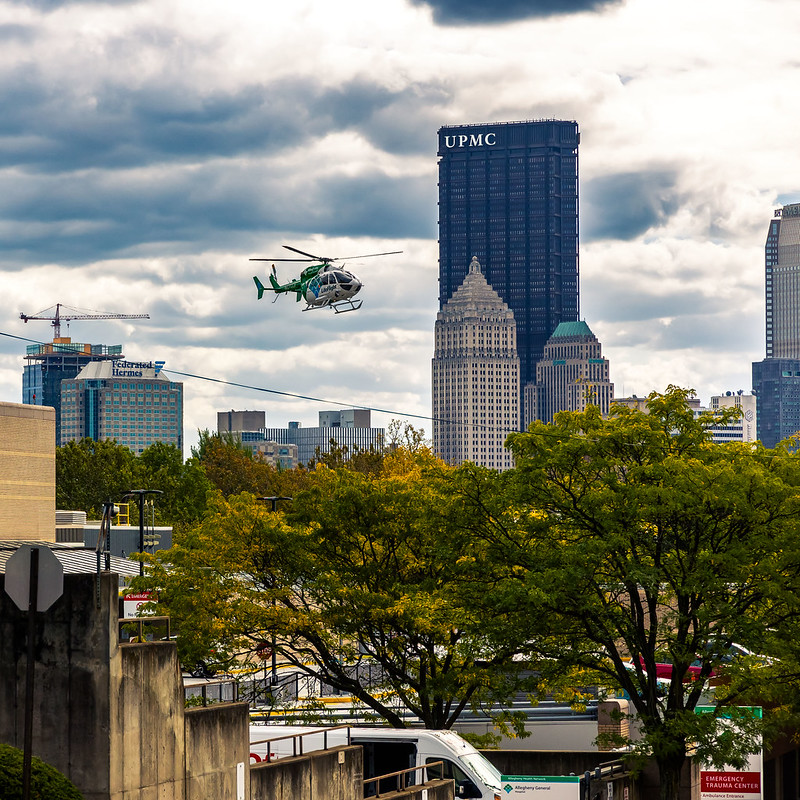
While I was waiting for Our Lady nearby the hospital, a helicoptor ambulance appeared. It seems that the Allegheny North people have a helipad that I didn’t know about, so see – you actually do learn something new every day.
Back tomorrow.
“follow” me on Twitter- @newtownpentacle
Buy a book!
“In the Shadows at Newtown Creek,” an 88 page softcover 8.5×11 magazine format photo book by Mitch Waxman, is now on sale at blurb.com for $30.
Whoopity Doo!
Thursday

– photo by Mitch Waxman
On the North Side of Pittsburgh, one will the presence of a medium sized city park called the ‘Allegheny Commons Park West.’
The National Aviary is contained therein, and the surrounding streets have an unusual number of schools and cultural institutions. I’m told this can be a bit of a rough area at night, but you hear that about a lot of neighborhoods in Pittsburgh.
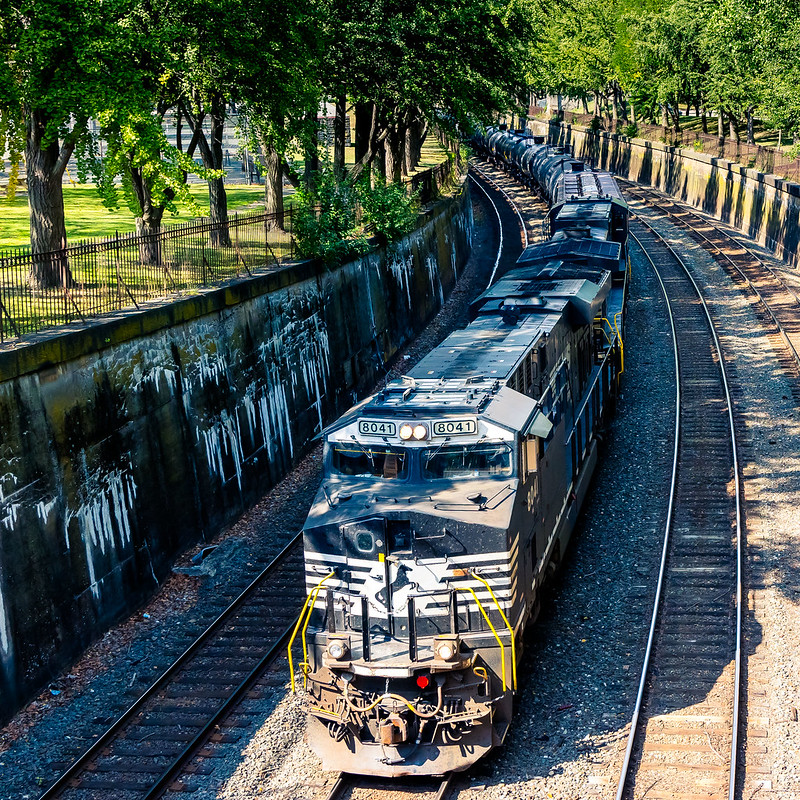
During one of the post surgical checkups that Our Lady of the Pentacle had to endure, post facto of the procedure she was the subject of, I had a couple of hours to kill. I’ve been hungry for the shot of a Norfolk Southern train set moving through this rail trench, cut into the park, for a while now, and since I had some time to kill… I parked the Mobile Oppression Platform in nearby metered spot and then waited…
– photo by Mitch Waxman
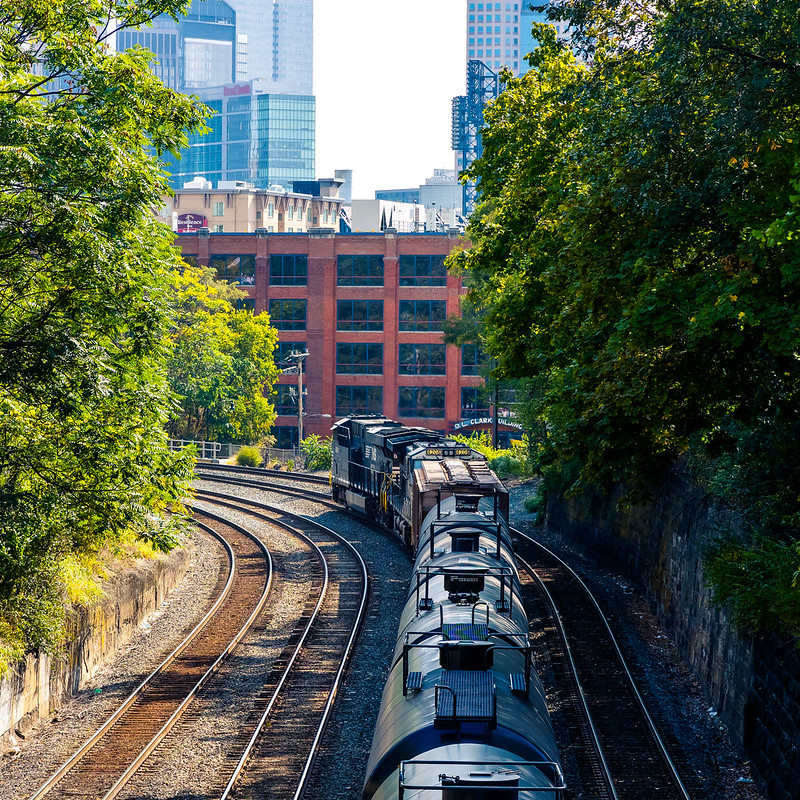
That’s NS’s #8041 in the shot above, which was built at the start of this century by General Electric and is a ES44AC model locomotive. Apparently, this sort of rig has lower emissions than earlier models, complying with the EPA’s ‘Tier 2’ standard. The AC stands for alternating current, and the tracks which it’s hurtling upon are part of the rail company’s “Pittsburgh Line.” The train is ‘coming into’ Pittsburgh, rather than leaving it.
As a note – I’m planning on returning to this spot when the autumnal leaves have fully turned. The trees are of the Ginkgo speciation, and their leaves turn bright yellow gold. Given that Pittsburgh’s official colors are black and gold, that’ll make for a nice ‘PGH’ shot – or so I reckon.
– photo by Mitch Waxman
One has since returned to this spot, during other medical appointments, and I can report that this is a fairly reliable POV as far as train spotting goes. My cold weather plans for further explorations over the next few months involve following this set of tracks all the way up the Ohio River and to the Norfolk Southern Conway Yard. I haven’t scouted that one yet, but will be doing so soon enough.
Pittsburgh is so damn cool, and visually pleasing.
Back tomorrow with something different.
“follow” me on Twitter- @newtownpentacle
Buy a book!
“In the Shadows at Newtown Creek,” an 88 page softcover 8.5×11 magazine format photo book by Mitch Waxman, is now on sale at blurb.com for $30.
Western Maryland Scenic Railroad
Thursday

– photo by Mitch Waxman
As detailed in earlier postings, a humble narrator left HQ in Pittsburgh in the early morning hours and piloted the Mobile Oppression Platform along a southeastern vector towards the panhandle section of Western Maryland, and specifically the City of Cumberland where my ‘turn around’ point was. Throughout the morning, I had kept “11:30 a.m.” in mind, since that’s when the Western Maryland Scenic Railroad would be offering a tour on their heritage railway with its historic rolling stock. There’s also a fairly large CSX railyard in Cumberland, but halfway through the morning I had decided that I’d be coming back this way again and would leave that one for ‘next time.’ This location is about 85 miles from HQ, which ends up being about a two hour drive if you don’t make multiple stops along the way, as I did.
I wasn’t going to be riding with WMRR on this day, but plenty of other people were. The Heritage RR operation offers fairly regular excursion tours between its 1913 Cumberland Station and the community of Frostburg. During the holiday season, they use an actual steam engine and fashion the trip along a Christmas theme as “The Polar Express,” as you’ll see in this particularly well shot YouTube video from Blue Comet Productions.

– photo by Mitch Waxman
After finding a solid place to leave the car, one set out on foot and got busy. As mentioned, this wasn’t the day which I’d be purchasing a ticket and riding on the thing. Saying that, they have California Zephyr Dome cars in addition to executive lounge cars attached to the engine, as well as an ‘open car’ about which their website description offers the caution that you WILL get cold, wet, and dirty while riding in. That’s the photographer centric one, as there are no windows. You can also pony up a few extra bucks if you want to ride in the locomotive engine with the engineer at the head of the snake.
The origins of the Western Maryland Railroad date back to 1852, and like all history associated with rail – there’s a complicated series of corporate owners, partnerships, mergers and acquisitions, and incremental expansions which you can sort out for yourself at this Wikipedia page. Ultimately, in 1973, the WMRR was incorporated into the ‘Chessie System’ which would later merge with an outfit called Seaboard Coast Line Industries in 1982. The combined outfit would rebrand itself in 1987 as CSX.

– photo by Mitch Waxman
After the merger in 1987, CSX abandoned the Cumberland to Frostburg tracks and several municipal entities (including Cumberland and Frostburg and the counties they reside in) foresaw creating a tourist attraction so they purchased the corridor and several of the yards and facilities owned by the WMRR in 1988. It runs regularly scheduled tourist trips in modernity.
Right on schedule, at 11:30 a.m., the guy with the flag arrived and stopped automotive traffic. The signal bells started ringing, and the train blew its horn. Me? I was standing on the concrete of the C&O Canal’s tow path (described yesterday), which adjoins the rail tracks.

– photo by Mitch Waxman
The steam engine which they’re so famous for was in the shop, and the WMRR was instead running a diesel engine at the front of the train. It’s a General Electric Dash 8-32B model #558, which used to be a part of Norfolk Southern’s fleet, and has been leased from that entity to the WMRR as of September of 2022. It’s painted in WM’s color way and heraldry.
My original intention for this leg of the day trip was to linger around Cumberland for a while, and see what I could get at the nearby CSX yard, but I’d been actively ‘doing my thing’ since 5 in the morning and was beginning to feel fatigued.

– photo by Mitch Waxman
Saying that, I’d actually had a full morning. I was at The Great Cross in Jumonville, the Youghiogheny River Lake, and there were a couple of other stops I had made along the way which weren’t all that productive. I still had a two hour drive to get back home, and unlike the morning journey, this time I’d have to contend with traffic and worst of all – school buses. It’s eminently logical to legally forbid the bypassing of school bus traffic, but when you find yourself behind one on a one lane country road… you’re just screwed.
I’m definitely coming back to Cumberland, and plan on riding with them on that Polar Express dealie. Unmentioned in this post, so far, has been the presence of the Great Allegheny Passage bike and pedestrian pathway. The GAP is the same trail that starts in Pittsburgh, which I’ve mentioned many times. An absolutely terrific number of people were observed unloading road bikes to take advantage of the trail, in the municipalities parking lot, where the Mobile Oppression Platform was waiting for our return trip to Pittsburgh.

– photo by Mitch Waxman
After the WMRR rode out of view, I returned to the car, and changed up my camera gear to traveling mode. A quick stop at a gas station was accomplished where the car was fueled up, where I got some much needed coffee, and away we went. On the way home, I stupidly followed a route, suggested by Google Maps, which added a half hour and about thirty miles onto the trip. By the time I was back in Pennsylvania’s Uniontown section, that salami sandwich I had eaten for breakfast was utterly metabolized and I needed a lunch break. McDonald’s, if you’re curious. Here’s a tip – the double quarter pounder is a Big Mac without the special sauce (which you can request they add) and it’s about $5 cheaper than the flagship sandwich.
One of my practices while traveling is to uncharacteristically eat such forms of fast food, since doing otherwise means that you’re kind of throwing the dice as far as food poisoning goes with unfamiliar roadside restaurants. McDonald’s corporate is famously hardcore in terms of enforcing health and safety rules on their franchisees – in terms of “quality,” food storage and cooking temperatures, and facility cleaning standards, so… it ain’t good for you – at all – but McDonald’s ‘fills the hole’ and probably won’t give you a case of the squirts. I learned this lesson about grabbing an ‘on the go’ meal when I was still drawing comics, and had to drive to and attend comic conventions all over the country to promote the books.
After washing the fry and burger grease off my hands, it was time to finish the trip back to Pittsburgh. I think I walked back into the house at about 3:30 p.m.
Whew. Back tomorrow, at this – your Newtown Pentacle.
“follow” me on Twitter- @newtownpentacle
Buy a book!
“In the Shadows at Newtown Creek,” an 88 page softcover 8.5×11 magazine format photo book by Mitch Waxman, is now on sale at blurb.com for $30.
Boss… ze train, ze train
Friday

– photo by Mitch Waxman
That’s Norfolk Southern’s Locomotive #1825 pictured above, and below, hurtling through Pittsburgh on the south side of the city. The unit came online in 1993 as NS #2507, an EMD SD70 model. #2507 was rebuilt in 2019 and the upgraded engine is now an SD70ACC model. The tracks it’s riding on are the ‘Mon Line,’ which was formerly owned by the Pennsylvania Railroad Company. As far as I can discern, other than an upgrade of certain mechanical drive and braking systems, the difference between the two models revolves around the operator’s cabin and the electronics found therein.
I know people who keep this sort of information in their head, all the time. This post was actuated as a response to one of these fellows, a friend of mine and whom I consider to be my ‘go-to’ or ‘rabbi’ for understanding how the insanely complicated world of Choo-Choo trains works. Like all my friends, he likes telling me what I haven’t done.

– photo by Mitch Waxman
I had sent this particular fellow a link to a few prior Newtown Pentacle posts which featured another train line here in Pittsburgh, that the CSX outfit operates on. An offered critique was that ‘I had mastered the flying wedge photo alright, but I needed to start getting to “rail photos level 2”…’ Grrrr, thought I.
So… after scuttling down Arlington Avenue – as described in the two posts directly preceding this one (here and here) – one proceeded to the PJ McArdle Roadway where I knew a ‘POV’ for the Mon Line tracks awaited a humble narrator. Grrrr. Level 2, my ass.

– photo by Mitch Waxman
One had to hang around for a bit, and I used the time to call my old pal Armstrong back in Brooklyn and check in with her. While chatting about the news of the day and hearing about the old neighborhood, #1825 rounded a corner and appeared in the distance. Gotta go, said I.
I had already figured out the camera’s exposure triangle, but it needed a bit of fine tuning. The shot above is zoomed out at 300mm, so atmospheric heat distortion manifested itself.

– photo by Mitch Waxman
The train got closer, and I kept on shooting.
My big news for this day’s walk was that for the first time in literally years, I was using my headphones and listening to one of my beloved Lovecraft audio books. This particular entertainment was a ‘radio drama’ performed by the H.P. Lovecraft Historical Society’s “Dark Adventure Radio Theater” company, a dramatic adaptation of ‘At the Mountains of Madness.’
As mentioned several times, ever since Covid appeared and the streets got weird, I’ve been avoiding the use of headphones while out walking. This habit started in NYC, and whereas I’ve continued it in Pittsburgh, I needed to let a different set of voices talk in my head for a change, and listen to something other than my horrific inner voice, which is impossible to tune out.

– photo by Mitch Waxman
I’ve actually been listening to some music, as well, other than the tried and true playlist which I refer to as my theme music. That inner voice of mine, with its paranoid imaginings and cruel replays of past failures and or embarrassments, has really been getting old and tiresome lately. Best to drown the intrusive thoughts, and fill my head with music, podcasts, or fiction instead – at least while I’m awake.
I know that I’m more than 20 years out of date on a lot of music, but I’m particularly enamored with this 2001 song at the moment – which quite fits my current mood. That’s a real cracker of a rock video too, if you ask me.
One was standing on a bridge while shooting these, a cantilevered span which carries a fairly high speed road, and one whose designers didn’t anticipate camera toting pedestrians running across the travel lanes in pursuit of a photograph. That would have been a very bad idea.

– photo by Mitch Waxman
Thereby, the lens was extended out into its zoom range again for this final shot of NS #1825 heading eastwards. As a note, remember when I mentioned rock slides further up the Monongahela Valley? Turns out that a landslide in 2018 just a half mile west of here and which damaged the Mon Line tracks caused a Norfolk Southern derailment, which created no small amount of chaos and damage. Wow.
Level 2… grrr…
Back next week with something different, at this – your Newtown Pentacle.
“follow” me on Twitter- @newtownpentacle
Buy a book!
“In the Shadows at Newtown Creek,” an 88 page softcover 8.5×11 magazine format photo book by Mitch Waxman, is now on sale at blurb.com for $30.


