Posts Tagged ‘Staten Island’
leaden coffin
It’s National Pancake Day, in these United States.

– photo by Mitch Waxman
Note: Flickr seems to be having some issues today, so if the shots in today’s post don’t appear or display “broken” image link icons, it ain’t me.
Last week, I took a new friend over to “Skelson’s office” on the Staten Island side of the Kill Van Kull. My new pal, who is a photographer that I met during the lowering of the Koscisuzcko Bridge truss during the summer, had never been to Kill Van Kull and given that she’s into shooting the same sort of maritime industrial stuff that I am…
“Skelson’s office” is a section of the Staten Island shoreline that another photographer buddy of mine named John Skelson, who has left this world, used to haunt and this was officially his “spot.”

– photo by Mitch Waxman
While we were at Skelson’s Office, the usual parade of tugs and barges sailed past, including the gargantua you see in today’s shots. That’s a Jersey City based Weeks Marine maritime crane, specifically the 533. Its boom is 210 feet long and it has a lifting capacity of 500 short tons. That’s 5,392 “regular people” gross tons if you’re curious. If you click over to the Weeks site via this link, you’ll see a space shuttle dangling off of it.
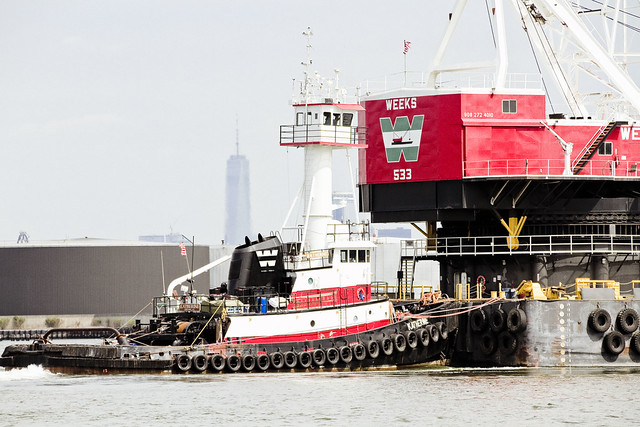
– photo by Mitch Waxman
There were two tugs guiding the crane along the Kill Van Kull, but the big one doing the actual towing was the Katherine, pictured above. My new pal had her mouth hanging open as this unit passed by, as you don’t see this sort of thing every day.
Well, I do, but there you go.
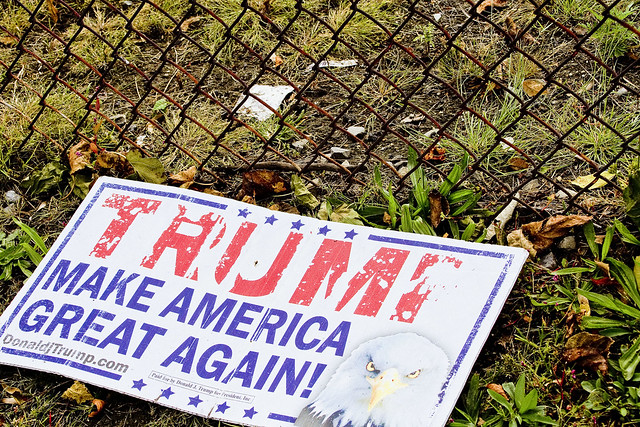
– photo by Mitch Waxman
Found some garbage lying along the shoreline, and since I had to urinate, the big red letters made for a decent enough target. Great, again? America is great, now.

– photo by Mitch Waxman
The show continued along the Kill Van Kull and we spent a couple of hours hanging out and photographing the tugs and barges and container ships passing by Skelson’s Office. If you want to see this sort of thing for yourself (I mean tugs and maritime industrial goodness, not me pissing on the word “Trump”) check out the link below for the recently announced Working Harbor Committee boat tour of both Kill Van Kull and Arthur Kill on October 15th.
Upcoming Tours and events
Exploring Long Island City, from Luxury Waterfront to Abandoned Factories Walking Tour,
with NY Adventure Club – Saturday, October 7th, 1 p.m. – 3 p.m.
Long Island City is a tale of two cities; one filled with glittering water-front skyscrapers and manicured parks, and the other, a highly active ground transportation & distribution zone vital to the New York economy — which will prevail? With Newtown Creek Alliance Historian Mitch Waxman – details here.
The Hidden Harbors Of Staten Island Boat Tour,
with Working Harbor Committee – Sunday, October 15th, 2 p.m. – 4 p.m.
A very cool boat tour that visits two of the maritime industrial waterways of New York Harbor which adjoin Staten Island and Bayonne in New Jersey – The Kill Van Kull and the Arthur Kill. There will be lots of tugboats, cargo docks, and you’ll get to see multiple bridges from the water – including the brand new Goethals Bridge. I’ll be on the mike, narrating with WHC board member Gordon Cooper – details here.
“follow” me on Twitter- @newtownpentacle
old privateers
It’s National Peach Ice Cream Day, in these United States.

– photo by Mitch Waxman
One believes that if you’ve got a problem to solve, the first step towards “victory state” over it involves wrapping your head around the problem and “getting smart.” I like to be fairly well educated about the nature of things before opening the hood and tinkering around with the engine, basically.
The subject of the MTA, or Metropolitan Transit Authority (a public benefit corporation), has been in the news quite a bit of late. The subways have been the particular focus, but the question a friend asked me the other night is what caused today’s post to come into existence.
What, exactly, is the MTA? Well, it’s complicated.
from wikipedia
Chartered by the New York State Legislature in 1965 as the Metropolitan Commuter Transportation Authority(MCTA), it was initially created by Governor Nelson Rockefeller to purchase and operate the bankrupt Long Island Rail Road. The MCTA dropped the word “Commuter” from its name and became the Metropolitan Transportation Authority (MTA) on March 1, 1968 when it took over operations of the New York City Transit Authority (NYCTA) (now MTA New York City Transit (NYCT)) and Triborough Bridge and Tunnel Authority(TBTA) (now MTA Bridges and Tunnels (B&T)). The construction of two bridges over the Long Island Sound was put under the jurisdiction of the MTA.
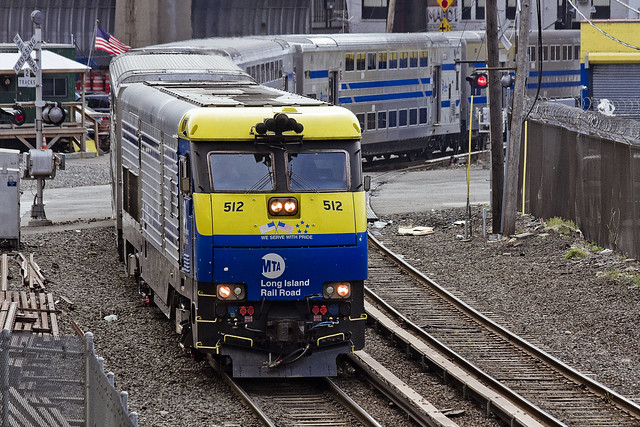
– photo by Mitch Waxman
To begin with, there’s just over 70,000 employees on the MTA’s payroll. MTA operates, ultimately, in the most densely populated sections of three states with the Shining City of Manhattan as the titular center and bullseye destination for its trains, automotive bridges and tunnels, and multiple fleets of buses.
Nearly all of the MTA train lines were originally built and owned by private businesses (with a significant public investment in the case of the subways) either during the late 19th or early 20th century, but bankruptcies and public foreclosures brought them into government hands. Private bus companies were acquired and folded into the Authority over the decades, along with bridges and tunnels that were formally owned and operated by seperate entities. Today, all of these operations are handled by the individual divisions of the MTA and overseen by a 17 member board of directors (who are all political appointees with virtually zero experience in transportation matters, incidentally).
from wikipedia
The Long Island Rail Road (reporting mark LI), legally known as the Long Island Rail Road Company and often abbreviated as the LIRR, is a commuter rail system in the southeastern part of the U.S. state of New York, stretching from Manhattan to the eastern tip of Suffolk County on Long Island. With an average weekday ridership of 337,800 passengers in 2014, it is the busiest commuter railroad in North America. It is also one of the world’s few commuter systems that runs 24 hours a day, 7 days a week, year-round. It is publicly owned by the Metropolitan Transportation Authority, which refers to it as MTA Long Island Rail Road.

– photo by Mitch Waxman
Capital Construction is where all the money disappears into, basically. Pictured above is the Second Avenue Subway under construction, and however much I wish that I could show you a shot from the East Side Access project – I haven’t managed to find a way to get my camera down there, yet. The MTA is ostensibly meant to be self funding, through bonds it issues and through fare revenue, but it seldom works out that way and both State and City end up sending a significant amount of tax revenue their way to handle deficits.
Everybody asks why it is that these mega projects orchestrated by Capital Construction have the political support that they do while the wheels are falling off the buses and subways. Short answer is that a shot of a politician watching some mechanic turn a wrench while repairing a track switch is a lot less compelling an image, electoral politics wise, than one showing the same politician cutting a ribbon at the opening ceremony of a fancy new subway stop in the richest section of Manhattan on the Uppper East Side.
Capital Construction, like all of MTA’s divisions, is a vertical silo with its own hierarchy and political patronage. They do what they do, and compete for funding with the other divisions.
from wikipedia
MTA Capital Construction is a subsidiary agency of the Metropolitan Transportation Authority (MTA), formed in July 2003 to manage the MTA’s major capital projects in the New York metropolitan area. It mainly focuses on improving transportation infrastructure and facilities in New York City, the Hudson Valley, and Long Island areas. Funding primarily comes from local, state, and national bond sales and budgets. As of April 2017, the current MTA Capital Construction president is Janno Lieber.

– photo by Mitch Waxman
Long Island Railroad, for instance, is a vertically integrated “thing” all of its own. If someone from the Metro North side of MTA calls in sick, they don’t send LIRR employees upstate to fill in the slack. It doesn’t share “synergies” with Metro North (repair facilities, union contracts etc.) or with the New York City Transit Authority (subways). This situation is owed partially to the formerly seperate corporate entities that created the original lines.
Metro North is the grandchild of the old New York Central Railroad passenger service, and the LIRR is the child of Central’s arch rival and adversarial enemy – the Pennsylvania Railroad Company.
I’m no expert on this subject, so, I reached out to a buddy who is one of my “rail rabbis” and he anonymously offered this statement and assessment of the situation involving Metro North and LIRR, which – despite logic and what you might think, don’t use the same trains nor operate in common fashion or custom.
“Metro-North Railroad is made up of three distinct operations. Two of these operate out of Grand Central Terminal, the third operates out of Hoboken Terminal.
Hudson and Harlem lines are the remnants of the New York Central Railroad (Vanderbilt), out of Grand Central Terminal.
The New Haven line is the former New York, New Haven and Hartford Railroad (New Haven for short).
The New Haven was unique in that they operated commuter trains out of Grand Central Terminal and their long distance trains out of Penn Station. The line over Hell Gate was financed by the New York Connecting Railroad, which was a paper railroad business agreement between the New Haven and the Pennsylvania Railroads.
The third operation is frequently overlooked. it is the former Erie Railroad (Jay Gould, THE robber baron), later Erie Lacawanna Railroad operation to Port Jervis New York. MTA pays for the New York portion, while New Jersey Transit pays for the New Jersey operation. This operates out of Hoboken Terminal.
The New York Central and Pennsylvania Railroad merged in 1968 into the Penn Central (Good book to read is “The Wreck of the Penn Central” by Joseph R. Daughen and Peter Binzen).
It was an unhappy merger, with battles between the two different management ideologies. It ended up with the US Government creation of Conrail in 1976 to salvage what remained of several north east railroad operations (Including Penn Central).
Conrail operated many commuter railroads, which received state subsidies for commuter operations. (Amtrak was formed in 1971 for intercity/long distance passenger trains, not the many commuter operations) Conrail wanted out of commuter operations at its founding and in 1983, it was NY States turn and Metro North was created.
The LIRR and Metro North are two distinct systems, with the only real compatible technology being the train couplings and the gauge of the trains.
Metro North utilizes an under-running third rail and the LIRR utilizes an over running third rail. Diesel locomotives and diesel hauled electric passenger cars also weigh different, with Metro North being able to haul heavier equipment, Long Island bridges are load limited. The Park Avenue Tunnels on Metro North and the East River Tunnels on the Long Island also limit the interchangeability of some equipment. Signal systems are also different.
The Electric Multiple Unit (MU) trains of Metro North and LIRR look similar and are ordered from the same vendor/companies, but they are configured to operate on their respective systems. They are not freely interchangeable. The Arch Street shop of the LIRR is a warranty shop for the recent purchase of the M-7 MU’s. Metro north ships them there for work, but not before all the third rail shoes are removed, and they have to travel over the Hell Gate from New Rochelle, NY. (The Ventilation system vents on the Metro North Roofs won’t fit in the LIRR East River Tunnels).
The LIRR bilevel cars will not fit in the Park Avenue tunnels.
Metro North diesel locomotives are too heavy for the bridges on the eastern end of Long Island.”
from wikipedia
The Metro-North Commuter Railroad (reporting mark MNCW), trading as MTA Metro-North Railroad or simply Metro-North, is a suburban commuter rail service run by the Metropolitan Transportation Authority (MTA), a public authority of the state of New York. With an average weekday ridership of 298,900 in 2014, it is the second-busiest commuter railroad in North America in terms of annual ridership, behind its sister railroad, the Long Island Rail Road. Metro-North runs service between New York City and its northern suburbs in New York and Connecticut, including Port Jervis, Spring Valley, Poughkeepsie, White Plains, and Wassaic in New York and New Canaan, Danbury, Waterbury, and New Haven in Connecticut. Metro-North also provides local rail service within New York City at a reduced fare. There are 124 stations on Metro-North Railroad’s five active lines (plus the Meadowlands Rail Line), which operate on more than 775 miles (1,247 km) of track, with the passenger railroad system totaling 385 miles (620 km) of route.

– photo by Mitch Waxman
Another vertical silo at MTA is the Bridges and Tunnels group. This is Robert Moses’ old Triborough Bridge and Tunnel Authority empire, rebranded and “nationalized” by Nelson Rockefeller back in the late 1960’s. TBTA has always been, and always will be, its own fiefdom.
For those of you not familiar with the terms “vertical silo” or “synergies,” that’s a fairly archaic series of terms used in the investment banking industry to describe business units within a corporate structure. When a corporate merger occurs, the investment bankers will often try to “flatten” these silos and merge them with other units to avoid redundancy, which saves them money and ostensibly streamlines an operation. This is not how Government people think, btw. If the MTA was a company and got taken over by another corporation, the VERY first thing the new owners would do is try to flatten these silos and eliminate the wasteful or redundant departments.
MTA, for instance, has multiple divisions of armed police and guardsmen. There’s TBTA cops, MTA cops, MTA Operations armed guards, a whole seperate department of MTA Security… and they’re all operating under different rules, jurisprudence, and circumstance.
It’s all very complicated.
from wikipedia
The Triborough Bridge and Tunnel Authority, doing business as MTA Bridges and Tunnels, is an affiliate agency of the Metropolitan Transportation Authority that operates seven intrastate toll bridges and two tunnels in New York City. In terms of traffic volume, it is the largest bridge and tunnel toll agency in the United States, serving more than a million people each day and generating more than $1.5 billion in toll revenue annually as of 2012.
The seven bridges are:
- Triborough Bridge (officially Robert F. Kennedy Bridge), the agency’s original namesake and flagship crossing, connecting Manhattan, the Bronx, and Queens, via Randalls and Wards Islands
- Bronx–Whitestone Bridge, connecting the Bronx and Queens
- Verrazano-Narrows Bridge, connecting Brooklyn and Staten Island
- Throgs Neck Bridge, connecting the Bronx and Queens
- Henry Hudson Bridge, connecting Manhattan and the BronxMarine Parkway–Gil Hodges Memorial Bridge, connecting Brooklyn and the Rockaways (Queens)
- Cross Bay Veterans Memorial Bridge, connecting Broad Channel to the Rockaways (Queens)
The two tunnels are:
- Brooklyn–Battery Tunnel (officially Hugh L. Carey Tunnel), connecting Brooklyn and Manhattan
- Queens–Midtown Tunnel, connecting Queens and Manhattan

– photo by Mitch Waxman
The focus of public ennui these days is generally related to the subway system, although this summer the LIRR situation has gathered a lot of storm clouds to the Long Island Railroad. What New Yorker hasn’t stood there on some subway platform and exhorted “EFF YOU, MTA” at least once?
My rail rabbi quoted above offers this, on the subject of the “switch problems” and the MTA’s promises that modernizing them will fix everything wrong with the subways:
“One thing we mentioned about “outdated signal systems” with regard to the subway is that the 100 year old signal, while worn out, allow better utilization of the tracks. As I understand it, typical headways on the NYC subway system are four to seven minutes at rush hour. As a comparison, newer fully automated systems, like BART in San Francisco, WAMATA in Washington DC and MARTA in Atlanta can’t beat seven minutes, with ten minutes being the normal.”
A humble narrator has been getting increasingly involved with transit issues in recent years, and I’ve joined the steering committee of Access Queens, a community organization led by Sunnyside’s Melissa Orlando, which grew out of the “7 train blues” Facebook group. I won’t bore you with the usual song you’ve read everywhere else about switches, overcrowding, deferred maintenance, and aging tracks – instead I’d ask for you to click through to the Access Queens site and see what our group has been working on.
It may be the “Summer of Hell” for the LIRR, but it’s always transit hell in Queens.
from wikipedia
The New York City Transit Authority (also known as NYCTA, The TA or simply Transit, and branded as MTA New York City Transit) is a public authority in the U.S. state of New York that operates public transportation in New York City. Part of the Metropolitan Transportation Authority, the busiest and largest transit system in North America, the NYCTA has a daily ridership of 7 million trips (over 2 billion annually).
The NYCTA operates the following systems:
- New York City Subway, a rapid transit system in Manhattan, The Bronx, Brooklyn, and Queens.
- Staten Island Railway, a rapid transit line in Staten Island (operated by the Staten Island Rapid Transit Operating Authority, a NYCTA subsidiary)
- New York City Bus, an extensive bus network serving all five boroughs, managed by MTA Regional Bus Operations.

– photo by Mitch Waxman
The MTA Bus company is part of NYCTA, or New York City Transit Authority, but that’s not all of it. There’s tons of bus lines in Nassau and Suffolk Counties, Yonkers, and even Westchester which MTA operates. Buses aren’t the sexiest way to get around, of course, but when it’s raining a bus is always superior to walking. Unfortunately, the vertical silo of the bus company seldom coordinates with the NYCTA subway company during outages and planned work, nor coordinates their schedule with them.
from wikipedia
MTA Regional Bus Operations (RBO) is the surface transit division of the Metropolitan Transportation Authority (MTA), created in 2008 to consolidate all bus operations in New York City operated by the MTA.
Upcoming Tours and events
The Poison Cauldron of the Newtown Creek Walking Tour, with Atlas Obscura – July 22nd, 11 a.m. – 2 p.m..
Explore the hellish waste transfer and petroleum districts of North Brooklyn on this daring walk towards the doomed Kosciuszko Bridge, with NCA Historian Mitch Waxman – details here.
“follow” me on Twitter- @newtownpentacle
bearded colleague
Kitteh, in today’s post.

– photo by Mitch Waxman
I’m taking a short break this week, and offering single images of the Internet’s favorite critter. These are all ferals, encountered in the nooks and crannies of NYC which I wander through. Have a great Thanksgiving.
“follow” me on Twitter- @newtownpentacle
intact copy
A short aside on the Arthur Kill, and a look at the Goethals Bridge project.

– photo by Mitch Waxman
For the last few days, I’ve been describing a day trip to South East Brooklyn, which we’ll return to later on, but for today’s post I want to show you what’s going on at the veritable edge of NYC on the western end of… Staten Island… at the Arthur Kill waterway. That’s the Goethals Bridge construction project you’re looking at, which is another one of the three mega projects involving bridges going on in NYC at the moment.
I was actually “at work” when these shots were captured, conducting a corporate boat excursion for a group that wanted to “see something different” than what you normally get on a harbor cruise. They were all eating lunch on another deck as we passed by the Goethals so I grabbed my camera and got busy.

– photo by Mitch Waxman
I’m nowhere near as familiar with Goethals as I am with the Kosciuszcko Bridge over my beloved Newtown Creek, of course, but I can tell you that the span overflying the water is 672 feet long. With its approaches, which connect Elizabeth, New Jersey (and the NJ Turnpike) to… Staten Island… the structure is actually some 7,109 feet long. It’s 62 feet wide, 135 feet over the Arthur Kill, and carries about 80,000 vehicles a day.
Goethals opened in June of 1928, and along with the nearby Outerbridge Crossing, was the inaugural project for a newly created organization known to modernity as the Port Authority of New and New Jersey.

– photo by Mitch Waxman
Like several of the depression era bridges in NYC, Goethals has been deemed as being insufficient for the amount of traffic it carries, and it has developed some structural issues over the last century. Port Authority is building a replacement bridge, which will be a cable stay type span. It’s going to be wider, have modern traffic lanes, and incorporate both bicycle and pedestrian access into its design. It’s also meant to be a “smart bridge” which will utilize active sensor technologies to monitor traffic and structural integrity.
The PANYNJ has also left room in their designs for future modifications to the span like adding a rapid transit line. The blue bridge you see just north east of the Goethals is a railroad lift bridge which connects New Jersey’s CSX rail lines to the New York Container Terminal port facility on the… Staten Island… side. It’s called the “Arthur Kill Vertical Lift Railroad Bridge,” for the curious.
The part of… Staten Island… where all this is happening is called “Howland Hook.”

– photo by Mitch Waxman
That’s the Elizabeth, New Jersey side, where the Goethals connects to New Jersey’s “Chemical Coast.” It’s called that for the enormous presence of the petroleum industry in Elizabeth. This area was formerly the property of the Standard Oil Company of New Jersey.
SOCONJ retained the corporate branding of the Standard Oil trust after the Sherman anti trust act was invoked by President Teddy Roosevelt back in 1911. That branding was “S.O.,” which over the course of the 20th century first became “ESSO” and then later became “EXXON.”

– photo by Mitch Waxman
The new Goethals Bridge is meant to be ready for use in 2018, at which point the PANYNJ will begin the demolition project to get rid of the original. The 1928 steel truss cantilever bridge was designed by a fellow named John Alexander Low Waddell, who also designed the nearby Outerbridge Crossing. As a note, Outerbridge Crossing is not called that due to it being the furthest out bridge, as colloquially believed. It’s named for a a guy named Eugenius Harvey Outerbridge, and I’m friends with his grandson Tom.
The Goethals Bridge(s) is named for General George Washington Goethals, superviser of construction for the Panama Canal, and first consulting engineer of the Port Authority of New and New Jersey.
The PANYNJ has a neat website set up for the project which includes live construction webcams, check it out here.
Upcoming Events and Tours
Saturday, July 23, 11:00 a.m. – 1:00 p.m. –
Calvary Cemetery Walking tour,
with Brooklyn Brainery. Click here for more details.
Tuesday, July 26, 6:30 p.m. – 8:30 p.m. –
Glittering Realms Walking tour,
with NYC H2O. Click here for more details.
Wednesday, July 27, 1st trip – 4:50 p.m. 2nd trip – 6:50 p.m. –
2 Newtown Creek Boat Tours,
with Open House NY. Click here for more details.
Saturday, July 30, 11:00 a.m. – 1:00 p.m. –
DUPBO Walking Tour,
with Atlas Obscura. Click here for more details.
Sunday, August 21, 11:00 a.m. – 1:00 p.m. –
Poison Cauldron Walking Tour,
with Atlas Obscura. Click here for more details.
“follow” me on Twitter- @newtownpentacle
gateway temple
Bayonne Bridge progress, in today’s post.

– photo by Mitch Waxman
The Bayonne Bridge spans the Kill Van Kull waterway, connecting Staten Island with Bayonne, New Jersey. The fourth largest steel arch bridge upon the earth, it was designed by Othmar Amman.
Bayonne Bridge’s origins were commemorated in this 2010 post. The Bayonne Bridge, and the Frederick E Bouchard tug, were discussed in this 2012 post. Also back in 2012, I walked over the original Bayonne Bridge for the last time. In August of last year, I gathered the shots featured in this 2015 post.

– photo by Mitch Waxman
A new class of cargo ships, the Panamax, will soon become standard for global trade. These gargantua have necessitated the widening of the Panama Canal, and will be too large to fit under the Bayonne Bridge in its original configuration at high tide. Given that Port Elizabeth Newark is found just beyond the Bayonne Bridge, the Port Authority of New York and New Jersey has been forced to take steps.
Very expensive steps.

– photo by Mitch Waxman
A seperate project is underway to increase the draught of NY Harbor’s Ambrose Channel and Kill Van Kull to fifty feet instead of forty via dredging, but the roadway of the Bayonne Bridge is being replaced by a new one which will be high enough to accommodate the new class of cargo ships.

– photo by Mitch Waxman
In the shot above, you can see the project is well underway. The shots in today’s post were captured from the waters of the Kill Van Kull in May of 2016, btw. The new roadway is quite a bit higher than the original, and the older one is slated to be demolished.

– photo by Mitch Waxman
Unlike the Kosciuszko Bridge at Newtown Creek (which is being fully replaced), the project engineers have decided to retain the original steel arch structure and approaches to the span. Also, unlike the Kosciuszko project, I have no special access or knowledge of the project beyond some water access.
I can tell you that certain harbor and shipping industry magnates I know favored demolishing the span entirely, reasoning that another class of mega cargo ships is inevitable, and that access to Newark Bay is paramount for the economy of the Northeastern United States. Right now, Port Elizabeth Newark is the second largest port facility in the USA’s part of North America. Bayonne Bridge provides a critical vehicular path to Staten Island and Brooklyn via the Verrazano Bridge for the trade items which arrive there.

– photo by Mitch Waxman
From a purely esthetic point of view, the composition and positioning of the new roadway is pretty “fugly.” Amman is turning in his grave, I’m sure.
Upcoming Events and Tours
Saturday, June 4, 11:00 a.m. -1:30 p.m. –
DUPBO: Down Under the Pulaski Bridge Onramp,
with Brooklyn Brainery. Click here for more details.
“follow” me on Twitter- @newtownpentacle


 The Newtown Pentacle