Posts Tagged ‘Hudson River’
parenthetical ideation
It’s National Barbecue Day, in these United States.
– photo by Mitch Waxman
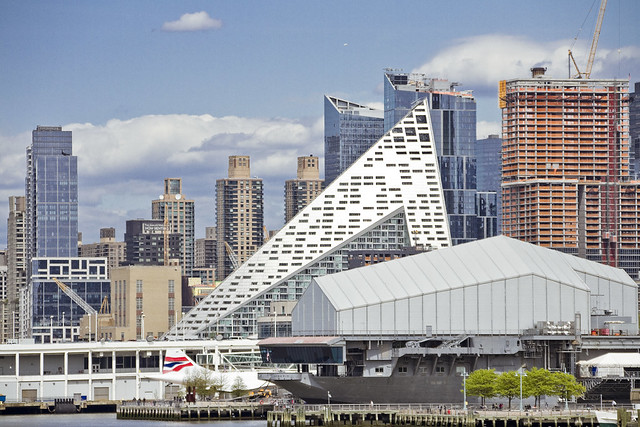
It’s no secret that we live in an age of real estate mega development, and that the skyline of NYC has been undergoing massive changes which we haven’t seen the like of since the late 1950’s and early 60’s. Unfortunately, so much of what is being built is uninspiring, and banal. Glass rectangles designed to maximize profit which offer no sense of wonder, inspiration, or esthetic joy.
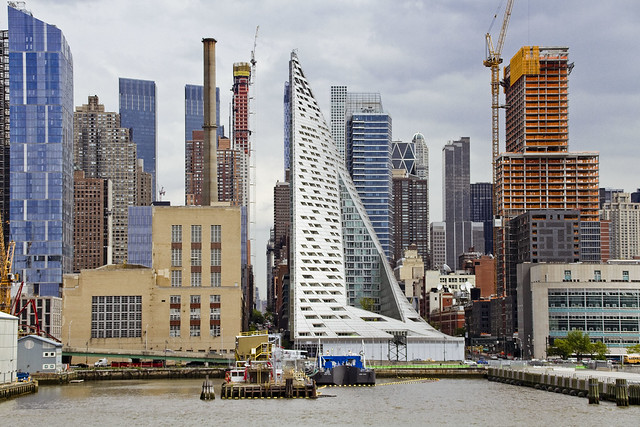
The exception to this modern rule is actually found in Manhattan, where what I consider to be the most interesting new building in NYC is found. It’s on West 57th street at the Hudson River – Bjarke Ingels’ W57. Check out this article at the Atlantic for all the details on it.

– photo by Mitch Waxman
I’ve been watching this one go up from the water for a couple of years now, and it’s made me think a bit. I’m in a constant argument with both friends and enemies over rhetorical tone and grammar when it comes to political terminology. “Gentrification” is a bugbear word for me, especially when it refers to LIC or Greenpoint. What’s going on there isn’t gentrification – we haven’t coined a name for what’s happening along the East River coast of Long Island, yet.
What happened in East Harlem and Park Slope in the 90’s – that was “gentrification.” Similarly, there’s no such thing as a “liberal” or a “conservative” or a “progressive” anymore, our culture is just stuck in a grammatical paradigm which was coined by an earlier generation (one which refuses to retire, much like the so called establishment it sought to replace in the 60’s).
– photo by Mitch Waxman
Where NYC architects went wrong was the embrace of inhuman and emotionless architecture like the so called “international style,” which imparted a soulless and somewhat fascist countenance to the city. Ask a native New Yorker, and we will always point to the Chrysler, Empire State, and Woolworth buildings as the ones to embrace. Soulful and inspiring, these sorts of mega structures are loved and welcomed by communities rather than reviled.
Hopefully, W57 will offer a lesson and act as a harbinger to the real estate shit flies out there. It’s not some “NIMBY” sentiment which activates community protests against their projects, rather it’s about avoiding the building of yet another banal glass rectangle whose singular purpose is “stealing the sky.”
Upcoming Tours and events
Newtown Creek Alliance Boat tour, May 21st.
Visit the new Newtown Creek on a two hour boat tour with NCA historian Mitch Waxman and NCA Project Manager Will Elkins, made possible with a grant from the Hudson River Foundation – details and tix here.
“follow” me on Twitter- @newtownpentacle
luring skyline
It’s Christmas Eve, if you’re Russian Orthodox, and Christmas Day if you’re Armenian Orthodox.

– photo by Mitch Waxman
As the burning thermonuclear eye of God itself dipped behind New Jersey, whilst on my way to that Holiday party in Hells Kitchen I’ve been talking about all week, I was reminded of something about myself. I’m lucky. Despite the objectionable nature of my personality, the disgusting personal habits I readily display, my sloth, bizarre opinions loudly repeated, and everything else which causes those who know me to curl their upper lips up in disgust – I’m lucky. I also need to get out more often.
As I was passing by the Circle Line at 42nd street and found myself approaching Pier 84, I noticed a series of maritime cranes and tugs at work.

– photo by Mitch Waxman
It was DonJon towing doing the work – the Sarah Ann and Brian Nicholas tugs were quite busy. You don’t get to see much maritime industrial stuff going on at the Hudson River coastline of Manhattan, in this century at least.

– photo by Mitch Waxman
The DonJon tugs were “wrassling” two barges into place, one carried a maritime crane, the other was full of what I originally perceived as being scrap. Couldn’t have been more wrong, as it turned out.

– photo by Mitch Waxman
Longtime readers of this – your Newtown Pentacle – know that I have a certain fascination with the DonJon towing company, who operate regularly on my beloved Newtown Creek. They have wonderful toys, DonJon does.

– photo by Mitch Waxman
The flat top barge was carrying huge “lomticks” of steel, which conversation with one of many “hard hats” on the pier described as being destined for the Hudson Yards project. Scrap indeed.

– photo by Mitch Waxman
Part of the reason that I originally thought the flat top barge was handling scrap was the significant tonnage of the stuff that I normally observe the DonJon people moving around the harbor. This post from 2012 follows the DonJon Tug Sarah Ann, pictured above, towing metal and employed by the recycling people.

– photo by Mitch Waxman
The other DonJon towing vessel on duty was the Brian Nicholas, discussed in another 2012 post, one which also happens to carry one of my all time favorite “tugboat on Newtown Creek” shots.

– photo by Mitch Waxman
The location which the steel was being delivered to is a fairly narrow channel that’s normally used to launch human powered boats by the Manhattan Kayak club people, adjoins Hudson River Park, and it neighbors the Intrepid Air and Space museum. This location is analogous to the Manhattan street grid as being 44th street.

– photo by Mitch Waxman
The crane barge is DonJon’s Columbia New York. She’s got a 140 foot long boom, dates back to the 1970’s, and can lift 310 short tons while its base is revolving. Everything you’d care to know about the thing can be found here.

– photo by Mitch Waxman
The entire operation slowed down to a crawl as they approached the Manhattan bulkheads. A small workboat was zipping around, and everywhere you looked on the vessels there were sailors peering over the sides communicating on walkie talkies. I guess they didn’t want to scratch the Intrepid or something.

– photo by Mitch Waxman
Brian Nicholas hung back as the crane and flat top barges moved into position.

– photo by Mitch Waxman
The crane barge began lowering its “spuds,” which are long steel bars that extend down to the bottom of the river and act as stabilizers (think table legs). While that was happening, ropes were flung around and tied off to bollards.

– photo by Mitch Waxman
Having successfully killed the time between leaving Point A (Astoria) and that Holiday party in Hells Kitchen by walking through LIC, taking the 7 to Hudson Yards, checking out the Hudson Yards megaproject from the High Line, and then luckily running into this maritime industrial display – it was actually now time for me to begin heading there directly.

– photo by Mitch Waxman
Couldn’t resist one or two more shots, however.

– photo by Mitch Waxman
There’s some of the structural steel being delivered to the Hudson Yards project, in a somewhat elevated shot gathered from a pedestrian bridge at West Street between 45 & 46th streets.

– photo by Mitch Waxman
From the same elevated position, and from a bit of a distance, you can get a better idea of the size of the crane.

– photo by Mitch Waxman
While all this was going on, rush hour was playing out on West Street.
– photo by Mitch Waxman
So, that’s the story about all the stuff I saw because I got invited to a holiday party in Hells Kitchen. I should leave the house more often, I guess. See what happened the next time I went out, next week at this – your Newtown Pentacle.
Also, Merry Christmas to all you orthodox Russians and Armenians. Sunday the 7th is “Gristmas,” btw, or Greek Orthodox Christmas.
“follow” me on Twitter- @newtownpentacle
inclement forecast
A labor day tradition, postponed.

– photo by Mitch Waxman
The 24th annual Great North River Tugboat Race and Competition has been postponed from September 4th to Sunday, October 9th, 2016 due to the likely appearance of Hurricane Hermine in NY Harbor on Sunday.
Click here for the Working Harbor Blog which will be your best source of information on the storm and the rescheduled Tug Race.
“follow” me on Twitter- @newtownpentacle
natural history
Happy 50th Brithday, Riverkeeper.

– photo by Mitch Waxman
I finally got to shoot a Kennedy.
In this case, it was Robert Kennedy Jr., while onboard a NY Water Taxi celebrating the 50th anniversary of the Riverkeeper organization. Mr. Kennedy, who in addition to being an environmental attorney and President of Riverkeeper, has a degree in history – offered the assembled group an absolutely fantastic encapsulation of the history of the Hudson River and spoke about the role and history of Riverkeeper in NY Harbor.

– photo by Mitch Waxman
Before I continue, my continuing practice of listing my conflicts of interest and personal prejudices must be enacted – Newtown Creek Alliance has had a LONG and deep connection with Riverkeeper. Current DEC Commisioner and former Riverkeeper official Basil Seggos, and Riverkeeper Attorney Philip Musegaas are both former board members of NCA.
Additionally, I have enjoyed the company and tutelage of Riverkeeper’s patrol boat Captain, John Lipscomb, on more than one occasion, and Riverkeeper’s current representative in my part of the world – Sean Dixon – is both a friend and ally of Newtown Creek Alliance and our goal to “reveal, restore, and revitalize” Newtown Creek.
Riverkeeper, as an organization, are the “good guys” in my opinion and I consider being in the company of the organization on this important milestone for them both an honor and a privilege.

– photo by Mitch Waxman
Robert Kennedy Jr. – suffice that whatever you want to say about the storied political dynasty from which he descends, when this fellow starts speaking – you pay attention. Kennedy described the formation of Riverkeeper from the Hudson Fisherman’s Association, and its role in cleaning up the notoriously polluted Hudson River over the last half of the 20th century and its expansion into other domestic waterways and now international efforts.

– photo by Mitch Waxman
Personally, as someone who has always identified with the liberal wing of the Democratic Party, a humble narrator was absolutely stoked just to be in the same room (or cabin) with him. That’s an actual leader you’re looking at above, and a bit of rock star at that. I’m not alone in this view, of course, and several of my colleagues from Newtown Creek and activists from the larger Harbor of New York and New Jersey were also invited onboard to celebrate the anniversary.

– photo by Mitch Waxman
Another “actual leader” is Paul Gallay of Riverkeeper. Mr. Gallay assessed Riverkeeper’s current efforts and made a cogent case against the continuing operation of the shoddily constructed and badly managed Indian Point Nuclear Power Plant which is just 45 miles from Manhattan.
He also discussed the so called petroleum “bomb trains” which have begun populating the rail system in upstate New York, and Riverkeeper’s ongoing battle to ensure a swimmable and fishable state for all of New York’s waterways – big or small.

– photo by Mitch Waxman
Unfortunately, it was quite rainy and cold when we were out on the NY Water Taxi. I managed to crack out one shot of the surrounding scenery, as evinced above.
“follow” me on Twitter- @newtownpentacle
Walking Tour – Saturday, April 23rd, 2016 –
First Calvary Cemetery Walk.
Join Newtown Creek Alliance historian Mitch Waxman at First Calvary Cemetery, found in LIC’s Blissville neighborhood along Newtown Creek. Attendance limited to 15 people.
Click here for more info and ticketing.
forms strangely
Fireboat 343, Hudson River.

– photo by Mitch Waxman
As mentioned, one is taking a short break – hence the singular image which greets you above. Back soon with new stuff.
“follow” me on Twitter- @newtownpentacle


 The Newtown Pentacle