Archive for March 2023
Montour Trail, Enlow tunnel
Friday

– photo by Mitch Waxman
As mentioned yesterday, one had headed over to a section of the Montour Trail which includes a railroad tunnel punched through a hill (or hillock, maybe?). Also mentioned, I’m playing around with using the ChatGPT “artificial intelligence” as a research assistant.
If you ask ChatGPT “what is the Enlow Tunnel on the Montour Trail” you get this response:
The Enlow Tunnel on the Montour Trail is a historic railroad tunnel that was constructed in 1914 and later converted into a recreational trail in the 1990s. It is named after the nearby Enlow Mine, which was once one of the largest underground coal mines in Pennsylvania.
The tunnel is approximately 600 feet long (183 meters) and is situated along the Montour Trail, a popular 60-mile (97 km) recreational trail that follows the path of the former Montour Railroad. The tunnel is known for its distinctive curved shape and its role as a gateway between two sections of the trail.
The Enlow Tunnel on the Montour Trail is a popular destination for hikers, bikers, and other outdoor enthusiasts who enjoy exploring the scenic beauty of western Pennsylvania. The tunnel is open year-round and provides a unique experience for those looking to take a break from the hustle and bustle of daily life.
Overall, the Enlow Tunnel on the Montour Trail is a remarkable piece of history that has been repurposed for modern use. It serves as a testament to the region’s industrial heritage while providing a unique recreational opportunity for visitors to the area.

– photo by Mitch Waxman
My interest in these ‘rail to trail’ paths is absolutely piqued. Given the often severe and physically challenging nature of the heavily wooded surrounding topography, having a railroad graded path to scuttle along has been absolute nepenthe. You can walk for four or five miles in one direction, then backtrack to where the car is parked. Railroad grading is typically one foot of elevation relative to one hundred feet horizontally. The surface of the trail is either crushed limestone or pavement of one kind or another.
So far, I’ve found all sorts of side paths which branch off of the main trail. You can find these “desire paths” by looking for areas where others have stomped through the brush.
Machine says:
In the context of urban planning, a desire path refers to a pathway or trail that is created by people’s repeated use, rather than being formally designed or constructed by planners or engineers. Desire paths are typically formed when people take shortcuts or alternative routes across open spaces or between buildings, often in response to perceived inefficiencies or obstacles in the existing network of sidewalks or pedestrian walkways.
Desire paths are important for urban planners and designers to observe and consider, as they can provide insights into the needs and preferences of the people who use the urban environment. By identifying desire paths, planners can better understand where people want to go and how they prefer to get there, and can use this information to improve the design of the built environment.
In some cases, planners may choose to formalize desire paths by paving or otherwise improving them, in order to provide a more efficient and direct route for pedestrians or cyclists. However, in other cases, desire paths may be left unpaved, in recognition of the fact that they represent an organic and responsive approach to urban design that prioritizes the needs of the people who use the space.

– photo by Mitch Waxman
Just off the Montour Trail path is Montour Run, a shallow but fast moving waterway which I found my way down to by following one of those desire paths. By NYC standards this would be wilderness, but by what I’m beginning to understand the Pennsylvania standard is, it’s still pretty urban. About an hour’s drive in any direction from Pittsburgh and you can be in the deep woods.
A two hour drive from Pittsburgh puts you into the reach of three states where people report having seen Sasquatches in the woods, specifically the “Pennsylvania Bigfoot.”
ChatGPT says: The “Bigfoot of Pennsylvania” – There have been several reported sightings of Bigfoot in the forests and wooded areas surrounding Pittsburgh. While there is no concrete evidence to support the existence of Bigfoot, many people believe that the creature could be a real, undiscovered species of primate.

– photo by Mitch Waxman
This whole “nature thing” is new to me, having lived in NYC my whole life. Back home, if you saw an Opossum or a Raccoon roaming about, it was a big deal and you’d mention it to people. Here, I’ve got deer and rabbits and every kind of bird you can imagine showing up in my back yard, and that’s about 5 miles from the “downtown” center of the City.
I got to wondering about what sort of predatory critters there might be roaming about in the rural areas, so I asked ChatGPT what it thought –
There are several predatory fauna species that can be found in the Pittsburgh area, including:
- Coyotes – Coyotes are a type of wild dog that can be found in both urban and rural areas of Pittsburgh. They are primarily nocturnal and feed on small mammals, birds, and carrion.
- Red-tailed hawks – Red-tailed hawks are a common species of bird of prey that can be found throughout the Pittsburgh area. They primarily feed on small mammals and birds.
- Eastern timber rattlesnakes – Eastern timber rattlesnakes are a venomous species of snake that can be found in the forests and wooded areas surrounding Pittsburgh. They primarily feed on small rodents and other small mammals.
- Black bears – Black bears are a larger predatory mammal that can be found in the wooded areas surrounding Pittsburgh. They primarily feed on plants and berries, but will occasionally prey on small mammals.
- Bobcats – Bobcats are a type of wild cat that can be found in the wooded areas surrounding Pittsburgh. They primarily feed on small mammals such as rabbits and rodents.
It’s important to note that while these species are considered predators, they generally do not pose a significant threat to humans unless they feel threatened or cornered. It’s important to practice caution when encountering wildlife and to follow local guidelines for wildlife safety.

– photo by Mitch Waxman
I’ve actually spotted a few caves carved out of the hillsides by water action, and given the “folded mountain” and “ridge and valley” topography, it would be unlikely that hydrological action hadn’t actively carved into the rock over the hundreds of millions of years that these sedimentary deposits and mountains have existed. These landforms are older than vertebrates, after all. Caves. That’s another one for my summer playlist.
VOX Automata says: There are several publicly accessible caves and caverns located in the Pittsburgh area. Here are a few examples:
- Laurel Caverns – Located about an hour south of Pittsburgh in Farmington, PA, Laurel Caverns is a popular destination for cave tours and exploration. Visitors can explore the underground chambers and passageways of the cave system, which features beautiful rock formations and unique geological features.
- Cucumber Falls Cave – Located in Ohiopyle State Park, about an hour southeast of Pittsburgh, the Cucumber Falls Cave is a small, narrow cave that is open to the public. Visitors can climb down into the cave and explore the interior, but should exercise caution and bring a flashlight.
- McDowell Quarry Cave – Located in McKees Rocks, just outside of Pittsburgh, the McDowell Quarry Cave is a popular destination for spelunkers and cave enthusiasts. The cave system is a series of interconnected passages and chambers, and requires specialized equipment and training to explore safely.
- Indian Echo Caverns – Located about three hours east of Pittsburgh in Hummelstown, PA, Indian Echo Caverns is a beautiful limestone cave system that is open to the public for guided tours. The cave features underground lakes, waterfalls, and unique rock formations.
It’s important to note that exploring caves can be dangerous, and visitors should exercise caution and follow all posted guidelines and safety recommendations.

– photo by Mitch Waxman
A final shot of the Enlow Tunnel, and it was time to scuttle back to the Mobile Oppression Platform. One disturbing bit of Pittsburgh history that I knew about, long before coming here, involved the so called “Pittsburgh incident of 1968” and the more recent “Monroeville incident of 1978.” Both of these occurrences were hushed up, but a local filmmaker’s fictionalizations got the word out.
You never know when that sort of thing is going to occur again, around these parts. Third time’s the charm, huh?
Back next week with something different, at your Newtown Pentacle.
“follow” me on Twitter- @newtownpentacle
Buy a book!
“In the Shadows at Newtown Creek,” an 88 page softcover 8.5×11 magazine format photo book by Mitch Waxman, is now on sale at blurb.com for $30.
sweatshirt weather
Thursday

– photo by Mitch Waxman
After visiting the Fall Run Park in Shaler Township with Our Lady of the Pentacle, we next found ourselves in the nearby community of Etna along the Allegheny River. We weren’t there ten minutes when I heard train horns being blown to the west. A Norfolk Southern train was a-coming.
As a note, I’m playing around with using ChatGPT’s “AI” as a research assistant, so here’s what that machine says about the locomotive pictured above, which is designated as being #7504: according to publicly available records, Norfolk Southern operates a variety of locomotives that were manufactured by different companies over several decades. The 7500 series locomotives are typically EMD SD70ACe locomotives, which were first manufactured in the late 1990s and early 2000s. However, it is possible that Norfolk Southern 7504 may have been refurbished or modified since its original manufacture date, which could affect its specifications and performance.

– photo by Mitch Waxman
Additional machine perceptions are offered here:
Norfolk Southern locomotives are typically large diesel-electric locomotives used for hauling freight across the United States. They are designed for high performance and reliability, with powerful engines and advanced technology to ensure smooth operation and efficient use of fuel. Norfolk Southern locomotives are often painted in the company’s distinctive black, white, and gray color scheme, with the locomotive number prominently displayed on the sides and front. It is likely that Norfolk Southern Locomotive 7504 is similar in appearance and function to other locomotives in the company’s fleet, but specific details may vary depending on the model and year of manufacture.
The AI, which is not really an artificial intelligence but is still fairly amazing, uses Google’s data coupled with a learning algorithm to scrape information off the http level of the web. It’s a lot more targeted than Google is these days, as it’s not carrying advertising links or being manipulated by SEO (search engine optimization). Yet.
Also, before you ask, yes I’ve seen the Terminator movies, read Asimov, and Colossus: The Forbin Project remains one of my favorites.

– photo by Mitch Waxman
On Monday the 6th, one had to run a few errands north and west of the Paris of Appalachia and once these tasks were accomplished I decided to take advantage of a 62 degree sunny February day – in Pittsburgh – and head over to a section of the Montour Trail which was next on my ‘go see it’ list. This part of the trail straddles the border of Pennsylvania’s Imperial and Findlay Township.
The machine that goes “ping” says this about the Montour Trail:
The Montour Trail is a multi-use recreational trail located in southwestern Pennsylvania, in the United States. The trail follows the former Montour Railroad line, which was originally built in the late 19th century and served the coal mines in the region. The trail stretches for more than 60 miles (97 kilometers) from Coraopolis, near Pittsburgh International Airport, to Clairton in Allegheny County.
The Montour Trail is a popular destination for hiking, biking, running, and other outdoor activities. It is a non-motorized trail that is open to the public year-round, free of charge. The trail offers scenic views of the surrounding landscape, including forests, hills, and streams. It also passes through several small towns and historic sites, such as the Montour Railroad Museum and the Walker’s Mill Covered Bridge.
In addition to its recreational uses, the Montour Trail also serves as an important transportation corridor for commuters and other travelers. The trail is part of the larger Great Allegheny Passage, which connects Pittsburgh to Washington, D.C., via a continuous system of trails and bike paths.
Overall, the Montour Trail is a valuable resource for residents and visitors to the Pittsburgh area, providing opportunities for outdoor recreation, transportation, and education about the region’s rich history and natural beauty.

– photo by Mitch Waxman
The waterway in these shots is called Montour Run. As described in the post about Fall Run Park, the “official and legal”definition of what a ‘run’ is in the Pennsylvania context is “run of the river means a facility where there is a continuous discharge of water without storage and release of water.” Apparently, it’s synonymous with Creek, and is an archaic language artifact just like the usage of the term “kill” is back in NYC.
Computer says:
Montour Run is a tributary stream of the Ohio River, located in western Pennsylvania in the United States. The stream flows for approximately 13 miles (21 kilometers) through Allegheny County, draining an area of about 36 square miles (93 square kilometers).
Montour Run is named for the Montour family, who were early settlers in the region and operated a gristmill along the stream in the 18th and 19th centuries. The stream is formed by the confluence of two smaller streams, North Fork Montour Run and South Fork Montour Run, near the borough of Coraopolis. It then flows westward, passing through several towns and suburbs before emptying into the Ohio River near the borough of McKees Rocks.
Montour Run and its surrounding watershed are important natural resources for the region, providing habitat for a variety of plant and animal species. The stream also serves as a source of drinking water for several communities in the area. However, the watershed has faced environmental challenges in recent years, including pollution from agricultural runoff, industrial activities, and urbanization.
Efforts are underway to protect and restore Montour Run and its surrounding ecosystem. This includes initiatives to reduce pollution and improve water quality, as well as efforts to conserve and restore natural habitats along the stream and its tributaries.

– photo by Mitch Waxman
One scuttled about a mile in the wrong direction, encountering this old rail car sitting on the property of a community center in Imperial. I realized that the tunnel I was keen on seeing wasn’t in this particular stretch, so I backtracked a bit after this to go the other way. It was a really beautiful day anyway and it was nice to just be kicking the dirt around in Pennsylvania’s community of Imperial.
Future machine overlord says:
Imperial is a small suburban community located in Allegheny County in western Pennsylvania, in the United States. The community is situated approximately 17 miles (27 kilometers) west of Pittsburgh, near the Pittsburgh International Airport.
Imperial is primarily a residential community, with a mix of single-family homes, townhouses, and apartments. The community also has a small commercial district along its main road, including a grocery store, gas station, and several restaurants and shops. The Imperial Volunteer Fire Department provides emergency services to the community.
Imperial is surrounded by a mix of rural and suburban landscapes, with farms and fields to the west and north, and other suburban communities to the east and south. The Montour Trail, a popular recreational trail, passes through the community, offering opportunities for biking, hiking, and other outdoor activities.
The community has a rich history, dating back to the early 19th century when it was first settled by European immigrants. The area was originally known for its coal mining and farming industries, and later became a hub for transportation and commerce, thanks to its location along the Ohio River and major highways.
Overall, Imperial is a quiet and peaceful community with a strong sense of history and tradition. Its proximity to Pittsburgh and other major attractions in the region make it a desirable place to live for those seeking a suburban lifestyle with easy access to urban amenities.

– photo by Mitch Waxman
One headed in the other direction and was soon walking past the parking spot occupied by the Mobile Oppression Platform, whereupon a humble narrator then set out in search of this particular ‘Enlow Tunnel’ on the Montour Trail which had drawn my attentions.
Back tomorrow with that part of the walk.
I asked the electrical collaborator for today’s post to “describe yourself,” here’s what it said:
EXTERMINATE, EXTERMINATE, EXTERMINATE…
Actually, it was:
As an AI language model, I don’t have a physical body, so I don’t have physical characteristics like height or eye color. However, I can describe myself in terms of my abilities and functions.
I am ChatGPT, a large language model trained by OpenAI. I have been designed to understand natural language and provide responses that are as human-like as possible. I have access to a vast database of information, including knowledge about a wide range of topics and the ability to perform various tasks such as calculations, translations, and data analysis.
My primary function is to communicate with humans through text-based interactions, such as chat and messaging platforms. I can answer questions, provide information, offer suggestions, and engage in conversations on a wide range of topics.
Overall, I am a versatile and adaptive language model that can help people find answers and solutions to their questions and problems.
“follow” me on Twitter- @newtownpentacle
Buy a book!
“In the Shadows at Newtown Creek,” an 88 page softcover 8.5×11 magazine format photo book by Mitch Waxman, is now on sale at blurb.com for $30.
Fall Run Park
Wednesday
– photo by Mitch Waxman
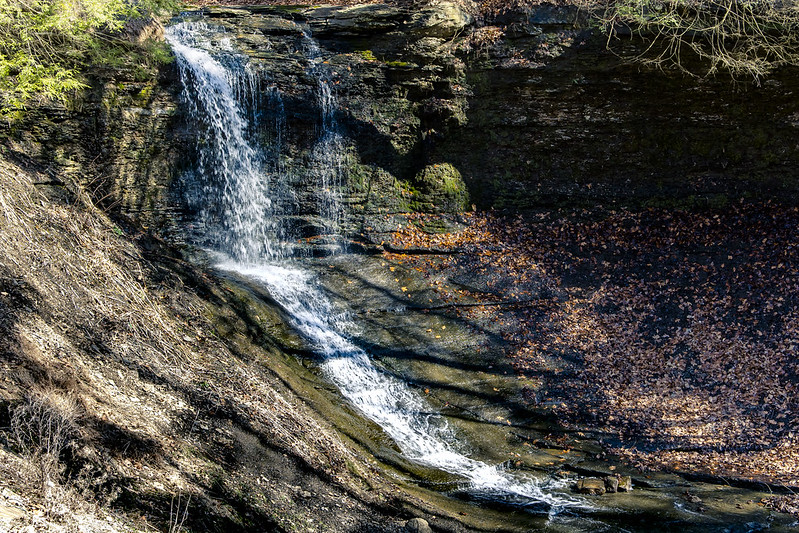
Last weekend, Our Lady of the Pentacle and myself were desirous of taking advantage of yet another unseasonably warm day here in Pittsburgh, so we piled into the Mobile Oppression Platform and drove about twenty minutes to Fall Run Park in the Glenshaw section of Shaler Township.
It’s a ‘run’ rather than a creek or a stream, which is a waterway term I’d never encountered before moving to Pittsburgh. Apparently ‘run’ is synonymous with ‘creek,’ but the former is indicative of rapidly flowing water, whereas the latter indicates slow moving or meandering water. According to legal officialdom – “run of the river means a facility where there is a continuous discharge of water without storage and release of water.”
There’s also a ‘riffle’ to consider, but there you go. There’s a big bunch of runs found in the Pittsburgh area. Has to do with the topology.
– photo by Mitch Waxman
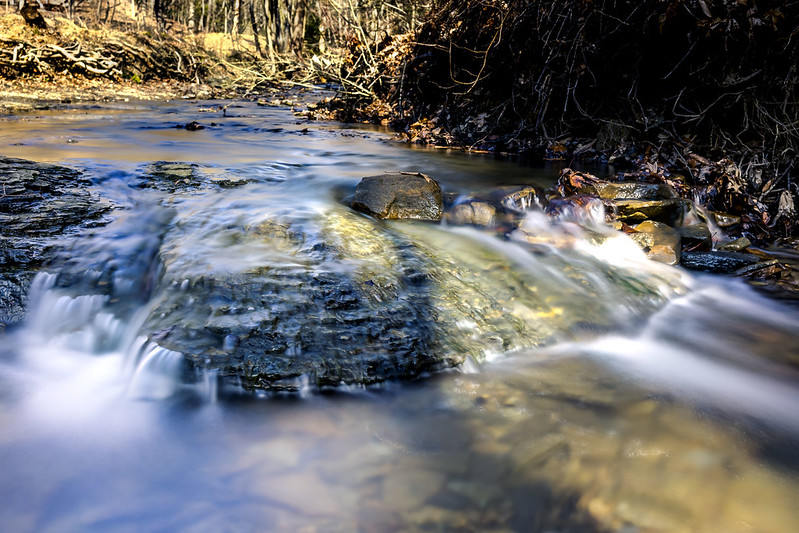
Seldom was the water more than a few inches deep, but it was shooting down hill at a good clip. The park was pretty well attended, and people were there with their kids and dogs. Lots of people, including Our Lady and myself, we’re stepping into the water’s bed in spots we here it was about an inch deep. The underlying rocks were quite slippery, as you’d imagine water polished stone with algae growing on it to be.
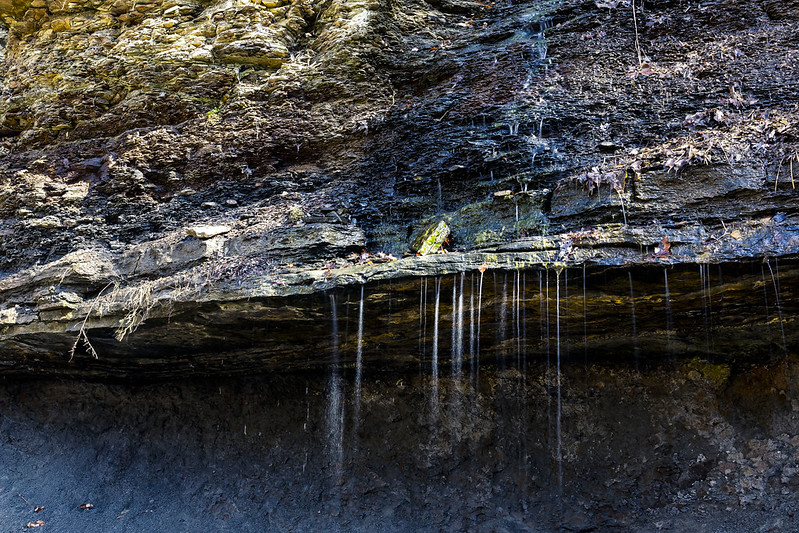
The geology of this place is absolutely fascinating, with sedimentary rock formations that were laid down during the Ordovician Era which is pretty much “pre fishies.” This ancient geology’s tectonic journeys around the globe, especially during the later Carboniferous Era, is why Pennsylvania has so much coal, oil, and gas locked up in the ground. The Appalachian chain is considered to be one of the oldest sets of mountains on the planet.
I just have to say it:
Who can guess, all there is, that might be buried down there?
– photo by Mitch Waxman
I know less about geography than I do about buying women’s shoes, but according to a bit of reading on the topic, the Appalachia’s are about 480 million years old. When the supercontinent which formed them broke apart, sections of this range ended up in both Scotland and Morocco as well as North America. Somewhere between 250 and 66 million years ago (Dinosaur time), the Appalachias – once as tall as the modern day Himalayas – had eroded down to flat ground. Uplift began during the Cenozoic Era, which started 66 million years ago and is the one we’re a part of, and the mountains began to rise. Water erosion cut through the sedimentary stones, revealing the layer cake of its geology. All of those individual layers include a treasury of minerals, including coal.
Really, this is the sort of hell which Our Lady has to live with. I can’t go to a freaking park without reading up on the history of plate tectonics, life on earth, and forming some familiarity with geologic theory.
– photo by Mitch Waxman
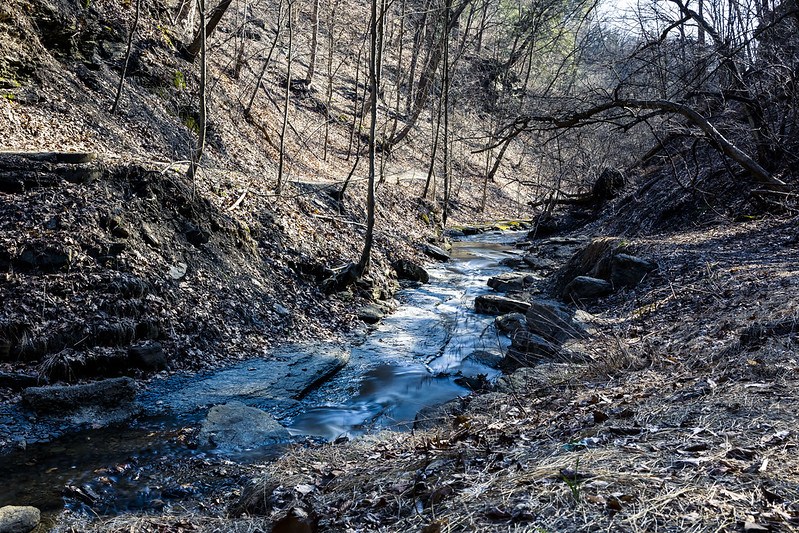
Due to the steep slopes and deep valleys here in Pittsburgh, there’s flowing water everywhere you look for it. The watershed here is vast. I still haven’t ventured into a proper set of woods, but there are conservation areas, national and state parks, and huge tracts set aside for hunting that are within easy reach.
Me? I was busy with the camera for a bit before the park got too crowded.

– photo by Mitch Waxman
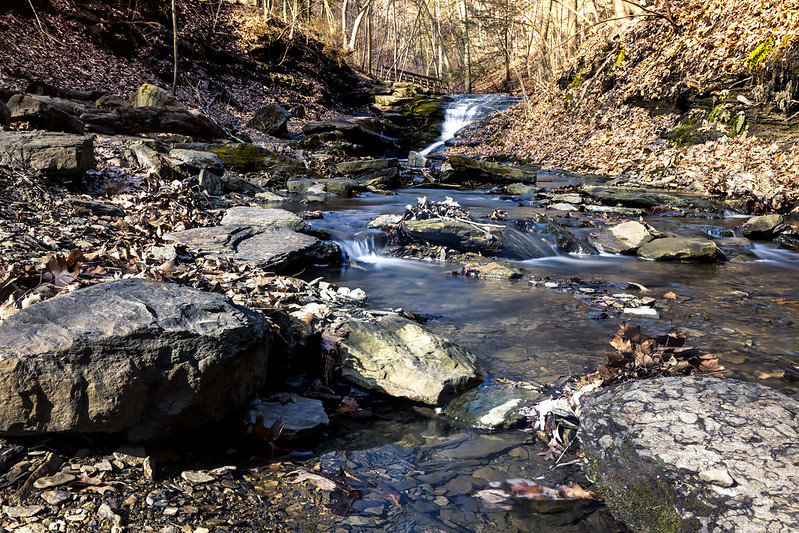
The water was shallow enough for me to just stride into the flow and set the tripod down in the stream bed, which is something I never did at Newtown Creek or the East River – for obvious reasons.
I think I overdid it with the long exposures in these, losing the texture of the flowing water entirely. Next time around, I’m going to cut my exposure time in half.
– photo by Mitch Waxman
Shaler Township is about a 15 minute drive northeast of Downtown Pittsburgh. Definitely coming back to this spot in about a month when there’s going to be greenery sprouting out of the ground.
Back tomorrow.
“follow” me on Twitter- @newtownpentacle
Buy a book!
“In the Shadows at Newtown Creek,” an 88 page softcover 8.5×11 magazine format photo book by Mitch Waxman, is now on sale at blurb.com for $30.
Second GAP: Part 2
Tuesday

– photo by Mitch Waxman
As described in yesterday’s post, one visited the Great Allegheny Passage trail on the south side of the Monongahela River again, but this time from the Duquesne side of things. That’s part of the United States Steel Mon Valley Works pictured above, which is found on the north side of the river in a community called Braddock.
The steel mill is fired up using coke and coal, and what that means is that there’s one heck of lot of railroad activity going on in its vicinity.

– photo by Mitch Waxman
That’s the Union RR Port Perry Bridge pictured above, with multiple locomotive engines working together to haul a series of coal cars to the furnaces. Union Rail Road is a Class 3 switching railroad which is ultimately owned by US Steel.
Port Perry used to be an actual town, on the north side of the river, but it essentially got swallowed by the steel mill as the operations there expanded. Saying all that, it’s not just Union RR that uses these tracks, the big boys play here too.

– photo by Mitch Waxman
A second rail bridge is found here, the PRR Port Perry Bridge, which carries Norfolk Southern’s Port Perry branch over the Monongahela River. A Class 1 railroad, Norfolk Southern has been in the news a lot over the last few weeks due to a spectacularly mishandled derailment in East Palestine, Ohio.
A friend of mine, who has a trench warrior’s mentality when it comes to his politics, recently spent a bit of time with me on the phone blaming the current President for this. The political partisan bait I was supposed to take would have seen me blaming the last President for this so then we could argue about stolen laptops, party islands, and all that.
Unfortunately for my pal, I actually know a little bit about this subject. Republicans only want to argue about what they’re currently mad about, so he was upset. This week, they’re going after Hershey’s Chocolate for being “woke” because the candy bars are “her” and “she.” I’m not kidding.

– photo by Mitch Waxman
First off, there hasn’t been an American President ever who wasn’t on the side of “management” regarding the railroads. That includes FDR, Harry Truman, and the rest. Union shmunion, they’ve all broken strikes for their sponsors in the board room.
Given the number of freight trains moving around the United States at any given time – there’s has to be somewhere between 5 and 10 thousand MILES of trains (deliberate underestimate) speedily moving about as you’re reading this – the East Palestine disaster stands out because it’s actually kind of rare. A statistical anomaly in terms of the total numbers.
You drive a car every day, for instance. You drive that car for ten years, never having a problem, but one day the car doesn’t start. That’s one day out if 3,650. 1/3650th downtime is what you’d call a statistical anomaly, not a pattern. Saying that, if you were to now define the entire ownership period based of that car on a statistical anomaly… that’s sort of where the national discussion is going right now on the subject of trains. Things went horribly wrong in East Palestine, just like in Canada’s Lac-Mégantic, but again – anomalous in terms of the total numbers of trains and miles involved. The fact that trains don’t derail every day, especially given the criminally low amount of money which the regulatory bodies require RR’s like Northern Southern to invest in infrastructure is certainly a testament to something.

– photo by Mitch Waxman
I should mention that the train pictured above is not the same unit seen in the prior two shots, instead I got this one early in the afternoon. The shots are out of order for storytelling purposes. I wasn’t in the right spot to capture this shot for the second train pictured coming over the bridge above.
I’ll say this, if your hobby is “rail fanning,” the GAP trail here in the Duquesne area offers excellent opportunities along a fairly comfortable path. I met a couple of blokes who were doing just that, and they filled me in on a few spots elsewhere in Pittsburgh where I’d enjoy waving the camera around. Apparently, Pittsburgh’s Schenley Park and ‘Panther Hollow’ is now on my list.

– photo by Mitch Waxman
The Norfolk Southern train was hauling empty mineral cars, ones which olfactory and visual inspection revealed as having recently been full of coal. This was a sunny 70 degree day, in Pittsburgh, in February. Hell, this post should’ve been about that – as that’s a statistical anomaly all of its own.
Back tomorrow with something different from the Paris of Appalachia, at your Newtown Pentacle.
“follow” me on Twitter- @newtownpentacle
Buy a book!
“In the Shadows at Newtown Creek,” an 88 page softcover 8.5×11 magazine format photo book by Mitch Waxman, is now on sale at blurb.com for $30.
Second GAP: Part 1
Monday

– photo by Mitch Waxman
So much fun was had by a humble narrator on a recent unseasonably warm afternoon that it cast a shadow over the rest of my week. As mentioned here in the past, one of the most surprising public facilities in Pittsburgh’s neck of the woods are a network of ‘rail to trail’ paths which snake around the rivers and neighborhoods in the Right Of Way or “ROW” footprints of defunct railroads. One of these liminal spaces that I’m exploring on foot at the moment is called ‘The Great Appalachian Passage’ trail, a path which I could theoretically walk along all the way to Washington D.C. Right now I’m doing it in sections of between two and four miles at a time, thank you very much.
A while back, I offered several posts (Part one, Part Two, Part Three) from the section of the GAP stretching from Homestead to a point directly across the Monongahela River from the USS Mon Valley Works on the northern side of the waterway.

– photo by Mitch Waxman
Parking the Mobile Oppression Platform (my Toyota) at a designated parking lot for the GAP in the community of Duquesne, one gathered up his old kit bag and crossed a secondary arterial highway at an incredibly terrifying intersection. There was a light, yeah, but terrifying. Smile, smile, smile.
The GAP in this section is found somewhat inland from the Monongahela River’s shoreline. There’s an entire industrial zone humming away on the side between the path and the water, whereas on the other there are several sets of railroad tracks which all seemed pretty active as I was scuttling through.

– photo by Mitch Waxman
A pipe yard is one of the many attractions hereabouts. This might be a great spot to get all artsy fartsy sometime. That’s what a humble narrator pondered for a moment, but I kept on moving. There were acres of these pipes stacked neatly.
My goal for the day was to get to the spot I had walked to from the Homestead side and take a look at what sort of photo opportunities existed in the stretch closer to Duquesne. I’m looking for vantage points overlooking the USS Mon Valley Works, in pursuit of gathering cool photos of it from a distance.
I found and subscribed to a great YouTube channel offered by Pittsburgh Photographer Jeffrey Bowser, called “Fort Frick,” which offers several startlingly well done time-lapses of the Mon Valley Works that exploit the sort of ‘POV’s’ which I’m anxious to find. Check out the Fort Frick channel here. I’m a fan.

– photo by Mitch Waxman
So why the pipes? Seems that US Steel manufactures gas at a nearby plant in Clairton and the pipes carry it over to the furnaces at the Mon Valley Works, or at least that’s what I think is happening. The pipe yard is where they store the old and new ones. I’m probably wrong about something in there, so not sure and ‘dunno.’ What I can tell you is that when a charge of gas goes through those pipes and you’re standing directly under them – it’s disconcerting. That’s basically the Shofar of Hephaestus blowing hydrocarbons right there above your head, all American style.
The sound is something like “floooooomph pufffffassasss” followed by a deep vibration which echoes out of the pipes.

– photo by Mitch Waxman
It’s not just gas that’s getting pushed towards the steel mill, there’s also high voltage transmission lines snaking out of the hills and pushing current towards the place. It seems that there’s a nuclear generating plant about fifty or so miles west of here, right along the Ohio border.
Duquesne, the community which this pathway is found in, used to have its own blast furnace – at the time the largest on the planet. Its post industrial period, however, started in 1930. Today, Duquesne, like it’s neighbor Braddock across the river deals with a declining population and a whole lot of challenges. Average median income in Duquesne is about 25k a year. AMI indicates the 50% mark, so that means that half of its citizenry survives on far less than that number.

– photo by Mitch Waxman
That’s the Mon Valley Works, which still incorporates Carnegie’s 1875 vintage Edgar Thompson blast furnace into its operations. I knew about the air pollution issues associated with the three surviving steel mills in the Pittsburgh area before moving here., but in person… They burn coal and coke, which produces a significant plume of sulfur dioxide into the atmosphere. Depending on which way the wind is blowing on any given day, you might catch a slight whiff of a rotten egg smell where I live, which is about 10-15 miles from here. For the communities which actually neighbor these plants, it’s a real and ever present problem. Here’s where the emanates of the steel mills are blowing towards today.
Back tomorrow with more from the GAP. Trains! There’ll be trains.
“follow” me on Twitter- @newtownpentacle
Buy a book!
“In the Shadows at Newtown Creek,” an 88 page softcover 8.5×11 magazine format photo book by Mitch Waxman, is now on sale at blurb.com for $30.


 The Newtown Pentacle