Archive for the ‘Brooklyn Bridge’ Category
average specimens

– photo by Mitch Waxman
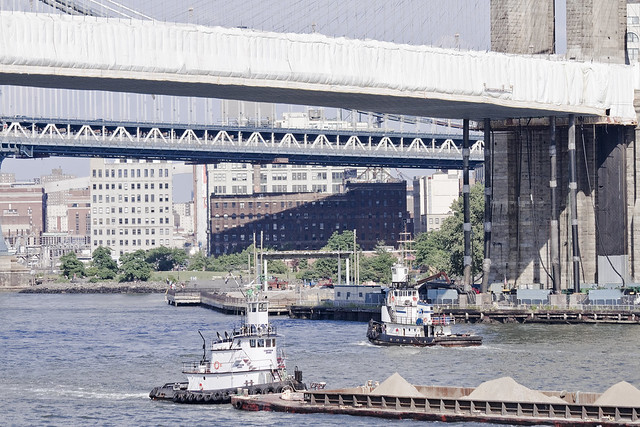
Captain Zeke is an 88 ton tug owned and operated by the White Near Coastal Towing Corp. of Syosset, and was built as the Lady Ora for Falgout Marine at Houma Shipbuilding in Louisiana back in 1980. Unfortunately, neither the company nor the tug have much information available about them, so there’s little more that can be said beyond its size- which is 30 m x 8 m, and its maximum recorded speed of 6.4 knots versus its average of 5.5 knots.
– photo by Mitch Waxman
Captain Zeke ran into a bit of trouble just a few years ago, on the Hudson River.
Spontaneous combustion involving paint rags in a fidley opening may have been the origin of the Aug. 31, 2008, fire aboard the Capt. Zeke, a Coast Guard investigator said. When their fire extinguishers proved inadequate, the tug crew fled to one of the barges.

– photo by Mitch Waxman
Speaking from a position of strictly deductive reasoning at this point, due to a lack of available information about this tug and its owners- Captain Zeke has been personally observed about the harbor moving small loads of a decidedly non volatile nature, as in the previous shot wherein the cargo seems to be sand.
It would be logical to assume that this role is well suited to the relatively small tug, which can most likely get into narrower spaces than the mated tug and barge gargantua which are employed by large players like Reinauer, Moran, or K-Sea (whose vessels specialize in the handling of volatiles) for the transport of various fuels and the handling of cargo vessels.
This theory is contradicted though, by this posting at the blog tuglife, which shows Captain Zeke tethered “on the hip” to a fuel barge.

– photo by Mitch Waxman
In the shots above and below, which were captured on the Kill Van Kull, Captain Zeke is tied to the sort of barge one regularly observes at Newtown Creek handling the SimsMetal trade in bulk metal. It is damnably odd, in the opinion of this humble narrator, that so little information is available online about this vessel. Normally, commercial maritime activity is copiously documented by a variety of private and government entities.
Regardless of this information vacuum, Newtown Pentacle’s “Maritime Sunday” nevertheless recognizes and sends a hearty greeting to Captain Zeke and its crew.
groves and gardens

– photo by Mitch Waxman
Yesterday, being the 10th of November, your humble narrator found himself at the Brooklyn Navy Yard for the opening of the Building 92 museum, a newly public space at that venerable institution found on the Wallabout.
from bldg92.org
The mission of the Brooklyn Navy Yard Center at BLDG 92 is to celebrate the Navy Yard’s past, present and future, and to promote the role the Yard and its tenants play as an engine for job creation and sustainable urban industrial growth. By providing access to exhibits, public tours, educational programs, archival resources and workforce development services, BLDG 92 reinforces the Yard’s unique bonds with the community and inspires future generations to become industrial innovators and entrepreneurs.
The Brooklyn Navy Yard Center at BLDG 92 is an exhibition and visitors center that is operated as a program of the Brooklyn Navy Yard Development Corporation.

– photo by Mitch Waxman
One of my associates from the Working Harbor Committee had brought me along, and upon arriving, I was handed a rather elaborate press kit. Said kit included facts and glad tidings about the new museum, which is housed in a renovated 1857 era structure.
from wikipedia
On the eve of World War II, the yard contained more than five miles (8 km) of paved streets, four drydocks ranging in length from 326 to 700 feet (99 to 213 meters), two steel shipways, and six pontoons and cylindrical floats for salvage work, barracks for marines, a power plant, a large radio station, and a railroad spur, as well as the expected foundries, machine shops, and warehouses. In 1937 the battleship North Carolina was laid down. In 1938, the yard employed about ten thousand men, of whom one-third were Works Progress Administration (WPA) workers. The battleship Iowa was completed in 1942 followed by the Missouri which became the site of the Surrender of Japan 2 September 1945. On 12 January 1953, test operations began on Antietam, which emerged in December 1952 from the yard as America’s first angled-deck aircraft carrier.

– photo by Mitch Waxman
The press event began with a naval color guard and pledge of allegiance, after which a group of kids were led on stage. The aim of the museum is of an educational nature, which made their presence seem appropriate.
from wikipedia
The Wallabout became the first spot on Long Island settled by Europeans when several families of French-speaking Walloons opted to purchase land there in the early 1630s, having arrived in New Netherland in the previous decade from Holland. Settlement of the area began in the mid-1630s when Joris Jansen Rapelje exchanged trade goods with the Canarsee Indians for some 335 acres (1.36 km2) of land at Wallabout Bay, but Rapelje, like other early Wallabout settlers, waited at least a decade before relocating fulltime to the area, until conflicts with the tribes had been resolved.

– photo by Mitch Waxman
All the best people from the Manhattan establishment were there, including Mayor Mike Bloomberg and Christine Quinn, Speaker of the City Council.
from “A history of the city of Brooklyn : including the old town and village of Brooklyn, the town of Bushwick, and the village and city of Williamsburgh” by Gabriel Furman, 1824, courtesy archive.org
John (George) Jansen de Ratalie, one of the Walloon emigrants of 1623, who first settled at Fort Orange (Albany), and in 1G26 removed to Amsterdam, on Manhattan Inland. On the lGth of June, 1637, Bapalie purchased from its native proprietors a piece of land called ” Hennegackonk,” lying on Long Island “in the bend of Mareckkawieck,” now better known as Wallabout Bay. This purchase, comprising about three hundred and thirty-five acres, now occupied in part by the grounds of the United States Marine Hospital, and by that portion of the city between Nostrand and Grand Avenues — although it may have been, and probably was, more or less improved as a farm by Bapalie — was not occupied by him as a residence until about 1654. 3 By that time, the gradual influx of other settlers, many of whom were Walloons, had gained for the neighborhood the appellation of the “Waal-Bogt,” or “the bay of the foreigners.”

– photo by Mitch Waxman
Mayor Bloomberg starting things off, describing the project and it’s significance to the crowd of dignitaries and veterans. He seemed to be in a particularly jocular mood.
from wikipedia
Michael Rubens Bloomberg (born February 14, 1942) is an American business magnate, politician, and philanthropist. Since 2002, he has been the Mayor of New York City and, with a net worth of $19.5 billion in 2011, he is also the 12th-richest person in the United States. He is the founder and eighty-eight percent owner of Bloomberg L.P., a financial news and information services media company.

– photo by Mitch Waxman
Apparently, the Navy Yard is an object of some attention for City Hall and hizzoner described the various political twists and financial turns over the last decade which culminated at this ceremony.
from nyc.gov
Mayor Michael R. Bloomberg and Brooklyn Navy Yard Development Corporation President Andrew Kimball cut the ribbon today on BLDG 92, a $25 million exhibition and visitors center that documents the historic significance of the 300-acre Brooklyn Navy Yard, and announced new hiring commitments from Navy Yard tenants. Over the coming year, tenants including Steiner Studios, Shiel Medical Laboratories, B&H Photo, Duggal Visual Solutions, Cumberland Packing, Ares Printing and Mercedes Distribution have agreed to work with the Navy Yard’s expanded employment program – to be housed in BLDG 92 – to place over 300 local residents in new jobs. To date, more than 1,000 local residents have been placed in jobs over the past 10 years. The new program will make a special effort to place veterans returning from Iraq and Afghanistan in the new jobs.

– photo by Mitch Waxman
A surprisingly large audience was present, including representatives of the various trade unions which worked on the project.
from wikipedia
A trade union (British English) or labor union (American English) is an organization of workers that have banded together to achieve common goals such as better working conditions. The trade union, through its leadership, bargains with the employer on behalf of union members (rank and file members) and negotiates labour contracts (collective bargaining) with employers. This may include the negotiation of wages, work rules, complaint procedures, rules governing hiring, firing and promotion of workers, benefits, workplace safety and policies. The agreements negotiated by the union leaders are binding on the rank and file members and the employer and in some cases on other non-member workers.
Originating in Europe, trade unions became popular in many countries during the Industrial Revolution, when the lack of skill necessary to perform most jobs shifted employment bargaining power almost completely to the employers’ side, causing many workers to be mistreated and underpaid. Trade union organizations may be composed of individual workers, professionals, past workers, or the unemployed. The most common, but by no means only, purpose of these organizations is “maintaining or improving the conditions of their employment”.

– photo by Mitch Waxman
Congresswoman Nydia Velazquez spoke next, as the Brooklyn Navy Yard is contained within her district. I had an opportunity to chat briefly with her afterwards, but we talked mainly about Newtown Creek.
from wikipedia
Nydia Margarita Velázquez (born March 28, 1953) is the U.S. Representative for New York’s 12th congressional district, serving since 1993. She is a member of the Democratic Party. The district includes residential areas of three boroughs (Brooklyn, Queens and Manhattan). She is the first Puerto Rican woman to be elected to Congress, and the chair of the Congressional Hispanic Caucus until January 3, 2011.

– photo by Mitch Waxman
Speaker Quinn spoke next, and described the managers of the project with great admiration.
also from nyc.gov
“The Navy Yard is a testament to New York City’s resilience and creativity,” said NYC Council Speaker Quinn. “Through thoughtful redevelopment efforts, what was once a thriving shipbuilding facility is now a model urban industrial park that houses some of the City’s most cutting edge companies. We are proud at the Council to have partnered with the Administration, State, Borough President Markowitz, and the Brooklyn Navy Yard to make BLDG 92 a reality and are thrilled to see that it will help connect local residents to more than 300 new jobs.”

– photo by Mitch Waxman
This fellow was a State Senator, I believe, named Daniel Squadron.
from wikipedia
Daniel Squadron is the state senator for the 25th district of the New York State Senate. He is a Democrat. The 25th Senate District covers lower Manhattan and an area of Brooklyn down the East River from part of Greenpoint to Carroll Gardens, and eastward to part of Downtown Brooklyn.
Before his election to the state senate, Squadron attended the Fieldston School in Riverdale, New York. He later served as a top aide to U.S. Senator Chuck Schumer, and helped to write Schumer’s book “Positively American: Winning Back the Middle-Class Majority One Family at a Time”. He ran in the Democratic primary against 30 year incumbent Martin Connor on September 9, 2008, defeating Connor with approximately 54% of the vote.

– photo by Mitch Waxman
Next up was Deputy Mayor Bob Steel.
from nyc.gov
Robert K. Steel is Deputy Mayor for Economic Development. He is responsible for the Bloomberg Administration’s five-borough economic development strategy and job-creation efforts, as well as its efforts to expand job training, strengthen small business assistance, promote new industries, diversify the economy, and achieve the goals of the New Housing Marketplace Plan, which is designed to build or preserve enough affordable housing for 500,000 New Yorkers by 2014. He spearheads the Administration’s major redevelopment projects, including those in Lower Manhattan, Flushing, Hunters Point South, Coney Island, Stapleton, the South Bronx, and Hudson Yards. Deputy Mayor Steel oversees such agencies as the Department of Housing Preservation and Development, Department of City Planning, Department of Small Business Services, NYC Economic Development Corporation and NYC & Company, and he serves as Chair of Brooklyn Bridge Park board.
Prior to his 2010 appointment as Deputy Mayor, Steel was the President and CEO of Wachovia. From 2006 to 2008, Steel was the Under Secretary for Domestic Finance at the U.S. Department of the Treasury. Prior to entering government service, Steel spent nearly 30 years at Goldman Sachs, ultimately rising to become co-head of the U.S. Equities Division and Vice Chairman of the firm. He is a graduate of Duke University and the University of Chicago’s Booth School of Business, and has distinguished himself as Chairman of Duke’s Board of Trustees, Chairman of the Aspen Institute’s Board of Trustees, Senior Fellow at the Harvard Kennedy School of Government, a member of the FDIC Advisory Committee on Economic Inclusion, Chairman of The After-School Corporation, and Co-Founder of SeaChange Capital Partners, an organization dedicated to helping nonprofits grow.

– photo by Mitch Waxman
Several military veterans were in attendance, as mentioned, these fellows had served on the USS Missouri which was launched from the Navy Yard during the second World War.
from wikipedia
USS Missouri (BB-63) (“Mighty Mo” or “Big Mo”) is a United States Navy Iowa-class battleship, and was the fourth ship of the U.S. Navy to be named in honor of the U.S. state of Missouri. Missouri was the last battleship built by the United States, and was the site of the surrender of the Empire of Japan which ended World War II.
Missouri was ordered in 1940 and commissioned in June 1944. In the Pacific Theater of World War II she fought in the battles of Iwo Jima and Okinawa and shelled the Japanese home islands, and she fought in the Korean War from 1950 to 1953. She was decommissioned in 1955 into the United States Navy reserve fleets (the “Mothball Fleet”), but reactivated and modernized in 1984 as part of the 600-ship Navy plan, and provided fire support during Operation Desert Storm in January/February 1991.
Missouri received a total of 11 battle stars for service in World War II, Korea, and the Persian Gulf, and was finally decommissioned on 31 March 1992, but remained on the Naval Vessel Register until her name was struck in January 1995. In 1998, she was donated to the USS Missouri Memorial Association and became a museum ship at Pearl Harbor, Hawaii.

– photo by Mitch Waxman
Another veteran was sitting on the dais, who was interviewed in a documentary on the project which accompanied and was distributed with the press kit.
from bldg92.org
Be among the first to walk through the gates of the Brooklyn Navy Yard when BLDG 92 opens to the public on 11/11/11. We will offer free tours, family fun and prizes to celebrate our grand opening.
Free shuttle service for opening weekend: From 12-6PM, the blue Brooklyn Navy Yard shuttle bus will make continuous loops between BLDG 92 and downtown Brooklyn (intersection: Jay Street and Willoughby Street) easily accessible from the Jay St/Metrotech station (A,C,F,N,R) and a quick walk from Borough Hall Stations (2,3,4,5)
Fri, Sat, Sun 12-6

– photo by Mitch Waxman
Along with the color guard, there was a military band present.
from wikipedia
The U.S. Navy School of Music was founded at the Washington Navy Yard by order of the Chief of the Bureau of Navigation on 26 June 1935. The school was originally run by the U.S. Navy Band, with members of the Navy Band teaching classes and private lessons in addition to their regular performance duties with the band. After the commencement of World War II, these duties were deemed too onerous for the Navy Band personnel and the school was separated from the band and relocated to the Anacostia Naval Receiving Station in Washington, D.C. on 24 April 1942.

– photo by Mitch Waxman
I was particularly taken with the Sousaphone player for some reason.
from wikipedia
The sousaphone is a valved brass instrument with the same tube length and musical range as other tubas. The sousaphone’s shape is such that the bell is above the tubist’s head and projecting forward. The valves are situated directly in front of the musician slightly above the waist and most of the weight rests on one shoulder. The bell is normally detachable from the instrument body to facilitate transportation and storage. Excepting the instrument’s general shape and appearance, the sousaphone is technically very similar to a standard (upright) tuba.
For simplicity and durability, modern sousaphones almost definitively use three non-compensating piston valves in their construction, in direct contrast to their concert counterparts’ large variation in number, type, and orientation. It has been incorrectly noted that the tuba is a conical brass instrument and the sousaphone is a cylindrical brass instrument; actually both instruments are semi-conical—no valved brass instrument can be entirely conical, since the middle section with the valves must be cylindrical. While the degree of conicity of the bore does affect the timbre of the instrument much as in a cornet and trumpet, or a euphonium and a trombone, the bore profile of a sousaphone and most tubas is similar.

– photo by Mitch Waxman
Within the structure, this is that 22,000 pound anchor that you’ve heard mentioned in other reports.
from wikipedia
The words ὀδὁντες and dentes (both meaning “teeth”) are frequently used to denote anchors in Greek and Latin poems. The invention of the teeth is ascribed by Pliny to the Tuscans; but Pausanias gives the credit to Midas, king of Phrygia. Originally there was only one fluke or tooth, whence anchors were called ἑτερόστομοι; but a second was added, according to Pliny, by Eupalamus, or, according to Strabo, by Anacharsis, the Scythian philosopher. The anchors with two teeth were called ἀμϕἱβολοι or ἀμϕἱστομοι, and from ancient monuments appear to have resembled generally those used in modern days except that the stock is absent from them all. Every ship had several anchors; the largest, corresponding to our sheet anchor, was used only in extreme danger, and was hence peculiarly termed ἱερά or sacra, whence the proverb sacram anchram solvere, as flying to the last refuge.

– photo by Mitch Waxman
The museum offered few vantage points of the actual working Navy Yard, this was one of them.
from nydailynews.com
“This will be a way for the public for the first time since 1801 to penetrate our walls and learn about our history and what we’re doing now,” said Brooklyn Navy Yard Development Corp. president Andrew Kimball. “We’ve worked really hard to break down that separation with the community.”
usual symptoms

– photo by Mitch Waxman
Existential reality and physical weakness govern this day, as your humble narrator is off to the shining city for consultations with the staff of medical specialists and practitioners whose art maintains an acceptable equilibrium between life and death for him. They plan on siphoning off some of my very lifeblood, and subjecting it to alchemical tests, as well as poking and piercing at my increasingly fragile leather with instrumentation whose appearance fills me with a nameless dread. Their prescribed potions will be assessed for effectiveness, and I will face inquisition regarding diet and lifestyle.

– photo by Mitch Waxman
Such exposure to the vagaries of science are required by the increasing fragility and easily upset homogeneity of life as one grows older, part of the overdue bill owed to the universe for that lifestyle of youthful vulgarity and distasteful indulgence which I once enjoyed. I prefer to tuck my conscious mind away in a little corner of my head, behind my left ear, and let them do to my body what they will- for that is the whole of their law. The great equalizer in our society is always found in the hospital ward, where commoner and king alike find themselves sitting on a paper covered table while wearing a cheap gown as strangers perform laboratory tests upon them.

– photo by Mitch Waxman
The staff of medical professionals which are employed on my behalf are, despite my lowly status and financial devastation, actually quite competent and highly placed- ignoring their vast experience and advice would be (and is) foolish. Weak in mind as well as body, I often dismiss this advice, but that is is part of the strange trade off one often makes in modern life- sacrificing what you know is good for you in favor of the quick fix and a feel good option. Seldom do I leave their offices without dire predictions or warnings having been offered, and today will most likely not be an exception.
with palpitant heart

– photo by Mitch Waxman
Startlingly interesting is the only way to describe the experiences of the preceding year. Attempts have been made to cogently describe and colorfully illustrate the encounters your humble narrator has enjoyed in this 10th year of the millennium. For those of you who have just recently started to read this, your Newtown Pentacle, this is your chance to check out some of the highlights of 2010 (according to me), and for the veteran Lords and Ladies of the Pentacle an opportunity to review.
If you’ll indulge me…
January, 2010- The Abbot

The sort of posting which satisfies me deeply, “The Abbot” monument found at Calvary focused my attentions on certain realities of 19th century New York, and proved my theory that Calvary Cemetery is the single greatest historical resource in Queens. Obviation of my satisfaction with the posting is provided by the admission that I had noticed the stone peripherally, found it interesting, and started shooting it with no idea at all about its meaning. Only at home, when reviewing the photos did the whole story come together. Al Smith is buried at Calvary as well (he’s the fellow who built the skyscraper seen in the night shot at the head of this post) but this paragraph is about January 2010 and Governor Smith’s story was told in 2009.
January, 2010- The Great Machine

Also in January, a pet ideation was advanced, one not of theory but of perception. The notion of the megalopolis figures heavily in my thinking- a concept that sees the eastern seaboard of the United States not as a series of cities, but rather one vast urban zone of varying densities with New York City at the titular center of a web of industry, transport, and agricultural systems. The center of the web has a center itself, which is Manhattan- specifically where it connects to “the Great Machine” of the Queensboro bridge and it’s corollaries.

– photo by Mitch Waxman
February 2010– Affordable Housing Development on Borden Avenue

This post, “Affordable Housing Development on Borden Avenue“, is included in the year end wrap up simply because it ended up being one of the more widely read and commented upon endeavors presented in 2010. Most likely, it was the linking shout out from Queenscrap that made it so, rather than any subjective quality or incisive observation. Homeless camps abound in the Newtown Pentacle, hidden away on seldom trodden lanes and along backwater pathways- in this case it’s alongside the oft delayed construction project at the Borden Avenue Bridge which spans Dutch Kills.
February 2010– horrible and unearthly ululations…

A lot of time was spent in 2010 trying to wrap my head fully around the story of the Newtown Creek (which culminated ultimately in the late October release of the first Newtown Pentacle book- Newtown Creek for the vulgarly curious) and “horrible and unearthly ululations…” was the first of several posts which attempted to boil complicated and obscure snippets of historical lore into a cohesive and accessible form. So much is made of the Greenpoint Oil Spill and the Meeker Avenue Plumes by the legal community, whose hungry jowls slaver and shake at the financial possibilities offered by the EPA’s superfund designation and various court decisions, that the true and terrible wonder of the Newtown Creek is often overlooked. This post and several others of its ilk attempt to present a fuller version of things, and act as reminders that what was may once again be.

– photo by Mitch Waxman
March 2010– The Shadow over Sunnyside

The St. Pat’s Day for All parade in Sunnyside is a yearly event which draws in a citywide coterie of political entities, all desperate for attention and attribution as being friendly to the GLTG members of the electorate. The parades origins are a reaction against the banning of outwardly gay marchers in the RC church’s own St. Patricks day parade in Manhattan. Despite its politically contentious birthing, the Sunnyside parade is actually a fun and light hearted event, and signals the coming of springtime in the Newtown Pentacle. While there principally to get shots of the political master race which rules over us, amongst the crowd I noticed small clots of dire intent armed with ugly signage. Research into this group, which was clearly coordinated and queerly ominous, revealed them to be adherents to a bastardized form of Catholic fundamentalism which has been outlawed and defined as a dangerous cult by several Nation-states. A shadow over Sunnyside indeed.
March 2010– Exhausted
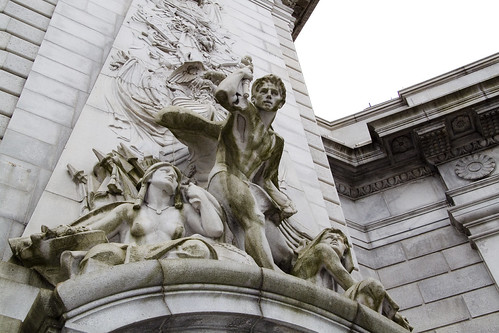
A brighter experience for your humble narrator was the Manhattan Bridge Centennial Time Capsule event, on March 5. Interactions and conversations were enjoyed by the least of men with certain powers and potentates of the City of Greater New York and entry to the interior space of the Manhattan Bridge was obtained. One of the high points of my year, “Exhausted” detailed the embedding of a time capsule in the East River Bridge #2- aka the Manhattan Bridge. Remarkable self control was exercised when I met the DOT Commissioner, Jeanette Sadik-Khan. My sincerest desire was to bend her ear with my alleged wisdom about bike lanes and bridge safety- but self control was ascendent that day and only congratulations were offered to both her and the other staffers at DOT.

– photo by Mitch Waxman
April 2010– City of Marble and Beryl
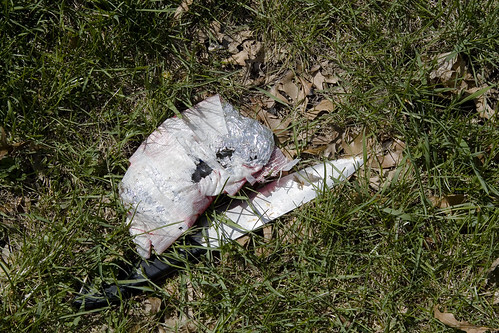
Odd shenanigans were observed at St. Michael’s Cemetery here in Astoria, which were of a decidedly magickal nature. A ritual site that your humble narrator stumbled across was examined and evidentiary examination suggested that certain third world cults were extant here in the old village of Astoria, conducting midnight bacchanals concurrent with the lunar cycle. “City of Marble and Beryl” was but the first of many moons which witnessed a working of will amongst the desolations of our kind.
April 2010– Searching for Gilman

A good part of 2010 was spent “Searching for Gilman” at First Calvary Cemetery, which I am doing as you are reading this, assuming it’s the start of 2011 whenever you do. Gilman is the source of no small amount of pain and financial hardship around these parts, as your humble narrator has become dangerously obsessive and paranoid around the subject. A psychotic need to find Gilman’s grave torments me, coloring my days and painting my dreams a dull yellow.

– photo by Mitch Waxman
May 2010– the king in yellow, brick
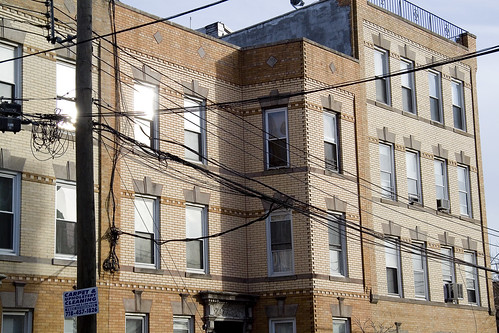
Remiss would be apparent were I to not mention the “Madison Avenue Bridge Centennial” but “the king in yellow, brick” advanced another of my pet theories and served up a fascinating (to me at least) sequence of events and relationships which attempts to explain why those yellow Kreischer bricks are all over the older sections of Queens.
May 2010– after cycles incalculable

“After cycles incalculable” is another one of those perfect posts, from a personal perspective. Wandering around with a friend, which is a disturbing trend which developed over the course of 2010, at Skillman Avenue’s start we observed the Lemuria hatching in concordance with the anniversary of the Roman festival of Lemuralia in Long Island City.

– photo by Mitch Waxman
June 2010– from Hells Gate, loosed upon the world

When I set out on my little walks, there is seldom a destination in mind. Literally wandering, obscure symbols and pseudo occultism guide my steps- I’ll follow a black cat, or merely adopt a roughly heliotropic path using my own shadow as compass. At the very end of May, my feet carried me toward Astoria Park and the notorious section of the East River known as Hells Gate. The odd craft, an “unidentified floating object” if you would, which sped past my lens required more than a small bit of detective work to identify- which was detailed in “from Hells Gate, loosed upon the world“.
June 2010– Gods Gift to Pain

English Kills, which is the logical and modern end of Newtown Creek, is a heavily industrialized and largely anaerobic tributary of the larger waterway and is seldom visited (by me, at least) at its extant. One fine day, while hanging out with another Creek enthusiast (you should not go to this place alone), we decided to enter the largely hidden urban foyer which leads here- despite the fact that we were most likely trespassing- which violates Newtown Pentacle policy. The title of the post- “Gods Gift to Pain” was lifted from an enigmatic and appropriate bit of graffiti observed in this forgotten pace of dissolution and poison.

– photo by Mitch Waxman
The reason for Brooklyn, and Queens- why it was a viable alternative to living in Manhattan in the 19th century was defined by the horrors of tenement life. The grand old buildings with their high ceilings, thick plastered walls, convenient dumbwaiters, and incredibly ornate lobbies- the structures which distinguished and made life desirable in the incalculably distant boroughs, were built as an alternative to the crowded and dangerous tenements of “The City”- especially the warren which was known as the “Five Points“. Additionally, Calvary Cemetery (of particular interest to me, and perhaps, to you) was founded by the parishioners of Old St. Patrick’s Cathedral which is smack dab in the middle of this ancient labyrinth of poverty, crime, and squalor. It was decided that to fully understand what one observes in the remains of the supposed “answer to the problem”, exploration of “the problem” itself is required.
July 2010– Bandits Roost, 2010

Ideal source material for the textural and societal milieu of the Five Points is the admittedly biased “How the Other Half Lives” by 19th century do-gooder Jacob Riis. Speaking the truth that power wants to hear is always a sound move if one considers fiscal realities and historical reputation. Attempts were made to find the modern locale in which Riis shot some of his more famous shots, such as this visit to “Bandits Roost 2010“.
July 2010– The house of Dagger John

Another critical visitation for me, as part of my larger education and study of the early development of the City of Greater New York was occasioned on the day when I went to “The house of Dagger John“. Old St. Patrick’s Cathedral satisfies both my continuing fascination with the counterpoint of sacred and profane in the story of the Megalopolis, and figures largely in the predictions of certain obscure lore which governs the schedule of my researches.

– photo by Mitch Waxman
August 2010– not to harsh anyone’s buzz… but…

August of 2010 brought a posting which garnered a lot of attention, due to curbed.com noticing and linking to it. Simply noticing that a growing proliferation of small boats were berthing illegally at the Vernon Avenue street end, it would be irresponsible of me- given everything that I know about the location not to point out the mortal and existential danger that the operators of these boats were placing themselves in. It’s not even the water, really, its the high pressure natural gas line- the enormous CSO which drains LIC- the omnipresent heavy industrial maritime traffic- which makes the spot so hazardous. Mortal threats were received via email (which I’ve kept private), and the comments thread displayed an angry and accusatory tone. As is the case with all such critique, these comments were presented verbatim- here’s a taste: “i have red your article in which you show a great deal of unger towards me and my friends . i believe that you base your article on many misconceptions that are rooted in a lack of communication”, “Blogger or not, the prudent journalist would make an effort to uncover basic facts before publishing a story full of assumptions”, “are you just the type of little man that tells teacher when the cool kids make you feel inferior. The water is public domain! And according to maritime law it is not illegal to moor a boat as long as it safe and looked after.”, “They are not bothering anyone. And get sick from the canal, come on. They are not living down there as far as I know. Parking your boat in the canal is not going to get them sick! Stop over doing it.” Check out “not to harsh anyone’s buzz… but…“.
August 2010– lively antics

One of the greatest joys of living in Queens are the chance encounters you’ll have with people who hail from the furthest points of the compass, such as this Bouzouki player during another visit to Hells Gate. His “lively antics” added splendor to a brightly lit walk around Astoria.

– photo by Mitch Waxman
September 2010– Lucky Shot

Although veteran photographers caution me against use of this term, I call the photo above my “shot of the year”. The steel structure attached to the bottom of the Brooklyn Bridge was installed as part of a bridge painting and maintenance project, and I was luckily along on a Working Harbor trip just as the sun was setting. Right place, right time, it was a “Lucky Shot“.
September 2010– stronger than fear

The dynamic new Safeboats utilized by NYPD and other entities around the harbor were a frequent subject over several of the Working Harbor expeditions I was lucky enough to attend. The many shapes, colorways, and missions of these quick little patrol boats are a delight to observe- and to those who would work maritime malice upon the metropolis- they are the head of the spear. Check out “stronger than fear“.

– photo by Mitch Waxman
A high of the year was the Newtown Creek Cruise which I had the honor of co-narrating with Bernard Ente on October 24th, of course, but the main topic of conversation amongst the antiquarian and environmental communities of the Newtown Pentacle in October revolved around the EPA’s superfund announcement about Newtown Creek at the very end of September. October is spooky time around these parts, and I spent a little time digging around the area for thrills and chills as well.
October 2010– blurred outlines

As part of series of postings detailing what might be seen in the Brooklyn neighborhood of Greenpoint, “blurred outlines” discusses the alleged appearance of a pyrokinetic at 84 Guernsey Street in January of 1895.
October 2010– scenes familiar, and loved

One of my frequent walks through Calvary Cemetery took me to the curiously empty chapel which enjoys the paramount of Laurel Hill. I will admit that I came here this day seeking two things- one was a likely entrance to a vast subterranean structure which underlies the area- the other was a vain hope that the grave of Gilman might present itself in a section which was, at the time, not terribly familiar to me as I normally stay close to the fringes of the place where the whipporwills wail. I very well might have captured what mass media paranormal media sources describe as a ghost orb in “scenes familiar, and loved“.

– photo by Mitch Waxman
November 2010– peace rests nevermore

One of the goals of this, your Newtown Pentacle, is to provide some sort of documentation about this terrible and wonderful place called the Newtown Creek- and I’m happy to say that I was there when the then Attorney General and Governor Elect Andrew Cuomo announced the settlement of a lawsuit brought by his office on behalf of New York State against Exxon-Mobil which involved the Greenpoint Oil Spill. “Peace rests nevermore” indeed.
November 2010– shocking coruscations

Entertaining maritime folklore from past centuries was offered in “shocking coruscations“, which is told against a series of twilight photos from good old Hells Gate between the two great bridges.

– photo by Mitch Waxman
During the cold, when inclement clime restricts my movements and the black dog nips at my heels, I tend toward shorter postings- and in December of 2010 there were two “Then and Now” postings that really took my fancy. These posts are difficult because of the scarce source material available in the public domain, but fun nevertheless. In my usual fashion “dumb idiot” fashion, I had shot the modern views completely unaware of the original photo. Our friends at the Greater Astoria Historic Society have recently released a book of similar historical views, which is worthy of consideration.
December 2010– Bowery Savings Bank 2010 and 1903

As the title states, this is the iconic shell of a once essential and awesomely powerful institution called the Bowery Savings Bank in Manhattan, with a 1903 photo from a similar perspective.
December 2010– Hunters Point Avenue Bridge Centennial

If you told me a year ago that I’d end up doing a press conference with a United States Congresswoman, I’d have hit you. That’s how I ended up at the Degnon Terminal’s own Sunshine Biscuits (LaGuardia Community College) building though, and by an odd coincidence- found myself standing in nearly the same spot as some unknown photographer did in 1921. This posting was built around the announcement of the “Hunters Point Avenue Bridge Centennial” event.

– photo by Mitch Waxman
Overall, a positive and exciting year, despite the deaths of several members of my family.
For a while, I enjoyed a spot on the board of the nascent Newtown Historical Society as a trustee, which is a position that I’ve had to resign for a variety of personal reasons- but I’d like to thank fellow board members Kevin Walsh, Christina Wilkinson, Steve Garza, and Bob Singleton for an interesting and educational experience. Kevin Walsh of forgotten-ny gets a personal call out, as his support, knowledge, and encouragement has been invaluable. Special thanks also are extended toward Capt. John Doswell and Meg Black of the Working Harbor Committee, all the guys and gals aboard the John J. Harvey fireboat, and everybody else who allowed a piss poor specimen such as myself to come along on adventures. Bernard Ente of the Newtown Creek Alliance, Working Harbor, and others also receives a heartfelt gratitude and shout out from this humble mendicant. Standing on the shoulders of giants is difficult if you suffer from altitude related nosebleeds.
What’s next?
Tell you what, feel like taking a walk?
Meet me at the border of Brooklyn and Queens – bring a camera… and ID… I’ll show you something cool…
Another Lucky shot

– photo by Mitch Waxman
Social gatherings and year end meetings consume the evening hours of twilit December, and recently, I had occasion to be at the Pier 17 complex at South Street Seaport. Upon arriving at my destination in the cavernous building, this scene greeted me.
Luckily, I had my trusty “old” camera- the Canon G10 with its magnetic tripod gadget attached which allows me to make “on the fly” long exposures. Even so, this was a lucky shot.
A 15 second exposure, looking north along the East River at the Brooklyn, Manhattan, and Williamsburg Bridges, on December 7th, 2010 at 7:50 PM.


 The Newtown Pentacle