Archive for the ‘Degnon Terminal’ Category
budding branches

– photo by Mitch Waxman
Returning from scouting a tour in hoary Greenpoint recently, your humble narrator was lucky enough to encounter the shot above waiting for me on Hunters Point avenue in Queens. Whereas I do seem to take quite a few shots of locomotives, I am no “railfan”. A true railfan or “foamer” obsesses over schedules and would be waiting for this train to pass. With me, it’s just pure serendipity. This is, of course, an Amtrak train heading for the Belmont tunnels which offer egress from Long Island to Manhattan via the Sunnyside Yards rail complex in Queens.

– photo by Mitch Waxman
In many ways, one can understand the apathy felt by the Manhattan elites toward Long Island City, for what do they see of the wonders hidden therein from the East River? Even the Newtown Creek appears to be just a simple bay from the water, another unremarkable inlet on the western coastline of a Long Island.

– photo by Mitch Waxman
Perhaps this is why I’ve been drawn to conducting all of these tours. Famously, the Newtown Creek Alliance motto is “Reveal, Restore, Revitalize”, and in my capacity as group historian- I’m the “reveal” guy. Next Saturday, I’m going to be doing some of that “revealing”- there are still a few tickets left for “the Poison Cauldron” walk- do come along, if you dare.

– photo by Mitch Waxman
Long have I been reluctant to bring people to this place.
For several months now, your humble narrator has been narrating in a not so humble fashion while leading boat and walking tours of the Newtown Creek watershed.
Literally hundreds of people have attended either the “Thirteen Steps around Dutch Kills“, “Insalubrious Valley“, or “Newtown Creek Boat Tour” events this year- and one question has been asked by all- “What about the Greenpoint Oil Spill?”.
Next week- a group of enthusiasts will be assembling, under the auspices of Atlas Obscura, to explore the lamentable “Poison Cauldron” of the Newtown Creek.
There are still tickets available, should you care to witness the place prior to its forthcoming demolition.

– photo by Mitch Waxman
Down Under the Kosciuszko Bridge Onramp, or DUKBO, is the name I’ve assigned to this lunar landscape of industrial mills and waste transfer stations which lines the Brooklyn side of the Creek. This year is functionally the last time you will be able to witness this place, as the Kosciuszko Bridge replacement project will be kicking into high gear in the spring of 2013.
For the urban explorer and photographer crowd, this is a wonderland of shattered streets and rusted infrastructure which will soon be eradicated from all but living memory.

– photo by Mitch Waxman
The tour will tell the story of Standard Oil at its start and cross over the Greenpoint Oil Spill’s heart, revealing that lost world of industrial aspiration and 20th century dissolution which lies less than a mile from the geographic and population centers of New York City.
In the past, I’ve described the area as “Mordor” at this, your Newtown Pentacle, and the Tolkien analogy is apt. The very air you breathe is a poisonous fume, the water is hopelessly tainted with bizarre combinations and millions of gallons of petroleum and industrial chemicals, the soil is impregnated with heavy metals, asbestos, and truly- who can guess all there is that might be buried down there?
An odd concentration of food distribution, waste transfer and garbage handling facilities, and energy industry plants make the area remarkable, and everywhere you look will be a “colour“- a bizarrely iridescent sheen which resembles no wholesome nor familiar earthly color but is instead like something from out of space- coating every bit of broken masonry and the sweat slicked skin of laborer and passerby alike.

– photo by Mitch Waxman
Standard offer copy follows:
Meetup at the corner of Kingsland and Norman Avenues in Greenpoint at 11 on Saturday, August 25th.
We will be exploring the petroleum and waste transfer districts of the Newtown Creek watershed in North Brooklyn. Heavily industrialized, the area we will be walking through is the heart of the Greenpoint Oil Spill and home to scores of waste transfer stations and other heavy industries. We will be heading for the thrice damned Kosciuszko Bridge, which is scheduled for a demolition and replacement project which will be starting in 2013. Photographers, in particular, will find this an interesting walk through a little known and quite obscure section of New York City.
Be prepared: We’ll be encountering broken pavement, sometimes heavy truck traffic, and experiencing a virtual urban desert as we move through the concrete devastations of North Brooklyn. Dress and pack appropriately for hiking, closed toe shoes are highly recommended- as are a hat or parasol to shield you from the sun.
Bathroom opportunities will be found only at the start of the walk, which will be around three hours long and cover approximately three miles of ground. Drivers, it would be wise to leave your cars in the vicinity of McGolrick Park in Greenpoint.
Click here for tickets, and as always- a limited number of walk ups will be welcomed- but for safety reasons we need to limit the group to a manageable size. Contact me at this email if you desire further details.
lands adjacent

– photo by Mitch Waxman
Found along Jackson Avenue in Long Island City, in the stretch between 21st Street and Queens Plaza, there are several truncated little blocks. Part of an earlier street grid pre dating the 20th century and the Queensboro Bridge, some host residences while others are partly residential while others are entirely industrial. All of these lanes share one commonality, which is ending where the Sunnyside Yard begins. Dutch Kills Street starts at Jackson Avenue and ends a mere block later at the fenced in rail yard.
from wikipedia
Dutch Kills is an area within Long Island City, in the New York City borough of Queens. It was a hamlet, named for its navigable tributary of Newtown Creek, that occupied what today is centrally Queensboro Plaza. Dutch Kills was an important road hub during the American Revolutionary War, and the site of a British Army garrison from 1776 to 1783. The area supported farms during the 19th Century, and was finally consolidated in 1870 with the villages of Astoria, Ravenswood, Hunters Point and Blissville to form Long Island City.

– photo by Mitch Waxman
Perpetual shadow stains the street here, titan masonry is sky flung and the steel of mighty Queensboro’s exit ramps is singing high above the pavement. Tumultuous passings of rail on the other side of an overgrown fence declare themselves loudly, and all around is evidence of poor drainage. A lonely dead end, it is one of the places where the residents of Queens enjoy indulging in the two art forms that the Borough is known for- illegal dumping and graffiti.
from wikipedia
The Pennsylvania Railroad (PRR) completed construction of the yard in 1910. At that time Sunnyside was the largest coach yard in the world, occupying 192 acres (0.78 km2) and containing 25.7 mi (41.4 km) of track. The yard served as the main train storage and service point for PRR trains serving New York City. It is connected to Pennsylvania Station in Midtown Manhattan by the East River Tunnels. The Sunnyside North Yard initially had 45 tracks with a capacity of 526 cars. The South Yard had 45 tracks with a 552 car capacity.

– photo by Mitch Waxman
A lurking menace is sensed here, the surety that one is being watched from cover. A risible smell colors the air, one which betrays the odors of mold and rot and urine. It is odd to be so close to the center of the human infestation, yet so totally alone. It would be very easy to disappear here, and imagined perils spring into the forefront of ones mind. The shining promise of the Degnon Terminal glowers with ambition and thwarted aspiration, providing backdrop and counterpoint.
from nytimes.com
PROGRESS is the watchword of Queens Borough at the present time, especially of the Queensboro Bridge Plaza and the adjacent parts of Long Island City. Never before have there been so many striking object lessons of this forward movement in that long-neglected borough as may be seen today within a few blocks of the spacious approach to the bridge.

– photo by Mitch Waxman
Some poor soul calls this place their own, living in a makeshift shanty. So many of the “working homeless” are observed around these back alleys and forgotten corners, lonely vagabonds ekeing out a subsistence living while living in squalor, surviving by craft and guile. What strange experiences and odd tales could they relate about what happens in the dark of night, here on Dutch Kills Street?
from wikipedia
Modern homelessness started as a result of economic stresses in society and reductions in the availability of affordable housing such as single room occupancies (SROs) for poorer people. In the United States, in the 1970s, the deinstitutionalisation of patients from state psychiatric hospitals was a precipitating factor which seeded the homeless population, especially in urban areas such as New York City.
The Community Mental Health Act of 1963 was a predisposing factor in setting the stage for homelessness in the United States. Long term psychiatric patients were released from state hospitals into SROs and supposed to be sent to community mental health centers for treatment and follow-up. It never quite worked out properly, the community mental health centers mostly did not materialize, and this population largely was found living in the streets soon thereafter with no sustainable support system.
Also, as real estate prices and neighborhood pressure increased to move these people out of their areas, the SROs diminished in number, putting most of their residents in the streets. Other populations were mixed in later, such as people losing their homes for economic reasons, and those with addictions (although alcoholic hobos had been visible as homeless people since the 1890s, and those stereotypes fueled public perceptions of homeless people in general), the elderly, and others.

– photo by Mitch Waxman
Although nothing of the sort was observed on this visit, one often sees candles and small altars to unknown gods in these places. Offerings of coins, foodstuffs, and cigars have often been noted amongst these arrangements. Peasant superstition and magicks are often the recourse of the desperate and desolated, however.
from wikipedia
Beliefs in witchcraft, and resulting witch-hunts, existed in many cultures worldwide and still exist in some today, mostly in Sub-Saharan Africa (e.g. in the witch smellers in Bantu culture). Historically these beliefs were notable in Early Modern Europe of the 14th to 18th century, where witchcraft came to be seen as a vast diabolical conspiracy against Christianity, and accusations of witchcraft led to large-scale witch-hunts, especially in Germanic Europe.
The “witch-cult hypothesis”, a controversial theory that European witchcraft was a suppressed pagan religion, was popular in the 19th and 20th centuries. Since the mid-20th century, Witchcraft has become the self-designation of a branch of neopaganism, especially in the Wicca tradition following Gerald Gardner, who claimed a religious tradition of Witchcraft with pre-Christian roots.
____________________________________________________________________________
Click for details on Mitch Waxman’s
Upcoming walking and boat tours of Newtown Creek
July 8th, 2012- Atlas Obscura Walking Tour- The Insalubrious Valley
(note: there was just one ticket left for this one when I hit “publish”)
for July 8th tickets, click here for the Atlas Obscura ticketing page
July 22nd, 2012- Working Harbor Committee Newtown Creek Boat Tour

darkly hidden

– photo by Mitch Waxman
As described in the recent posting “Obscure World“, the location of Conrad Wissel’s notorious “Dead Animal and Night Soil Wharf” has been finally nailed down and confirmed by contmeporaneous maps and photographs. A lot of people ask me where I find my information about the oft occluded history of the Newtown Creek, and are surprised when informed about my methodology.
Basically, it all boils down to this- I’ll notice something hidden in plain sight while wandering around, take photos of it, and start researching when back at HQ. There’s a whole list of mysteries in my “to do” pile, and often the answer to what they were is presented while searching for something else entirely. It’s how the whole “missing Lamp Post of the Queensboro bridge thing” got started. Accordingly, whenever accusations of pursuing some political agenda are leveled at this- your Newtown Pentacle- great amusement ensues.
The utterly forgotten headquarters of the General Electric Vehicle Company of Long Island City, which had been staring me in the face for years, revealed itself in this manner. Easy to miss the third largest factory building in Queens, I guess, even if its painted with bright yellow and green stripes.

– photo by Mitch Waxman
As detailed in the posting “uncommented masonry“, one was merely poking around for some information about the “Blissville Banshee“.
A supernatural phenomena, the Banshee was reported on in 1884 by the NY Times (she was described as red haired, blue eyed, and screaming “Oh Ho” like … well… a banshee), and was an obvious jab at the largely Irish and Catholic population of Blissville by Manhattan’s patrician “Nativists”. Racial or ethnic prejudice is commonly encountered in journalism of that era, and quite unsurprising to those familiar with reportage of the period. In the 1880’s, “politically correct” meant not shooting someone on sight.
What emerged about the structure above, however, was that in 1915- a quarter of the 40,000 or so trucks then plying the streets of New York City were electric (and participated in a rail based battery exchange program). Most of them were manufactured in Long Island City within the building pictured above, by the General Electric Vehicle Company.
This is my favorite sort of posting, a product of serendipity and pure discovery.
Which brings me to the Tammany men, and why there very well might be a horse buried in Calvary Cemetery.

– photo by Mitch Waxman
“The Abbot” from January of 2010, described a chance sighting of a curious obelisk in Queens’s Calvary Cemetery.
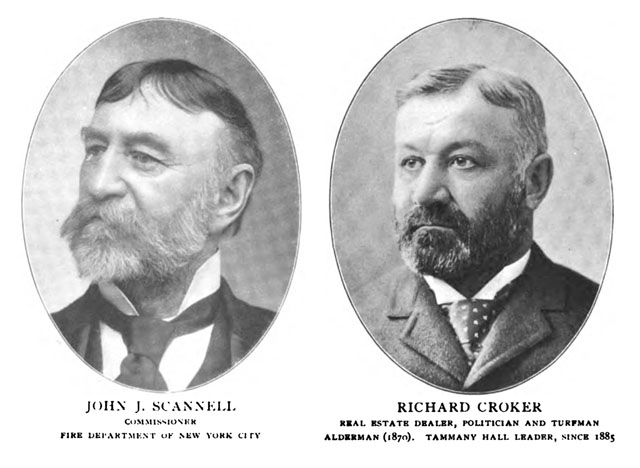
By the time that I was done with this post, I had found the young J.J. Scannell and Richard Croker sitting out a sentence in Manhattan’s “Tombs”. Quite a propitious meeting- in retrospect, one with far reaching consequence.
These two men would rise to the top of Tammany Hall one day, preside over the consolidation of the City of Greater New York from the shadowed world of the “smoke filled room”, and grow filthy rich on a buttery diet of political corruption.
Think Boss Tweed was something? In that case, you’ve never heard of Scannell and Croker.
All this because I enjoy strolling through Calvary in the afternoon while the Dropkick Murphys are playing on my headphones.
incidentally, something recently discovered (see how it works?) were these portraits of Mr.’s Scannell and Croker- found in Moses King’s “Notable New Yorkers of 1896-1899, courtesy google books

– photo by Mitch Waxman
“from some point in space“, another 2010 posting, showcases a shot of Dutch Kills acquired before a press conference which highly placed members of the Newtown Creek Alliance had asked me to represent them at (literally no one else from Queens was available).
My statement was prepared, thankfully, as I was standing next to and was introduced by Congresswoman Carolyn Maloney. Stage fright and hallucination inducing nervousness ruled my mood during the lead up.
To alleviate the anxiety while waiting for the event to begin… and as I happened to be standing in a south facing room within the Degnon Terminal’s former Loose Wiles building… which overlooks the waters of the Dutch Kills tributary of Newtown Creek- a window was soon roughly thrown open and I shot the image above.
As it happens, while attempting to research a group of heretical Quakers operating in the area just before the Revolutionary War, I came across the following image in another one of those “old and out of copyright” municipal journals which have found their way onto the web.

– Photo from 1921’s ”The Newtown Creek industrial district of New York City By Merchants’ Association of New York. Industrial Bureau”, courtesy google books
Cool, huh?
An August 2011 post, called the “the dark moor“, reversed the point of view and showed the view from infinite Brooklyn into Queens from atop the digester eggs of the Newtown Creek Waste Water Treatment Plant.
Click for details on Mitch Waxman’s
Upcoming walking and boat tours of Newtown Creek, and Staten Island’s Kill Van Kull
June 23rd, 2012- Atlas Obscura Thirteen Steps around Dutch Kills walk (this Saturday)
for June 23rd tickets, click here for the Atlas Obscura ticketing page
June 30th, 2012- Working Harbor Committee Kill Van Kull walk
for June 30th tickets, click here for the Working Harbor Committee ticketing page
July 8th, 2012- Atlas Obscura Walking Tour- The Insalubrious Valley
for July 8th tickets, click here for the Atlas Obscura ticketing page
July 22nd, 2012- Working Harbor Committee Newtown Creek Boat Tour
silent circle

– photo by Mitch Waxman
Memorial Day weekend, despite the swelter, found me down and around Dutch Kills.
Just passing through, I was on my way to a holiday party in Greenpoint, and decided to take advantage of the deserted industrial center and get a little “artsy-fartsy” with the camera. The rainy interval recently experienced in the watershed has swollen the Dutch Kills tributary of the Newtown Creek- indeed, the entire waterway is supercharged with contaminants- due to the action of the loathsome Combined Sewer Outfalls which feed directly into the water during storm events.
from dec.ny.gov
Combined sewer systems (CSS) are sewers that are designed to collect storm water runoff, domestic sewage, and industrial wastewater in the same pipe. During rain events, when storm water enters the sewers, the capacity of the sewer system may be exceeded and the excess effluent will be discharged directly to the receiving water. A combined sewer overflow (CSO) is the discharge from a combined sewer system that is caused by snow melt or storm water runoff.

– photo by Mitch Waxman
The water had a large amount of floatable materials in it, and there were eddy patterns around the banks that sported pools of congealed fats and cooking oils, but that wasn’t what I was going for in these shots. Instead, I was fascinated by the shapes of the grottoes produced by the rotting bulkheads of the red white and blue structure pictured above.
Satisfied, I resumed my course toward Greenpoint.
from nyc.gov
DEP has a broad citywide effort to better manage stormwater using a variety of innovative, sustainable green infrastructure. Improved stormwater management is an important component of Mayor Bloomberg’s PlaNYC initiative and Sustainable Stormwater Management Plan. Green infrastructure, or source controls, are a set of techniques that detain or retain stormwater runoff through capture and controlled release, infiltration into the ground, vegetative uptake and evapotranspiration thereby reducing the need for end-of-pipe stormwater storage and treatment systems.

– photo by Mitch Waxman
As I moved past a weed choked lot, whose every vegetative inhabitant was stained with the irrepressible “colour”, a sudden flash of motion drew my eye. Unbelievable, a monarch(?) butterfly alighted on one of the stalks and posed for a moment. Butterflies, you see, are the “canary in the coal mine” of the insect world- highly sensitive to environmental conditions and here was one right in the middle of Queens’ industrial heartlands.
from wikipedia
The Monarch butterfly (Danaus plexippus) is a milkweed butterfly (subfamily Danainae), in the family Nymphalidae. It is perhaps the best known of all North American butterflies. Since the 19th century, it has been found in New Zealand, and in Australia since 1871 where it is called the Wanderer.It is resident in the Canary Islands, the Azores, and Madeira, and is found as an occasional migrant in Western Europe and a rare migrant in the United Kingdom.
Also:
June 16th, 2012- Newtown Creek Alliance Dutch Kills walk

– photo by Mitch Waxman
The Newtown Creek Alliance has asked that, in my official capacity as group historian, a tour be conducted on the 16th of June- a Saturday. This walk will follow the Dutch Kills tributary, and will include a couple of guest speakers from the Alliance itself, which will provide welcome relief for tour goers from listening to me rattle on about Michael Degnon, Patrick “Battle Ax” Gleason, and a bunch of bridges that no one has ever heard of.
for June 16th tickets, click here for the Newtown Creek Alliance ticketing page
June 23rd, 2012- Atlas Obscura Thirteen Steps around Dutch Kills walk

– photo by Mitch Waxman
Additionally- the “Obscura Day” Thirteen Steps around Dutch Kills tour proved that the efficacy and charms of the Newtown Creek’s least known tributary, with its myriad points of interest, could cause a large group to overlook my various inadequacies and failings. The folks at Atlas Obscura, which is a fantastic website worthy of your attentions (btw), have asked me to repeat the tour on the 23rd of June- also a Saturday.
for June 23rd tickets, click here for the Atlas Obscura ticketing page
June 30th, 2012- Working Harbor Committee Kill Van Kull walk

– photo by Mitch Waxman
My various interests out on the sixth borough, NY Harbor, have brought me into association with the Working Harbor Committee. A member of the group’s Steering Committee- I also serve as the “official” group photographer, am chairman and principal narrator of their annual Newtown Creek Boat Tour, and occasionally speak on the microphone during other tours (mainly the Brooklyn one). This year, the group has branched out into terrestrial explorations to compliment the intense and extant schedule of boat tours, and I’m going to be leading a Kill Van Kull walking tour that should be a lot of fun.
The Kill Van Kull, or tugboat alley as its known to we harbor rats, is a tidal strait that defines the border of Staten Island and New Jersey. A busy and highly industrialized waterfront, Working Harbor’s popular “Hidden Harbor – Newark Bay” boat tours provide water access to the Kill, but what is it like on the landward side?
Starting at the St. George Staten Island Ferry terminal, join WHC Steering Committee member Mitch Waxman for a walk up the Kill Van Kull via Staten Islands Richmond Terrace. You’ll encounter unrivaled views of the maritime traffic on the Kill itself, as well as the hidden past of the maritime communities which line it’s shores. Surprising and historic neighborhoods, an abandoned railway, and tales of prohibition era bootleggers await.
The tour will start at 11, sharp, and you must be on (at least) the 10:30 AM Staten Island Ferry to meet the group at St. George. Again, plan for transportation changes and unexpected weirdness to be revealed to you at MTA.info.
For June 30th tickets, click here for the Working Harbor Committee ticketing page
Walking Tours in June

– photo by Mitch Waxman
Despite my loathsome appearance, abhorrent personality, and an unwholesome nature which engenders disdain from strangers- the walking tours of the Newtown Creek Watershed I’ve been conducting have all proved to be quite popular and in fact- have sold out. There have been one or two that I’ve publicized, and a few that were privately organized.
Demand has dictated that an expanded schedule of these walks, albeit punctuated by my incessant prattle, be offered.
To wit:
June 16th, 2012- Newtown Creek Alliance Dutch Kills walk
– photo by Mitch Waxman
The Newtown Creek Alliance has asked that, in my official capacity as group historian, a tour be conducted on the 16th of June- a Saturday. This walk will follow the Dutch Kills tributary, and will include a couple of guest speakers from the Alliance itself, which will provide welcome relief for tour goers from listening to me rattle on about Michael Degnon, Patrick “Battle Ax” Gleason, and a bunch of bridges that no one has ever heard of.
for June 16th tickets, click here for the Newtown Creek Alliance ticketing page
June 23rd, 2012- Atlas Obscura Thirteen Steps around Dutch Kills walk
– photo by Mitch Waxman
Additionally- the “Obscura Day” Thirteen Steps around Dutch Kills tour proved that the efficacy and charms of the Newtown Creek’s least known tributary, with its myriad points of interest, could cause a large group to overlook my various inadequacies and failings. The folks at Atlas Obscura, which is a fantastic website worthy of your attentions (btw), have asked me to repeat the tour on the 23rd of June- also a Saturday.
for June 23rd tickets, click here for the Atlas Obscura ticketing page

– photo by Mitch Waxman
The tours will cover similar ground, but approach the subject from differing angles. Both share the same dire warnings about traffic and footwear and the “boiler plate” offer is included below. As a rule, walkups are allowed, but be warned- when the group get to a certain size, I’m forced to refuse additional participants.
Buying a ticket in advance is your best bet.
Join Newtown Creek Alliance Historian Mitch Waxman for an intense exploration of Newtown Creek’s Dutch Kills tributary — found less than one mile from the East River. Dutch Kills is home to four movable (and one fixed span) bridges, including one of only two retractile bridges remaining in New York City. Dutch Kills is considered to be the central artery of industrial Long Island City and is ringed with enormous factory buildings, titan rail yards — it’s where the industrial revolution actually happened. Bring your camera, as the tour will be revealing an incredible landscape along this section of the troubled Newtown Creek Watershed.
Be prepared: We’ll be encountering broken pavement, sometimes heavy truck traffic, and moving through a virtual urban desert as we cross the currently undefended border of Brooklyn and Queens. Dress and pack appropriately for hiking, closed toe shoes are highly recommended.
Bathroom opportunities will be found only at the start of the walk, which will be around three hours long and cover approximately three miles of ground.
Meetup – At the Albert E. Short Triangle park found at the corner of Jackson Avenue and 23rd Street in Long Island City, Queens. This is the Court Square MTA station, and served by the 7, G, and M lines. Additionally, the Q39 and B62 buses have nearby stops. Check MTA.info as ongoing construction at Queens Plaza often causes delays and interruptions.
Drivers, it would be wise to leave your vehicle in the vicinity of the Pulaski Bridge in either Greenpoint or Long Island City.
June 30th, 2012- Working Harbor Committee Kill Van Kull walk
– photo by Mitch Waxman
My various interests out on the sixth borough, NY Harbor, have brought me into association with the Working Harbor Committee. A member of the group’s Steering Committee- I also serve as the “official” group photographer, am chairman and principal narrator of their annual Newtown Creek Boat Tour, and occasionally speak on the microphone during other tours (mainly the Brooklyn one). This year, the group has branched out into terrestrial explorations to compliment the intense and extant schedule of boat tours, and I’m going to be leading a Kill Van Kull walking tour that should be a lot of fun.
The Kill Van Kull, or tugboat alley as its known to we harbor rats, is a tidal strait that defines the border of Staten Island and New Jersey. A busy and highly industrialized waterfront, Working Harbor’s popular “Hidden Harbor – Newark Bay” boat tours provide water access to the Kill, but what is it like on the landward side?
Starting at the St. George Staten Island Ferry terminal, join WHC Steering Committee member Mitch Waxman for a walk up the Kill Van Kull via Staten Islands Richmond Terrace. You’ll encounter unrivaled views of the maritime traffic on the Kill itself, as well as the hidden past of the maritime communities which line it’s shores. Surprising and historic neighborhoods, an abandoned railway, and tales of prohibition era bootleggers await.
The tour will start at 11, sharp, and you must be on (at least) the 10:30 AM Staten Island Ferry to meet the group at St. George. Again, plan for transportation changes and unexpected weirdness to be revealed to you at MTA.info.
For June 30th tickets, click here for the Working Harbor Committee ticketing page


 The Newtown Pentacle