Archive for the ‘Dutch Kills’ Category
profound discouragement

– photo by Mitch Waxman
With my favored vantage on Dutch Kills, the estimable Borden Avenue Bridge, once more accessible– I’ve been making it a point to aim my wanderings toward its general direction whenever I can summon the fortitude to brave the ice. As crazy as it sounds, and regular readers of this- your Newtown Pentacle- have become fairly accustomed to crazy, I really missed this little bridge for the nearly 2 years it had been undergoing emergency repair.

– photo by Mitch Waxman
Perhaps its because this is the first section of the Newtown Creek that I actively explored, researched, and made it a point of documenting. Maybe its simply because this is the most easily attained of the Creek’s tributaries for one who walks, or that it seems to be the most “down on it’s luck” section of the vast watershed and I’m drawn by nature to the runt of the litter.
English Kills in far off Brooklyn makes for far better cautionary tales, but there’s just something tragic about Dutch Kills that always draws me in.

– photo by Mitch Waxman
An actual “out loud gasp” escaped my food hole when I discovered that the resident Crow of the Borden Avenue Bridge had not been forced out of his shanty by the long construction project, and if anything- the fellow had been building additions to the ramshackle hut constructed from found materials.
Last time that I had pointed my lens at this character was in the February 3rd posting of 2010 titled “affordable housing development on Borden Avenue“.

– photo by Mitch Waxman
The smell of a wood fire was wafting from the Crow’s slapdash of plywood, tyvek, and sheet metal- a vague scent which crowded its way into the otherwise extant perfumes normally associated with Dutch Kills.
For those of you who haven’t been reading the Newtown Pentacle since inception- “Crow” is a term I picked up from the neighborhood in Astoria that describes the armies of itinerant scrap metal collectors who find profit in other people’s waste- “put something shiny out on the sidewalk, and the crows will show up and take it” is a common aphorism around my part of Astoria.
I’ve assigned this crow a name “Blue Crow”, but both the “red crow” and the “burgundy crow” have been mentioned previously.

– photo by Mitch Waxman
There’s a bunch of these folks I’ve been spying on, and I’ve even heard rumors of a criminal group who pilfer the white bronze monuments and copper fittings of area cemeteries to sell the valuable metals on the scrap market, but I have yet to regale you with tales of the other- and quite polychromatic- crows who hold the “Green Recycling Jobs of Tomorrow, Today”.
One has also wondered, and more than wondered, at what foul congress the Blue Crow might have had with that which cannot possibly exist in the velvet deep of the malign Dutch Kills.
for silver
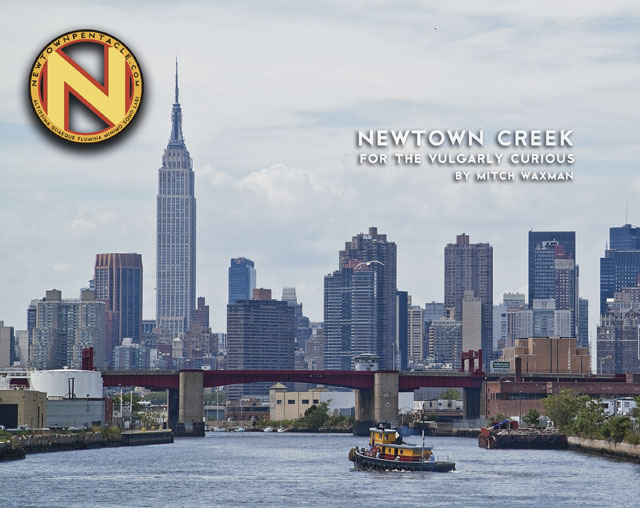
“Newtown Creek for the Vulgarly Curious” is a fully annotated 68 page, full-color journey from the mouth of Newtown Creek at the East River all the way back to the heart of darkness at English Kills, with photos and text by Mitch Waxman.
Check out the preview of the book at lulu.com, which is handling printing and order fulfillment, by clicking here.
Every book sold contributes directly to the material support and continuance of this, your Newtown Pentacle.
gentle manner

Combined Sewer Outfall BB-013, from the Pulaski Bridge – photo by Mitch Waxman
To begin- I warn you- this post will most likely “gross you out”.
In 1674, Boyle said: “I have often suspected, that there may be in the Air some yet more latent Qualities or Powers differing enough from all these, and principally due to the Substantial Parts or Ingredients, whereof it consists. For this is not as many imagine a simple and elementary body, but a confused aggregate of ‘effluviums’ from such differing bodies, that, though they all agree in constituting by their minuteness and various motions one great mass of fluid matter, yet perhaps there is scarce a more heterogeneous body in the world”.
When the pithy observation was recorded, “effluviums” were the central notion behind the miasmatic theory of disease.

CSO Outfall NC-077, Maspeth Creek, discharges 288.7M gallons per year into English Kills – photo by Mitch Waxman
The viewpoint of the learned classes in prior ages held that when certain noxious vapors produced by a mingling of soil with that standing water typically found about marsh, swamp, and sewer- then mixed with the cool night air- form so called miasmas (which is an ancient greek for pollution, I’m told).

CSO Outfall NC-077, Maspeth Creek, Tier 2 outfall – photo by Mitch Waxman
These miasmas- or “epidemic influences”- were believed to be the cause of Cholera and Typhus– and all the other plagues which would one day scythe through the crowded 18th and 19th century cities of the Industrial Revolution.
Vitruvius, in the 1st century BCE, said: “For when the morning breezes blow toward the town at sunrise, if they bring with them mist from marshes and, mingled with the mist, the poisonous breath of creatures of the marshes to be wafted into the bodies of the inhabitants, they will make the site unhealthy.”

CSO Outfall NC-077, Maspeth Creek, Ranked 25 out of over 400 in terms of volume – photo by Mitch Waxman
The air produced by, in, and around a sewer is typically an aerosol of whatever liquid solution might be floating through it. Hydroden sulfide, carbon dioxide, methane, ammonia and a host of other constituent compounds mingle and form what is generically known as “Sewer Gas”. Typically, this gas has the sulfurous smell commonly associated with rotten eggs. Otherwise lacking and poor, the average human’s sense of smell can discern this odor when its concentration in the surrounding air is minor- which speaks to an evolutionary quirk.
Obviously- our ancestors who could not detect this aerosol, or miasma, died off while while those who could detect them passed on these sensitivities on to future generations.

CSO Outfall BB-026, Dutch Kills – photo by Mitch Waxman
If you suffer from Obsessive Compulsive Disorder, this would probably be a good time to stop reading this post, incidentally. Things are about to get ugly.
As an example- When a toilet is flushed, and there is scientific evidence to back this, a plume of microscopic droplets- an aerosol– erupts from the water. These droplets carry microbes and virus particles, which then settle on surfaces around the commode facilitating the “surface to hand to mouth” vector of infection. Modern plumbing does its best to minimize this bioaerosol in the house, but routine antimicrobial maintenance with bleach and other chemicals is necessary to sterilize the potential infections which might otherwise occur.
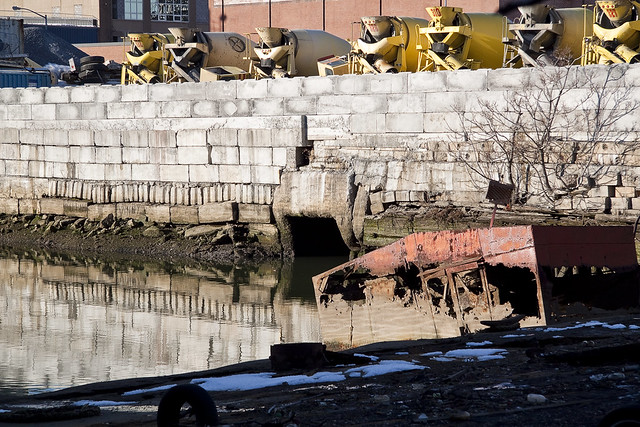
CSO Outfall BB-026, Dutch Kills – photo by Mitch Waxman
Of course, these cleaning chemicals- along with non neutralized microbes- end up in the wastewater flow, and make their way into the sewers… just like the petroleum products, volatile organic chemicals, and everything else that the human hive produces… where they swirl about beneath the streets and follow gravity to low lying areas. A properly designed system intercepts these waters, but in the case of a “CSO”, a lot of the poison makes it into the mud.

CSO Outfall BB-026, Dutch Kills – photo by Mitch Waxman
A classic example of a bacterium whose spread is defined by such aerosol dissemination is Legionella, but heavy metals and other contaminants may also find a pathway into the human body via such aerosols (let’s just call it vapor or fog). Additionally, fibers of toxic manmade substances- Asbestos for instance- are left behind during evaporation. Such deposits are then picked up on the wind, as are the dusty remains of the putrescent particulates which escape treatment by wastewater industries like the Newtown Creek Wastewater Treatment plant in Greenpoint or the Bowery Bay facility in Astoria.
During heavy rain events, some untreated sewage reaches the rivers, but a large percentage of it- the lion’s share- oozes out from the bulkheads of that assassination of joy called the Newtown Creek.

CSO Outfall NCB-632 – photo by Mitch Waxman
The Newtown Creek and its tributaries are indeed waterways, but no one ever discusses this plume of disease and contamination in the air. Fingers are pointed at certain chimneys and infamous underground lakes of petroleum and chemicals, heated discussions of when it might be safe to kayak or swim in the water are offered by interested parties, and odd admissions that there are some who actually fish in and consume the catch from these waters (which according to the EPA, are offering this catch for sale in area restaurants) both shock and titillate area wags- but what about the miasmas?

CSO Outfall NCB-632 – photo by Mitch Waxman
The sewer system of New York City is a composite beast, marrying together the municipal infrastructure of multiple communities into a single system. The cities of Brooklyn, Queens, and Manhattan (the historically agrarian and until modernity- lightly populated – Bronx has almost always been ruled over by Manhattan) each had their own standard, staring elevation, and set of regulations governing the sewers.
This NYTimes.com article from 2008 discusses recent attempts to consolidate and digitize the municipal record, and make sense out of the byzantine network of pipes which underlie the city.

CSO Outfall NCB-632 – photo by Mitch Waxman
Who can guess, all there is, that might be buried down there?
Who can speculate, all there is, which might be wafting out from these deep channels of filth and what strange aerosols are carried upon the gentle breeze- here in the Newtown Pentacle?
the stinking shallows

– photo by Mitch Waxman
As mentioned in yesterday’s posting, aimless wandering around the Dutch Kills tributary of Newtown Creek was how your humble narrator spent Monday afternoon. The stealthy ones… let’s just call them Cats… pointed me in this direction, and low tide was observed.
Strewn, the 29th street roadside coast of the canal is a favored location for illegal dumping of both construction debris and putrescent garbage- which- when combined with the stagnant conditions which are typical of this water and factoring the recent snow melt…
-let’s just say that the smell here is a tangible and seemingly sentient thing.

– photo by Mitch Waxman
It was low tide when I stood there, my attentions drawn to exposed sediments and that curiously decayed steel which composes the hull of a long stranded barge- both of which are remarkable. Casting my lens around, I noticed the sickly trees adorning the filth bearing shore and began thinking about the posting “a creeping run” which was presented here- at your Newtown Pentacle- just days ago.
Hyperbolic, the post pondered the presence of organochemical mutagens in the water, swirling about in that vast cocktail of industrial runoff– whose whispered effects have been studied only as individual constituents rather than “in solution” or “in concert”- not just here, but all along that cautionary tale known as the Newtown Creek.
The trees.

– photo by Mitch Waxman
Let me state three things here…
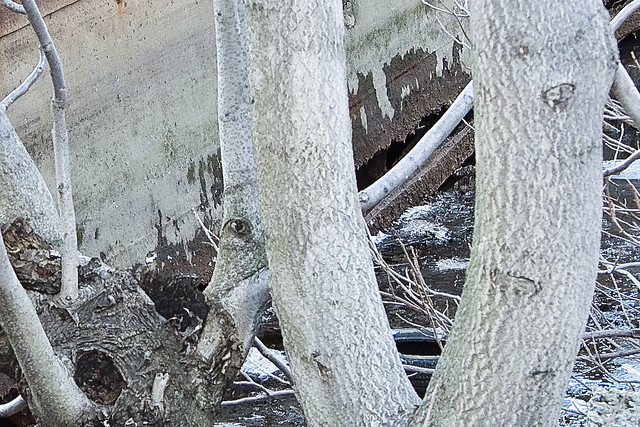
first- “simulacra” is a term I use to describe the appearance to the human eye of patterns in organic and random shapes. Certain contrasts in entirely random shapes might suggest a “man in the moon” or a “dragon in the clouds” or “Jesus on a pancake” or “Allah’s name inside an apple” or any of the usual visual coincidences experienced by people when confronted with a well done puppet or artistically wrought doll. It’s the way our eyes and brains work, ultimately. I don’t know what other people call it, but that’s what is meant when I say it.
second- I’m a professional photo retoucher in the New York City advertising world, and routine tasks call for me to create composite images which blend multiple exposures into a single illusory image (as well as taking the mustaches off the pretty ladies). This is the creation of a lie in photographic form, featuring distortions of anatomy and removal of a subjective series of perceived flaws in the subject matter. One of the tricks of the trade is understanding how to manipulate that sense of “simulacra”. In other words, I am quite capable of faking something, photographically speaking.
third- As a statement of principle and duty to the record- the photos which occur during these postings are unaltered except for color and exposure correction and sharpening. Whenever it’s a “trick image” like an “HDR” or “stitched panorama” or “tilt shift”- I endeavor to label it as such.
The Trees.
– photo by Mitch Waxman
This shot is un-messed around with, a simulacra caused by a broken branch or a parasitic infection… it must be…
For even around the malignant Dutch Kills…
Even when deeply sunken roots are drinking in some mutagenic stew of petroleum byproducts, sewage borne pharmaceutical runoff, and unmentionable organocoppers…
Even in these unmentionable and shunned waste meadows of the Creekland…
The Trees…
The Trees… are not meant to have eyes.
Guess what

– photo by Mitch Waxman
So, I went out for a walk today. My only intention was to begin carving off some of the lard which has been quickly accumulating about my midsection during the gluttonous holiday season, but found my steps drawn toward the flat marshlands of Hunters Point and Long Island City as I descended from the swollen hills of Astoria. Following my shadow, it wasn’t long before I started seeing… the Cats… again. My odd habit of turning left whenever a feline shape presents itself led me directly to the Borden Avenue Bridge…
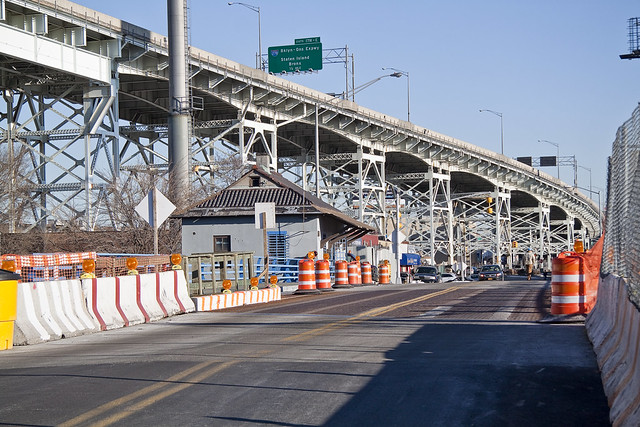
WHICH WAS OPEN TO TRAFFIC!!!
– photo by Mitch Waxman
There was still construction activity going on, but a quick check with one of the guys in high visibility colors revealed that the structure’s roadway was available. The sidewalks were still being worked on, and safety barriers were present- but the long running project seems to be nearing an end. I’m not sure if the bridge is “officially open”, but at least today it was.
Thank you, weird Cats of the Creeklands.

– photo by Mitch Waxman
I should mention that this structure is one of my favorite locations along the Dutch Kills tributary, from a photographic point of view, and an uncharacteristic giddiness seems to be filling me at the near return of a long cherished vantage point. Check out what I mean here.

– photo by Mitch Waxman
The official truth, from the NYC DOT site is:
Borden Avenue is a two-lane local City street in Queens. Borden Avenue runs east-west extending from Second Street at the East River to Greenpoint Avenue. The Borden Avenue Bridge over Dutch Kills is located just south of the Long Island Expressway between 27th Street and Review Avenue in the Sunnyside section of Queens. Borden Avenue Bridge is a retractile type moveable bridge. The general appearance of the bridge remains the same as when it was first opened in 1908. The bridge structure carries a two-lane two-way vehicular roadway with sidewalks on either side. The roadway width is 10.5m and the sidewalks are 2.0 m. The west approach and east approach roadways, which are wider than the bridge roadway, are 15.3m and 13.0m respectively. The bridge provides a horizontal clearance of 14.9m and a vertical clearance in the closed position of 1.2m at MHW and 2.7m at MLW.
As part of the construction of Borden Avenue in 1868, a wooden bridge was built over Dutch Kills. This bridge was later replaced by an iron swing bridge, which was removed in 1906. The current bridge was opened on March 25, 1908 at a cost of $157,606. The deck’s original design consisted of creosote-treated wood blocks, with two trolley tracks in the roadway. Character-defining features of this bridge include the stucco-clad operator’s house, four pairs of rails, and a rock-faced stone retaining wall. The gable-on-hip roof of the operator’s house retains the original clay tile at the upper part. Although alterations have been made, the bridge is a rare survivor of its type and retains sufficient period integrity to convey its historic design significance.
The Department of Transportation has identified a pocket of contaminated soil which has been classified as “contaminated non-hazardous”. As such, it poses no significant health risk to workers or the surrounding community. However, precautionary measures will be taken and every effort is being made to remove and dispose of the contamination quickly, yet safely, within all New York City and State guidelines. A Corrective Action Plan (CAP) for the removal and disposal of the contamination has been submitted to the NYS Department of Environmental Conservation (NYSDEC) for review and approval. Upon receipt of the NYSDEC approval, the contractor will prepare a new construction schedule and commence work under the terms of the permits. At this time, a date for the resumption of work is unknown which precludes an accurate prediction of a new anticipated completion date, although every effort will be made to complete the project in the late Fall of 2010. All posted detours will remain in effect until further notice.
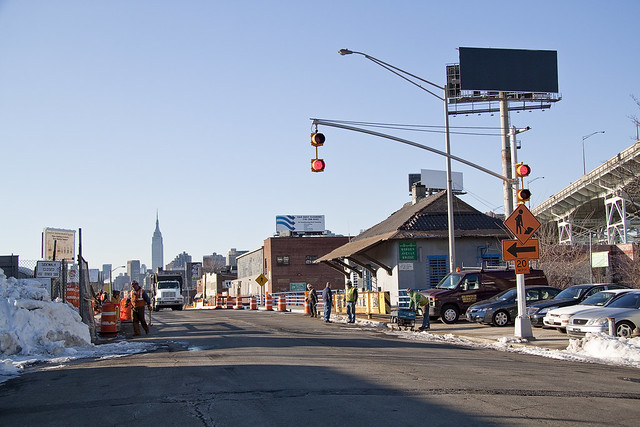
– photo by Mitch Waxman
Further official truth is found in the DOT’s Weekly Traffic Advisory of Saturday January 1, 2011 to Friday January 7, 2011
Borden Avenue Bridge over Dutch Kills (at 27th Street): This Bridge was closed December 31st 2008 for emergency reconstruction and reopened December 24, 2010 to two-way traffic. This closure was to necessitate NYCDOT Bridge major construction activity. Single lane closures will resume after January 2, 2011 to complete sidewalk and punch list work.


 The Newtown Pentacle