Archive for the ‘Hells Gate’ Category
with palpitant heart

– photo by Mitch Waxman
Startlingly interesting is the only way to describe the experiences of the preceding year. Attempts have been made to cogently describe and colorfully illustrate the encounters your humble narrator has enjoyed in this 10th year of the millennium. For those of you who have just recently started to read this, your Newtown Pentacle, this is your chance to check out some of the highlights of 2010 (according to me), and for the veteran Lords and Ladies of the Pentacle an opportunity to review.
If you’ll indulge me…
January, 2010- The Abbot

The sort of posting which satisfies me deeply, “The Abbot” monument found at Calvary focused my attentions on certain realities of 19th century New York, and proved my theory that Calvary Cemetery is the single greatest historical resource in Queens. Obviation of my satisfaction with the posting is provided by the admission that I had noticed the stone peripherally, found it interesting, and started shooting it with no idea at all about its meaning. Only at home, when reviewing the photos did the whole story come together. Al Smith is buried at Calvary as well (he’s the fellow who built the skyscraper seen in the night shot at the head of this post) but this paragraph is about January 2010 and Governor Smith’s story was told in 2009.
January, 2010- The Great Machine

Also in January, a pet ideation was advanced, one not of theory but of perception. The notion of the megalopolis figures heavily in my thinking- a concept that sees the eastern seaboard of the United States not as a series of cities, but rather one vast urban zone of varying densities with New York City at the titular center of a web of industry, transport, and agricultural systems. The center of the web has a center itself, which is Manhattan- specifically where it connects to “the Great Machine” of the Queensboro bridge and it’s corollaries.

– photo by Mitch Waxman
February 2010– Affordable Housing Development on Borden Avenue

This post, “Affordable Housing Development on Borden Avenue“, is included in the year end wrap up simply because it ended up being one of the more widely read and commented upon endeavors presented in 2010. Most likely, it was the linking shout out from Queenscrap that made it so, rather than any subjective quality or incisive observation. Homeless camps abound in the Newtown Pentacle, hidden away on seldom trodden lanes and along backwater pathways- in this case it’s alongside the oft delayed construction project at the Borden Avenue Bridge which spans Dutch Kills.
February 2010– horrible and unearthly ululations…

A lot of time was spent in 2010 trying to wrap my head fully around the story of the Newtown Creek (which culminated ultimately in the late October release of the first Newtown Pentacle book- Newtown Creek for the vulgarly curious) and “horrible and unearthly ululations…” was the first of several posts which attempted to boil complicated and obscure snippets of historical lore into a cohesive and accessible form. So much is made of the Greenpoint Oil Spill and the Meeker Avenue Plumes by the legal community, whose hungry jowls slaver and shake at the financial possibilities offered by the EPA’s superfund designation and various court decisions, that the true and terrible wonder of the Newtown Creek is often overlooked. This post and several others of its ilk attempt to present a fuller version of things, and act as reminders that what was may once again be.

– photo by Mitch Waxman
March 2010– The Shadow over Sunnyside

The St. Pat’s Day for All parade in Sunnyside is a yearly event which draws in a citywide coterie of political entities, all desperate for attention and attribution as being friendly to the GLTG members of the electorate. The parades origins are a reaction against the banning of outwardly gay marchers in the RC church’s own St. Patricks day parade in Manhattan. Despite its politically contentious birthing, the Sunnyside parade is actually a fun and light hearted event, and signals the coming of springtime in the Newtown Pentacle. While there principally to get shots of the political master race which rules over us, amongst the crowd I noticed small clots of dire intent armed with ugly signage. Research into this group, which was clearly coordinated and queerly ominous, revealed them to be adherents to a bastardized form of Catholic fundamentalism which has been outlawed and defined as a dangerous cult by several Nation-states. A shadow over Sunnyside indeed.
March 2010– Exhausted
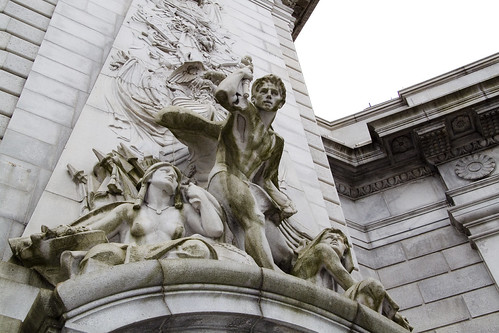
A brighter experience for your humble narrator was the Manhattan Bridge Centennial Time Capsule event, on March 5. Interactions and conversations were enjoyed by the least of men with certain powers and potentates of the City of Greater New York and entry to the interior space of the Manhattan Bridge was obtained. One of the high points of my year, “Exhausted” detailed the embedding of a time capsule in the East River Bridge #2- aka the Manhattan Bridge. Remarkable self control was exercised when I met the DOT Commissioner, Jeanette Sadik-Khan. My sincerest desire was to bend her ear with my alleged wisdom about bike lanes and bridge safety- but self control was ascendent that day and only congratulations were offered to both her and the other staffers at DOT.

– photo by Mitch Waxman
April 2010– City of Marble and Beryl
Odd shenanigans were observed at St. Michael’s Cemetery here in Astoria, which were of a decidedly magickal nature. A ritual site that your humble narrator stumbled across was examined and evidentiary examination suggested that certain third world cults were extant here in the old village of Astoria, conducting midnight bacchanals concurrent with the lunar cycle. “City of Marble and Beryl” was but the first of many moons which witnessed a working of will amongst the desolations of our kind.
April 2010– Searching for Gilman

A good part of 2010 was spent “Searching for Gilman” at First Calvary Cemetery, which I am doing as you are reading this, assuming it’s the start of 2011 whenever you do. Gilman is the source of no small amount of pain and financial hardship around these parts, as your humble narrator has become dangerously obsessive and paranoid around the subject. A psychotic need to find Gilman’s grave torments me, coloring my days and painting my dreams a dull yellow.

– photo by Mitch Waxman
May 2010– the king in yellow, brick
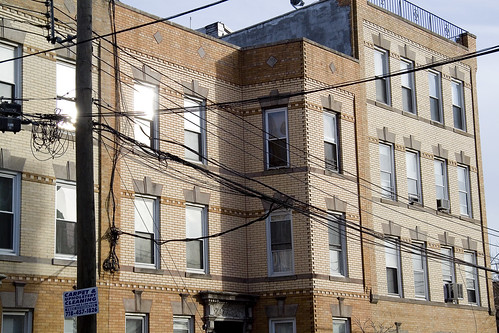
Remiss would be apparent were I to not mention the “Madison Avenue Bridge Centennial” but “the king in yellow, brick” advanced another of my pet theories and served up a fascinating (to me at least) sequence of events and relationships which attempts to explain why those yellow Kreischer bricks are all over the older sections of Queens.
May 2010– after cycles incalculable

“After cycles incalculable” is another one of those perfect posts, from a personal perspective. Wandering around with a friend, which is a disturbing trend which developed over the course of 2010, at Skillman Avenue’s start we observed the Lemuria hatching in concordance with the anniversary of the Roman festival of Lemuralia in Long Island City.

– photo by Mitch Waxman
June 2010– from Hells Gate, loosed upon the world

When I set out on my little walks, there is seldom a destination in mind. Literally wandering, obscure symbols and pseudo occultism guide my steps- I’ll follow a black cat, or merely adopt a roughly heliotropic path using my own shadow as compass. At the very end of May, my feet carried me toward Astoria Park and the notorious section of the East River known as Hells Gate. The odd craft, an “unidentified floating object” if you would, which sped past my lens required more than a small bit of detective work to identify- which was detailed in “from Hells Gate, loosed upon the world“.
June 2010– Gods Gift to Pain

English Kills, which is the logical and modern end of Newtown Creek, is a heavily industrialized and largely anaerobic tributary of the larger waterway and is seldom visited (by me, at least) at its extant. One fine day, while hanging out with another Creek enthusiast (you should not go to this place alone), we decided to enter the largely hidden urban foyer which leads here- despite the fact that we were most likely trespassing- which violates Newtown Pentacle policy. The title of the post- “Gods Gift to Pain” was lifted from an enigmatic and appropriate bit of graffiti observed in this forgotten pace of dissolution and poison.

– photo by Mitch Waxman
The reason for Brooklyn, and Queens- why it was a viable alternative to living in Manhattan in the 19th century was defined by the horrors of tenement life. The grand old buildings with their high ceilings, thick plastered walls, convenient dumbwaiters, and incredibly ornate lobbies- the structures which distinguished and made life desirable in the incalculably distant boroughs, were built as an alternative to the crowded and dangerous tenements of “The City”- especially the warren which was known as the “Five Points“. Additionally, Calvary Cemetery (of particular interest to me, and perhaps, to you) was founded by the parishioners of Old St. Patrick’s Cathedral which is smack dab in the middle of this ancient labyrinth of poverty, crime, and squalor. It was decided that to fully understand what one observes in the remains of the supposed “answer to the problem”, exploration of “the problem” itself is required.
July 2010– Bandits Roost, 2010

Ideal source material for the textural and societal milieu of the Five Points is the admittedly biased “How the Other Half Lives” by 19th century do-gooder Jacob Riis. Speaking the truth that power wants to hear is always a sound move if one considers fiscal realities and historical reputation. Attempts were made to find the modern locale in which Riis shot some of his more famous shots, such as this visit to “Bandits Roost 2010“.
July 2010– The house of Dagger John

Another critical visitation for me, as part of my larger education and study of the early development of the City of Greater New York was occasioned on the day when I went to “The house of Dagger John“. Old St. Patrick’s Cathedral satisfies both my continuing fascination with the counterpoint of sacred and profane in the story of the Megalopolis, and figures largely in the predictions of certain obscure lore which governs the schedule of my researches.

– photo by Mitch Waxman
August 2010– not to harsh anyone’s buzz… but…

August of 2010 brought a posting which garnered a lot of attention, due to curbed.com noticing and linking to it. Simply noticing that a growing proliferation of small boats were berthing illegally at the Vernon Avenue street end, it would be irresponsible of me- given everything that I know about the location not to point out the mortal and existential danger that the operators of these boats were placing themselves in. It’s not even the water, really, its the high pressure natural gas line- the enormous CSO which drains LIC- the omnipresent heavy industrial maritime traffic- which makes the spot so hazardous. Mortal threats were received via email (which I’ve kept private), and the comments thread displayed an angry and accusatory tone. As is the case with all such critique, these comments were presented verbatim- here’s a taste: “i have red your article in which you show a great deal of unger towards me and my friends . i believe that you base your article on many misconceptions that are rooted in a lack of communication”, “Blogger or not, the prudent journalist would make an effort to uncover basic facts before publishing a story full of assumptions”, “are you just the type of little man that tells teacher when the cool kids make you feel inferior. The water is public domain! And according to maritime law it is not illegal to moor a boat as long as it safe and looked after.”, “They are not bothering anyone. And get sick from the canal, come on. They are not living down there as far as I know. Parking your boat in the canal is not going to get them sick! Stop over doing it.” Check out “not to harsh anyone’s buzz… but…“.
August 2010– lively antics

One of the greatest joys of living in Queens are the chance encounters you’ll have with people who hail from the furthest points of the compass, such as this Bouzouki player during another visit to Hells Gate. His “lively antics” added splendor to a brightly lit walk around Astoria.

– photo by Mitch Waxman
September 2010– Lucky Shot

Although veteran photographers caution me against use of this term, I call the photo above my “shot of the year”. The steel structure attached to the bottom of the Brooklyn Bridge was installed as part of a bridge painting and maintenance project, and I was luckily along on a Working Harbor trip just as the sun was setting. Right place, right time, it was a “Lucky Shot“.
September 2010– stronger than fear

The dynamic new Safeboats utilized by NYPD and other entities around the harbor were a frequent subject over several of the Working Harbor expeditions I was lucky enough to attend. The many shapes, colorways, and missions of these quick little patrol boats are a delight to observe- and to those who would work maritime malice upon the metropolis- they are the head of the spear. Check out “stronger than fear“.

– photo by Mitch Waxman
A high of the year was the Newtown Creek Cruise which I had the honor of co-narrating with Bernard Ente on October 24th, of course, but the main topic of conversation amongst the antiquarian and environmental communities of the Newtown Pentacle in October revolved around the EPA’s superfund announcement about Newtown Creek at the very end of September. October is spooky time around these parts, and I spent a little time digging around the area for thrills and chills as well.
October 2010– blurred outlines

As part of series of postings detailing what might be seen in the Brooklyn neighborhood of Greenpoint, “blurred outlines” discusses the alleged appearance of a pyrokinetic at 84 Guernsey Street in January of 1895.
October 2010– scenes familiar, and loved

One of my frequent walks through Calvary Cemetery took me to the curiously empty chapel which enjoys the paramount of Laurel Hill. I will admit that I came here this day seeking two things- one was a likely entrance to a vast subterranean structure which underlies the area- the other was a vain hope that the grave of Gilman might present itself in a section which was, at the time, not terribly familiar to me as I normally stay close to the fringes of the place where the whipporwills wail. I very well might have captured what mass media paranormal media sources describe as a ghost orb in “scenes familiar, and loved“.

– photo by Mitch Waxman
November 2010– peace rests nevermore

One of the goals of this, your Newtown Pentacle, is to provide some sort of documentation about this terrible and wonderful place called the Newtown Creek- and I’m happy to say that I was there when the then Attorney General and Governor Elect Andrew Cuomo announced the settlement of a lawsuit brought by his office on behalf of New York State against Exxon-Mobil which involved the Greenpoint Oil Spill. “Peace rests nevermore” indeed.
November 2010– shocking coruscations

Entertaining maritime folklore from past centuries was offered in “shocking coruscations“, which is told against a series of twilight photos from good old Hells Gate between the two great bridges.

– photo by Mitch Waxman
During the cold, when inclement clime restricts my movements and the black dog nips at my heels, I tend toward shorter postings- and in December of 2010 there were two “Then and Now” postings that really took my fancy. These posts are difficult because of the scarce source material available in the public domain, but fun nevertheless. In my usual fashion “dumb idiot” fashion, I had shot the modern views completely unaware of the original photo. Our friends at the Greater Astoria Historic Society have recently released a book of similar historical views, which is worthy of consideration.
December 2010– Bowery Savings Bank 2010 and 1903

As the title states, this is the iconic shell of a once essential and awesomely powerful institution called the Bowery Savings Bank in Manhattan, with a 1903 photo from a similar perspective.
December 2010– Hunters Point Avenue Bridge Centennial

If you told me a year ago that I’d end up doing a press conference with a United States Congresswoman, I’d have hit you. That’s how I ended up at the Degnon Terminal’s own Sunshine Biscuits (LaGuardia Community College) building though, and by an odd coincidence- found myself standing in nearly the same spot as some unknown photographer did in 1921. This posting was built around the announcement of the “Hunters Point Avenue Bridge Centennial” event.

– photo by Mitch Waxman
Overall, a positive and exciting year, despite the deaths of several members of my family.
For a while, I enjoyed a spot on the board of the nascent Newtown Historical Society as a trustee, which is a position that I’ve had to resign for a variety of personal reasons- but I’d like to thank fellow board members Kevin Walsh, Christina Wilkinson, Steve Garza, and Bob Singleton for an interesting and educational experience. Kevin Walsh of forgotten-ny gets a personal call out, as his support, knowledge, and encouragement has been invaluable. Special thanks also are extended toward Capt. John Doswell and Meg Black of the Working Harbor Committee, all the guys and gals aboard the John J. Harvey fireboat, and everybody else who allowed a piss poor specimen such as myself to come along on adventures. Bernard Ente of the Newtown Creek Alliance, Working Harbor, and others also receives a heartfelt gratitude and shout out from this humble mendicant. Standing on the shoulders of giants is difficult if you suffer from altitude related nosebleeds.
What’s next?
Tell you what, feel like taking a walk?
Meet me at the border of Brooklyn and Queens – bring a camera… and ID… I’ll show you something cool…
Happy Birthday Mr. Moses

– photo by Mitch Waxman
The great builder, Robert Moses was built himself on this date in 1888. A controversial subject amongst the preservationist community, Moses nevertheless shaped the City of Greater New York into its familiar modern pattern.
from wikipedia
Robert Moses (December 18, 1888 – July 29, 1981) was the “master builder” of mid-20th century New York City, Long Island, Rockland County, and Westchester County, New York. As the shaper of a modern city, he is sometimes compared to Baron Haussmann of Second Empire Paris, and is one of the most polarizing figures in the history of urban planning in the United States. He changed shorelines, built bridges, tunnels and roadways, and transformed neighborhoods forever. His decisions favoring highways over public transit helped create the modern suburbs of Long Island and influenced a generation of engineers, architects, and urban planners who spread his philosophies across the nation.
Never elected to public office, Moses was responsible for the creation and leadership of numerous public authorities which he could control without having to answer to the general public or to elected officials. It is due to Moses that there are a disproportionate number of public benefit corporations in New York state, which are the prime mode of infrastructure building and maintenance in New York, and are currently responsible for 90% of the state’s debt.[3] As head of various authorities, he controlled millions in income from his projects’ revenue generation, such as tolls, and he had the power to issue bonds to borrow vast sums, allowing him to initiate new ventures with little or no approval from legislative bodies, bypassing the usual power of the purse as it normally functioned in the United States, and the cumbersome process of citizen comment on major public works.

– photo from wikipedia

– photo by Mitch Waxman
The jewel in his crown was always mighty Triborough, and it was the center of his empire.
from wikipedia
Originally named the Triborough Bridge Authority, the authority was created in 1933 as a public-benefit corporation by the New York State Legislature. It was tasked with completing construction of the Robert F. Kennedy (Triborough) Bridge, which had been started by New York City in 1929 but had stalled due to the Great Depression.
Under the chairmanship of Robert Moses, the agency grew in a series of mergers with four other agencies:
- Henry Hudson Parkway Authority, in 1940
- Marine Parkway Authority, in 1940
- New York City Parkway Authority, in 1940
- New York City City Tunnel Authority, in 1946
With the last merger in 1946, the authority was renamed the Triborough Bridge and Tunnel Authority.
Generating millions of dollars in toll revenue annually, the TBTA easily became a powerful city agency as it was capable of funding large capital projects. From the 1940s-60s, the TBTA built the Battery Parking Garage, Jacob Riis Beach Parking Field, Coliseum Office Building and Exposition Center and East Side Airlines Terminal, as well as many parks in the city.
dark apertures

– photo by Mitch Waxman
“The daily reminder”:
Please consider purchasing a copy of the first Newtown Pentacle book:
“Newtown Creek for the Vulgarly Curious” – a fully annotated 68 page, full-color journey from the mouth of Newtown Creek at the East River all the way back to the heart of darkness at English Kills, with photos and text by Mitch Waxman.
Lamentable, this dark part of of the solar cycle both frustrates and delights.
Unwelcome, the return of frigid conditions renders my wrecked health tremulous. Unbalanced, my delicate constitution reaches out desperately for amusement and titillation. Tenebrous- the light of December is thin, ephemeral, a cloying charlatan.
I’m all ‘effed up.
from wikipedia
Anxiety is a generalized mood condition that can often occur without an identifiable triggering stimulus. As such, it is distinguished from fear, which is an emotional response to a perceived threat. Additionally, fear is related to the specific behaviors of escape and avoidance, whereas anxiety is related to situations perceived as uncontrollable or unavoidable. An alternative view defines anxiety as “a future-oriented mood state in which one is ready or prepared to attempt to cope with upcoming negative events”, suggesting that it is a distinction between future vs. present dangers which divides anxiety and fear.
Physical effects of anxiety may include heart palpitations, muscle weakness and tension, fatigue, nausea, chest pain, shortness of breath, stomach aches, or headaches. The body prepares to deal with a threat: blood pressure and heart rate are increased, sweating is increased, blood flow to the major muscle groups is increased, and immune and digestive system functions are inhibited (the fight or flight response). External signs of anxiety may include pale skin, sweating, trembling, and pupillary dilation. Someone who has anxiety might also experience it as a sense of dread or panic. Although panic attacks are not experienced by every person who has anxiety, they are a common symptom. Panic attacks usually come without warning, and although the fear is generally irrational, the perception of danger is very real. A person experiencing a panic attack will often feel as if he or she is about to die or pass out.

– photo by Mitch Waxman
Loathsome, the reflection which gazes from every shop window and puddle of urine during my long walks is that of something which can only be superficially referred to as a man.
Filthy and blackened by time, my garb has become tattered and beggarly of late. Financial hardship experienced over a long and sordid lifetime instructs that only the coarse and lasting textiles worn by beasts of burden should be considered for replacements, as they will outlast the fancy caprices of fashion and comfort by virtue of their sheer and stolid composition. These are hard times my friends, and the hard rain has already fallen.
A season of the witch is apparent, Lords and Ladies, and Woody Guthrie would recognize our time immediately as his own.
from wikipedia
Self-Awareness Theory states that when we focus our attention on ourselves, we evaluate and compare our current behavior to our internal standards and values. We become self-conscious as objective evaluators of ourselves. Various emotional states are intensified by self-awareness, and people sometimes try to reduce or escape it through things like television, video games, drugs, etc. However, some people may seek to increase their self-awareness through these outlets. People are more likely to align their behavior with their standards when made self-aware. People will be negatively affected if they don’t live up to their personal standards. Various environmental cues and situations induce awareness of the self, such as mirrors, an audience, or being videotaped or recorded. These cues also increase accuracy of personal memory.

– photo by Mitch Waxman
Lutescent, my skin color produces impressions of some jaundiced ginger candy lightly drizzled over with a thin syrup of sweat, a noted change from the sun baked complexion which was earned during the many maritime adventures of the vernal months that were described at this, your Newtown Pentacle.
A recent observation of myself at 4:30 AM in the bathroom mirror, after having spent a considerable number of hours researching a certain bridge which crosses that malign influence known as the Newtown Creek, was the moment when I realized that I had let my beard grow unchecked for better than 60 days and allowed my external appearance to betray my state of mind. The wild eyed thing staring back at me… reaching out to me as I did the same to him… surely it remains trapped in that pane of mirrored glass.
I went to the barber the next morning, and as Joe of “Joe and Tony’s” dragged a straight razor across my throat and scratched off months of neglect- for the first time in ages- I was able to relax.
from wikipedia
Clinicians assess the physical aspects such as the appearance of a patient, including apparent age, height, weight, and manner of dress and grooming. Colorful or bizarre clothing might suggest mania, while unkempt, dirty clothes might suggest schizophrenia or depression. If the patient appears much older than his or her chronological age this can suggest chronic poor self-care or ill-health. Clothing and accessories of a particular subculture, body modifications, or clothing not typical of the patient’s gender, might give clues to personality. Observations of physical appearance might include the physical features of alcoholism or drug abuse, such as signs of malnutrition, nicotine stains, dental erosion, a rash around the mouth from inhalant abuse, or needle track marks from intravenous drug abuse. Observations can also include any odor which might suggest poor personal hygiene due to extreme self-neglect, or alcohol intoxication. Gelder, Mayou & Geddes (2005) tells us to look out for weight loss. This could signify a depressive disorder, physical illness, anorexia nervosa or chronic anxiety.

– photo by Mitch Waxman
Labefaction of my very self continues unabated, and flavor is absent from all the elixirs of joy.
Sleep, and concurrent dreaming, has plagued me with its insistence and Antaeus like grip. When the oppression of these periods of unconscious hallucinations lift, I force myself from home and wander the streets in the manner and aforementioned garb of a mendicant. Drifting like some cast off ember caught on the wind, I follow the sun but as always- I am relegated to stand in the shadows of this world and its bright places are reserved for others to enjoy. Outside, in the cold and filth is where I belong- not amongst bright and happy faces chortling over shared intimacies and embarrassing overtures.
Inevitability is enjoyed by the sleepy, for in the end, they shall drop off.
from wikipedia
Depersonalization (or depersonalisation) is a malfunction or anomaly of the mechanism by which an individual has self-awareness. It is a feeling of watching oneself act, while having no control over a situation. It can be considered desirable, such as in the use of recreational drugs, but it usually refers to the severe form found in anxiety and, in the most intense cases, panic attacks. Sufferers feel they have changed, and the world has become less real, vague, dreamlike, or lacking in significance. It can be a disturbing experience, since many feel that, indeed, they are living in a “dream”. Depersonalization is a subjective experience of unreality in one’s sense of self, while derealization is unreality of the outside world. Although most authors currently regard depersonalization (self) and derealization (surroundings) as independent constructs, many do not want to separate derealization from depersonalization.Chronic depersonalization refers to depersonalization disorder, which is classified by the DSM-IV as a dissociative disorder. Though depersonalization-derealization feelings can happen to anyone subject to temporary severe anxiety/stress, chronic depersonalization is more related to individuals who have experienced a severe trauma or prolonged stress/anxiety. Depersonalization-derealization is the single most important symptom in the spectrum of dissociative disorders, including Dissociative Identity Disorder and Dissociative Disorder Not Otherwise Specified (DD-NOS). It is also a prominent symptom in some other non-dissociative disorders, such as anxiety disorders, clinical depression, bipolar disorder, borderline personality disorder, obsessive-compulsive disorder, migraine, sleep deprivation, and some types of epilepsy.

– photo by Mitch Waxman
Lexiphanic lickspittle, the lickerish lientery offered today is limaceous, foully libanophorous, and is admittedly… logorrhoea.
The question you may be asking, of course, might be “What exactly does this all have to do with anything, and what’s up with dem boids?”. Simply put, today is the beginning of the Roman festival of Saturnalia, a day of tricks and treats- and described as the “best of days” by the poet Catullus.
Traditionally, it was the day when masters and slaves would trade places. What fun that would be.
from wikipedia
Mad hatter disease describes the symptoms of mercury poisoning, specifically its effect on the nervous system. These include paraesthesias, vision and hearing impairment, slurred speech, anxiety, hallucinations, irritability, depression, lack of coordination, and tremors. The condition was observed among workers in the hat-making industry in the 1800s. Chronic mercury exposure was common in hatters who used a mercury solution during the process of curing animal pelts. Poor ventilation in the workshops of the time resulted in the hatters breathing in the fumes of this highly toxic metal, leading to an accumulation of mercury in the workers’ bodies. Metal toxicity was poorly understood and the broad range of symptoms were also associated with insanity.The phrase mad as a hatter is derived from the condition, and commonly associated with Lewis Carroll’s character the Mad Hatter in Alice’s Adventures in Wonderland. While the character’s eccentricities differ from those suffering from mercury poisoning (the Hatter was likely inspired by Theophilus Carter, a furniture dealer), Lewis Carroll grew up near the town of Stockport, where hatting was the dominant trade.
shocking coruscations

– photo by Mitch Waxman
Conversation offered by divers and submarine enthusiasts inform this posting, which like your humble narrator, lingers about at Hells Gate.
Explorations of the occluded depths in this area, as reported, reveal a shattered series of reefs and alluvial boulders underlying this region of the East River. In addition there are depressions found in the sediment here, which form enormous cauldron like holes dropping down into the silt choked darkness, and I am informed that such formations are commonly called “pots” by those familiar with such subaqueous geography. Within these pots might be found a hodge podge of archaeological record, but the strong currents above them form venturi effect vortices within, and any who might enter one are considered to be extraordinarily lucky to exit such a feature intact and alive.
from “Myths and Legends of our Own Land, by Charles M. Skinner” at gutenberg.org
Satan appears to have troubled the early settlers in America almost as grievously as he did the German students. He came in many shapes to many people, and sometimes he met his match. Did he not try to stop old Peter Stuyvesant from rowing through Hell Gate one moonlight night, and did not that tough old soldier put something at his shoulder that Satan thought must be his wooden leg? But it wasn’t a leg: it was a gun, loaded with a silver bullet that had been charged home with prayer. Peter fired and the missile whistled off to Ward’s Island, where three boys found it afterward and swapped it for double handfuls of doughnuts and bulls’ eyes. Incidentally it passed between the devil’s ribs and the fiend exploded with a yell and a smell, the latter of sulphur, to Peter’sblended satisfaction and alarm. And did not the same spirit of evil plague the old women of Massachusetts Bay and craze the French and Spaniards in the South?
– photo by Mitch Waxman
Rumors which have persisted since the advent of European colonization suggest that great treasures might by found in these deep eddies and swirling maelstroms of the underwater grottoes. Famously, the wreck of a British ship called “the Hussar” carried a great fortune and many lives down to the bottom of Hells Gate- and the aboriginal inhabitants of the archipelago related stories of a race of giants who originally inhabited these islands that would cross the river by merely stepping across the rocks. Of course, there used to be a lot more rocks, before the Army Corps of Engineers set off the greatest manmade explosion (until Hiroshima) in history to “assure navigability”.
The effort to clear “flat rock”, “frying pan”, “pot rock”, “Flood Rock”, and “Hallet’s Point Reef” was explored in some detail in a Newtown Pentacle Posting of June 5, 2009- “The River of Sound”, and the enigmatic Hells Gate Bridge and its environs was discussed in some detail in the September 23, 2009 posting “A Bright Passage”.
from “Myths and Legends of our Own Land, by Charles M. Skinner” at gutenberg.org
Back in the days before the Revolution, a negro called Mud Sam, who lived in a cabin at the Battery, New York City, was benighted at about the place where One Hundredth Street now touches East River while waiting there for the tide to take him up the Sound. He beguiled the time by a nap, and, on waking, he started to leave his sleeping place under the trees to regain his boat, when the gleam of a lantern and the sound of voices coming up the bank caused him to shrink back into the shadow.
- At first he thought that he might be dreaming, for Hell Gate was a place of such repute that one might readily have bad dreams there, and the legends of the spot passed quickly through his mind: the skeletons that lived in the wreck on Hen and Chickens and looked out at passing ships with blue lights in the eye-sockets of their skulls;
- the brown fellow, known as “the pirate’s spuke,” that used to cruise up and down the wrathfultorrent, and was snuffed out of sight for some hours by old Peter Stuyvesant with a silver bullet;
- a black-looking scoundrel with a split lip, who used to brattle about the tavern at Corlaer’s Hook, and who tumbled into East River while trying to lug an iron chest aboard of a suspicious craft that had stolen in to shore in a fog.
This latter bogy was often seen riding up Hell Gate a-straddle of that very chest, snapping his fingers at the stars and roaring Bacchanalian odes, just as skipper Onderdonk’s boatswain, who had been buried at sea without prayers, chased the ship for days, sitting on the waves, with his shroud for a sail, and shoving hills of water after the vessel with the plash of his hands.

– photo by Mitch Waxman
A busy industrial corridor in the ominous 21st century, the efforts of engineers have rendered Hell Gate tame and predictable, although one might still observe the occasional spiral eddy and acre wide pools of swirling water near the shorelines on windy days. If one watches carefully, a phastasmagorical plethora of animal forms persists in this part of the river- diving cormorants are common, Birds of Prey are present as are riverine and littoral mammalia, and there are said to be other less well known phyla. Every now and then, one might even encounter a U.F.O. (an Unidentified Floating Object).
Who can guess, after all, what is is that may be hiding down there?
from “HISTORY OF QUEENS COUNTY with illustrations, Portraits & Sketches of Prominent Families and Individuals. New York: W.W. Munsell & Co.; 1882.” at bklyn-genealogy-info.com
Hallett’s purchase at Hell Gate Neck included much of the territory later incorporated as the village of Astoria. The original proprietor lived there to the age of about ninety, and was foremost in many early improvements. He divided his property at that point in 1688 between his sons William and Samuel, the former receiving the lands south of the road Since forming Greenoak Street, St. George’s Place, Welling and Main streets and Newtown avenue, the latter the lands lying north of that road.
It is probable that the Indians who sold Hell Gate Neck to William Hallett were of the Canarsie tribe, a clan of reputed power whose jurisdiction extended over the whole of Kings county, the islands in Hell Gate, and, O’Callaghan says, some part of Newtown. A large tract of land including the southwestern portion of the present city was deeded “to the inhabitants of Newtowne, alias Middleburg,” by Pomwaukon and Roweroenesteo of the above tribe, July 9th 1666.

– photo by Mitch Waxman
Indolent, and quite susceptible to environmental stressors, your humble narrator has commented several times about the odd sonic qualities of this patch of the East River. Mighty Triborough never sleeps, and its steel hums continually. Staccato, the traffic over Hells Gate is no less affecting, but it is just not in the same league as the constant oppression of infrasonic drone emanating from Triborough, or the din of nearby heavy industrial activity on Wards Island.
Here is part of a recording made on May 28th of 2010, directly beneath the Triborough Bridge… using the admittedly poor microphone of an iPhone headset… for your consideration…
from wikipedia
After the war ended, Jaspar Ward and Bartholomew Ward took ownership of the island that later carried their surname. Although a small population had lived on the island since as early as the 17th century, the Ward brothers developed the island more heavily by building a cotton mill and building the first bridge to cross the East River in 1807, connecting the island with Manhattan at 114th Street.
The bridge, paid for by Bartholomew Ward and Philip Milledolar, was a wooden drawbridge. The bridge lasted until 1821, when it was destroyed in a storm.After the bridge was destroyed, the island was largely abandoned until 1840, when the island was transformed into a dumping ground for everything unwanted in New York City. Between 1840 and 1930 the island was used for:
- Burial of hundreds of thousands of bodies relocated from the Madison Square and Bryant Park graveyards.
- The State Emigrant Refuge, a hospital for sick and destitute immigrants, opened in 1847, the biggest hospital complex in the world during the 1850s.
- The New York City Asylum for the Insane, opened around 1863.
- An immigration station from 1860 until the 1892 opening of Ellis Island.
- Manhattan State Hospital, operated by the New York State Department of Mental Hygiene when it took over the immigration and asylum buildings in 1899. With 4,400 patients, it was the largest psychiatric institution in the world. The 1920 census notes that the hospital had a total of 6045 patients. It later became the Manhattan Psychiatric Center.
always as before

– photo by Mitch Waxman
All along the Hell Gate Extension tracks which snake across Astoria, one may find spots which are favored by the local flocks of Pigeons for use as a latrine. How or why these spots are selected is anyone’s guess, but I always find it curious when I discover what seems to be a purposeful arrangement of cast off goods in such a place.
Again- in Western Queens, illegal dumping is an art form.


 The Newtown Pentacle