Archive for the ‘Long Island City’ Category
arisen another
Tug Dory at Newtown Creek in today’s post.

– photo by Mitch Waxman
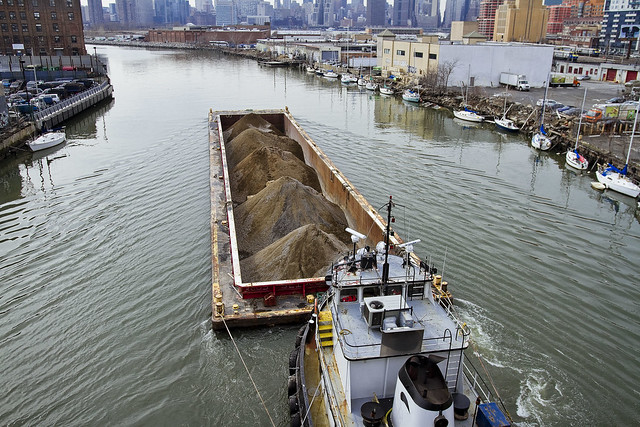
Heading over to Greenpoint, which seems to be my occupation sometimes, your humble narrator was utilizing the Pulaski Bridge to cross the malign Newtown Creek. Suddenly, from below, waves began crashing and a vast oblong shape appeared from the void formed by the span.
– photo by Mitch Waxman
This barge likely came from Allocco, an aggregates company based on Kingsland Avenue in Greenpoint. Allocco, by the way, isn’t some fey corporate composite name, rather its a family name. I’ve met members of the eponymous clan, and they’re nice guys. They sort debris into graded materials – sand, gravel etc. for resale. Allocco is one of the few corporations along Newtown Creek who fully utilize their maritime bulkheads, so I’m a fan. What’s being moved around in that barge would require the services of around 30 trucks otherwise.
– photo by Mitch Waxman
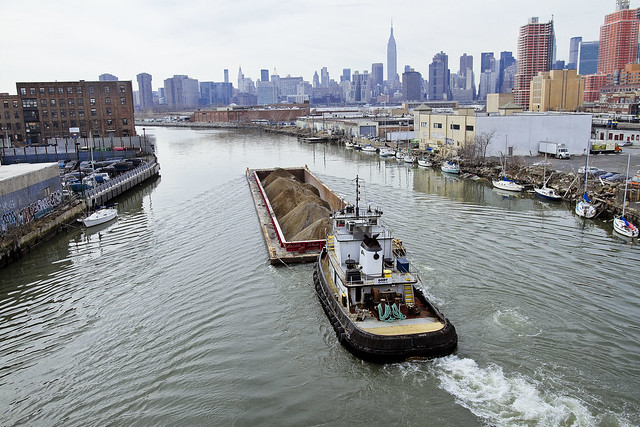
Never have I seen the Tug Dory on the Creek before. This boat is a bit of a mystery to me, and not much is available on it. Unfortunately, they weren’t displaying their IMO number in a place visible from my vantage, so I’m afraid that all I can tell you is that it’s painted white.
– photo by Mitch Waxman
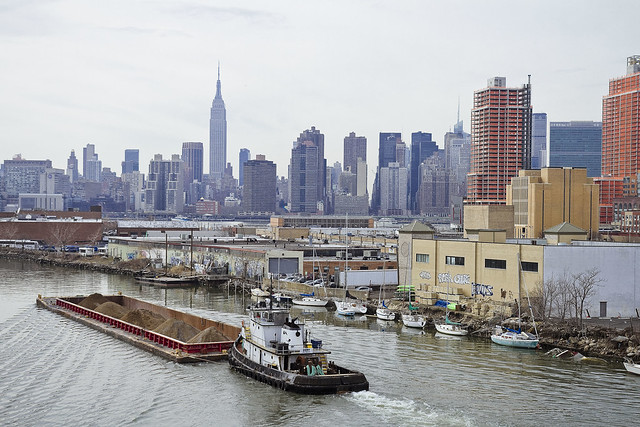
She may be somewhat anonymous, a pale enigma posed alongside an oblong shape if you will, but Tug Dory still looks pretty good heading out of the Newtown Creek on her way to the East River.
“follow” me on Twitter- @newtownpentacle
shall vex
A baited trap, in LIC.

– photo by Mitch Waxman
Everyone knows about the particular predilection that the Gendarme has for those toroids of fried and sweetened dough which are commonly called Donuts, and it is simply “messed up” that someone seems to using one as bait. Should a hungry constable happen along and happily reach for this confection, what sort of snare might be triggered? Is this a cop trap of some kind? What’s hidden inside that duct or pipe?

– photo by Mitch Waxman
The funny thing about the cop/donut myth is that it really isn’t true. Most of the police officers I’ve met over the years were actually in pretty good shape, and the ones who weren’t in wholesome condition owed it to a love of the brewer’s art rather than that of the baker’s. Still one wonders how many innocent but hungry servants of the realm hereabouts have been ensnared on this LIC block, adjoining Skillman Avenue?

– photo by Mitch Waxman
Commonly held, the mythology about American Police and their love for donuts is reasonably predicated upon the frequent observation of unit cars and uniformed personnel, by the citizenry at large, congregating at locations commonly called “Donut Shops.” Simply answered, even if your job is to drive around a neighborhood for eight hours at a pop, you still need to pee and or buy coffee periodically – an endless cycle in itself – and sharing a common location for such activity allows units to compare notes on the days events. Donut shops are open late, as are the Police. It’s messed up that someone is setting out donut baited snares though, and provides for a worrisome development within this, our Newtown Pentacle.
“follow” me on Twitter- @newtownpentacle
Thirteen Steps across Dutch Kills
The 2014 Walking Tours begin.

– photo by Mitch Waxman
Join Newtown Creek Alliance Historian Mitch Waxman and Atlas Obscura for an intense exploration of Newtown Creek’s Dutch Kills tributary – found less than one mile from the East River. Dutch Kills is home to four movable (and one fixed span) bridges, including one of only two retractile bridges remaining in New York City. Dutch Kills is considered to be the central artery of industrial Long Island City and is ringed with enormous factory buildings, titan rail yards – it’s where the industrial revolution actually happened.
Bring your camera, as the tour will be revealing an incredible landscape along this section of the troubled Newtown Creek Watershed.
Be prepared: We’ll be encountering broken pavement, sometimes heavy truck traffic, and moving through a virtual urban desert as we cross the currently undefended border of Brooklyn and Queens. Dress and pack appropriately for hiking, closed toe shoes are highly recommended.
Bathroom opportunities will be found only at the start of the walk, which will be around three hours long and cover approximately three miles of ground.
Meetup – At the Albert E. Short Triangle park found at the corner of Jackson Avenue and 23rd Street in Long Island City, Queens. This is the Court Square MTA station, and served by the 7, G, and M lines. Additionally, the Q39 and B62 buses have nearby stops. Check MTA.info as ongoing construction at Queens Plaza often causes delays and interruptions.
X
X
“follow” me on Twitter- @newtownpentacle
unidentifiable flowerings
Catching up with the Newtown Pentacle.

– photo by Mitch Waxman
This long winter has been especially difficult for one such as myself, who possesses no reserve of warmth. Accordingly, hermitage is enacted. Hair, beard, and nails are allowed to seek their natural length while an induced stupor was enjoyed by the brain. Now that the burning thermonuclear eye of god itself has once more attained an efficacious position in the sky, all of the dead cellular material external to the skinvelope has been trimmed back and an understimulated brain called to action once more.
The long marches across the concrete devastations have resumed.

– photo by Mitch Waxman
The spot of trouble enjoyed by my household in recent weeks, regarding the reliable availability of internet service – as supplied by Time Warner Cable – seems to have been resolved due to the actions of this fellow. Last Saturday, the third most hated corporation in modern day America sent this fellow, Jose, over to rewire and rekajigger the connections. The connectivity issues seem to have been repaired accordingly, and now the service has returned to “it just sucks” as opposed to “doesn’t work at all.”

– photo by Mitch Waxman
Last Sunday, whilst crossing the Pulaski Bridge to visit Greenpoint via Long Island City, these graffitos were spotted. Displaying an unusually literate and somewhat scientifically accurate credo, my attentions were caught. It wasn’t this screed which stopped me in my tracks, instead it was the one in the penultimate photograph adorning this post.

– photo by Mitch Waxman
No comment, except to say that hidden in green slimy vaults, in his house at R’lyeh…
“follow” me on Twitter- @newtownpentacle
damnably irregular
A curious bird, spotted in this dirty old part of the city, where the sun refuse to shine.

– photo by Mitch Waxman
Just the other day, a squamous thing wrapped in a dirty black raincoat was sashaying down sturdy Jackson Avenue and enjoying the glamorous environs of the Court Square section while anticipating, with palpitant heart, entering Queens Plaza when an odd avian seized all attentions. That squamous travesty, your humble narrator and faithful chronicler of all things odd here in the “Borough that Time Forgot,” accordingly stopped dead in his tracks and reached for the camera.
What, exactly, is up with those red and yellow feathers?
from wikipedia
Pigeons and doves constitute the bird clade Columbidae, that includes about 310 species. They are stout-bodied birds with short necks, and have short, slender bills with fleshy ceres. Doves feed on seeds, fruits, and plants. This family occurs worldwide, but the greatest variety is in the Indomalaya and Australasia ecozones.

– photo by Mitch Waxman
It all started when a path was being negotiated through a herd of these so called ferals. Birds know that no ill will is borne for their kind from one such as myself, and they seldom scatter when my path carries me through their chaotic gatherings on the pavement. This is an issue, as great effort is expended in the attempt not to crush or kick them while in mid step.
Whilst picking my way amongst them, one bird stood out from the pack.
from wikipedia
Feral pigeons (Columba livia), also called city doves, city pigeons, or street pigeons, are derived from domestic pigeons that have returned to the wild. The domestic pigeon was originally bred from the wild Rock Dove, which naturally inhabits sea-cliffs and mountains. Rock (i.e., ‘wild’), domestic, and feral pigeons are all the same species and will readily interbreed. Feral pigeons find the ledges of buildings to be a substitute for sea cliffs, have become adapted to urban life, and are abundant in towns and cities throughout much of the world.

– photo by Mitch Waxman
Disturbingly heterogenous, Pigeons exhibit multitudes of colorations naturally, something the normal urban observer would readily acknowledge. Never has a bird of this speciation displayed anything like what’s depicted in these shots in my presence. A Pigeon with red and yellow wings is something new, to me at least.
Weird.
from phys.org
Various forms of a gene named Tyrp1 make pigeons either blue-black (the grayish color of common city pigeons), red or brown. Mutations of a second gene, named Sox10, makes pigeons red no matter what the first gene does. And different forms of a third gene, named Slc45a2, make the pigeons’ colors either intense or washed out.

– photo by Mitch Waxman
It didn’t seem to be paint or dye, it should be mentioned, which would betray itself by causing the appearance of the feathers to be matted. This ain’t “photoshop” either, lords and ladies, as a note for the jaded or suspicious amongst you.
That’s a wild NYC Pigeon, with wings and a tail which are red and yellow, spotted on Jackson Avenue in Long Island City on the 9th of March in 2014 – just for the record.
Scientists have long wondered why feral pigeon populations show such plumage diversity compared to other feral animals. Generally, feral animals revert to the wild or ancestral type (in this case a blue-bar colouration), yet towns and cities are full of pigeons of a wide variety of colours. The question is, what causes this variation? Is it that female pigeons are choosing particular coloured males or vice versa? Are particular coloured pigeons more or less vulnerable to predation?
“follow” me on Twitter- @newtownpentacle


