Archive for the ‘Long Island City’ Category
intently and shudderingly
“follow” me on Twitter at @newtownpentacle

– photo by Mitch Waxman
Dissonant, the mad cacophonies of Western Queens often drive one such as myself beyond the brink of madness, and solace from this unending assault can only be found deep within the grounds of Calvary Cemetery. First Calvary, that is. To me, the name of the neighborhood which hosts the burial grounds of the Roman Catholics is aptly named, and Blissville is where one retreats to commune with the relative silence of the polyandrion.
Now, over the last few years, I have seen many strange and wonderful things, and witnessed places in New York City that only a select would even suspect to exist. I have seen dead animals of all sorts littering the streets, a few killed in rituals, but mostly from accidents. I have never seen a dead human being floating by in the rivers or the creeks, nor have I found some dude lying on the side of the road- I’m lucky like that.
– photo by Mitch Waxman
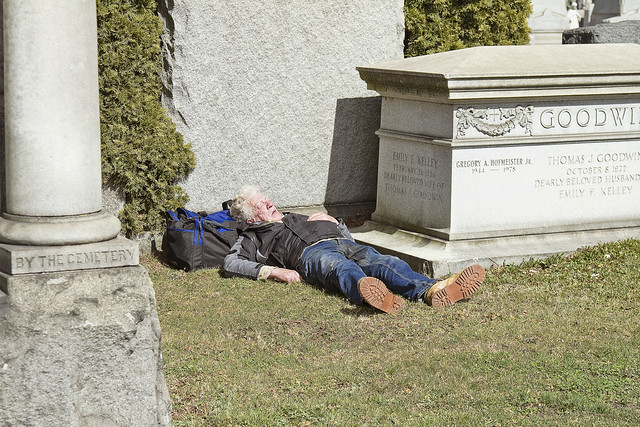
Imagine how excited I was, then, when this seeming casualty appeared on my jaunty stroll through First Calvary on a sunny March afternoon. Finally. That’s when the terror set in.
A question which a humble narrator often asks himself, when confronted with situations that require moral, legal, and philosophical contemplations is simply “How would I explain this to Judge Judy?.”
In the case of photographing a possibly deceased human (pondered as I shot these pictures so quite obviously one wasn’t exactly impaled on the horns of dilemma) do you photograph first and then call the cops? What exactly do you tell the cops? “Yeah… I do this blog… Yes sir, I walked here… No sir, nothing like that… Yes sir, Waxman with an x”… and so on?

– photo by Mitch Waxman
As your humble narrator processed an answer which might be acceptable to both televised jurist and hard boiled gendarme, the corpse suddenly animated, its mouth parts bleating out a long and phlegmatic tone which reminded one most of snoring.
Deductive reason suggests that instead of dead, this fellow was merely asleep. A lovely place for a nap, despite the shocking suggestions offered by a prone positioned human laying stock still on the ground in a cemetery, as the sun was warm and bright, soft grass welcomes, and there is plentiful company. Below, three million lie.

– photo by Mitch Waxman
The ground at Calvary is sown with “all too soon’s,” “should have been me instead’s,” and “why’s.” The soil is composed of the “they’ll never get to’s” and “cut down in their prime’s,” along with the good who died young and the bad who died old. If there is any place in New York City where one can sense that there very well might be a whole other side to existence that extends beyond the meat, it’s at Calvary.
Spending too much time here can be dangerous, a little over three hours usually does it, when a hypnagogic spell begins to infiltrate the mind of the visitor.
Lethargy and somnolence exert a pull inexorable, and afflicted day trippers experience a desire to just lay down on the ground… and nap.
“Just for a little while,” they will say. I always answer this with a single question.

– photo by Mitch Waxman
What would one dream of, if they were to fall sleep in First Calvary Cemetery?
higher order
“follow” me on Twitter at @newtownpentacle

– photo by Mitch Waxman
Happy Monday Newtowniverians, and a healthy one is wished for all the Brooklynites and Queensicans out there.
Today’s post displays a couple of interesting shots I managed to grab before a meeting held at LaGuardia Community College for the Newtown Creek CAG.
This CAG is a sort of advisory/community group which has formed up around the edges of the EPA Superfund project. The CAG is a requirement for EPA, and they periodically convene a meeting to inform us about their activities and overall status of the process.
from epa.gov
A Superfund Community Advisory Group (CAG) is made up of members of the community and is designed to serve as the focal point for the exchange of information among the local community and EPA, the State regulatory agency, and other pertinent Federal agencies involved in cleanup of the Superfund site.

– photo by Mitch Waxman
In this meeting, during which a presentation from the NYC DEP was offered describing a forthcoming dredging project on Newtown Creek, discussion of various issues surrounding the Superfund project between Federal officials and community representatives was offered. Everyone else in the room was a lettered professional or community leader or of high professional caliber, representing every conceivable office, power, and potentate involved in the Newtown Creek story.
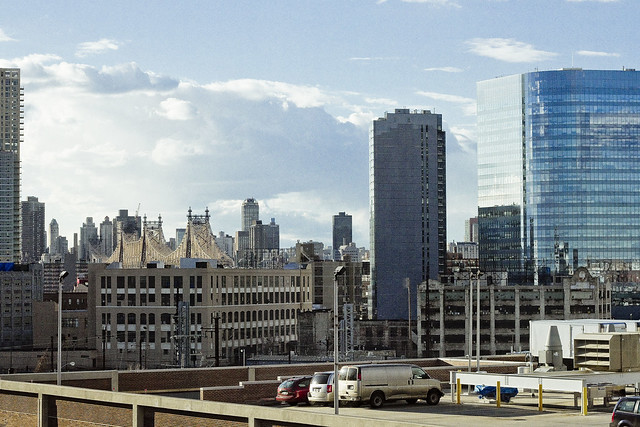
Then there’s me, who kept on having his attention drift over to the Sunnyside Yard and the fantastic views of it at rush hour which I wasn’t photographing.
from newtowncreekcag.wordpress.com
Newtown Creek CAG membership is structured on a rolling basis. The Superfund process on Newtown Creek will take many years, and interested stakeholders are encouraged to become CAG members as they learn of and want to fully participate in the process.
The CAG is designed to serve as an ongoing vehicle for information-sharing, discussion, and, where possible, consensus-building regarding decision-making related to the Newtown Creek Superfund Site. Its members represent a diverse cross-section of key stakeholder interests, including affected property owners, concerned residents, local governments, community groups, environmental groups, health experts, the business community, and others as appropriate. Requirements and responsibilities for CAG members are described in the CAG’s Operating Procedures, posted in the Resources tab.
– photo by Mitch Waxman
An odd duck, even after all these years, it is so strange to think that someone like me is even allowed in the building let alone invited to participate and offer both questions for correct answering and contribute direct observations of obscure places being discussed. The folks at EPA have shared some of their early findings, which have greatly excited the scientific minded and fired the imaginations of those who imagine a “greener” city. Check out the CAG site for details.
“out of your depth”- meaning: in water that is so deep that it goes over your head when you are standing: I’m not a strong swimmer so I prefer not to go out of my depth.
cunning mask

– photo by Mitch Waxman
Recently, a college student contacted me and asked if she might tag along on one of my walks around Newtown Creek. After enduring my usual admonishment toward the wearing of sandals, we met in Greenpoint and engaged In a generalized saunter around certain points of interest in what I refer to as “The Lower Creek,” specifically the area contained on both north and south banks between the Greenpoint Avenue and Pulaski Bridges. At the Newtown Creek Waste Water Treatment Plant Nature Walk in Greenpoint, we encountered the Captain Zeke tug.
Welcome back to Maritime Sunday at this, your Newtown Pentacle.

– photo by Mitch Waxman
Captain Zeke has been discussed before, in the posting “average specimens” from February of 2012. The barges Captain Zeke was handling seemed to be headed for the Allocco dock whose street address is on Kingsland Avenue in Greenpoint. That would indicate that these barges are for moving bulk materials such as rock, gravel, or even scrap metals. From my vantage, I could not see any cargo in the barges, and they were sitting quite high in the water so they were likely empty.

– photo by Mitch Waxman
After maneuvering their charge into place, the tug crew began moving around the boat, coiling rope and stowing away equipment. The tug reversed itself away form the barges and proceeded eastwards up the Creek to unknown destinations. In this case, the hearty Maritime Sunday shout out was offered in person, as the tug was less than 100 yards away from where my collegiate friend and I stood and the sailors onboard waved back.
As always, the thing in the Megalith watched on.
artificial means
“follow” me on Twitter at @newtownpentacle

– photo by Mitch Waxman
Maritime Sunday is suspended again this week, so as to incorporate the timely but dire warning that another Abomination has been spotted, moving freely through the community. This time the sighting was on Greenpoint Avenue in Sunnyside, whereas the last place and time I reported that such an entity walked amongst us was in Manhattan, back in December of 2012.

– photo by Mitch Waxman
The beast had taken up station on the block opposite the park, and in some wild pantomime of clumsy gesticulations admonished passersby to accept a script of some kind. The blood chills thinking about what sort of bargain might be offered by such a creature, and one wonders if there are some things which might well be worth any cost.

– photo by Mitch Waxman
The whirring staccato of my camera shutter attracted the attention of this rodent of great size, no doubt due to its overdeveloped auditory capabilities. Irregular coruscations of the cardiac action ensued deep within your humble narrator when the great beast suddenly stiffened and began to turn towards me, for given the speed legendarily attributed to its kind an attempt at escape would be, at best, a fruitless endeavor.

– photo by Mitch Waxman
Cruelly baleful in expression, the monster fixed me in its glare while baring monstrous teeth, which were not fangs, instead its mandibular apparatus appeared to be bare plates of bone whose prominent shape and appearance reminded one of nothing less than the steel blades of jack hammers. ThIs halfling hare was around one and three quarter meters tall, and seemed both sturdily built and well armored by a dense hide which tended to hang loosely about its presumably sinewy limbs.
Watch your back out there today, it may be Easter Sunday, but this Abomination was lurking around, on the sunny side of the Newtown Pentacle, just yesterday.
decreasing wind
“follow” me on Twitter at @newtownpentacle

– photo by Mitch Waxman
Foaming, your humble narrator was scuttling his way to Brooklyn recently when sonic evidence of certain titanic exertions, whose only source could be a locomotive engine at work, penetrated through my ever present head phones.
On this particular afternoon, nearby the so called “Bliss Tower” along those tracks of the Long Island Railroad which snake along beneath the Greenpoint Avenue Bridge in a nameless section of Queens, once known as Blissville but which I describe as DUGABO, it was a NY and Atlantic freight operation which was raising the ruckus.
from anacostia.com
New York & Atlantic Railway began operation in May 1997 of the privatized concession to operate freight trains on the lines owned by Long Island Rail Road. The railway serves a diverse customer base and shares track with the densest passenger system in the United States.

– photo by Mitch Waxman
My headphones were not playing Norwegian Black Metal, nor late 80’s NYC Hardcore. They were not transmitting one of my many H.P. Lovecraft audio books, the soundtrack from the first Omen movie, or any of my usual playlists of childish anthems and guitar driven ballads.
Instead, the audio files I was enthralled by were podcasts, specifically Dan Carlin’s “Wrath of the Khans” series, which is presented episodically at his Hardcore History show.
If you’re not listening to Dan, you’re missing out.
from wikipedia
There is an urban legend that Julius Caesar specified a legal width for chariots at the width of standard gauge, causing road ruts at that width, so all later wagons had to have the same width or else risk having one set of wheels suddenly fall into one deep rut but not the other.
In fact, the origins of the standard gauge considerably pre-date the Roman Empire, and may even pre-date the invention of the wheel. The width of prehistoric vehicles was determined by a number of interacting factors which gave rise to a fairly standard vehicle width of a little under 2 metres (6.6 ft). These factors have changed little over the millennia, and are still reflected in today’s motor vehicles. Road rutting was common in early roads, even with stone pavements. The initial impetus for the ruts probably came from the grooves made by sleds and slide cars dragged over the surfaces of ancient trackways. Since early carts had no steering and no brakes, negotiating hills and curves was dangerous, and cutting ruts into the stone helped them negotiate the hazardous parts of the roads.
Neolithic wheeled carts found in Europe had gauges varying from 130 to 175 centimetres (4 ft 3 in to 5 ft 9 in). By the Bronze age, wheel gauges appeared to have stabilized between 140 to 145 centimetres (4 ft 7 in to 4 ft 9 in) which was attributed to a tradition in ancient technology which was perpetuated throughout European history. The ancient Assyrians, Babylonians, Persians and Greeks constructed roads with artificial wheelruts cut in rock spaced the wheelspan of an ordinary carriage. Such ancient stone rutways connected major cities with sacred sites, such as Athens to Eleusis, Sparta to Ayklia, or Elis to Olympia. The gauge of these stone grooves was 138 to 144 centimetres (4 ft 6 in to 4 ft 9 in). The largest number of preserved stone trackways, over 150, are found on Malta.
Some of these ancient stone rutways were very ambitious. Around 600 BC the citizens of ancient Corinth constructed the Diolkos, which some consider the world’s first railway, a granite road with grooved tracks along which large wooden flatbed cars carrying ships and their cargo were pulled by slaves or draft animals. The space between the grooved tracks in the granite was a consistent 1.5 metres (4 ft 11 in).
The Roman Empire actually made less use of stone trackways than the prior Greek civilization because the Roman roads were much better than those of previous civilizations. However, there is evidence that the Romans used a more or less consistent wheel gauge adopted from the Greeks throughout Europe, and brought it to England with the Roman conquest of Britain in AD 43. After the Roman departure from Britain, this more-or-less standard gauge continued in use, so the wheel gauge of animal drawn vehicles in 19th century Britain was 1.4 to 1.5 metres (4 ft 7 in to 4 ft 10 in). In 1814 George Stephenson copied the gauge of British coal wagons in his area (about 1.42 metres (4 ft 8 in)) for his new locomotive, and for technical reasons widened it slightly to achieve the modern railway standard gauge of 1.435 metres (4 ft 8.5 in).

– photo by Mitch Waxman
Normally, the media I consume is not something I think people would be interested in, at least that’s been my experience in real life. A recent conversation with Kevin Walsh of Forgotten-NY fame, wherein that intrepid explorer queried me about where to find some of these Lovecraft audio files which are so often mentioned, forced me to reconsider that maxim. Accordingly, since its a holiday weekend and you might have some free time, here you go.
The Atlanta Radio Theater Company is great. The website… their stuff is available as mp3’s at itunes and others, so go hunt them down.
The astounding H.P. Lovecraft Historical Society.
ARTC made a better Dunwich, by my taste, but HPLHS did both “Mountains of Madness” and “Shadow Out of TIme” better and they made a freaking “Call of Cthulhu” silent movie as well as the unbelievably great “Whisperer in Darkness” film. Dark Adventure Radio Theatre just rocks.
Huge talents, a podcast performed by two of its associates is HPPodcraft.com.
Incidentally, just like the LIRR Engine 102 featured in yesterday’s post, today’s NY&A engine is an EMD SW1001.
from wikipedia
The EMD SW1001 was a 1,000-horsepower (750 kW) diesel locomotive for industrial switching service built by General Motors’ Electro-Motive Division between September 1968 and June 1986. A total of 230 examples were constructed, mainly for North American railroads and industrial operations.
The SW1001 was developed because EMD’s SW1000 model had proved unpopular among industrial railroad customers, as the heights of its walkway and cab eaves were much greater than those of earlier EMD switcher models. The overall height was similar, but the SW1000′s roof was much flatter in curvature. Industrial railroads that only operated switchers often had facilities designed to the proportions of EMD’s earlier switchers.

– photo by Mitch Waxman
Gold standard, the best of the best unabridged readings are from Audiorealms, featuring narrator Wayne June. Flat out readings of the Lovecraft Texts by professional voice talent in a studio. Genre defining, these are commercial works which really deserve support. Buy em, highest Mitch Waxman ratings- lengthy, mellifluous, well worth the hard slaved money. Six volumes, covering all the really good stuff. I think I got them through iTunes, although audible.com has them for sale.
The unmentionable Jeffry Combs reads “Herbert West Re-Animator.”
Additional mentions for theatrical productions of “Call of Cthulhu” and “Lurking Fear,” pro recordings from “back in the day,” when audio books were released on things called “audio cassettes.” Check out lovecraftzine.com for a list of free downloads which includes these two gems.
Archive.org is hosting Maria Lectrix‘s readings of “The Dream Quest of Unknown Kadath.“ Free, and open sourced, go get em. Poke around at archive.org, by the way. This isn’t the only Lovecraft audio there- look for “Herbert West: Reanimator” and others.
from nyc.gov
Greenpoint Avenue is a four-lane local street in Queens and Brooklyn, running northeast from the East River in Greenpoint, Brooklyn to Roosevelt Avenue in Sunnyside, Queens. The Greenpoint Avenue Bridge, also known as the J. J. Byrne Memorial Bridge, is located approximately 2.2 km from the mouth of Newtown Creek. The bridge is situated between Kingsland Avenue in Greenpoint, Brooklyn and Review Avenue in the Blissville section of Queens.


