Archive for the ‘Long Island City’ Category
time convulsed

– photo by Mitch Waxman
As mentioned in yesterday’s posting, I spend an atrocious amount of time studying century old publications and journals found on google books. These periodicals, both trade and municipal in nature, often discuss the origins of the Newtown Creek as it exists today. At the beginning of the 20th century, when the Creek was at its arguable worst (environmentally speaking), there was a popular sentiment that engineering could fix all of its problems.
Hindsight suggests that they just made things worse, of course, but there’s the human condition for you. Pictured above is the Greenpoint Avenue Bridge in modernity, while below is the 1910 version.
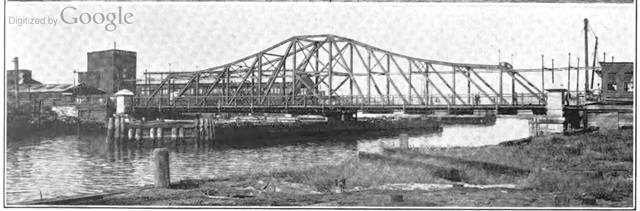
– photo from Engineering magazine, Volume 38, 1910- courtesy google books
This is the bridge that burned away in the 1919 Locust Hill Oil Refinery disaster, a swing bridge not unlike the relict Grand Street Bridge found further up the Creek. Whenever such “Now and then” shots come into my hands, especially images considered to be in the public domain- they will be eagerly shared at this- your Newtown Pentacle.
For more on the history of the Greenpoint Avenue Bridge and its environs, which I call DUGABO- Down Under the Greenpoint Avenue Bridge Onramp- click here
Also:

– photo by Mitch Waxman
An NCA event, which I for one am pretty stoked about:
April NCA meeting hosts Dr. Eric Sanderson
Thursday, April 26, 2012 at 6pm
Ridgewood Democratic Club, 6070 Putnam Avenue, Ridgewood, NY 11385
In addition to important updates from our members – in particular the Bioremedition Workgroup has been very busy! – we will be hosting a special presentation on the “Historical Ecology of Newtown Creek”.
Dr. Eric Sanderson, senior conservation ecologist at the Wildlife Conservation Society and author of “Mannahatta: A Natural History of New York City” (Abrams, 2009), will describe recent studies of the historical ecology of Newtown Creek, describing the original wetlands, creek channels, topography and vegetation of the area. He will show a series of 18th and 19th century maps of the watershed of the creek and discuss the process of synthesizing them into an integrated ecological picture that can be used to inform and inspire natural restoration and cultural appreciation of the Newtown Creek watershed. This work is part of the Welikia Project (welikia.org), an investigation into the historical ecology of the five boroughs of New York City and surrounding waters.
And this Saturday,

Obscura Day 2012, Thirteen Steps around Dutch Kills
Saturday April 28th, 10 a.m.
Your humble narrator will be narrating humbly at this year’s Obscura Day event on April 28th, leading a walking tour of Dutch Kills. There are a few tickets left, so grab them while you can.
“Found less than one mile from the East River, Dutch Kills is home to four movable (and one fixed span) bridges, including one of only two retractible bridges remaining in New York City. Dutch Kills is considered to be the central artery of industrial Long Island City and is ringed with enormous factory buildings, titan rail yards — it’s where the industrial revolution actually happened. Bring your camera, as the tour will be revealing an incredible landscape along this section of the troubled Newtown Creek Watershed.”
For tickets and full details, click here :
obscuraday.com/events/thirteen-steps-dutch-kills-newtown-creek-exploration
halting tongue

– photo by Mitch Waxman
As mentioned in prior postings, an awful lot of time is consumed around Newtown Pentacle HQ in the pursuit of historical anecdote and photographic documentation of the Newtown Creek’s storied past. Often, I’m asked “where do you do your research?”. In the case of today’s posting, it’s the amazing archives of municipal journals and industrial journals which can accessed at google books.
NEW VERNON AVENUE BRIDGE OPEN LONG ISLAND CITY
1908 image from “Illustrated History of the Borough of Queens, New York City By Georg von Skal, Flushing Journal, Flushing, N.Y” – courtesy google books
The Pulaski Bridge is a block or so from the spot where the Vernon Avenue Bridge spanned the creek (between Vernon Ave. in Queens and Manhattan Avenue in Brooklyn), until the Pulaski was erected in 1959 1954. The “Vernon Avenue Bridge” pictured above is the 1908 variant, as there was more than one version of the Vernon Avenue Bridge over the years- including an early swing bridge.

– photo by Mitch Waxman
Included today is this helpful graphic, shot from the Pulaski Bridge, illustrating the abutments of the old bridge. Both are street ends today. In Brooklyn, one will find a park and in Queens, one will find an unofficial dock.
Also:
– photo by Mitch Waxman
An NCA event, which I for one am pretty stoked about:
April NCA meeting hosts Dr. Eric Sanderson
April 26, 2012 at 6pm
Ridgewood Democratic Club, 6070 Putnam Avenue, Ridgewood, NY 11385
In addition to important updates from our members – in particular the Bioremedition Workgroup has been very busy! – we will be hosting a special presentation on the “Historical Ecology of Newtown Creek”.
Dr. Eric Sanderson, senior conservation ecologist at the Wildlife Conservation Society and author of “Mannahatta: A Natural History of New York City” (Abrams, 2009), will describe recent studies of the historical ecology of Newtown Creek, describing the original wetlands, creek channels, topography and vegetation of the area. He will show a series of 18th and 19th century maps of the watershed of the creek and discuss the process of synthesizing them into an integrated ecological picture that can be used to inform and inspire natural restoration and cultural appreciation of the Newtown Creek watershed. This work is part of the Welikia Project (welikia.org), an investigation into the historical ecology of the five boroughs of New York City and surrounding waters.
brief and desolate

Vintage Tugboat at Newtown Creek – photo by Mitch Waxman
Note: This is a “reblog”, and was originally presented in August of 2010.
A rare opportunity to ride up the Newtown Creek was recently enjoyed by your humble narrator, and on my journey up that maligned cataract I spotted an artifact of New York Harbor’s glorious past sneaking past Hunters Point.
from epa.gov
Blue-claw crabs, bluefish, weakfish, striped bass, and other species inhabit the creek, and fishing and crabbing for human consumption occurs [Ref. 7, pp. 2, 5; 8, p. 11; 21, p. 13; 22, pp. 1-2; 24, p. 143; 52, p. 93; 68, p. 3; 69, p. 1]. Subsistence fishing has been observed in Newtown Creek at Dutch Kills, and crabbing for consumption has been observed at the end of Manhattan Avenue in Brooklyn [Ref. 7, p. 5; 21, p. 13; 22, pp. 1-2; 68, p. 3; 69, p. 1]. These locations are both within the zone of contamination for the Newtown Creek site [Figure 2 of this HRS documentation record]. Therefore, Actual Contamination is documented, and the target fishery is evaluated for Actual Human Food Chain Contamination.

the W O Decker at Newtown Creek – photo by Mitch Waxman
Wooden hulled, its spitting steam boilers have long been replaced by modern diesel engines, this little (52 feet long) tugboat is the W O Decker.
also from epa.gov
Beginning in the late 1800s and continuing into the 1930s, Newtown Creek was widened, deepened, and lined with bulkheads to accommodate the growing traffic, leading to the destruction of all its freshwater sources [Ref. 8, p. 10; 12, p. 52]. During World War II, the government commandeered factories along the creek to make military equipment, such as a factory that made aluminum for fighter planes [Ref. 11, p. 14]. At that time, Newtown Creek was the busiest industrial port in the Northeast, with tanker traffic lining its length [Ref. 7, p. 1; 11, p. 13]. The national highway system built after the war took business away from the nation’s waterways, leading to a rapid decline in the level of industry along Newtown Creek [Ref. 7, pp. 1-2].

the W O Decker passing by the “Greenpoint Manufacturing and Design Center” – photo by Mitch Waxman
A “historic place” the Decker was originally called the Russell 1 when it was built in 1930 for the Newtown Creek Towing Company, who were specialists in berthing and towing heavy cargo along the crowded and narrow waterway.
from gmdconline.org
The Greenpoint Manufacturing and Design Center (GMDC) started in the late 1980s as an innovative intersection of two interests: reclaiming derelict factories in North Brooklyn’s Greenpoint neighborhood and sustaining industry and manufacturing in New York City. The organization formally incorporated in 1992.
From its initial purchase and redevelopment of a large facility at 1155 Manhattan Avenue for use by light manufacturers and artisans, GMDC has since expanded and today is the only nonprofit industrial developer in New York City. The organization acquires, develops, and manages industrial real estate that provides small and medium-sized manufacturing enterprises with affordable, flexible production space.

In the shot above, The Decker is passing the Newtown Creek Waste Water Treatment Facility in Greenpoint, Brooklyn – photo by Mitch Waxman
The Decker is currently a high end tour vessel, operated by and out of the South Street Seaport in Manhattan.
from seany.org
The wooden tugboat W.O. Decker was built in Long Island City, Queens in 1930 for the Newtown Creek Towing Company, a firm specializing in berthing ships and barges in the creek that separates Brooklyn and Queens. Originally called the Russell I for the towing company’s owners, she was renamed the W.O. Decker in 1946 after being sold to the Decker family’s Staten Island tugboat firm.

The shield wall of the Shining City, framed by Long Island City on the right and industrial Brooklyn on the left with the Pulaski Bridge just at Horizon – photo by Mitch Waxman
The vessel I was aboard continued on toward the Greenpoint Avenue Bridge, but the Decker turned in the narrow part of the Newtown Creek near the confluence of its tributaries Whale Creek and Dutch Kills.
Check out this 1896 article at the NYTimes, which actually interviews the manager of Newtown Creek Towing Company, John Russell, for whom the Decker was originally named.
darkness and silence

– photo by Mitch Waxman
As mentioned in yesterday’s post, a humble narrator has been spending some time and effort in pursuit of filling in a lack of nocturnal photographs in my library of Newtown Creek shots. While in the midst of this on the Greenpoint Avenue Bridge, just last week, I heard the bells and whistles signaling the approach of a NY & Atlantic freight train.
The thing kind of snuck up on me, as my headphones were actively pumping out a carefully selected playlist of mid-career Motörhead. Lemmy Kilmeister, you must understand, is far louder than any mere locomotive.

– photo by Mitch Waxman
These are the sort of “night shots” which I’m trying not to get. High ISO, selectively focused, and overly grainy- all of which was actually unavoidable. Simply put, if you’re “hand holding” the camera and it’s dark, one must open the lens up- losing deep focus- and increase the “ISO sensitivity” of the camera, which introduces grain. Ideally, you’ve got the thing on a tripod, which I didn’t.
My other camera was set up with specialized night gear, but there was no way to get it set it up in time when surprised by the sudden appearance of the train.

– photo by Mitch Waxman
Out came my dslr, and with the help of a fortuitously placed hole in the fence of the GPA Bridge, the camera could be steadied and these shots were gained. This is probably not a terribly exciting tale to relate, but every photographer will understand my frustrations. Digital cameras are a technology still in infancy, and the form factor and capabilities of the things are still influenced by the shape and metaphor of older devices which used chemical emulsions (film) for recording.
One is reminded of 1960’s and 70’s televisions built into cabinetry it shared with “hi-fi” stereos, or clock radios. When will we forget the metaphor of a film camera and allow these devices to flower into their own?
singularly heavy

– photo by Mitch Waxman
So, nowadays one finds oneself hanging off bridges late in the evening attempting to capture “time exposures” after realizing that there aren’t all that many “night shots” in the library. Honestly, even I find this behavior suspicious, which is why there aren’t that many “night shots” in the aforementioned library. When the thermonuclear eye of god itself shines not upon the Newtown Creek is when a lot of the really “fun stuff” happens around these parts, only a small part of which involves a rodentine army which emerges and swirls out from hidden apertures in the concrete devastations.

– photo by Mitch Waxman
The first and second shots featured today are captured from the Pulaski Bridge, specifically the staircase which carries pedestrian traffic to Borden Avenue from the elevated path. The shot above looks toward Greenpoint with Manhattan behind it. The shutter was open something like eight seconds, which is why the water appears glassy and the artificial lighting of parking lot and lamp posts have taken on a star like halo. The halo is caused by the iris shutter mechanism within the camera, and is shaped by the blades of the device.

– photo by Mitch Waxman
The big problem I’m having with gathering this sort of material is actually the pedestrian nature of my movements. As automotive conveyance is a luxury which I currently do not enjoy, there are large sections of the Creeklands which I just don’t want to walk through at night. A vast physical coward and feckless quisling, the problems your humble narrator is experiencing are dual.
First- I am simply too meek and bookish to trust that the cruelty of the nocturne streets will leave me unmolested, and second- I fear that which may be revealed in the result. Who can guess what it is, that might march about the deserted industrial lowlands of the Newtown Creek when free from the tyranny of casual observation?


