Archive for the ‘Long Island City’ Category
a mediocre fellow

– photo by Mitch Waxman
Fragile and mercurial in temperament, your humble narrator has been suffering from stormy weather of late. Sleep has been an elusive and foresworn luxury, and a season of tumult has settled over Newtown Pentacle HQ, here in the silken heart of Astoria. Seismic twistings of my little world are underway, again.
Always, I must remain, an Outsider.
from wikipedia
In Western philosophy, misanthropy is connected to isolation from human society. In Plato’s Phaedo, Socrates defines the misanthrope in relation to his fellow man: “Misanthropy develops when without art one puts complete trust in somebody thinking the man absolutely true and sound and reliable and then a little later discovers him to be bad and unreliable…and when it happens to someone often…he ends up…hating everyone.” Misanthropy, then, is presented as the result of thwarted expectations or even excess optimism, since Socrates argues that “art” would have allowed the potential misanthrope to recognize that the majority of men are to be found in between good and evil. Aristotle follows a more ontological route: the misanthrope, as an essentially solitary man, is not a man at all: he must be a beast or a god, a view reflected in the Renaissance of misanthropy as a “beast-like state.”

– photo by Mitch Waxman
Always desperate for praise and attention from relative strangers, your humble narrator has found himself walking in august company of late. In the last months, I’ve met (and in some cases actually touched) a Mayor, a Congressman, a Senator, several members of the City Council, 3 Borough Presidents, and a sampling of those third and fourth tier authorities who actually run New York City.
Heady stuff for one such as myself, and such experiences have been forcing me to question exactly which road I’m scuttling down these days. I’m not crowing about this, rather reeling from the experience, as I am neither right nor left- merely lukewarm.
from wikipedia
The industrial revolution produced a parallel revolution in political thought. Urbanization and capitalism greatly reshaped society. During this same period, the socialist movement began to form. In the mid-19th century, Marxism was developed, and socialism in general gained increasing popular support, mostly from the urban working class. Without breaking entirely from the past, Marx established the principles which would be used by the future revolutionaries of the 20th century namely Lenin, Mao Tse Tung, Ho Chi Minh and Fidel Castro. Although Hegel’s philosophy of history is similar to Kant’s, and Marx’s theory of revolution towards the common good is partly based on Kant’s view of history, Marx is said to have declared that on the whole, he was just trying to straighten out Hegel who was actually upside down. Unlike Marx who believed in historical materialism, Hegel believed in the Phenomenology of Spirit.[18] Be that as it may, by the late 19th century, socialism and trade unions were established members of the political landscape. In addition, the various branches of anarchism, with thinkers such as Bakunin, Proudhon or Kropotkin, and syndicalism also gained some prominence. In the Anglo-American world, anti-imperialism and pluralism began gaining currency at the turn of the century.

– photo by Mitch Waxman
Politics are a nasty business, one I have little interest in other than as a spectator sport.
I find myself pining for the empty streets of Long Island City, the canalized horrors of Newtown Creek, and the mysteries of Calvary. These places, and their stories, have become like old friends to me and I’m missing their company. The other night, engaged in conversation with a known and influential member of the national Republican party, I was told that my politics are far left. Just a week or two ago, the horror and shock exhibited by a group of so called leftists I was sharing a bottle with at a local bar, as I argued against a few meme based theories and “accepted truths”, was followed by accusations of my membership in some mythical Nazi party and fidelity to a debauched national mythology.
Sigh…
What can I say, other than that technology and progress is part of the answer, and not all of the problem.
from wikipedia
The terms “left” and “right” appeared during the French Revolution of 1789 when members of the National Assembly divided into supporters of the king to the president’s right and supporters of the revolution to his left. (The seating may have been influenced by the tradition of the English parliament, where the monarch’s ministers sit to the speaker’s right, while the opposition sit to his or her left.) One deputy, the Baron de Gauville explained, “We began to recognize each other: those who were loyal to religion and the king took up positions to the right of the chair so as to avoid the shouts, oaths, and indecencies that enjoyed free rein in the opposing camp”. However the Right opposed the seating arrangement because they believed that deputies should support private or general interests but should not form factions or political parties. The contemporary press occassionally used the terms “left” and “right” to refer to the opposing sides.
When the National Assembly was replaced in 1791 by a Legislative Assembly composed of entirely new members the divisions continued. “Innovators” sat on the left, “moderates” gathered in the center, while the “conscientous defenders of the constitution” found themselves sitting on the right, where the defenders of the ancien regime had previously gathered. When the succeeding National Convention met in 1792, the seating arrangement continued, but following the coup d’etat of June 2, 1793, and the arrest of the Girondins, the right side of the assembly was deserted, and any remaining members who had sat there moved to the center. However following the Thermidorian Reaction of 1794 the members of the far left were excluded and the method of seating was abolished. The new constitution included rules for the assembly that would “break up the party groups”.

– photo by Mitch Waxman
It’s funny the way that the culture has fractured, around outdated 19th century descriptors like republic, capitalism, or socialism, or even the “nation state“. The whole notion of right and left is a relict of earlier times, and the ideation of the New York megalopolis being confined to its legal borders is ridiculous. Our local economy, even in its current state, is greater than that of most countries. Somehow though, everybody seems to be parroting the same lines on the left- and the right has fractured into a million little pieces. Everyone is pissed off, all the time, and ready for battle…
from wikipedia
The economy of New York City is the largest regional economy in the United States and the second largest city economy in the world after Tokyo. Along with London, New York City is the leading financial center of the world and a premier headquarters location for leading global financial services companies. New York is distinctive for its high concentrations of advanced service sector firms in fields such as law, accountancy, banking and management consultancy.
The financial, insurance, health care, and real estate industries form the basis of New York’s economy. The city is also the most important center for mass media, journalism and publishing in the United States, and is the preeminent arts center in the country. Creative industries such as new media, advertising, fashion, design and architecture account for a growing share of employment, with New York City possessing a strong competitive advantage in these industries. Manufacturing, although declining, remains consequential.
The New York Stock Exchange is by far the largest stock exchange in the world by market capitalization of listed companies. The NASDAQ electronic exchange has the most companies listed and is third largest in the world by market capitalization of listed companies.
The New York metropolitan area had an estimated gross metropolitan product of $1.13 trillion in 2005, the largest regional economy in the United States. The city’s economy accounts for the majority of the economic activity in the states of New York and New Jersey.

– photo by Mitch Waxman
Meanwhile, that omniscient thing- which neither sleeps nor breathes nor lives but eternal hungers- looks down from the megalith, amused by the ants.
Musings about the politicians and the philosophies of the bosses stop here, though, on the street…

– photo by Mitch Waxman
…where the wise asses are and the tyranny of “the real” begins. It is going to be a hot summer, I think, the sort of season we haven’t seen since the 1970’s in New York.
opiate peace

– photo by Mitch Waxman
This is not a dead place, this Creek which forms the currently undefended border between much of Brooklyn and Queens, despite wholly inaccurate statements to the contrary recently presented by major publications. To begin with, there is the teeming human infestation, whose population is in the millions. Additionally- migratory birds, invertebrate and vertebrate water fauna, and an enormous hidden population of higher mammals lurk amongst the canalized shorelines of the Newtown Creek.
from the nytimes.com– an article that gets a lot of things completely wrong, which is surprising for the times, and seems to be shilling against “Big Oil”
People don’t often think of urban creeks as biodiverse waterways, but Newtown Creek was once a rich tidal estuary popular among hunters and fishermen. Starting in the 1870s, however, Standard Oil and other refineries began spilling or dumping excess fuels and toxic chemicals into the water or onto the soil, slowly poisoning the ecosystem.

– photo by Mitch Waxman
Famously and recently, a Dolphin’s appearance near the Pulaski Bridge excited the neighboring communities, but such extravagances of nature would have a difficult time at Newtown Creek. There are ocean going and brackish water fish that get swept into the Creek by the East River’s irresistible tidal cycles, which actually drown in the oxygen poor water, but I’ve observed other things swimming in its shallow depths. Weird squamous things that defy description, burrowers and soft bodied tunnelers which thrive in the putrid muds that line its soft bottom. Perhaps, when the federal EPA superfund work begins, studies of these uncommented organisms will commence.
Hey, not everything that lives is beautiful, but against all the odds- life is tenacious and nature will find a way to get by.
from epa.gov
Newtown Creek is a part of the New York – New Jersey Harbor Estuary that forms the northernmost border between the New York City boroughs of Brooklyn and Queens. In the mid 1800s, the area adjacent to the 3.8 mile Newtown Creek was one of the busiest hubs of industrial activity in New York City. More than 50 refineries were located along its banks, including oil refineries, petrochemical plants, fertilizer and glue factories, sawmills, and lumber and coal yards. The creek was crowded with commercial vessels, including large boats bringing in raw materials and fuel and taking out oil, chemicals and metals. In addition to the industrial pollution that resulted from all of this activity, the city began dumping raw sewage directly into the water in 1856. During World War II, the creek was one of the busiest ports in the nation. Currently, factories and facilities still operate along the creek. Various contaminated sites along the creek have contributed to the contamination at Newtown Creek. Today, as a result of its industrial history, including countless spills, Newtown Creek is one of the nation’s most polluted waterways.
Various sediment and surface water samples have been taken along the creek. Pesticides, metals, PCBs, and volatile organic compounds (VOCs), which are potentially harmful contaminants that can easily evaporate into the air, have been detected at the creek.
In the early 1990s, New York State declared that Newtown Creek was not meeting water quality standards under the Clean Water Act. Since then, a number of government sponsored cleanups of the creek have taken place. The New York City Department of Environmental Protection has sampled sediment and surface water at a number of locations along the creek since 1980. In 2009, EPA will further sample the sediment throughout the length of Newtown Creek and its tributaries. The samples will be analyzed for a wide range of industrial contaminants. EPA will use the data collected to define the nature of the environmental problems associated with Newtown Creek as a whole.
shining city

– photo by Mitch Waxman
Gantry Plaza State Park, along the waterfront in the Tower Town section of Long Island City, offers fine panoramas of the shield wall of Manhattan’s east side. Some of my friends tell me that Long Island CIty is best exploited photographically in the early morning, when the burning thermonuclear eye of god itself is still in the east, illuminating the Shining City. For me it’s sunset.
from nysparks.state.ny.us
Gantry Plaza State Park is a 12-acre riverside oasis that boasts spectacular views of the midtown Manhattan skyline, including the Empire State Building and the United Nations. Enjoy a relaxing stroll along the park’s four piers or through the park’s manicured gardens and unique mist fountain. Along the way take a moment to admire the rugged beauty of the park’s centerpieces – restored gantries. These industrial monuments were once used to load and unload rail car floats and barges; today they are striking reminders of our waterfront’s past. With the city skyline as a backdrop and the gantries as a stage, the park’s plaza is a wonderful place to enjoy a spring or summer concert or to enjoy the Macy’s Fourth of July fireworks display.Recreational facilities include basketball courts, playgrounds, handball courts, and a fishing pier with its own cleaning table.

– photo by Mitch Waxman
The funny thing, of course, if that if a 19th century citizen of the independent cities of Long Island City or Manhattan were to observe the modern scene- their first question would be “What happened to all the ships and factories?”.
from fordham.edu
Shipyards lined both the Manhattan and Brooklyn banks of the East River. In the heyday of New York’s port, the ships being built were primarily square-rigged crafts made of wood, especially oak. The raw materials for ships were readily available on the mainland and the labor force in New York did not lack members, especially during the 19th century, when immigrants were pouring in from Europe en masse. While Europeans experimented with the building of iron ships, Americans perfected the art of building the wooden ship.
Renowned for the quality and style of the ships it manufactured, the Port of New York was also known for the sheer quantity of ships that were built there. The East River was the most concentrated area of shipbuilding in the United States. The three greatest shipyards of the East River were probably the Webb-Eckford yard, the Bergh-Westervelt yard, and the Brown-Bell yard. These produced some of the most famous ships and made a fortune in the business, but they represent only a small fraction of the multiple and diverse shipyards dominating the East River.
Commercial yards made up a vast majority of the East River shipbuilding industry, but the government also took advantage of the area to establish a shipyard. The New York Naval Shipyard was established on the site of a former mercantile shipyard, located on the Brooklyn bank, in 1801. It built and outfitted approximately 100 vessels during the War of 1812 and was called upon again during the Civil War to build nine-gun steam sloops and eight-gun side-wheel double-enders. Established by John Quincy Adams, the New York Naval Shipyard continued to build ships well into the 20th century, until it was finally abandoned in 1966.

– photo by Mitch Waxman
The East River was once bursting with industry, and was lined by docks. Famously dangerous, the docks of New York and its corollary municipalities were the first melting pot. When a ship’s cargo was being unloaded and a new one loaded, a process that might take as long as a week, the crews of itinerant sailors would pass the time in flophouses and bars which lined the waterfront. Established society shunned the waterfront, with its temporary populations of tattooed sailors and the mongrel contagion of ideas and exotic possibilities they carried with them.
from earlysda.com
At about 8 o’clock P. M., two lines of people were formed to march each side of the street. Wax candles, about three inches in circumference and four feet long, were now lighted, and given into the hands of each man in the procession. The corpse, which was richly dressed, and adorned with fresh flowers, was placed in a little basket with four handles, four little boys carrying it. It looked like a sweet little child asleep. The procession, with the priest ahead of the child in the middle of the street, and two long lines of men with lighted candles on each side, was rather an imposing sight in the dark night. The walk was about one mile and a half, to an ancient-looking stone church in the upper town. As we passed into the church I saw one of the flagging stones of the floor raised up, and a small pile of bones and dirt beside it. The consul told me the little child was to be put in there. The child was set down by the altar. The priest occupied but a few moments in speaking, then took up a long-handled cup or ball, perforated with holes like a grater, through which, as he uttered a few words, he sprinkled the child with what they call holy water, some of which, whether by accident or otherwise, feel on us who stood at the head of the procession. After this part of the ceremony, all but the child returned in order with the procession. Mr. Harden, the consul, on returning, told me how the child would be disposed of. Two black slaves would strip it of all its clothing, cover it with quick-lime to eat off its flesh, then pound it down in that hole with the other bones and dust, until the stone would lie in its place again. They would have its clothing for their labor. Thus, in this dilapidated charnel-house, and place for divine worship, they disposed of their dead. I was told that Paraiba was one of the oldest towns in South America, being of nearly three hundred years’ standing.
After disposing of our cargo here, we invested our funds in hides and skins, and sailed for New York. After a pleasant and prosperous passage of some thirty days, with the exception of cold, freezing storms on our coast, we arrived at the quarantine ground several miles below the city of New York about the last of March, 1826. As we had no sickness on board, I was allowed the privilege on Sunday of taking my crew with me to hear service at the Dutch Reformed church. This was the first religious assembly I had met with since I covenanted to serve God, and I enjoyed it much. It seemed good to be there. In a few days we were relieved from quarantine, and I was made glad in meeting my companion and sister in New York. My brother F. took my place on board the Empress for another South American voyage, and I left for Fairhaven, to enjoy for a season the society of my family and friends, after an absence of some twenty months.
Like something from the 19th century…

– photo by Mitch Waxman
Big Allis from the Roosevelt Avenue bridge on a cold and humid day, belching Dickensian clouds of steam out over the East River.
from wikipedia
Big Allis, formally known as Ravenswood No. 3, is a giant electric power generator originally commissioned by Consolidated Edison Company (ConEd) and built by the Allis-Chalmers Corporation in 1965. Currently owned by Transcanada Corp., it is located on 36th Avenue and Vernon Boulevard in western Queens, New York.
During 1963, Allis-Chalmers announced that ConEd had ordered the “world’s first MILLION-KILOWATT unit…big enough to serve 3,000,000 people.” This sheer scale helped the plant become popularly known as “Big Allis”.
At the time of its installation, it was the world’s largest energy generating facility. It is located on the Ravenswood site, consisting of Units 1, 2, 3 and 4, as well as several small Gas Turbines (GTs), and an oil farm. The site overall produces about 2,000 MW, or approximately 16% of New York City’s current energy needs. The current installed capacity of Big Allis is around 980 MW.
The Ravenswood, Queens site also includes a steam generation plant consisting of four B&W boilers, commonly known as “The A House”, owned by Con Edison but run by employees of Transcanada. It helps in the supply of steam to Manhattan.
the king in yellow, brick

Matthews Model Flats, Astoria – photo by Mitch Waxman
As mentioned in the past, Newtown Pentacle HQ is embedded within one of the few corner to corner blocks of Matthews Model Flats remaining in Astoria, Queens. This is also one of the postings where I’m thinking out loud, so if your humble narrator is in error, let me know.
Yellow bricks, which once distinguished much of western Queens, compose the street faces of these buildings. This particular stretch of Matthews flats in Astoria is just about a hundred years old (1911), as is a lot of the building stock in what I’ve been told was called “the German Section”- “back in the day”. Model tenements, as they were known, and while walking my little dog Zuzu one morning I began to ponder those bricks. Those yellow bricks.
Everywhere you go, from Ridgewood to Greenpoint, Maspeth and Astoria- you see those bricks.
from an EXCELLENT illustrated history of Brick manufacturing in the New World at brickcollecting.com
The first bricks in the English colonies in North America were probably made in Virginia as early as 1612. New England saw its first brick kiln erected at Salem, Massachusetts in 1629. The Dutch colonists in New Amsterdam imported yellow bricks from Holland, which imparted a Dutch character to the architecture of the city. The excellent quality and abundance of local clays in the colonies made it unnecessary to import bricks from across the Atlantic. Brick-making centers developed in Fort Orange (what is now Albany), New York; near Philadelphia, Pennsylvania; and Burlington and Trenton, New Jersey, as well as along the Raritan River.

Grand 30th avenue, Astoria – photo by Mitch Waxman
One of the real pleasures encountered when working on postings for this, your Newtown Pentacle, are the moments when I suddenly have to research something mundane because I realize that I actually know nothing about the subject. In this case, it’s bricks.
A couple of years ago, I pursued knowledge of industrial Honey production– How, exactly, do all those millions of gallons of honey get to the little bottles in your supermarket? What can the industrial process be, I asked. The answers are pedantic, complex, and suffice to say that China is the world’s Honey superpower and that Honey was arguably the first industrial commodity.
The story of these yellow Kriescher bricks however, has something for everyone.
also from brickcollecting.com
The Manhattan Fire Brick and Enameled Clay Retort Works (as described in New York Illustrated (New York: D.Appleton & Co., 1876) was located on East 15th Street near the East River. Henry Maurer learned the fireclay manufacturing business in his uncle’s firm, Maurer & Weber, and then established his own firm which relocated from New York and Staten Island to Maurer, New Jersey, in 1874
There were several firms in New York City that took advantage of the nearby deposits of fire clay and manufactured both clay retorts and fire bricks. In 1845 Balthazar Kreischer established a fire-brick works in Manhattan, later known as the New York Fire Brick and Clay Retort Works; Kreischer acquired a fire-clay deposit on Staten Island in 1852 and established a works there which eventually replaced the Manhattan factory (his son’s house, the Charles Kreischer House and the workers’ houses for the company, the Kreischerville Worker’s Houses are both designated New York City Landmarks). Joseph K. Brick established the Brooklyn Clay Retort and Fire Brick Works in 1854. The Maurer & Weber Company later known as the Manhattan Fire Brick and Enameled Clay Retort Works, opened in 1863.
In 1868 John Cooper established a business, later known as the Greenpoint Fire Brick and Sewer Pipe Works, at 413-421 Oakland Street, Brooklyn. While there were 350 fire brick manufacturers in the United States in 1895, the New York-New Jersey area remained one of the major fire brick manufacturing centers.
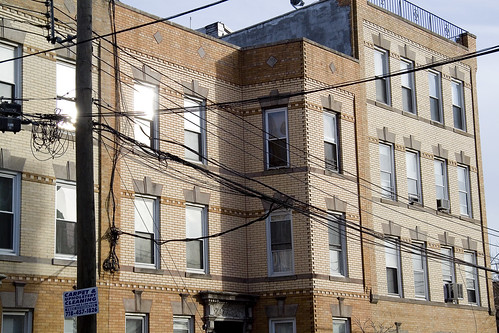
Matthews Houses – photo by Mitch Waxman
19th century businessmen were either merchant princes or robber barons, depending on your point of view. Both are accurate, but suffice to say that communities of labor would cluster around the industrialist, corollary industry would arise to support growing populations around the main mill, and even competitors would often locate in their vicinity to take advantage of locale and the skilled worker population. This is why you find financial, garment, and flower districts in Manhattan and its also why Astoria is visually distinct from the neighborhoods around it.
William Steinway was here, and his interests were larger than just pianos. Steinway was a primal force in digging the first Subway Tunnel from Queens to Manhattan (completed by Michael Degnon, of course), and was a major player in the Queens Trolley business. Wealthy, philanthropic, and well regarded by all reports- Steinway’s Piano mill pulled a population to it. Out on Staten Island, Balthazar Kreischer worked a somewhat coarser but technologically sophisticated operation that made… Bricks.
from boards.ancestry.com
…trying to find the descendants of Balthasar KREISCHER (3.13.1813-8.15.1886) of the Kreischer & Sons Brick Company of Staten Island, and interred in The Green-Wood Cemetery of Brooklyn, New York.
Descendants/Family include his 4 daughters Catherine KREISCHER-WEBER, Fredricka P. KREISCHER, Louisa Albertina KREISCHER-STEINWAY and Caroline L. KREISCHER-ELLIS and his 3 sons: Charles C. KREISCHER, Edward B. KREISCHER and George F. KREISCHER. Some Kreischers settled into Brooklyn.
Louisa Albertina KREISCHER-STEINWAY (d. 6.30.1926) married Albert STEINWAY (b. 6.10.1849- d. 5.14.1877), the youngest son of of Steinway & Sons Piano Mfgr. of Astoria, New York, and had 2 daughters: Henrietta Julia STEINWAY and Ella Frederica STEINWAY. Louisa, Albert and Frederick P. Kreischer are interred in the Steinway mausoleum in Green-Wood Cemetery of Brooklyn, NY.

Maspeth Matthews Houses – photo by Mitch Waxman
Both great men were successful and accepted, rich beyond avarice, and had children. Steinway’s son Albert married Kreischer’s daughter Louisa, connecting the two families in business and standing. Both men also had holdings and interests in the burgeoning railroad business, Kreischer an investor in the Vanderbilt’s Staten Island Railroad and Steinway a rail mogul in Queens. Many of these yellow brick homes, so typical of ancient Queens, lie along the route that trolley tracks once followed.
My supposition is that Kreischer received a family discount for moving his product around on Steinway’s rails, and use of Kreischer Brick in a new project bought some good will from the Steinways- known for their generous nature and political connections in New York, Newtown, and the upstart Long Island City with its scandalous political class.
This is theory, of course, but sounds kind of like the way things worked in 19th century New York when the “old boys” club ruled. Again- theory.
from astorialic.org
“It was reported on the street on Friday that Gleason had sold his railway interests to the Steinway syndicate for $275,000. It has been reported for a long time that the Gleason roads did not pay. The road up Borden Avenue to Calvary Cemetery [in Woodside] was not well patronized. There are not many people who go to Blissville [Sunnyside] unless it is to visit the dead. The Blissville people as a rule do not travel much and when they do they patronize the Greenpoint line in preference to Gleason’s, thus his exchequer has suffered, and again the cars to the cemetery are cold this winter, and the conductors lugubrious on account of the scarcity of pennies and passengers, and a traveler after a survey of one of the cars, is tempted to foot it in preference to riding in an open car, as they had to do on Christmas Day.”

St. Joseph’s RC Church, Grand 30th avenue, Astoria – photo by Mitch Waxman
Louisa’s brother Edward, it seems, met a tragic end.
Check out this page at thecabinet.com, which tells a detailed story of that Kreischer Mansion where Edward lost his life, which describes ghostly phenomena and the violent history experienced by those who have inhabited it since.
Also, don’t miss forgotten-ny’s page on the Steinways and Kreischer’s


