Archive for the ‘Maspeth’ Category
of straw and willow

– photo by Mitch Waxman
Before I left Calvary- that day when I finally located the grave of it’s first interment (Esther Ennis, 1848), stepped in a dead rabbit, and picked up a paranormal companion on my long walk- two things came to my notice.
The first was what I’ve been referring to for awhile as “disturbing subsidences”, which in the case of this posting, seem to have been a result of the series of those winter storm events which bedeviled New York City in January and February of 2011. On my few attempts to enter the place during this period, an untrammeled yard deep layering of snow and ice covered the ground.
The second… we’ll talk about that tomorrow.
from wikipedia
Snow remains on the ground until it melts or sublimates. Sublimation of snow directly into water vapor is most likely to occur on a dry and windy day such as when a strong downslope wind, such as a Chinook wind, exists. The water equivalent of a given amount of snow is the depth of a layer of water having the same mass and upper area. For example, if the snow covering a given area has a water equivalent of 50 centimeters (20 in), then it will melt into a pool of water 50 centimeters (20 in) deep covering the same area. This is a much more useful measurement to hydrologists than snow depth, as the density of cool freshly fallen snow widely varies. New snow commonly has a density of around 8% of water. This means that 33 centimeters (13 in) of snow melts down to 2.5 centimeters (1 in) of water. Cloud temperatures and physical processes in the cloud affect the shape of individual snow crystals. Highly branched or dendritic crystals tend to have more space between the arms of ice that form the snowflake and this snow will therefore have a lower density, often referred to as “dry” snow. Conditions that create columnar or plate-like crystals will have much less air space within the crystal and will therefore be denser and feel “wetter”.
Once the snow is on the ground, it will settle under its own weight (largely due to differential evaporation) until its density is approximately 30% of water. Increases in density above this initial compression occur primarily by melting and refreezing, caused by temperatures above freezing or by direct solar radiation. In colder climates, snow lies on the ground all winter. By late spring, snow densities typically reach a maximum of 50% of water. When the snow does not all melt in the summer it evolves into firn, where individual granules become more spherical in nature, evolving into a glacier as the ice flows downhill.

– photo by Mitch Waxman
Take into account the size of this place, with vast acreages unshielded by geological feature or manmade structure (unless one considers that the entire place is a sort of construct). Next, imagine snow… a lot of snow.
With a square foot of snow estimated to weigh some 12.5 to 20 pounds (depending on density, i.e. fluffy versus wet), and calculate not just the crushing weight of this frosty load upon the ground and the graves themselves- but the actions of the tens of millions of gallons of water released into the soil during the melting process.
from wikipedia
In hydrology, snowmelt is surface runoff produced from melting snow. It can also be used to describe the period or season during which such runoff is produced. Water produced by snowmelt is an important part of the annual water cycle in many parts of the world, in some cases contributing high fractions of the annual runoff in a watershed. Predicting snowmelt runoff from a drainage basin may be a part of designing water control projects. Rapid snowmelt can cause flooding. If the snowmelt is then frozen, very dangerous conditions and accidents can occur, introducing the need for salt to melt the ice.

– photo by Mitch Waxman
Understand what I’m attempting to show in these shots, which are not presented for prurient reasons.
The headstones in a cemetery almost always stand on a concrete base which acts a foundation against the shifting of soil and alleviates fears of the heavy monument falling over and shattering- perhaps even wounding a passerby like myself. In some cemeteries, where marshy conditions exist, the graves aren’t truly in the soil but are rather inside of a sort of cement or concrete vault which holds the interment in place (it also aids in not contaminating ground water) that is itself filled in with dirt. A coffin for a coffin, as it were.
The “b” sections of Calvary which are lower in elevation than the rest and lie along the Review Avenue and Laurel Hill Blvd. sides, I am told, use this sort of approach.
from wikipedia
Groundwater is water located beneath the ground surface in soil pore spaces and in the fractures of rock formations. A unit of rock or an unconsolidated deposit is called an aquifer when it can yield a usable quantity of water. The depth at which soil pore spaces or fractures and voids in rock become completely saturated with water is called the water table. Groundwater is recharged from, and eventually flows to, the surface naturally; natural discharge often occurs at springs and seeps, and can form oases or wetlands. Groundwater is also often withdrawn for agricultural, municipal and industrial use by constructing and operating extraction wells. The study of the distribution and movement of groundwater is hydrogeology, also called groundwater hydrology.
Typically, groundwater is thought of as liquid water flowing through shallow aquifers, but technically it can also include soil moisture, permafrost (frozen soil), immobile water in very low permeability bedrock, and deep geothermal or oil formation water. Groundwater is hypothesized to provide lubrication that can possibly influence the movement of faults. It is likely that much of the Earth’s subsurface contains some water, which may be mixed with other fluids in some instances. Groundwater may not be confined only to the Earth. The formation of some of the landforms observed on Mars may have been influenced by groundwater. There is also evidence that liquid water may also exist in the subsurface of Jupiter’s moon Europa.

– photo by Mitch Waxman
What’s interesting about these 2 images is not that the snow melt washed out a section of soil as it sought low ground. It’s that little peak of red brick and masonry in the extreme corner. It’s the first time that we’ve witnessed a part of (what I believe to be) the 1848 structural elements built into the ground poking out. Confidentiality restrains me from discussing certain reminiscences about these red bricks, and their meaning in Calvary’s original section at this point in time, but these are a very important feature. Possibly very important.
More on that in later postings, as researches into the place are going well beyond the normal scope of inquiry practiced by this, your Newtown Pentacle.
from wikipedia
Some couples or groups of people (such as a married couple or other family members) may wish to be buried in the same plot. In some cases, the coffins (or urns) may simply be buried side by side. In others, one casket may be interred above another. If this is planned for in advance, the first casket may be buried more deeply than is the usual practice so that the second casket may be placed over it without disturbing the first. In many states in Australia all graves are designated two or three depth (depending of the water table) for multiple burials, at the discretion of the burial rights holder, with each new interment atop the previous coffin separated by a thin layer of earth. As such all graves are dug to greater depth for the initial burial than the traditional six feet to facilitate this practice.

– photo by Mitch Waxman
At higher elevations in the ancient cemetery, the evidences of the “business” of the place intrude on the dispassionate and detached observer. This grave’s last interment was a mere 30 years ago, but the characteristic and familiar shape of its subsidence make it pretty clear what the rushing torrents of melting snow have caused as they filtered down through the soil. The grounds keepers of the place will add it to their labors, I’m sure, and cosmetically adjust the spot to an even grade.
Oddly, Calvary had it’s own odor this day, one which actually overwhelmed the perfumes emitted by that nearby assassination of joy called the Newtown Creek.
from wikipedia
The habitation of lowlands, such as coastal or delta plains, requires drainage. The resulting aeration of the soil leads to the oxidation of its organic components, such as peat, and this decomposition process may cause significant land subsidence. This applies especially when ground water levels are periodically adapted to subsidence, in order to maintain desired unsaturated zone depths, exposing more and more peat to oxygen. In addition to this, drained soils consolidate as a result of increased effective stress. In this way, land subsidence has the potential of becoming self-perpetuating, having rates up to 5 cm/yr. Water management used to be tuned primarily to factors such as crop optimisation but, to varying extents, avoiding subsidence has come to be taken into account as well.

– photo by Mitch Waxman
It wasn’t coming from this recent burial, nor from the one shown in the shots above. It was in Section 9, on top of the hill and behind the Johnston Mausoleum that it was emanated from. No photos were gathered, as it was a VERY recent burial, and it would violate Newtown Pentacle policy on this subject. Like this shot, the washout had carved a hydrologic pathway down and into the earth, cutting into the loam and descending into the vast unknown that underlies a world known only to these tomb legions. Unlike this shot, the melting water had eroded the soils covering the grave to the point… the outline of a coffin could just be traced out in the clay and sand, and… other… sensory information was also made available. The olfactory, unfortunately, was amongst them.
As the wind turned, your humble narrator shrieked in the manner of a small girl, and as I turned- the shadow which had been following me since I entered the place ducked behind the nearby Lynch Monument.
from wikipedia
Soil mechanics is a branch of engineering mechanics that describes the behavior of soils. It differs from fluid mechanics and solid mechanics in the sense that soils consist of a heterogeneous mixture of fluids (usually air and water) and particles (usually clay, silt, sand, and gravel) but soil may also contain organic solids, liquids, and gasses and other matter. Along with rock mechanics, soil mechanics provides the theoretical basis for analysis in geotechnical engineering, a subdiscipline of Civil engineering. Soil mechanics is used to analyze the deformations of and flow of fluids within natural and man-made structures that are supported on or made of soil, or structures that are buried in soils.

– photo by Mitch Waxman
I always attempt to avoid using cemetery roads, partially because the fear of automotive encounter and disastrous consequences bedevil the frequent pedestrian, but mainly because of some instinctual desire to avoid crossroads in places like this…
But I really needed to get out of here…
from wikipedia
In the folk magic of many cultures, the crossroads is a location “between the worlds” and, as such, a site where supernatural spirits can be contacted and paranormal events can take place. Symbolically, it can mean a locality where two realms touch and therefore represents liminality, a place literally “neither here nor there”, “betwixt and between”.
settled shape

– photo by Mitch Waxman
As stated in yesterday’s posting, a certain “sense of pursuit” possessed me after having visited Calvary Cemetery the other day.
A panicked perambulation, flight more than evasion, came upon me and carried your humble narrator bodily across most of western Queens for the rest of the day as attempts were made to return the rolling hillocks of Astoria. The spectral shadow which dogged my steps, whose identity is suspected, appeared shortly after one particularly gruesome moment.
I stepped in a dead rabbit.
The population of “groundling burrowers” at Calvary Cemetery has been discussed before, in this February 2010 Newtown Pentacle posting “Shoosh… Be Very Quiet… I’m hunting rabbits…“

– photo by Mitch Waxman
The hydrological after effects of the recent snow cover, and its concurrent melt waters, are evidenced across the great cemetery by disturbing subsidence and in some places- wash outs. The ground itself is not altogether stable, given its level of saturation, and caution was exercised in not getting too close to older monuments and headstones for fear of toppling them from an undermined foundation.
A moment of indiscretion resulted in me planting a step right into the carcass of a groundling, however.
(these hydrological events will be discussed in a later posting)
from eho.syr.edu
Dead Animals are associated with the spread of human disease and may present a potential hazard for employees, students and visitors.
The greatest hazard related to dead animals is the potential for the indirect spread of human disease by live animal parasites (fleas and ticks). Fleas and ticks are parasites that feed, breed and live on most wild animals. Both fleas and ticks have irritating bites and can transmit disease. Risk of exposure to fleas and ticks increases when handling dead animals, because these parasites are actively seeking a live host and may be very abundant on the animal or in the immediate area. Dead animals should only be handled by appropriate Physical Plant and Housing employees.
Animal Carcass Disposal Procedures. The following procedures must be used when removing and disposing of an animal carcass:
- At a minimum, workers must wear thick rubber gloves, a long sleeve shirt and pants, and closed toed shoes when handling dead animals.
- Transfer small animal carcasses to doubled plastic bags using shovel or gloved hand.
- Double bagged carcasses must be placed in an outdoor garbage dumpster.
- Large animal carcasses, such as a deer, must be transported to a remote wood area on University property and buried three feet below ground. Only University owned pick-up trucks may be used to transport large animal carcasses.

– photo by Mitch Waxman
What was odd, given the predators which overfly or cross Calvary in a quadripedal manner- and an abundant soil ecosystem whose foodstuffs are better left undescribed- was that the rabbit itself seemed to have just died on the spot and was left to decay. It “came apart” due to my accidental contact, seemed to be quite dehydrated, and was just laying out in the open.
One would expect to witness a cloud of flies, or other forms of insectivorous life at work, but it was curiously intact. Maybe the Chinese New Year figures into it somehow.
from wikipedia
The Chinese Year of the Rabbit ( 兔 ) is actually the Chinese Year of the Hare, as China has seven native species of hares and no native species of rabbits. The Chinese applied their word for hare to the first rabbits to be taken to China, and the word is now erroneously back-translated into English as rabbit. The hare is the fourth animal in the 12-year cycle of the Chinese zodiac. The Year of the Hare is associated with the earthly branch symbol 卯.

– photo by Mitch Waxman
An exquisite irony, of course, is that Calvary Cemetery is the final resting place for many Irish immigrants of the 19th century- including a large number who were members of the legendary street gang “the De’d Ráibéads” or “Dead Rabbits”. When escape from my ghostly pursuer was finally attained, and this tale was breathlessly related back at Newtown Pentacle HQ, my patient listeners thought that I had actually fallen into the grave of some 19th century Lower East Sider like Kit Burns.
from wikipedia
The Dead Rabbits were a gang in New York City in the 1850s, and originally were a part of the Roach Guards. The name has a second meaning rooted in Irish American vernacular of NYC in 1857. The word “Rabbit” is the phonetic corruption of the Irish word ráibéad, meaning “man to be feared”. “Dead” was a slang intensifier meaning “very”. Thus, a “Dead Ráibéad” means a man to be greatly feared. The gang was sometimes also known as the Black Birds.
The gang was led by Priest Valon and achieved great renown for their organization and prowess as thieves and thugs. The fighting uniform of the Roach Guards was a blue stripe on their pantaloons, while the Dead Rabbits adopted a red stripe. In riots their emblem was a dead rabbit impaled on a spike. The Rabbits and the Guards swore undying enmity and constantly fought each other at the Five Points, but in the rows with the water-front and Bowery Boys they made common cause against the enemy, as did other Five Points gangs including the Shirt Tails and Chichesters. The gang was later led by Irishman Aidan Bourke also known as “Black Dog” possibly because a ruthless nature similar to that of the ghost dog in the folklores of the Celtic and British Isles.

– photo by Mitch Waxman
This rabbit’s foot seems to have brought little or no luck to it’s original owner, and little sense has ever accompanied that particular superstition as far as I’m concerned. It was while taking this shot that I suddenly became aware of a “feeling of being watched”, a well honed sense impression for those of us who wander the streets with our cameras, one which normally presages the familiar “bleep bleep” of an NYPD radio patrol car or some Private Security guard about to query “what are you doing?”. Looking around, solitude remained untrammeled, but a weird reflection behind me was observed on the corner of the lens to my glasses.
Upon spinning around, expecting to see a groundskeeper or some other visitor to the place, there was nothing and no one.
from wikipedia
A mild form of hallucination is known as a disturbance, and can occur in any of the senses above. These may be things like seeing movement in peripheral vision, or hearing faint noises and/or voices. Auditory hallucinations are very common in paranoid schizophrenia. They may be benevolent (telling the patient good things about themselves) or malicious, cursing the patient etc. Auditory hallucinations of the malicious type are frequently heard like people talking about the patient behind their back. Like auditory hallucinations, the source of their visual counterpart can also be behind the patient’s back. Their visual counterpart is the feeling of being looked-stared at, usually with malicious intent. Frequently, auditory hallucinations and their visual counterpart are experienced by the patient together.
Hypnagogic hallucinations and hypnopompic hallucinations are considered normal phenomena. Hypnagogic hallucinations can occur as one is falling asleep and hypnopompic hallucinations occur when one is waking up.

– photo by Mitch Waxman
Disturbed at this point by my perception, and by the curious feeling of being watched, I nevertheless continued my “business” at Calvary. Antiquarian pursuits and historical inquiries aside, it was quite a lovely day- and the first hint of spring was in the air.
What better way to spend it than in a lovely garden cemetery?
from wikipedia
The rural cemetery or garden cemetery is a style of burial ground that uses landscaping in a park-like setting.
Landscaping and tree planting at Green-Wood Cemetery in BrooklynAs early as 1711 the architect Sir Christopher Wren had advocated the creation of burial grounds on the outskirts of town, “inclosed with a strong Brick Wall, and having a walk round, and two cross walks, decently planted with Yew-trees”[1]. By the early 19th century, with urban populations expanding, the existing churchyards were growing unhealthily overcrowded with graves stacked upon each other, or emptied and reused for newer burials. As a reaction to this, the first landscaped cemetery was opened in 1804, as the Père Lachaise Cemetery in Paris.
The garden cemetery in the USA was a development of this style. Prior to this, urban burial grounds were generally sectarian located on small plots within cities. The new design took the cemetery out of the control of the church, using an attractive park built on a grander scale, using architectural design and careful planting, inspired by the English garden movement.
of stout body
Ok, just one more frozen Calvary post… and apologies for the sparse presentations this week, a dear friend of the Pentacle has been hospitalized and I’ve been spending a good amount of time visiting with and attempting to take some of the load off of the immediate family. Such is the price of true fealty and companionship, this duty to “be there” when the good times stop. I’m no “good time charlie”, after all.

– photo by Mitch Waxman
These shots are from the same walk through the ice at Calvary Cemetery discussed during a couple of last week’s transmissions . On the lookout for animal tracks (I’ll find that damned Coyote), I discovered these curious prints etching back and forth through the crusty ice and deep snow.
from wikipedia
In 1847, faced with cholera epidemics and a shortage of burial grounds in Manhattan, the New York State Legislature passed the Rural Cemetery Act authorizing nonprofit corporations to operate commercial cemeteries. Old St. Patrick’s Cathedral trustees had purchased land in Maspeth in 1846, and this land was used to develop Calvary Cemetery. The first burial in Calvary Cemetery was in 1848 and by 1852 there were 50 burials a day, half of them the Irish poor under seven years of age.
The original division of the cemetery, now known as First Calvary or Old Calvary, was filled by 1867. The Archdiocese of New York expanded the area of the cemetery, adding more sections, and by the 1990s there were nearly 3 million burials in Calvary Cemetery.

– photo by Mitch Waxman
Childhood fantasy blossomed in my thoughts, and despite the obviousness of these being bird tracks, I entertained certain vague memories of Spring Heel Jack and other Dickensian bogeymen. Imagine if there were some monopodal mystery hopping about the place, thought an idiot in a filthy black raincoat while standing in knee deep frozen precipitants at an ancient cemetery in Queens.
from wikipedia
Spring Heeled Jack (also Springheel Jack, Spring-heel Jack, etc.) is a character from English folklore said to have existed during the Victorian era and able to jump extraordinarily high. The first claimed sighting of Spring Heeled Jack that is known occurred in 1837. Later alleged sightings were reported all over England, from London up to Sheffield and Liverpool, but they were especially prevalent in suburban London and later in the Midlands and Scotland.
Many theories have been proposed to ascertain the nature and identity of Spring Heeled Jack. The urban legend of Spring Heeled Jack gained immense popularity in its time due to the tales of his bizarre appearance and ability to make extraordinary leaps, to the point where he became the topic of several works of fiction.
Spring Heeled Jack was described by people claiming to have seen him as having a terrifying and frightful appearance, with diabolical physiognomy, clawed hands, and eyes that “resembled red balls of fire”. One report claimed that, beneath a black cloak, he wore a helmet and a tight-fitting white garment like an “oilskin”. Many stories also mention a “Devil-like” aspect. Spring Heeled Jack was said to be tall and thin, with the appearance of a gentleman, and capable of making great leaps. Several reports mention that he could breathe out blue and white flames and that he wore sharp metallic claws at his fingertips. At least two people claimed that he was able to speak comprehensible English.

– photo by Mitch Waxman
Inexpert, I clumsily followed the tracks, moving in my typically arthritic, lurching, and uneven winter scuttle. By this point, the specie which had left its mark behind was clearly avian, and quite obviously a water bird of some sort.
from wikipedia
Anatidae is the biological family that includes ducks, geese and swans. The family has a cosmopolitan distribution, occurring on all the world’s continents except Antarctica and on most of the world’s islands and island groups. These are birds that are adapted through evolution for swimming, floating on the water surface, and in some cases diving in at least shallow water. (The Magpie Goose is no longer considered to be part of the Anatidae, but is placed in its own family Anseranatidae.) The family contains around 146 species in 40 genera. They are generally herbivorous, and are monogamous breeders. A number of species undertake annual migrations. A few species have been domesticated for agriculture, and many others are hunted for food and recreation. Five species have become extinct since 1600, and many more are threatened with extinction.

– photo by Mitch Waxman
Three toes and webbed at that, this was no Spring Heeled entity… I recognized what shared my walk through Calvary that cold day… And then they appeared…
from wikipedia
6-8 living species of black geese are known. In addition, one species has been described from subfossil remains found in the Hawaiian Islands, where it became extinct in prehistoric times. Another undescribed prehistoric species from the Big Island of Hawai‘i was extremely large and flightless; it is tentatively assigned to this genus due to being very peculiar. It is fairly certain that at least another species of this genus awaits discovery on the Big Island, judging from the facts that at least one species of Branta was found on every major Hawaiian island, and that remains of such birds have not been intentionally searched for on the Big Island.

– photo by Mitch Waxman
Several Canada Geese appeared at the top of a hill, quietly picking at the ice. Copious deposits of their feces were observed as well- but not pictured as to insure against the delicate sensibilities of the Lords and Ladies of the Newtown Pentacle being offended.
from wikipedia
This species is native to North America. It breeds in Canada and the northern United States in a variety of habitats. Its nest is usually located in an elevated area near water such as streams, lakes, ponds and sometimes on a beaver lodge. Its eggs are laid in a shallow depression lined with plant material and down. The Great Lakes region maintains a very large population of Canada Geese.
By the early 20th century, over-hunting and loss of habitat in the late 19th century and early 20th century had resulted in a serious decline in the numbers of this bird in its native range. The Giant Canada Goose subspecies was believed to be extinct in the 1950s until, in 1962, a small flock was discovered wintering in Rochester, Minnesota, by Harold Hanson of the Illinois Natural History Survey. With improved game laws and habitat recreation and preservation programs, their populations have recovered in most of their range, although some local populations, especially of the subspecies occidentalis, may still be declining.
In recent years, Canada Geese populations in some areas have grown substantially, so much so that many consider them pests (for their droppings, the bacteria in their droppings, noise and confrontational behavior). This problem is partially due to the removal of natural predators and an abundance of safe, man-made bodies of water (such as on golf courses, public parks and beaches, and in planned communities).

– photo by Mitch Waxman
Often are such Geese observed here at First Calvary, even during the summer. It’s odd, alongside the maligned Newtown Creek and within the walls of New york’s ancient burying ground, that there exists a sort of nature preserve amongst the tomb legions.
from a 2009 nytimes.com report:
All commercial airplane engines are required to pass a “bird strike” test before they can be certified for use. Engine manufacturers, including CFM International, which produced the engines on the US Airways Airbus A320 involved in Thursday’s sudden landing, test the engines physically and through computer simulation.
In the physical tests, the engines are revved to full power inside a test facility and absorb various kinds of birds, from those the size of sparrows to those the size of herons, one at a time. (The birds are already dead.) The engines also ingest multiple birds meant to simulate a collision with a flock, said Matthew Perra, a spokesman for the engine manufacturer Pratt & Whitney.
To pass the test, engines must keep operating after the collision, maintaining enough power to take off, fly around the airport and land the plane safely, he said. That is because a jet with two engines has to be able to take off on 50 percent power
a ghastly plot
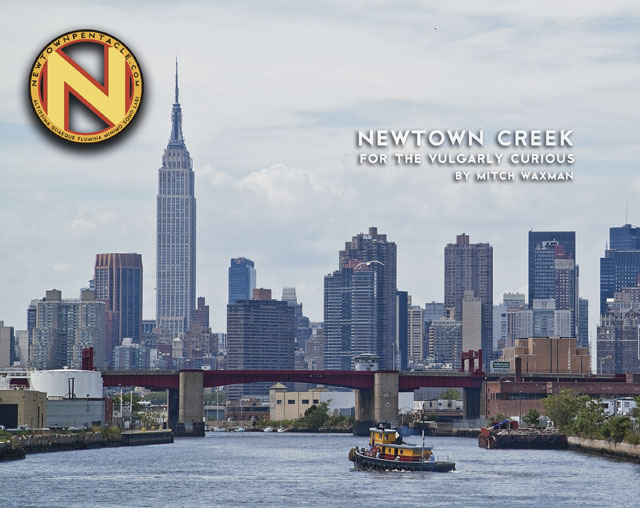
“Newtown Creek for the Vulgarly Curious” is a fully annotated 68 page, full-color journey from the mouth of Newtown Creek at the East River all the way back to the heart of darkness at English Kills, with photos and text by Mitch Waxman.
Check out the preview of the book at lulu.com, which is handling printing and order fulfillment, by clicking here.
Every book sold contributes directly to the material support and continuance of this, your Newtown Pentacle.
the loved dead

– photo by Mitch Waxman
On Sunday I fell in a hole…
Literally, a pothole on 49th street (which adjoins the hideous Maspeth Creek tributary of that answer to civilization known as the Newtown Creek) swallowed your humble narrator. Banged up a bit, an injury to the left knee punctured my skinvelope and the jury was out on whether or not a finger on the right hand might have been fractured. Of all the things that can go wrong or happen to you around the Newtown Creek, falling in a hole was absolutely the last thing I worried about.
Actually, I’ve worried a lot about falling into a hole at Calvary and Mt. Zion…

– photo by Mitch Waxman
On Monday my computer died.
The funeral montage for my newly deceased G5 plays unheralded in my mind. With me for quite a number of years, the Mac was a workhorse, and despite its steadily declining capabilities (it hadn’t been able to burn a DVD for years, and recently required replacement of several internal components) it never let me down. I remember the first time we went to the park together, the long nights working on freelance jobs… sigh. If you have a Windows based machine, you don’t understand this, but Mac owners develop a certain emotional bond with their gizmo and it is painful to part with it. Luckily, I salvaged the hard drive from it, and the soul of the beast was intact. So, off to the Apple store at 1AM, back home deeper in debt than ever. The good news is that the new Mac has been able to read everything, the “migration assistant” was able to transfer my files in a fairly seamless fashion, and I seem to be back in business.
Still, bad things are supposed to happen in threes, right?

– photo by Mitch Waxman
Today, I’m living in fear of further possible torment and death.
Mental notes have been made to both back up the computer more often and to ensure sure footing before shifting my weight from one foot to the other. I saw a few interesting things on Sunday, which will be discussed in forthcoming postings of this- the winter session of your Newtown Pentacle.
Note:
The Newtown Creek Alliance meeting which was cancelled due to the recent ice storm on has been rescheduled for February 17th- here’s the details:
When: Thursday, February 17th, 6:30pm
Where: LaGuardia Community College, Building E, Room 501
The agenda as listed is:
At the meeting we will be discussing:
- The recent designation of Newtown Creek as a Superfund Site
- The Greenpoint Oil Spill Settlement Agreement between the NYS AG, Riverkeeper, and ExxonMobil
- The distribution of Newtown Creek Sewage Treatment Plant Environmental Benefit Funds
- DEP’s signage for the Newtown Creek Nature Walk
- The NYC Green Infrastructure Plan and its potential impact on Newtown Creek
- The status of Newtown Creek Alliance’s application to incorporate as a not-for-profit organization.
The “NYC Green infrastructure plan” section of the discussion promises to be VERY interesting. Come and meet some truly smart people, in Long Island City of all places.


 The Newtown Pentacle