Archive for the ‘Mt. Zion Cemetery’ Category
a ghastly plot
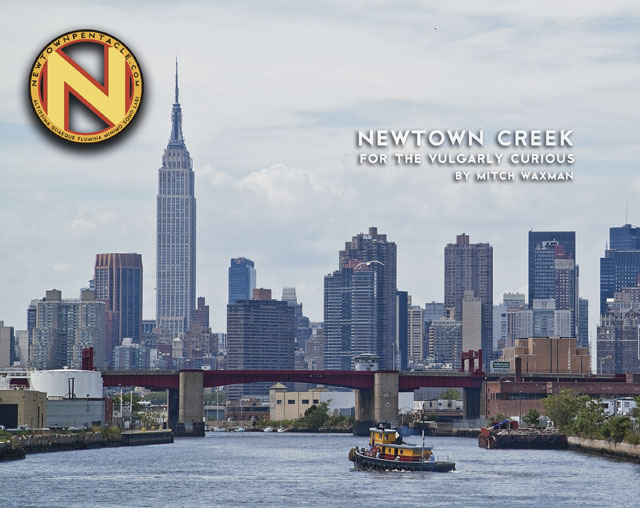
“Newtown Creek for the Vulgarly Curious” is a fully annotated 68 page, full-color journey from the mouth of Newtown Creek at the East River all the way back to the heart of darkness at English Kills, with photos and text by Mitch Waxman.
Check out the preview of the book at lulu.com, which is handling printing and order fulfillment, by clicking here.
Every book sold contributes directly to the material support and continuance of this, your Newtown Pentacle.
the loved dead

– photo by Mitch Waxman
On Sunday I fell in a hole…
Literally, a pothole on 49th street (which adjoins the hideous Maspeth Creek tributary of that answer to civilization known as the Newtown Creek) swallowed your humble narrator. Banged up a bit, an injury to the left knee punctured my skinvelope and the jury was out on whether or not a finger on the right hand might have been fractured. Of all the things that can go wrong or happen to you around the Newtown Creek, falling in a hole was absolutely the last thing I worried about.
Actually, I’ve worried a lot about falling into a hole at Calvary and Mt. Zion…

– photo by Mitch Waxman
On Monday my computer died.
The funeral montage for my newly deceased G5 plays unheralded in my mind. With me for quite a number of years, the Mac was a workhorse, and despite its steadily declining capabilities (it hadn’t been able to burn a DVD for years, and recently required replacement of several internal components) it never let me down. I remember the first time we went to the park together, the long nights working on freelance jobs… sigh. If you have a Windows based machine, you don’t understand this, but Mac owners develop a certain emotional bond with their gizmo and it is painful to part with it. Luckily, I salvaged the hard drive from it, and the soul of the beast was intact. So, off to the Apple store at 1AM, back home deeper in debt than ever. The good news is that the new Mac has been able to read everything, the “migration assistant” was able to transfer my files in a fairly seamless fashion, and I seem to be back in business.
Still, bad things are supposed to happen in threes, right?

– photo by Mitch Waxman
Today, I’m living in fear of further possible torment and death.
Mental notes have been made to both back up the computer more often and to ensure sure footing before shifting my weight from one foot to the other. I saw a few interesting things on Sunday, which will be discussed in forthcoming postings of this- the winter session of your Newtown Pentacle.
Note:
The Newtown Creek Alliance meeting which was cancelled due to the recent ice storm on has been rescheduled for February 17th- here’s the details:
When: Thursday, February 17th, 6:30pm
Where: LaGuardia Community College, Building E, Room 501
The agenda as listed is:
At the meeting we will be discussing:
- The recent designation of Newtown Creek as a Superfund Site
- The Greenpoint Oil Spill Settlement Agreement between the NYS AG, Riverkeeper, and ExxonMobil
- The distribution of Newtown Creek Sewage Treatment Plant Environmental Benefit Funds
- DEP’s signage for the Newtown Creek Nature Walk
- The NYC Green Infrastructure Plan and its potential impact on Newtown Creek
- The status of Newtown Creek Alliance’s application to incorporate as a not-for-profit organization.
The “NYC Green infrastructure plan” section of the discussion promises to be VERY interesting. Come and meet some truly smart people, in Long Island City of all places.
restless lichens

– photo by Mitch Waxman
A sharp eyed reader and fellow haunter of the tombs tipped me on to this, something I never noticed on 58th street, a sidewalk deprived viaduct that runs between two cemeteries- New Calvary and Mt. Zion.
Mount Zion Cemetery encompasses an area of 78 acres. This cemetery is located in Maspeth, Queens near the Manhattan Border. When this cemetery was first established the surrounding area was considered to be rural. There was an ongoing need for burial spaces to accommodate the explosion of the immigrant population in not only Queens, but also the nearby neighborhoods of Manhattan and Brooklyn. Mount Zion Cemetery has more than 210,000 burials on its 78 acres making it one of the more interesting burial grounds.

– photo by Mitch Waxman
Nitre dripping, the walls of Zion are composed of conventional mortar and stone for much of their length, protecting its centuries of interments with a stout but rusty fence.
from wikipedia
Masonry is the building of structures from individual units laid in and bound together by mortar; the term masonry can also refer to the units themselves. The common materials of masonry construction are brick, stone such as marble, granite, travertine, limestone; concrete block, glass block, and tile. Masonry is generally a highly durable form of construction. However, the materials used, the quality of the mortar and workmanship, and the pattern in which the units are assembled can strongly affect the durability of the overall masonry construction.

– photo by Mitch Waxman
As one nears Laurel Hill Blvd. and the stature of the masonry wall shrinks back to a human scale, a curious heterogeneousness in its composition is noticed. Suddenly granite and “finishing marble” is noticed.
from wikipedia
Sculpture
White marble was prized for its use in sculptures since classical times. This preference has to do with the softness and relative isotropy and homogeneity, and a relative resistance to shattering. Also, the low index of refraction of calcite allows light to penetrate several millimeters into the stone before being scattered out, resulting in the characteristic “waxy” look which gives “life” to marble sculptures of the human body.
Construction marble
Construction marble is a stone which is composed of calcite, dolomite or serpentine which is capable of taking a polish. More generally in construction, specifically the dimension stone trade, the term “marble” is used for any crystalline calcitic rock (and some non-calcitic rocks) useful as building stone. For example, Tennessee marble is really a dense granular fossiliferous gray to pink to maroon Ordovician limestone that geologists call the Holston Formation.

– photo by Mitch Waxman
Proceeding up the block, certain familiar shapes become recognizable in the wall, and a cold dread is realized. Tombstones. They used tombstones to make this part of the wall.
from wikipedia
The stele (plural stelae), as they are called in an archaeological context, is one of the oldest forms of funerary art. Originally, a tombstone was the stone lid of a stone coffin, or the coffin itself, and a gravestone was the stone slab that was laid over a grave. Now all three terms are also used for markers placed at the head of the grave. Originally graves in the 1700s also contained footstones to demarcate the foot end of the grave. Footstones were rarely carved with more than the deceased’s initials and year of death, and many cemeteries and churchyards have removed them to make cutting the grass easier. Note however that in many UK cemeteries the principal, and indeed only, marker is placed at the foot of the grave.
Graves and any related memorials are a focus for mourning and remembrance. The names of relatives are often added to a gravestone over the years, so that one marker may chronicle the passing of an entire family spread over decades. Since gravestones and a plot in a cemetery or churchyard cost money, they are also a symbol of wealth or prominence in a community. Some gravestones were even commissioned and erected to their own memory by people who were still living, as a testament to their wealth and status. In a Christian context, the very wealthy often erected elaborate memorials within churches rather than having simply external gravestones.

– photo by Mitch Waxman
Section markers and footpath monuments are used, as well as grave markers whose screed faces inward. Oh what treasures may be entrusted to the grave’s holding that only some future archaeologist will know?
from sciencedaily.com
“Until now we have relied on evidence from medieval rubbish – including food remains, pottery and other finds – to build up a picture of medieval life in the city. This group of burials represents the first opportunity to examine the medieval population itself, in terms of life expectancy, stature and health.
“Evidence of some communal burials and high infant mortality also indicate evidence of infection and disease.
“The skeletons are very well preserved – some were in coffins and others weren’t and were placed in shrouds. We were expecting there to be some 300 skeletons- but the scale of this discovery is stunning.”
The site dates from between the 12th century and the mid 1500s and is part of the medieval church of St Peter’s – one of two parish churches in the city which disappeared in the late medieval period.
Mt Zion 6- Crystal Oblivion

– photo by Mitch Waxman
Awakening from the dead faint which had ended my ruminations on those oppressions suffered by both Jew and Roma in a war torn exemplar of peasant ignorance and malign oligarchy which is the European Peninsula, your humble narrator noticed the gloaming of late afternoon settling upon the centenarian graveyard and realized that one way or another- an escape must be hazarded from the oblivion of Mount Zion cemetery if I ever desired to return to the yellow brick lanes of Astoria.

– photo by Mitch Waxman
The curious singsong chant of those odd children had stopped, and echoing along the tombstones was the sound of wholesome and cheerful laughing. From my vantage, I could discern that the first group of children were fleeing from a second, whose colorful clothing and raven hair marked them as the picturesque crowd I had spotted earlier on 53rd avenue. The flabby jowled, unblinking, scaly group of youths which had been tormenting me- and whose apparent leader was a girl carrying a curiously polydactyl cat whose aspect “I did not like”- were running off in the direction of that stygian cataract called the Newtown Creek.

– photo by Mitch Waxman
Regaining my composure, I realized that I had found the highest spot in Zion, and watched as the group of dark haired and festively adorned children jeered the fleeing “others”. I turned for a moment, looking south toward Brooklyn, along the gates of a Sanitation Dept. Garbage truck depot. This is a lonely spot, tragic and shunned.

– photo by Mitch Waxman
Populated by graves of children, often stillborn, this is the highest point of elevation in Mt. Zion by my estimation. I resolved to make my way for the gates, and felt an eerie tiredness take over me. Cemeteries are uncomfortable places not because of the omnipresent reminders of mortality, but because they remind us that anonymity is the ultimate fate of nearly all of us.

– photo by Mitch Waxman
All they were, and had done, and built- the ultimate meaning of themselves- led to centuried silence and the anonymity of the tomb. I’ve been asking myself, lately, why I’ve been so compelled to spend my time with them, instead of amongst the living. A lot of wise old jewish grandmothers are buried here, and my own would say that this recent pursuit is “no good for you, go see a movie instead”.
She also told me, when I told her I intended to follow a career in visual arts, that “all I wanted was to be a bum in the village with a needle in my arm”.

– photo by Mitch Waxman
Mission Statements – 1 – Breaking character
One of my quasi mystical opinions is that by telling a story, transmitting the lore of civilization from one generation to another, you keep the subject of the story alive- in a sense. We know the story of Beowulf, and Christ, and Churchill. In my ham handed and alliterative patois of pop cultural imagery and historical allusion, this notion of “telling the hero’s story” (with the “hero” being the working class) is part of my motivation behind these explorations. In a sense, I fancy myself as C-3PO telling the story of Luke and Leia to the Ewoks.

– photo by Mitch Waxman
Mission Statements – 2 – Horns and Dilemmas
A vast and shining monument to future archaeology is what I see the Cemetery Belt of western Queens and North Brooklyn as, awaiting the end of living memory and improved imaging technology. Vast dilemmas of conscience often plague me as I make the “selects” from the hundreds of shots I’ll gather at just one of the many locations explored at the Newtown Pentacle. That’s an identifiable face, or corporate trademark, or the ridiculous laws which require the owner of a skyscraper to approve the publication of an image of their structure. The graveyard stuff is touchy, and I attempt to only show graves of those who died well out of “living memory”, which is a flexible topic for me.

– photo by Mitch Waxman
Mission Statements – 3 – Contradictions and Logic
Problematic, because it’s self defined, my “living memory” concept is roughly this- if the stone is older than the second world war- I consider it fair game and part of the public record. Saying that, if you’ve seen a gravestone of a relative in one of my shots that you’d really rather not have public, contact me and it’s pulled (I’m not a dick)- just know that the shot was chosen for either its odd qualities or historical significance (like the O’Brien monument in Old Calvary), or because it’s a beautiful piece of sculpture that was chosen to illustrate the esthetic or political milieu of an era I’m trying to describe. Any editorial implications of the accompanying quoted references (from abc.com, in italics) or “humble narrator” copy should be discarded as the product of a sick, cowardly, and weary man who is “all ‘effed up”. No one will visit my grave, Lords and Ladies of Newtown, except to gloat and defecate.
I also never trespass, enter onto Railroad properties uninvited, or use transportation of any kind other than my feet when I’m out on one of my little missions. Kissing the right posterior and being “nice” offers tremendous access to these places, “legally”, and brings insight and opportunity. Why make trouble?

– photo by Mitch Waxman
Back to the post:
When I passed out of the ancient cemetery, through the western section’s gates, I saw that group of gaily dressed children who had chased off those menacingly mutant urchins that had caused me to faint three times as I hid in the shadows of this garden of obelisks.
One of the oddest moments of the day occurred when a waste hauler’s truck sped down Maurice Avenue at top speed, occluding my view of them for a few seconds, during which they disappeared. Puzzled, I scuttled back to the waiting arms of Astoria, and the entire way I thought I heard the creaking agony of wooden carriage wheels.
Mt Zion 5- Sunken Houses of Sleep

– photo by Mitch Waxman
Steeling myself for the inevitable humiliating encounter with those oddly menacing children who seemed to be waiting for my reemergence on Maurice Avenue, I moved down the hill from the 58th street side of the burial grounds.
Older than my years, vast psychological inadequacies and shameful physical “episodes” render your humble narrator a helpless emotional cripple. Even the thought of direct confrontation with that which may exist around the Newtown Creek- or because of it- is enough to make me lightheaded and coat my skin in cold sweat. Staying out of sight, I broke into a dogtrot instead of my usual scuttle, and continued along the central artery of Mount Zion Cemetery. On the hill is the DSNY’s gargantuan Queens West Garage complex and an accompanying garbage incinerator.

– photo by Mitch Waxman
The counterpoint of a Jewish Cemetery next door to an industrial incinerator is obvious and exhibits poor municipal siting, conversely this is probably an ideal location for such industry. Western Queens is the backbone of New York City, from a metropolitan industrial complex’s point of view.
Airports, railroad yards, maritime facilities, petrochemical storage and processing, illegal and legal dumping, sewer plants, waste and recycling facilities, cemeteries. The borders of the Newtown Pentacle’s left ventricle are festooned with heavy industry and the toll taken on the health of both land and population is manifest. A vast national agglutination of technologies and a sprawl of transportation arteries stretching across the continent are all centered on Manhattan- which is powered, fed, and flushed by that which may be found around a shimmering ribbon of abnormality called the Newtown Creek.
from jhom.com
The lion motif was common in the ancient Middle Eastern civilizations as a battling, fighting and attacking force. In the Bible, the lion is portrayed as both capable of destroying and punishing, and of saving and protecting. In ancient Jewish art we find the lions in this protective role, guarding the Holy Ark or at the entrances to the chapel, as in the sculpture of the ancient synagogues at Sardis (in Asia Minor), Horazin and Bar’am (in Palestine), and in many mosaics dating from the early Byzantine period.

– photo by Mitch Waxman
But that’s the “why” of how these people came to be buried in America, of all places.
They weren’t coming to be free (that’s Roosevelt talking), most of them, except to be free of poverty and warfare.
In 1894, when Mrs. Chasnov, (pictured below) was born, the last Tsar of Russia took his throne succeeding his father Tsar Alexander 3. Anarchists were tossing bombs in European capitals, and in New York City- the “Robert Moses” of the 19th century, Andrew Haswell Green, formed the American Scenic and Historic Preservation Society.
In 1894, the last known antichrist was only 5 years old, and lived near Linz.
from wikipedia
The stele, as they are called in an archaeological context, is one of the oldest forms of funerary art. Originally, a tombstone was the stone lid of a stone coffin, or the coffin itself, and a gravestone was the stone slab that was laid over a grave. Now all three terms are also used for markers placed at the head of the grave. Originally graves in the 1700s also contained footstones to demarcate the foot end of the grave. Footstones were rarely carved with more than the deceased’s initials and year of death, and many cemeteries and churchyards have removed them to make cutting the grass easier. Note however that in many UK cemeteries the principal, and indeed only, marker is placed at the foot of the grave.

– photo by Mitch Waxman
This is the generation that “it” happened to.
Not these people, of course, who were safe in America- but their cousins and parents and friends who had stayed back in ancient Europe. They saw the Great War play out, displacing millions, and thought that at last the eternal struggles between Hapsburgh and Austrian and Turk and Frenchman and Russian had sorted themselves out.
It wasn’t just Jews, or Irish, or Italians- even the Roma came to America to find work. And the skills possessed by the Cunning Folk were older than the narrow streets of Rome, or the impenetrable complexity of the New York of its time- London, or even the lost city of pillared Irem in the pathless deserts of Arabia.
from nytimes.com
Maspeth is named for the Mespat Indians, who originally settled near what is now Mount Zion Cemetery, on the neighborhood’s edge. In 1642, the first formal colony was established in the area, though conflicts with Indians caused settlers to flee east into what is now Elmhurst.
Mount Olivet Cemetery boasts a much-cherished Manhattan view, and Nathanael West, who wrote “Miss Lonelyhearts” and “The Day of the Locust,” is buried at Mount Zion.

– photo by Mitch Waxman
In Europe, hatred of the Hebrew race has some understandable historical underpinnings. The Moorish and Turk governments employed Jews as officials and clerks, often assigning them as tax collectors to the serf and freeman villages of their conquests. After a period of time, when the islamic tide had been pushed back by Russian, German, Pole, and especially the Wallachian and Hungarian states, the Jews were left behind.
When Peter the Great settled Jews in the so-called “Pale”, it was meant to be a punishment for the Szhlactas and Boyars (Barons and Dukes) who had opposed him. Ultimately, anti-semitism is a political thema which took root and transformed into something cultural.
Hatred of the Roma, though, is something else entirely.
from junipercivic.com
In the vicinity of Mount Zion and lower Calvary cemeteries were swamps. Frogs, polywogs, goldfish were plentiful among the tall cattails and were sport for young boys. Punks were plentiful among the cattails, the plump brown ones were cut down, dried in the sun and when lit gave off an aromatic scent that was not only pleasing to the smell, but was said to keep away mosquitoes which were a nuisance.

– photo by Mitch Waxman
Lingering at the suggestively open door of a tomb, trying to ignore the singsong chant of those menacing children, your humble narrator began to once again feel light headed.
also from junipercivic.com
A short distance away along Maurice Avenue, was a Gypsy Camp. A core group of gypsies lived there permanently and others came from far and wide to visit. Colorfully dressed in gypsy regalia, they danced, sang, and partied, cooking suckling pigs on spits over roaring fires and living in ramshackle huts and tents. For them a carefree existence, but I must admit, for the local lads and lassies a somewhat frightening scene and we watched from afar. When a member of the tribe died, the wake was most often held in Vogel’s Funeral Parlor which was located on Grand Avenue opposite the main entrance to Mount Olivet Cemetery. Gypsies from all around the country would come to pay their respects, especially if the deceased was a member of the Royal family.

– photo by Mitch Waxman
Metal working, particularly copper smithing, that’s what the Ludar- or as the modern Croats and Bosnians call them- the Rudari- were famed for and that’s most likely how they ended up in Maspeth. That and their skill in training animals.
Ever wonder why the annual tradition of the Circus trains coming to LIC and Maspeth, with its spectacle of Elephants marching through the Midtown Tunnel, started? The Rudari were animal trainers, as well as being copper workers. The metal shaping work was an inheritance- Rudar means miner- which is what this tribe of Roma was forced to do during their enslavement to the princes of Europe. After their suffrage, they became trainers of bears, monkeys, and horses for circuses.
All this continued in America.
Incidentally, in Romania, the Rudari were known as the Ursari. The royal potentate that ruled over them was the Voivode of the Wallachian Throne, seated high in the Carpathian Mountains, and in the 15th century- that throne was occupied by Vlad Tepes.
Dracula, as known in the west, and the gypsies mentioned in Stoker’s book were the Ursari, or Rudari.
from wikipedia
Following the immigration waves of the 19th century, Maspeth was home to a shanty town of Boyash (Ludar) Gypsies between 1925 and 1939, though this was eventually bulldozed.

– photo by Mitch Waxman
Just what kind of place is this Newtown Pentacle, anyway?
That’s the last thing I thought, another “very bad idea”, before I passed out again in another dead faint.
The Ludar, or “Romanian Gypsies,” also immigrated to the United States during the great immigration from southern and eastern Europe between 1880 and 1914. Most of the Ludar came from northwestern Bosnia. Upon their arrival in the United States they specialized as animal trainers and showpeople, and indeed passenger manifests show bears and monkeys as a major part of their baggage. Most of de Wendler-Funaro’s photographs of this group were taken in Maspeth, a section of the borough of Queens in New York City, where the Ludar created a “village” of homemade shacks that existed from about 1925 to 1939, when it was razed. A similar settlement stood in the Chicago suburbs during the same period.


 The Newtown Pentacle