Archive for the ‘Greenpoint Avenue Bridge’ Category
vague stones and symbols

– photo by Mitch Waxman
A caprice which your humble narrator enjoys, long have I referred to this part of the Newtown Creek as “DUGABO” – an abbreviation for “Down Under the Greenpoint Avenue Bridge Onramp“. Historically, this has always been home to companies who deal in the refining and distribution of fuel- whether it was spermaceti oil, coal, natural gas, or petroleum. Standard Oil had a base here, and it’s modern day incarnation as Exxon Mobil is still very much present in the locale.
A long history of fires and industrial accidents surround DUGABO, from the Locust Hill and Sone and Fleming refinery fires in the 1880’s to a 1919 immolation which consumed the bridge itself. Standing in the middle of this area of concentrated wealth and industry, however, is a 9 story tall enigma.

– photo by Mitch Waxman
425 Greenpoint Avenue is the address of this structure, and its bold face designates itself as “The Miller Building”.
Like many of the enormous factory structures which grace the Newtown Creek Watershed, its original purpose has been lost to changing economic times and in modernity it serves as a self storage warehouse. The building is visible from great distance, and for those of involved in the history of Newtown Creek- something of a mystery. Even my departed friend Bernard Ente, whose encyclopedic knowledge of Newtown Creek was legendary, was stumped as to its original purpose. It looks for all the world like a grain terminal. It’s not.

– photo by Mitch Waxman
First hand accounts from current occupants of the building offered few clues to its origins, although descriptions of an ad hoc pet cemetery located on its grounds tantalize with their wild suggestions. It is located in a petrochemical center, a poured concrete structure which is at a minimum 90 years old and some 9 stories in height (which is remarkable in itself), and stands on some of the most valuable real estate (from a early to mid 20th century point of view) in New York City.

– photo by Mitch Waxman
All the usual sources, including the estimable database maintained by the NYC Department of Buildings, return few if any results on its origins. this is often the case with older structures that were built in the so called outer boroughs around the time of “consolidation” and I’m sure that somewhere in the Brooklyn Borough Hall there must exist a record of the place in the atavist files of the City of Brooklyn- but I have not been able to find them. Accordingly, an attempt has been made to “beat the brush” amongst the many historical enthusiasts I have been fortunate enough to meet over the last few years.
T.J. Connick, a scholar who I’ve never met in person and know only from the vast interwebs, has been immensely helpful in the endeavor and is singled out for generously adding to the research effort.

– photo by Mitch Waxman
Modern cohorts who run a large petro chemical business based on Kingsland Avenue responded to my queries about the Miller Building with “it used to be a glue factory” as late as the 1970’s. In fact, many Greenpointers will repeat this, as a 20th century glue and varnish factory was housed here which was legendary for its effluent smells. The earliest mention I’ve been able to find about the place, and which surely discusses the antecedent of the modern structure, is in a 1911 trade journal.
From Paint, oil and drug review, Volume 52 , courtesy google books
Unknown cause, Tuesday, July 11, destroyed the plant of the Charles Miller varnish works, at Greenpoint avenue and Newtown Creek, Brooklyn. The flames threatened surrounding factories, but the firemen kept the blaze confined to the doomed building. At the time there were but few employes in the place, and they escaped without injury. The damage was estimated at $3,000.

– photo by Mitch Waxman
Logically- the modern Miller Building must have been erected sometime in the eight years between the 1911 fire and a conflagration in 1919 known as “The Standard Oil fire”. “The Miller building” discussed in the link below is obviously the modern structure.
From 1919’s Insurance newsweek, Volume 20, courtesy google books
Across the street from this plant is the Miller Building, which is fireproof and has wired glass windows. This building was undamaged, and prevented the fire from reaching the buildings of the Green Point Storage Co., in which are stored naval supplies such as resin and tar. The New York fire insurance companies also had lines on this risk. A remarkable fact was that no one was killed. This was probably due to the fact that exploding oil does not have the force of powders, and also much less concussion. The tanks that were blown, however, were twisted and torn as if some colossal force had thrown them down from a great height. The blazing oil which ran about in rivulets was a constant menace to the other tanks. The office of the Standard Oil Co., which was supposed to have been of fireproof construction, was destroyed, but most of the important records were saved.
Additionally, the 1919 fire was explored here at your Newtown Pentacle, in the posting “Tales of Calvary 11- Keegan and Locust Hill“.

– photo by Mitch Waxman
T.J. Connick, in answer to my queries about the Miller Building, sent along these fascinating tidbits which are presented as received:
- Charles A. Miller appears, as described in my previous email, as father to Charles Clifford Miller.
- It appears that Charles A Miller and Mrs. raised family at 128 Kent Street. Mr. & Mrs. were active in the Third Church (Universalist). Daughter Hattie was Sunday school teacher. Florence I. Miller appears at the address, class of 1903 at Pratt Institute. Maybe it’s Hattie, maybe some other relation.
- Mrs. Charles A Miller’s obit appears in July 2, 1901 Brooklyn Eagle (p.2). Her name was Justice Liberty Miller – no joke. She died at 43.
- Oct 26, 1913 Brooklyn Daily Eagle (page 2) reports on marriage of Charles Clifford Miller. He married Hazel Walrath of Fort Plain, NY in Universalist Church ceremony in her home town. He was described as head of Eclipse Box & Lumber Company (this located 425 Greenpoint), member of Northport Yacht Club (his yacht the 30-foot Dutchess), and motorist.
- The couple planned to make their home at 13 Greenway Terrace, Forest Hills (Queens)
- Subdued affair due to recent death of his father Charles Miller “prominent manufacturer of Brooklyn and a widely known Universalist.”
- Advertisement appeared in New York Lumber Trade Journal of May 1, 1921
“FOR SALE or LEASE Planing Mill & Lumber Yard
Tel. 1803 Greenpoint Charles C. Miller
425 Greenpoint Ave. Brooklyn NY - I also found description of Charles C. Miller where the author states that he Miller had recently joined Eclipse Box after association with Eclipse Oil Works.
- Charles A Miller (presumably his father) appears in 1911 Directory of Directors in City of New York: Miller, Charles A. with Standard Oil Co., 425 Greenpoint Ave., Brooklyn
- Charles Clifford Miller died in Fall of 1945 at home in Forest Hills.
- Miller’s a common name; makes searches tough. Eclipse Box & Lumber a definite, and Charles Clifford Miller’s association established in the wedding report in the Eagle, and by industry items in some trade journals from 1904 onwards. As regards “varnish” connection, Miller was flexible with his operation. A 1904 report indicated that his business was providing wood shavings to the gaslight industry in the neighborhood. The leftovers were used to make boxes, hence Eclipse Box & Lumber. Boxes were varnished, why not make your own? Same for Glue, etc.
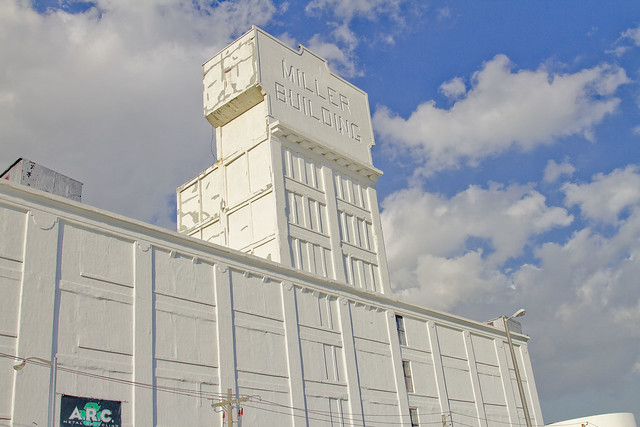
– photo by Mitch Waxman
Connections with the Universalist sect track- in 1913, as the 425 Greenpoint Avenue address was given in a Universalist journal for a “Recording Secretary” named Ida Ritter East at the address. My bet would be that old man Miller was listing his office address, and that Ida was his actual secretary- but that’s idle supposition.
Connick’s postulations are also confirmed by this link which offers the address of Eclipse Box and Lumber at the selfsame 425 Greenpoint.
Eclipse seemed to have been sharing the space with other companies as early as 1917, if one believes the testimony of one Charles M. Bopp. Manhattan Briar Pipe Co. was on site as late as 1919, according to this scanned newspaper.

– photo by Mitch Waxman
A fairly reliable source, in 1912’s THE EASTERN DISTRICT of BROOKLYN, Eugene Armbruster listed:
“Eclipse Oil Works, Newtown Creek. The Eclipse Box & Lumber Company, Greenpoint Avenue. American Varnish Company, Greenpoint Avenue” as having occupied this part of the Newtown Creek waterfront.
Additionally, the Universalist creed of Charles A. Miller seems to be confirmed in this outtake from a Brooklyn Citizens Almanac of 1894:
Third Universalist of Reconciliation— North Henry st., near Nassau av.; org. 1857; Pastors. Alice Kinney Wright and Alfred Ellsworth Wright, 206 North Henry St.; Chas. A. Miller, Sec, 128 Kent St.; membership, 33; sittings. 300; S.S. Supt, C. H. Palmateer, 159 Dupoht St ; S.S. membership, 146; value of property, 88,000; Trustees: C. H. Palmateer, C. A. Miller, A. P. Howard, J. W. Moore, Chas. E. Lund and Jas. English.

– photo by Mitch Waxman
Connick, it seems, is a force to be reckoned with. Thank you, T.J.
Personally speaking, I’m still not satisfied, and feel as if the Miller Building has defeated me. How, exactly, does an obviously significant structure such as this escape the historical record so successfully? Newtown Creek is in many ways a black hole as far as the aforementioned record goes, but this is frankly ridiculous… Grrr.
My hope would be that one of you, the knowledgeable lords and ladies of Newtown, will read this post and have some mercy upon a humble narrator- sharing some anecdote or family history that will put a face of some kind on this place. I can always be reached at this address.

– photo by Mitch Waxman
Thanks, again, to T.J. Connick. At least have an idea who “Miller” was, and some of the texture of what happened in and around this mysterious structure which rises high above the Newtown Creek.
As far as the latter day history of the building, I think the picture says it all.
dark and stern

– photo by Mitch Waxman
Just the other day, one observed this crow walking down the center median of the Greenpoint Avenue Bridge. For the purposes of nomenclature, we’ll refer to him as the Grey Crow. Even by the standards of their kind, this particular Crow seemed seedy and more than a little “off”. For those of you new to the ongoing story of the Crows- if a piece of metal, or a mattress, or anything shiny- finds its way to the sidewalk anywhere in western Queens or North Brooklyn, itinerant metal collectors like this gentleman sweep in and grab it. Soiled and blackened by their occupation, these foot soldiers of recycling then make their way to one of the several scrap metal dealers in the neighborhood, where they sell the materials at market rates and by the pound. Often, these fellows won’t wait for metals to reach the curbside midden, and they will harvest whatever metals they might happen across- as recently documented by Ms. Heather at NY-shitty.com.

– photo by Mitch Waxman
While one applauds the industry of the Crows, for they are a hard working bunch who operate in an invisible and unspoken economy at the absolute bottom of the economic spectrum, they are often the proverbial “rats in the walls” of our community. One need only walk through one of the 22,000 square acres of cemetery which distinguish western Queens to see the effects of their actions. Monument and mausoleum are part of their harvest, and the valuable white bronze and copper adornments which have been pried loose from century old graves are testament to their actions. Of late, manhole and gas main covers have been part of their harvest. The Grey Crow didn’t seem to be carrying any of this illicit cargo, but these sullen and solitary men (they are almost always men) are opportunist scavengers nibbling in at the edges of civilization.

– photo by Mitch Waxman
Dark in aspect and mood, existing at the edge of law and society, the Crows are growing in population- no doubt due to the worsening economic conditions which have been felt by all. This Grey Crow drew my attention due to the reckless manner in which he crossed the busy Greenpoint Avenue Bridge, walking down the center median of the traffic choked span which crosses the malign Newtown Creek between Blissville in Queens and Greenpoint in Brooklyn. Like many of his kind, when he observed a shabby man in a black trench coat pointing a camera at him, sneering commentary and verbal threats were offered to that photographic mendicant, who remains as always- your humble narrator.
nighted secrets

– photo by Mitch Waxman
This has been one crazily busy few days for your humble narrator, and frankly- I’m a nervous wreck.
Tonight, the Metropolitan Waterfront Alliance will be hosting the “Heroes of the Harbor” soiree at Pier 61 on the Hudson River at 6 p.m.- that’s Chelsea Piers for those unfamiliar with the demarcation of Manhattan’s surviving docks.
The MWA will be presenting the “Parade of Boats” at sunset, which will include (amongst others) the FDNY’s bon vivant “Three Forty Three” Fireboat. I’ll be there attempting to photograph the show.
Additionally, I remind you of the announcement made late Friday afternoon about the Working Harbor Committee and Newtown Creek Alliance produced boat tours of Newtown Creek on October 23rd which I will also be participating in. Tickets sales are flying, so order yours today.
“Join me on two Newtown Creek boat tours, both on October 23rd, 2011. I’ll be your tour guide, narrating humbly.
These tours are the co production of the Working Harbor Committee and the Newtown Creek Alliance made possible by funding from the NYCEF Newtown Creek Fund of the Hudson River Foundation. Accordingly, the tours will be heavily discounted, and tickets will cost only $10.
Made possible by funding from the NYCEF Newtown Creek Fund of the Hudson River Foundation”

– photo by Mitch Waxman
Inadvertently, your humble narrator caused some confusion with that aforementioned post from Friday afternoon when a draft version was published which listed the wrong date and time for the two tours, and apologies are offered. Thanks are offered to the many sharp eyed readers of this, your Newtown Pentacle, who immediately let me know that an error had been published.
I long for the days of winter at this point, when solitary communion with my beloved Creeklands can be embraced again.
Oh, to fly with the night gaunts over the concrete desolations and haunt the rolling hillocks of Newtown once more …
So speaks the contemplative mood experienced by your humble narrator today…

– photo by Mitch Waxman
For those of you new to my little world- here’s how this whole thing got started:
Several years ago, after a serious illness brought on by a slothful and overly indulgent lifestyle, my staff of doctors had prescribed exercise and wholesome activity as a curative. They told me to run, but having grown up in Brooklyn- I only run when someone of something is chasing me- so I began to walk. A shabby and defeated man in a filthy black raincoat, camera in hand, reduced to walking the earth in the manner of a mendicant. Vastly inferior to others, and perhaps the worst of men, I am an unpleasant fellow given to tidal fluctuations of mood and temperament which cause me to display an uncompromising face to all. Accordingly, the world had crumpled me up and thrown me away like so much refuse. I put away childish things, and disappeared into the wastelands of western Queens.
Like every other discarded piece of wind strewn trash casually thrown away in the city of New York, I eventually turned up at the Newtown Creek. The emerald devastations of Calvary, the mysteries of a forgotten world of industrial supremacy, the wonders of a deeply hidden world had been awaiting me. The hellish green flame of revelation soon presented itself here, at the Creek, and before I knew it- my various researches, photographs, and activities were noticed by both the historical community and political establishment of Queens.
Before long, I found myself standing alongside respected scholars and scientific pillars, advocating for the Creek in public, and telling its story to boat loads of eager enthusiasts. This is something which I am still getting used to.
A few aphorisms and truisms have emerged in the preceding years- “make no assumptions”, “it’s not good, it’s not bad, it just is”, “next time I go down English Kills in a rowboat, I’m wearing a respirator”, and “if it can happen, it happened here, and if it happened here it was ten times worse than anywhere else”. When the Open House NY walks on the 15th and 16th are done, and the boat tours are finished in October, my plan is to resume solitary wanderings and delve into deeper waters at the Creek which the general public need not visit. As always, I’ll be sharing my pedantic adventures with you, my lords and ladies of the Pentacle.
quite convinced
– photo by Mitch Waxman
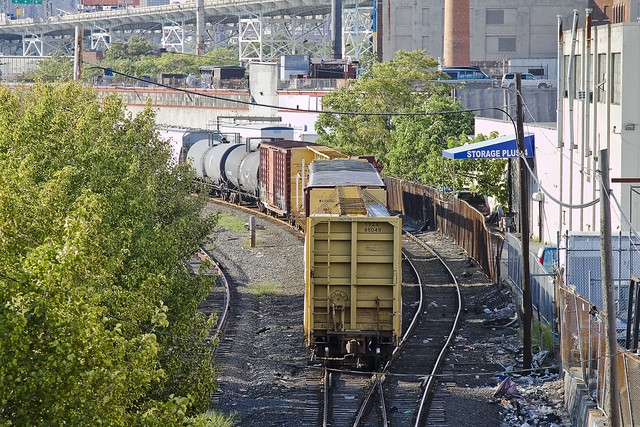
Recent financial setbacks and personal problems infect your humble narrator with a form of deep melancholy and a vast ennui. When such moments come upon me, there is a certain pizzeria in Greenpoint (Norman corner of Manhattan, near the train) whose offerings can be summed up best as: an actual and old fashioned “Brooklyn Slice”. On the day I spied this collection of rail cars at the so called “Bliss Tower” in DUGABO, I had scuttled forth from the rolling hillocks of my beloved Astoria in pursuit of one of these aforementioned slices, in an effort designed to brighten my mood.

– photo by Mitch Waxman
Errors and omissions mar my record when discussing the Rails, much to the chagrin of the knowledgable railfan community (whose helpful comments and corrections are always appreciated here at Newtown Pentacle). As such, what I can categorically tell you is that this a New York & Atlantic Locomotive, one of the 11 engine units which service the 269 miles of track operated upon by the Glendale based company in Brooklyn, Queens, and both Nassau and Suffolk counties. It shares much of its road with the passenger based Long Island Railroad, and NY&A’s distinctive emerald, white, and black engines are regularly observed around the Newtown Creek.

– photo by Mitch Waxman
Across the Newtown Creek Watershed, one encounters a landscape built for rail. Long abandoned track beds lie buried in inches of road asphalt, pointing the way to industrial giants long absent. Train stops orphaned from their purpose, spars and switches which were rudely severed to make room for modernity. All of it operated at street grade, and the remnants of the iron road are often the only tangible remains of great concerns and financial largesse. If you follow the right spar, you’ll discover that the NYPD Barricades unit was once Thypin Steel, or that LaGuardia Community College was once the Loose Wiles bakery and part of the Degnon Terminal.

– photo by Mitch Waxman
Within the communities which surround the Newtown Creek, a complaint often repeated concerns the presence of large numbers of trucks utilizing local streets in their quest to move goods from A to B. I had the privilege last year of attending a presentation by certain factions within the Port Authority that described a proposal which would eliminate several thousand truck trips a day throughout the City and over the George Washington Bridge, simply by shipping New York City’s garbage out to land fill utilizing locomotive rather than automotive means. Calculations about air pollution, road maintenance costs, and vehicular accident rates were presented at the time which compared rail quite favorably with truck based shipping.There was a maritime component to the plan as well, which was a bit hazy, but the train concept was spun gold.

– photo by Mitch Waxman
The shot above represents an NY&A Locomotive making a drop off of a customer in Maspeth near the ill fated St. Saviour’s church site, where they will uncouple a car or two for the unloading or loading of certain cargo. An unthinkable amount of trucks would be required to carry the same tonnage. The subject of Green Technology and “Greening New York” is often bandied about by many these days. Too much of the conversation, however, is “cocktail party environmentalism”- which sounds great but just isn’t practical on a policy level.
I’ve developed this funny notion, however, that the way forward is actually to re-imagine and re-invent the heaviest industry of them all.

– photo by Mitch Waxman
Rail infrastructure is what made Long Island City the factory of not just New York, but the entire world at the turn of the last century and multiple generations of capitalists and real estate interests founded vast fortunes because of the initial investment in it. Newtown Creek was the busiest waterway in North America, carrying more ship and barge traffic than the entire Mississippi for a time, and all of that maritime activity was fed by rail. Intermodal rail floats actually carried whole trains across the harbor to Manhattan, Staten Island, New Jersey and beyond. Imagine the benefits, in both individual wealth and environmental health, were we to try and save the future by looking for solutions in the past.
I’m still kind of forming this idea up for myself, but the key to it is containerization. More on this soon.
What do you, lords and ladies, think on the subject? Use the comments “Reply box” below, if you would like to start a conversation about it.


 The Newtown Pentacle