Archive for the ‘DUGABO’ Category
fulgent images

– photo by Mitch Waxman
This is not the world you know, this 3.8 mile long cataract of water which forms the currently undefended border of Brooklyn and Queens, whose mouth is found directly opposite the Bellevue Psychiatric Hospital in Manhattan. The very air you breathe is a poisonous fume, and beneath the languid ripples of its mirrored surface hide a morass of centuries old poisons which have been allowed to agglutinate and congeal in fuligin depths. This is where the industrial revolution actually happened, around the canalized bulkheads of the infamous Newtown Creek.

– photo by Mitch Waxman
Great fortunes have arisen here- the Pratts, and Rockefellers, even Peter Cooper- all grew fat at this banquet table. Five great cities arose around the Creek- Williamsburg, Long Island City, Greenpoint, Bushwick, and New York- and by 1900 a thriving maritime industry saw more cargo cross this tiny waterway than could be found on the entire Mississippi river. The vast populations of those five cities found employment here, in titan rail yards and factory mills whose smokestacks blotted out the light cascading down from the burning thermonuclear eye of god itself. This is where the bill came due in the early 20th century, as you cannot have a “Manhattan” without causing a “Newtown Creek”.

– photo by Mitch Waxman
Thought irredeemable, this place became a dumping ground, with raw sewage and every imaginable kind of filth allowed to pool and mingle with the water. By the end of the 20th century, it was a literal backwater and forgotten by all but those cursed to live nearby. Petroleum swirls about beneath the ground, mingling with the esoteric byproducts of early chemical factories and one and a half centuries of breakneck industrial growth. The top soil is impregnated by heavy metals, asbestos, and tons of soot deposited daily by automotive exhaust. Along the rotting bulkheads, sediment mounds of sewage rise from the water, and from forgotten pipelines unknown chemical combinations drip and drool. Who can guess, all there is, that might be buried down there?

– photo by Mitch Waxman
Hope rises, however, at the start of the Superfund era. Federal authorities have begun the laborious process of analyzing and categorizing those sediments which lie fifteen to twenty feet thick on the bottom of the waterway, colloquially referred to as “Black Mayonnaise”. The Superfund legislation which governs their actions has compelled them to remove and remediate these sediments, and deliver Newtown Creek to the future in a healthier condition. Community groups, industrial stakeholders, and officials from both the State and City have begun the task of planning the Newtown Creek of future times. This is the literal backbone and center of New York City.
curiously dissociated

– photo by Mitch Waxman
One presumes that it is merely part of the human condition to remember the bad rather than the good. War and the concurrent homefront is reminisced upon fondly, whereas peaceful spans are oft forgotten. Economic downturn, sickness and loss, even the Black Death are considered romantic. Pity abounds for the reputation of a place like Blissville, once a thriving bucolic community, which is remembered today as one of the darkest sections of the fabled Newtown Creek.
from wikipedia
Blissville is a neighborhood within Long Island City, in the New York City borough of Queens. It is bordered by Calvary Cemetery to the east; the Long Island Expressway to the north; Newtown Creek to the south; and Dutch Kills, a tributary of Newtown Creek, to the west. Blissville was named after Neziah Bliss, who owned most of the land in the 1830s and 1840s.


– photo by Mitch Waxman
Named for Neziah Bliss who -with Eliaphet Nott- founded the community in the early 19th century, Blissville was once what we would call “affordable housing” for the laborers of Newtown Creek. Sure, there were Europeans here since the 1600’s- in Maspeth and Hunters Point and in Brooklyn- but it wasn’t until the period right around the Civil War that things really kicked into gear around here.
from 1921’s Brooklyn Daily Eagle Almanac, Volume 36 – courtesy google books
NEWTOWN CREEK. Although less than four miles from its source, among the oil refineries of Blissville and Greenpoint, L. I., to ita mouth at the East River, Newtown Creek ia known as one of the “world’s busiest waterways.” The Mississippi River, from New Orleans to St. Paul, ia 1,” miles In length and flows through a great industrial and agricultural district. Recent figures show that 5,220,000 tons of cargo are carried annually on the upper and lower reaches of the longest river In the world, while the annual average of tonnage carried on the little four-mile Newtown Creek was 5,620,000.
Note: the bolded character in the quotation above resolves to something like 1,000 miles. the Mississippi has been significantly altered over the years.

– photo by Mitch Waxman
A chance encounter with a local historian of some note resulted in a critique of recent statements made by your humble narrator on this subject, (asserting that industry arrived here in force during the 1870’s) and he reminded me that there were industrial concerns operating in the area far earlier than even the arrival of Neziah Bliss. Tidal Grist mills, Lumber Yards, and the like were in these parts before the American Revolution, I will concede, and it is true that General Chemical, and M. Kalbfleish &Sons, and Peter Coopers Glue Factory were all well established along the Creek by 1840- all of which were early examples of the so called “Second Industrial Revolution” kicking into gear- it all depends on what you mean by “industry”.
from 1876’s Our dumb animals, Volumes 9-14 – courtesy google books
…an account of a visit of Mr. Bergh to certain stables attached to the distillery of Gaff, Fleischman & Co., at a place singularly named Blissville, on Long Island. Within the enclosure he found three immense stables, containing about nine hundred cows There was not a single door or window open, and the tainted atmosphere arrested the progress of all present Many cows were lying down, but the insufficient space necessitated their partly resting on one another. Dr. Raymond, Sanitary Superintendent of Brooklyn, says: “These animals never leave the stables, until, giving no more milk, and being- ‘ fattened,’ they are driven to the slaughter-house, contributing during life to the propagation of disease through their milk, robbing the inlant of its sole chance of life; and, alter death, furnishing diseased meat to nil consumers.”

– photo by Mitch Waxman
Master, apprentice, journeyman, mechanic- all of these terms had far different meaning in the past than they do today. So did the term “industrial”. Before the rail came through, and by rail I mean the Long Island Railroad- operations around the Creek were necessarily small. An employer of a hundred working men in 1800 would have been a tycoon, and the “factory” would have been no larger than a modern day primary school, and even then only the largest and most successful companies would have been so comfortably ensconced. After the rail came, something like Phelps Dodge or the Standard Oil works became possible- vast complexes of multi story structures, connected by rail tracks with bulkheaded docks, and chimneys belching smoke six to seven stories above the ground.
from 1879’s The Analyst, Volume 4 – courtesy google books
Sir,—In the month of February I made an official inspection of some cow stables, at a place called Blissville, on Long Island, which were connected with a distillery. Thinking that my investigations at that time might prove of some interest to yourself and other Public Analysts, I tako the liberty of writing you upon the subject.
At the time of my visit to the above stables there were between 700 and 800 cows in them, crowded into narrow stalls, to which they were fastened by a rope not more than three feet in length, which barely permitted them to lie down, but kept their mouths continually at a trough into which flowed the “swill” from the adjacent distillery in a steaming and fermenting condition.
Most of the animals were emaciated and feverish, and were affected with cough, diarrhoea, and polyuria. Some appeared to have recently arrived, and were in good condition. The temperature of several of the animals was noted, and ranged from 102° to 109°. The stable floors were kept all the time wet and slippery with excrementitious matters, and I did not see how it was possible for the cows to be milked and prevent the surrounding filth from splashing into the milk.
These poor creatures, crowded together within low sheds, with insufficient food, imperfect or no moans of ventilation, no exercise, no pure water to drink, and breathing an atmosphere poisoned by the exhalations from their wretched bodies, their excretions, and the steaming and fermented food, are expected, under these conditions, to secrete milk fit for human consumption.

– photo by Mitch Waxman
The vast populations of the five great cities around the Creek- Williamsburg, Greenpoint, Maspeth, Hunters Point, and New York- were made possible by the vast industrial mills which arrived in the middle and latter half of the 19th century. Those self same mills are what ended up staining the reputation of Blissville in the historic record. Any attempt to describe its homes, schools, and churches is overshadowed by the tales of pneumatic cattle, wormy pigs, bad air, and mountains of rotting offal. Pity poor Blissville, a place whose name brings a wry and ironic smile to the face of modern visitors. It was once a beautiful place to live.
from 1884’s Annual report of the State Board of Health of New York – courtesy google books
The stench nuisance next in the series along the main trunk of the Long Island railroad consists of and is located at and near the old distillery and yeast factory recently known as Gaff & Fleischmann’s, and now controlled by an ownership and superintendent mentioned in the inspector’s list. It has long been an insufferable nuisance because of the “swill-like odor of the mash,” and still more, because of the fact that the cattle stables on the right alongside the railroad track are reeking with semi-liquid filth (see page 12 of report marked C).
The next in the series is Preston’s bone-boiling, bone-burning and fertilizer establishment where the “web scrap,” horse-flesh, entrails and other putrescent matters from numerous fat rendering factories are stored in great quantities, and where bones and refuse flesh and waste “clippings” from the markets and elsewhere are boiled in kettles that are not kept suitably covered, which necessarily pollute the atmosphere to a considerable extent beyond the premises, which are located close along the south side of the Long Island railroad track. The business of calcining the bones obtained in the business just mentioned, and from other sources, is carried on at Preston’s factory, and is a source of very offensive stenches which extend along the line of the railroad for half a mile or more. This factory being a branch of the fertilizer factory owned by the same persons and situated near Keyport, N. J., much of the storage as well as mixing of materials for the latter establishment is carried on at this place in Blissville, and at times is the source of exceptional offensiveness.
Next is the place of John Kehoe, situated near Preston’s and the distillery above described. He boils fat in open kettles.
Reid’s fertilizer factory is next in order as we proceed eastward upon the north bank of Newtown creek. Superphosphate fertilizer is made by the use of sulphuric acid upon scrap and the phosphate rock of South Carolina.
Though the offensive odor does not extend a great distance, and probably is offensive to only railway passengers and along the line of the railway, the business is too offensive to be long permitted to remain close by the side of a great highway like that of the Long Island railroad.
Next in the series is the bone boiling establishment of Fred. Hoffner, who works with open kettles, giving off excessively offensive stenches.
Simon Steinfel’s rendering establishment, which is on Furman’s island in Newtown creek (and within the limits of Newtown), gives off very offensive emanations for a long distance in the course of the railway route. Great quantities of decomposing animal matters were found upon the premises in barrels and otherwise packed in readiness for rendering.
constantly consulting

– photo by Mitch Waxman
Gilman, Gilman, Gilman.
Idiotic, your humble narrator cannot break loose of the compulsion which drives me toward destruction, which will be the result of locating a certain grave amongst Calvary Cemetery’s emerald devastations. Weak of will and enslaved by fevered thoughts, once more do my feet fall upon a carpet of grass fed by a morbid nutrition, stumbling across and into the city of the dead. On the subject at hand, which is the attempt to locate a tiny needle in a gigantic hay stack- a needle not even certain to still exist in this age- let’s recap:
As mentioned in the post “Searching for Gilman“:
“Somewhere in the viridian depths of Calvary Cemetery lies an unremarked merchant from Massachusetts, who died in an accident along the delirious Newtown Creek in 1931. No obituary I can find discusses him, and Gilman slid unnoticed into the hallowed loam of Calvary’s charitable sections. His anonymity came to an end when, according to neighborhood sources and contemporary diarists, a relict 3 masted schooner arrived at the Penny Bridge docks and ordered an eccentric monument be erected on Gilman’s resting place. The captain of that black ship, a leathery bastard named Marsh, collected Gilman’s belongings and sailed via Newtown Creek to the East River, turning North toward Hell Gate- ultimately disappearing into the mists of Long Island Sound heading for New England.”
from epa.gov
The first survey of Newtown Creek was completed by Dutch explorers in 1613-1614, and the Dutch acquired the area from the local Mespatches tribe shortly thereafter. Initially, the Newtown Creek area was used primarily for agriculture, but following the Revolutionary War, it became industrialized with glue and tin factories, rope works, tanneries, and the Sampson Oil Cloth Factory operating along Newtown Creek and its tributaries. There was a shift to shipbuilding in the Pre-Civil War Period. Following the Civil War, textile manufacturing and oil refining replaced shipbuilding along Newtown Creek and its tributaries.

– photo by Mitch Waxman
It has been established, circumstantially, that the accident which claimed Gilman was definitively in Blissville, and happened westward of Penny Bridge but east of the Greenpoint Avenue crossing. Additionally, disturbing intonations that the packs of feral dogs which were contemporaneously described as endemic to the area avoided the cadaver, but that the local rodent population did not find itself constrained from feasting.
from the posting “A World Yet Inchoate“:
“Enigma, my search for the elusive final resting place of the Massachusetts based dealer in far eastern art has taken me to distant and forgotten sections of the City of Greater New York. I have consulted with asiatic mystics in Manhattan’s Chinatown, visited a heretical Kabbalist in Brooklyn, and have drawn the ire of certain extant allies of the dead man whose influence and reach extend into the federal government and modernity itself who wish me to remain silent on the subject.”
from 1892’s History of the Catholic Church in the United States, By John Gilmary Shea – courtesy google books
The burial place for the Catholic dead of the great city now required, apparently, a vast extent of ground. The little plot around St. Peter’s Church had been the first, but a nook in Trinity Church yard held, and still holds, some Catholic dead. Then the ground around St. Patrick’s Cathedral was used, and in time a cemetery was purchased on Eleventh Street. These had all proved insufficient. Bishop Hughes looked beyond the limits of the city for a spot not likely to be reached for many years by the rapid growth of population, yet comparatively easy of access. Thirty acres of the Alsop farm, on Newtown Creek, Long Island, were purchased, and the ground was solemnly blessed by Rt. Rev. Bishop Hughes, as Calvary Cemetery, July 27, 1848, and in a few days the first interment took place. The cemetery has been enlarged by subsequent purchases, till it now contains more than a hundred acres.

– photo by Mitch Waxman
Problematic in locating even a general area to search within, for the obsequious and gauche monument which the eponymous Capt. Marsh installed within the cemetery in remembrance of the fallen Gilman would have been in one of the so called “poor sections” of the polyandrion. Imagine, the sheer volume of dead bodies shipped out from Manhattan in that era, reported at the time as nearly one hundred on an average day (and far higher in times of fever, plague, and riot). These poor, or charity, sections saw hundreds of interments per week. Could it be possible that the monument to Gilman actually adorned his own grave, or that it might somehow still exist within the walls of Calvary?
from the posting “marble glories”
“Of course, this is a Roman Catholic cemetery, which suggests that the multitudes who lie here were sealed off- magickly- by the sacrament of “Extreme Unction” from suffering such macabre experiences as walking about the earth seeking living victims in some post mortem half life. The heritage of the Catholics extends back through time to the Dagon devotees of Syria and the tomb worshipping Etruscans, and the Romans spent enough time in Egypt and North Africa to have picked up and incorporated many of the Magicks they found into the syncretic system of beliefs and rites known as and inherited by modernity as Catholicism. The mysteries of the church are many, and varied, and more has been forgotten or lost over the centuries than any single lifetime can recover.”
from 1890’s HOW THE OTHER HALF LIVES, By JACOB A. RIIS –courtesy google books
Life in the tenements in July and August spells death to an army of little ones whom the doctor’s skill is powerless to save. When the white badge of mourning flutters from every second door, sleepless mothers walk the streets in the gray of the early dawn, trying to stir a cooling breeze to fan the brow of the sick baby. There is no sadder sight than this patient devotion striving against fearfully hopeless odds. Fifty “summer doctors,” especially trained to this work, are then sent into the tenements by the Board of Health, with free advice and medicine for the poor. Devoted women follow in their track with care and nursing for the sick. Fresh-air excursions run daily out of New York on land and water; but despite all efforts the grave-diggers in Calvary work over-time, and little coffins are stacked mountain – high on the deck of the Charity Commissioners’ boat when it makes its semi-weekly trips to the city cemetery.
time convulsed

– photo by Mitch Waxman
As mentioned in yesterday’s posting, I spend an atrocious amount of time studying century old publications and journals found on google books. These periodicals, both trade and municipal in nature, often discuss the origins of the Newtown Creek as it exists today. At the beginning of the 20th century, when the Creek was at its arguable worst (environmentally speaking), there was a popular sentiment that engineering could fix all of its problems.
Hindsight suggests that they just made things worse, of course, but there’s the human condition for you. Pictured above is the Greenpoint Avenue Bridge in modernity, while below is the 1910 version.
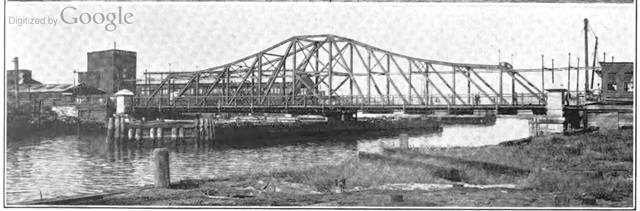
– photo from Engineering magazine, Volume 38, 1910- courtesy google books
This is the bridge that burned away in the 1919 Locust Hill Oil Refinery disaster, a swing bridge not unlike the relict Grand Street Bridge found further up the Creek. Whenever such “Now and then” shots come into my hands, especially images considered to be in the public domain- they will be eagerly shared at this- your Newtown Pentacle.
For more on the history of the Greenpoint Avenue Bridge and its environs, which I call DUGABO- Down Under the Greenpoint Avenue Bridge Onramp- click here
Also:

– photo by Mitch Waxman
An NCA event, which I for one am pretty stoked about:
April NCA meeting hosts Dr. Eric Sanderson
Thursday, April 26, 2012 at 6pm
Ridgewood Democratic Club, 6070 Putnam Avenue, Ridgewood, NY 11385
In addition to important updates from our members – in particular the Bioremedition Workgroup has been very busy! – we will be hosting a special presentation on the “Historical Ecology of Newtown Creek”.
Dr. Eric Sanderson, senior conservation ecologist at the Wildlife Conservation Society and author of “Mannahatta: A Natural History of New York City” (Abrams, 2009), will describe recent studies of the historical ecology of Newtown Creek, describing the original wetlands, creek channels, topography and vegetation of the area. He will show a series of 18th and 19th century maps of the watershed of the creek and discuss the process of synthesizing them into an integrated ecological picture that can be used to inform and inspire natural restoration and cultural appreciation of the Newtown Creek watershed. This work is part of the Welikia Project (welikia.org), an investigation into the historical ecology of the five boroughs of New York City and surrounding waters.
And this Saturday,

Obscura Day 2012, Thirteen Steps around Dutch Kills
Saturday April 28th, 10 a.m.
Your humble narrator will be narrating humbly at this year’s Obscura Day event on April 28th, leading a walking tour of Dutch Kills. There are a few tickets left, so grab them while you can.
“Found less than one mile from the East River, Dutch Kills is home to four movable (and one fixed span) bridges, including one of only two retractible bridges remaining in New York City. Dutch Kills is considered to be the central artery of industrial Long Island City and is ringed with enormous factory buildings, titan rail yards — it’s where the industrial revolution actually happened. Bring your camera, as the tour will be revealing an incredible landscape along this section of the troubled Newtown Creek Watershed.”
For tickets and full details, click here :
obscuraday.com/events/thirteen-steps-dutch-kills-newtown-creek-exploration
brief and desolate

Vintage Tugboat at Newtown Creek – photo by Mitch Waxman
Note: This is a “reblog”, and was originally presented in August of 2010.
A rare opportunity to ride up the Newtown Creek was recently enjoyed by your humble narrator, and on my journey up that maligned cataract I spotted an artifact of New York Harbor’s glorious past sneaking past Hunters Point.
from epa.gov
Blue-claw crabs, bluefish, weakfish, striped bass, and other species inhabit the creek, and fishing and crabbing for human consumption occurs [Ref. 7, pp. 2, 5; 8, p. 11; 21, p. 13; 22, pp. 1-2; 24, p. 143; 52, p. 93; 68, p. 3; 69, p. 1]. Subsistence fishing has been observed in Newtown Creek at Dutch Kills, and crabbing for consumption has been observed at the end of Manhattan Avenue in Brooklyn [Ref. 7, p. 5; 21, p. 13; 22, pp. 1-2; 68, p. 3; 69, p. 1]. These locations are both within the zone of contamination for the Newtown Creek site [Figure 2 of this HRS documentation record]. Therefore, Actual Contamination is documented, and the target fishery is evaluated for Actual Human Food Chain Contamination.

the W O Decker at Newtown Creek – photo by Mitch Waxman
Wooden hulled, its spitting steam boilers have long been replaced by modern diesel engines, this little (52 feet long) tugboat is the W O Decker.
also from epa.gov
Beginning in the late 1800s and continuing into the 1930s, Newtown Creek was widened, deepened, and lined with bulkheads to accommodate the growing traffic, leading to the destruction of all its freshwater sources [Ref. 8, p. 10; 12, p. 52]. During World War II, the government commandeered factories along the creek to make military equipment, such as a factory that made aluminum for fighter planes [Ref. 11, p. 14]. At that time, Newtown Creek was the busiest industrial port in the Northeast, with tanker traffic lining its length [Ref. 7, p. 1; 11, p. 13]. The national highway system built after the war took business away from the nation’s waterways, leading to a rapid decline in the level of industry along Newtown Creek [Ref. 7, pp. 1-2].

the W O Decker passing by the “Greenpoint Manufacturing and Design Center” – photo by Mitch Waxman
A “historic place” the Decker was originally called the Russell 1 when it was built in 1930 for the Newtown Creek Towing Company, who were specialists in berthing and towing heavy cargo along the crowded and narrow waterway.
from gmdconline.org
The Greenpoint Manufacturing and Design Center (GMDC) started in the late 1980s as an innovative intersection of two interests: reclaiming derelict factories in North Brooklyn’s Greenpoint neighborhood and sustaining industry and manufacturing in New York City. The organization formally incorporated in 1992.
From its initial purchase and redevelopment of a large facility at 1155 Manhattan Avenue for use by light manufacturers and artisans, GMDC has since expanded and today is the only nonprofit industrial developer in New York City. The organization acquires, develops, and manages industrial real estate that provides small and medium-sized manufacturing enterprises with affordable, flexible production space.

In the shot above, The Decker is passing the Newtown Creek Waste Water Treatment Facility in Greenpoint, Brooklyn – photo by Mitch Waxman
The Decker is currently a high end tour vessel, operated by and out of the South Street Seaport in Manhattan.
from seany.org
The wooden tugboat W.O. Decker was built in Long Island City, Queens in 1930 for the Newtown Creek Towing Company, a firm specializing in berthing ships and barges in the creek that separates Brooklyn and Queens. Originally called the Russell I for the towing company’s owners, she was renamed the W.O. Decker in 1946 after being sold to the Decker family’s Staten Island tugboat firm.

The shield wall of the Shining City, framed by Long Island City on the right and industrial Brooklyn on the left with the Pulaski Bridge just at Horizon – photo by Mitch Waxman
The vessel I was aboard continued on toward the Greenpoint Avenue Bridge, but the Decker turned in the narrow part of the Newtown Creek near the confluence of its tributaries Whale Creek and Dutch Kills.
Check out this 1896 article at the NYTimes, which actually interviews the manager of Newtown Creek Towing Company, John Russell, for whom the Decker was originally named.


 The Newtown Pentacle