Archive for the ‘DUPBO’ Category
brief and desolate

Vintage Tugboat at Newtown Creek – photo by Mitch Waxman
Note: This is a “reblog”, and was originally presented in August of 2010.
A rare opportunity to ride up the Newtown Creek was recently enjoyed by your humble narrator, and on my journey up that maligned cataract I spotted an artifact of New York Harbor’s glorious past sneaking past Hunters Point.
from epa.gov
Blue-claw crabs, bluefish, weakfish, striped bass, and other species inhabit the creek, and fishing and crabbing for human consumption occurs [Ref. 7, pp. 2, 5; 8, p. 11; 21, p. 13; 22, pp. 1-2; 24, p. 143; 52, p. 93; 68, p. 3; 69, p. 1]. Subsistence fishing has been observed in Newtown Creek at Dutch Kills, and crabbing for consumption has been observed at the end of Manhattan Avenue in Brooklyn [Ref. 7, p. 5; 21, p. 13; 22, pp. 1-2; 68, p. 3; 69, p. 1]. These locations are both within the zone of contamination for the Newtown Creek site [Figure 2 of this HRS documentation record]. Therefore, Actual Contamination is documented, and the target fishery is evaluated for Actual Human Food Chain Contamination.

the W O Decker at Newtown Creek – photo by Mitch Waxman
Wooden hulled, its spitting steam boilers have long been replaced by modern diesel engines, this little (52 feet long) tugboat is the W O Decker.
also from epa.gov
Beginning in the late 1800s and continuing into the 1930s, Newtown Creek was widened, deepened, and lined with bulkheads to accommodate the growing traffic, leading to the destruction of all its freshwater sources [Ref. 8, p. 10; 12, p. 52]. During World War II, the government commandeered factories along the creek to make military equipment, such as a factory that made aluminum for fighter planes [Ref. 11, p. 14]. At that time, Newtown Creek was the busiest industrial port in the Northeast, with tanker traffic lining its length [Ref. 7, p. 1; 11, p. 13]. The national highway system built after the war took business away from the nation’s waterways, leading to a rapid decline in the level of industry along Newtown Creek [Ref. 7, pp. 1-2].

the W O Decker passing by the “Greenpoint Manufacturing and Design Center” – photo by Mitch Waxman
A “historic place” the Decker was originally called the Russell 1 when it was built in 1930 for the Newtown Creek Towing Company, who were specialists in berthing and towing heavy cargo along the crowded and narrow waterway.
from gmdconline.org
The Greenpoint Manufacturing and Design Center (GMDC) started in the late 1980s as an innovative intersection of two interests: reclaiming derelict factories in North Brooklyn’s Greenpoint neighborhood and sustaining industry and manufacturing in New York City. The organization formally incorporated in 1992.
From its initial purchase and redevelopment of a large facility at 1155 Manhattan Avenue for use by light manufacturers and artisans, GMDC has since expanded and today is the only nonprofit industrial developer in New York City. The organization acquires, develops, and manages industrial real estate that provides small and medium-sized manufacturing enterprises with affordable, flexible production space.

In the shot above, The Decker is passing the Newtown Creek Waste Water Treatment Facility in Greenpoint, Brooklyn – photo by Mitch Waxman
The Decker is currently a high end tour vessel, operated by and out of the South Street Seaport in Manhattan.
from seany.org
The wooden tugboat W.O. Decker was built in Long Island City, Queens in 1930 for the Newtown Creek Towing Company, a firm specializing in berthing ships and barges in the creek that separates Brooklyn and Queens. Originally called the Russell I for the towing company’s owners, she was renamed the W.O. Decker in 1946 after being sold to the Decker family’s Staten Island tugboat firm.

The shield wall of the Shining City, framed by Long Island City on the right and industrial Brooklyn on the left with the Pulaski Bridge just at Horizon – photo by Mitch Waxman
The vessel I was aboard continued on toward the Greenpoint Avenue Bridge, but the Decker turned in the narrow part of the Newtown Creek near the confluence of its tributaries Whale Creek and Dutch Kills.
Check out this 1896 article at the NYTimes, which actually interviews the manager of Newtown Creek Towing Company, John Russell, for whom the Decker was originally named.
singularly heavy

– photo by Mitch Waxman
So, nowadays one finds oneself hanging off bridges late in the evening attempting to capture “time exposures” after realizing that there aren’t all that many “night shots” in the library. Honestly, even I find this behavior suspicious, which is why there aren’t that many “night shots” in the aforementioned library. When the thermonuclear eye of god itself shines not upon the Newtown Creek is when a lot of the really “fun stuff” happens around these parts, only a small part of which involves a rodentine army which emerges and swirls out from hidden apertures in the concrete devastations.

– photo by Mitch Waxman
The first and second shots featured today are captured from the Pulaski Bridge, specifically the staircase which carries pedestrian traffic to Borden Avenue from the elevated path. The shot above looks toward Greenpoint with Manhattan behind it. The shutter was open something like eight seconds, which is why the water appears glassy and the artificial lighting of parking lot and lamp posts have taken on a star like halo. The halo is caused by the iris shutter mechanism within the camera, and is shaped by the blades of the device.

– photo by Mitch Waxman
The big problem I’m having with gathering this sort of material is actually the pedestrian nature of my movements. As automotive conveyance is a luxury which I currently do not enjoy, there are large sections of the Creeklands which I just don’t want to walk through at night. A vast physical coward and feckless quisling, the problems your humble narrator is experiencing are dual.
First- I am simply too meek and bookish to trust that the cruelty of the nocturne streets will leave me unmolested, and second- I fear that which may be revealed in the result. Who can guess what it is, that might march about the deserted industrial lowlands of the Newtown Creek when free from the tyranny of casual observation?
outward course

– photo by Mitch Waxman
The Kimberly Poling was observed recently, as it headed west along the infamous Newtown Creek, and has sailed directly into Maritime Sunday at this- your Newtown Pentacle. The tug is owned by Poling and Cutler, and we recently examined one of their other tugs on this self same stretch of the Creek- the Crystal Cutler.
The name of the game in the shipping industry is to never transport an empty container. As such- after disgorging the petroleum cargo carried by its fuel barge to Newtown Creek, the Kimberly Poling took on another load for transport.
from marcon.com
Marcon International, Inc. is pleased to announce the sale of the US Flag Twin Screw Tug “Jaguar” from Mobro Marine, Inc. to P&C Kimberly Poling, LLC. “Jaguar” was built by Main Iron Works in 1994. She measures 105′ LOA x 34′ beam x 15′ depth. The vessel is powered by two EMD 12-645E2 main engines, producing 3000 total BHP at 900 RPM. Reintjes gears drive two 93″ x 91″ fixed pitch propellers in kort nozzles producing an estimated 40 tons bollard pull. The vessel is fitted with fully air-conditioned accommodations for 7 crew in 4 cabins. “Jaguar” will work for her new owners in the US Northeast. Marcon acted as sole broker in the transaction.

– photo by Mitch Waxman
Within the double walled steel tanks of the fuel barge, which is the Edwin A Poling by the way, can be found several thousand gallons of Diet Coca Cola, no doubt pumped in from the Coca Cola bottling plant on 58th street in Maspeth.
Carbonated beverages can be quite volatile when subjected to the rolling waves of the open harbor and as such precautions must be observed. The Captain of the Kimberly Poling must personally ensure that there are no “Mentos” brand mints onboard, for instance.
Founded in 1995, Poling Cutler began operations near the time the former Poling Transportation went out of business.
The Founders of the new company were Ed Poling, whose grandfather started the former Poling company, and Gary Cutler who spent years working in the financial world before getting involved in Marine Transportation.

– photo by Mitch Waxman
The “Dr. Pepper drama”, which played out over three days off the coast of Nassau Island during the winter of 1997- known as the “Bahamian Belch”- is still quite fresh in the mind of the maritime community. Accordingly, Coast Guard penalties for the improper transportation of and off loading of all soft drinks are quite severe.
The barge is most likely bound for Staten Island, which has been experiencing extreme shortages of the stuff since the spring of 2010.
Newtown Creek was designated a Significant Maritime and Industrial Area (SMIA) in the NYC Department of City Planning ‘s 1992 Comprehensive Waterfront Plan for its characteristic clusters of industrial businesses and water-dependent uses. In the 2010 update of this plan, Vision 2020, Newtown Creek maintains its place as New York City’s largest SMIA in terms of both land area and employment. After losing half its jobs from 1992 to 2008, the number of jobs in Newtown Creek SMIA grew by nearly 1,400 (totaling 15,000 jobs) from 2000 to 2008.

– photo by Mitch Waxman
The carbonation of the cargo is causative rather than coincidental as to why the barge is riding so high in the water, as the frothy action of the pressurized bubbles in the beverage buoy it up. The Maritime Shipping Association sees this sector of the business expanding exponentially and demand for the diet drink doubling within the decade.
It is good to know, on this the 1st of April, that the thirst of Staten Islanders will be satiated.
from wikipedia
Diet Coke (also known as Diet Coca-Cola, Coca-Cola light or Coke Light) is a sugar-free soft drink produced and distributed by The Coca-Cola Company. It was first introduced in the United States on August 9, 1982, as the first new brand since 1886 to use the Coca-Cola trademark. The product quickly overtook the soft drink Tab in sales.
Diet Coke was sweetened with aspartame after the sweetener became available in the United States in 1983; to save money, this was originally in a blend with saccharin. After Diet Rite cola advertised its 100 percent use of aspartame, and the manufacturer of NutraSweet (then, G.D. Searle & Company) warned that the NutraSweet trademark would not be made available to a blend of sweeteners, Coca-Cola switched the formula to 100 percent NutraSweet. Diet Coke from fountain dispensers still contains some saccharin to extend shelf life.
aerial ocean

– photo by Mitch Waxman
Just a short one today, some of the interesting odds and ends observed during my travels over the last few weeks. The shot above is from 58th rd. in Maspeth, once known as the Maspeth Plank road and paved with crushed oyster shells. It led to Furman’s Island, a notorious spit of muddy land that was legendary in its time for the offensive industries located there.

– photo by Mitch Waxman
This curious collection of women’s shoes, singles not pairs, was spotted on Provost in Greenpoint, Brooklyn. The mind boggles at where the mated shoes might have been dumped, but these are found on the street named for one of the “OG’s” – the Original Greenpointers. They were named Provoost rather than Provost, of course, but Dutch words seldom translate unscathed into english.

– photo by Mitch Waxman
Also in Greenpoint, this time nearby Manhattan Avenue. Manhattan is a double wide street because there was a street car or Trolley line that ran down it, which broke off from the East River to Calvary line which plied Greenpoint Avenue. The Manhattan Avenue line went over the Vernon Avenue Bridge and connected with Long Island City. The street art or graffiti depicted in this shot is signed “Mara” and a humble narrator is glad that some of the conclusions I’ve drawn about Newtown Creek are seemingly being noticed by others.
lethal foliage

– photo by Mitch Waxman
Would that a humble narrator might tell you that these shots were captured whilst riding upon some Hedorah like cacodaemon, but it was actually during one of last fall’s Newtown Creek Tours and onboard an entirely mundane NY Water Taxi that the subject of this “Maritime Sunday” posting was photographed.
As you can see, something was advancing toward us on the Newtown Creek that day, something newly born.
from epa.gov
Newtown Creek, located in the City of New York, is a part of the New York – New Jersey Harbor Estuary and forms the northern border of the Borough of Brooklyn and the southern border of the borough of Queens. In the mid 1800s, the area adjacent to the 3.8 mile Newtown Creek was one of the busiest hubs of industrial activity in New York City. More than 50 refineries were located along its banks, including oil refineries, petrochemical plants, fertilizer and glue factories, sawmills, and lumber and coal yards. The creek was crowded with commercial vessels, including large boats bringing in raw materials and fuel and taking out oil, chemicals and metals.

– photo by Mitch Waxman
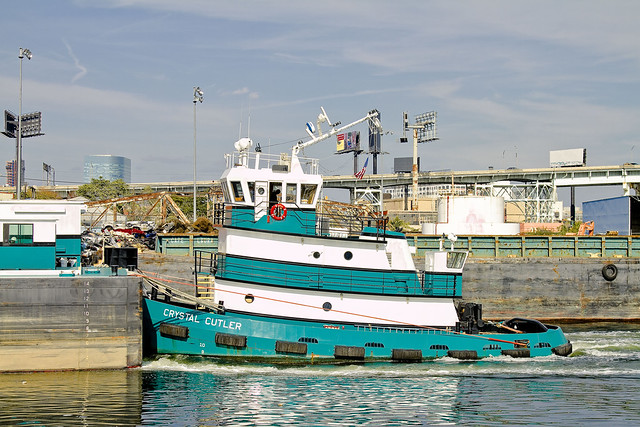
Built Nov. 04, 2010- this is the tugboat Crystal Cutler and her articulated barge (the Patricia E. Poling) plying the Newtown Creek. The article linked to below will tell you everything you could possibly ask about this tug and those who Captain and command her.
What mysteries they might have witnessed along the Creek, however, are not discussed in this profile.
The 70-foot, 1,500-hp twin-screw tug Crystal Cutler has been pushing and occasionally towing a 15,000-barrel clean oil barge since the tug was introduced in 2010. The tug places a high demand on her captains and crews as she ventures into shallow rivers and estuaries, moving about in a highly dynamic harbor with loads of gasoline, fuel additives or heating oil for small oil terminals.

– photo by Mitch Waxman
Amongst the larger harbor community, Newtown Creek is seldom referred to in glowing terms. There are those who dispute its role and historical significance to the maritime industry- as their eyes and hearts are drawn to the Brooklyn Navy Yard, the West Side of Manhattan, and the gargantuan modern ports in New Jersey.
Many would like to abandon it as an industrial corridor entirely, saying that its day as a working waterway is done, and give it over to kayaking and other recreational occupations.
Founded in 1995, Poling Cutler began operations near the time the former Poling Transportation went out of business.
The Founders of the new company were Ed Poling, whose grandfather started the former Poling company, and Gary Cutler who spent years working in the financial world before getting involved in Marine Transportation.
– photo by Mitch Waxman
One of the greatest sins along the Newtown Creek is precisely how few of its docks are utilized today. Most of the modern business along the Creek looks toward truck transportation to bring their goods to market and for the delivery of raw materials, ignoring their valuable docking rights and imprimature. Miles of bulkheads, expensively installed during prior generations, are allowed to rot away.
What a wasted opportunity.
Moving essential bulk materials by barge is more efficient economically and environmentally. From what we hear, a single barge has the same capacity as 28 – 56 long haul trucks, depending on the industry. Compared to other transportation modes, barge transport of bulk materials is safer in terms of worker injuries and generates far fewer emissions of particulate matter, hydrocarbons, carbon monoxide, CO2 and nitrous oxide on a per ton mile moved basis.
Despite the critical importance of barge transport as a best practice for industries on Newtown Creek, much of the bulkhead along this waterway is in disrepair. Overall bulkhead condition reveals a trend of disinvestment in maritime transit and a decline in related industries. According to Army Corps of Engineers, there were 19 businesses with working docks in 1999, compared to the nine that remain active today, as of January 2011.

– photo by Mitch Waxman
When you boil it down, the whole purpose of the Newtown Creek in its current form is to bring bulk goods into New York City by barge. Admittedly, the days of Standard Oil, Phelps Dodge, and the great Lumber interests are long gone- but… imagine some farmers in upstate New York loading their harvest goods onto a barge, and sending a floating green market directly to Long Island City or Greenpoint or even Maspeth. The barge could return to the farmer laden with cash and whatever else might be needed for the next harvest, completing a virtuous circle.
Imagine standing on the shoulders of giants, rather than rifling through their corpses like so many bugs.
from dot.ny.gov
Commercial and industrial development along Newtown Creek began circa 1854-60 and accelerated rapidly, spurred by low land values, water access for ships and boats, and relative remoteness from populated areas or regulations. The first kerosene refinery in the United States (1854) and modern oil refinery (1867) helped transform Newtown Creek into an industrial waterway. The first few industries also included a distillery near the Newtown side of the Penny Bridge, and the Peter Cooper glue factory relocated from elsewhere in Greenpoint to a site in Bushwick north of Maspeth Avenue10. The influx of industry and jobs, aggressive real estate development in and around Hunter’s Point, including LIRR’s presence on the creek in 1861, and the explosive growth of refined petroleum products all enhanced Newtown Creek’s attractions and helped transform the drainage into an industrial waterway circa 1860-1880. At the Industrial Revolution’s height, Newtown Creek’s industries were flourishing, bringing thousands of people to work at its plants and factories.

– photo by Mitch Waxman
The United States Coast Guard sometimes refers to Newtown Creek as part of “America’s Maritime Superhighway”, a vital industrial waterway which must be protected from the interests of those too short sighted to realize its potential to reinvigorate the economies of those communities through which it flows. It is the very definition of the future, and New York’s destiny is and has always been directly linked to it.
It’s heart warming to see clear eyed mariners like those onboard the Crystal Cutler plying its waters.
from nycppf.org
Significant Maritime and Industrial Area
Newtown Creek, at over 780 acres the city’s largest SMIA, abuts portions of the Greenpoint, Williamsburg, Long Island City, and Maspeth industrial areas. The waterfront area is characterized by heavy industry and municipal facilities, many of which are water- dependent. Newtown Creek is also the largest SMIA in terms of employment.
Although from 1992 to 2008 the SMIA lost roughly half its jobs, from 2000 to 2008 the number of jobs in the SMIA grew by nearly 1,400 to reach a total of approximately 15,000 jobs. Nearly half of the jobs in 2008 were in transportation and warehousing and wholesale trade. However, the business mix is becoming much more diverse. In the eight-year period examined, non-industrial jobs grew by more than 35 percent.


 The Newtown Pentacle