Archive for the ‘Photowalks’ Category
Project Firebox 86
An ongoing catalog of New York’s endangered Fireboxes.

– photo by Mitch Waxman
This municipal button has style, verve, and swagger. It towers precipitously on Crescent Street at the border of Astoria and Dutch Kills (the neighborhood, not the waterway, baby) awaiting the emergent and quite uncool news that trouble has arrived. Always at the ready to raise the roof or the alarum, this party loving firebox lets all that pass know help is just one shake of the lever away.
Things to do!
Working Harbor Committee presents: Great North River Tugboat Races and Competition, September 1st, 2013
9:30-11:30 a.m. at West 42nd Street and the Hudson River. Spectator Boat tickets now on sale.
grinning androsphynxes
In today’s post… Staten Island…

– photo by Mitch Waxman
A rock thrust roughly from the sea, named for the parliamentary body of the 17th century incarnation of the nation of Holland, …Staten Island… is a place which I’ve been developing a real interest in of late. I will admit that the connections between the Kriescher and Steinway families discussed in this Newtown Pentacle post from May of 2010 spurred my curiosity, but I haven’t strayed too far from the Northern Coast of the island.
An abundance of my posts about Staten Island seem to start and end with a tugboat, but there is a lot going on out here in the deep south which one hopes to explore in the near future.

– photo by Mitch Waxman
Intentions to move a bit farther out on… Staten Island… unfortunately involves the use of MTA buses due to the vast size and distances offered by the place. This introduces an distinct kink in my usual plan, which is wander around and find stuff, but for those of you who haven’t walked around the the borough, it offers steep hills and an unforgiving number of cul de sacs which branch off the main roads.
One could easily find himself isolated and surrounded by angry old women armed with brooms or shovels.

– photo by Mitch Waxman
Still, there are some real treasures buried in the wooded hills on Staten Island. This little number was introduced to me by Kevin Walsh from Forgotten-NY a couple of years ago, a storybook house set on a hill from which one can see tugboats passing by on the Kill Van Kull.
Things to do!
Working Harbor Committee presents: Great North River Tugboat Races and Competition, September 1st, 2013
9:30-11:30 a.m. at West 42nd Street and the Hudson River. Spectator Boat tickets now on sale.
An unexpected birthday
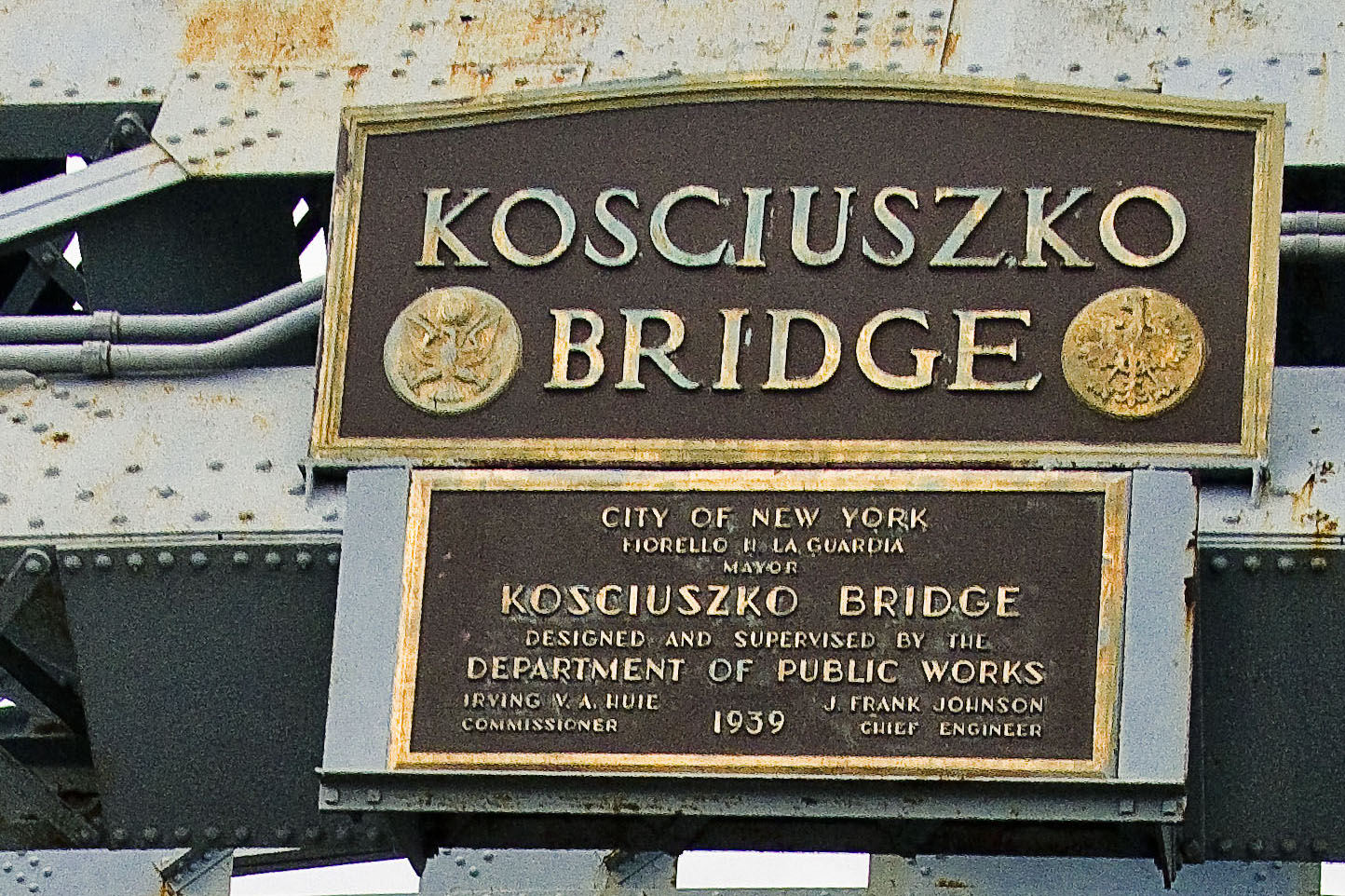
This is a reblog from exactly one year ago, commemorating both the Birthday of the Kosciuszko Bridge and the Night of the Living Dead.
– photo by Mitch Waxman
Oh, the old gray mare, she ain’t what she used to be,
Ain’t what she used to be, ain’t what she used to be.
The old gray mare, she ain’t what she used to be, Many long years ago.
Seventy Four years ago today, the Little Flower cut the ribbon and officially opened the “New Meeker Avenue Bridge” to traffic. The following April in 1940, it was renamed as the Kosciuszko Bridge.
It’s the Night of the Living Dead, by the way. Also, it’s Vulcanalia…
August 23, 1939, image New York City Municipal Archives at nycma.lunaimaging.com

– photo by Arthur J. Foley
According to the Long Island City Star-Journal of August 24th, 1939– the lineup of folks in the shot and action above are described as:
Mayor LaGuardia snips the ribbon which admitted the first autos lo use the lofty new Meeker Avenue Bridge over Newtown Creek in Laurel Hill, at the dedication held yesterday at Laurel Hill Plaza. To the right of the mayor is Acting Borough President John J. Halloran of Queens. To his left is Borough President Raymond V. Ingersoll of Brooklyn. Left of Ingersoll is Frederick J. H. Kracke, who was commissioner of Plant and Structures when that department originated plans for the bridge.

– photo by Mitch Waxman
American Bridge Company and Bethlehem Steel worked on her, along with dozens of other contractors. The Big K was part of what was known as “the Regional Plan”, which also provied the pretext for the erection of the Triborough, Whitestone, Marine Parkway and a slew of other bridges across the archipelago.
July 14, 1939, image New York City Municipal Archives at nycma.lunaimaging.com,

– photo by Arthur J. Foley

– photo by Mitch Waxman
Odds are very good that this is her last birthday (wrong again, Mitch), as the “Fast Track” program announced by the Governor will be kick starting the construction of a “Newer Meeker Avenue Bridge”- or perhaps the “Kosciuszko Two”- by the late spring of 2013. She will be gone by 2017, if one were to believe the schedule currently touted by State officials.
June 29, 1939, image New York City Municipal Archives at nycma.lunaimaging.com,

– photo by Joseph Shelderfer

– photo by Mitch Waxman
The historic shots included in this post all link out to the New York City Municipal Archives site, which has famously begun releasing thousands of historic images of the City online. One of the tricks to using the system, I’ve discovered, is knowing what things used to be called. It’s a “streetcar” versus “trolley” kind of thing. We call the former light rail system by the latter name, while those who dwelled in the past used the former.
June 29, 1939, image New York City Municipal Archives at nycma.lunaimaging.com,

– photo by Joseph Shelderfer

– photo by Mitch Waxman
Very little information is available about the construction and planning of the Kosciuszko, but there’s plenty about the New Meeker Avenue Bridge. The Big K was built for two official reasons- first, to provide a link between the multitudes of infinite Brooklyn and the World Fair Grounds in Flushing (Flushing Meadow Corona Park), and secondly to replace the aging swing bridge that spanned Newtown Creek between Meeker Avenue in Brooklyn and Laurel Hill Blvd. in Queens. Unofficially, Robert Moses really wanted to get the Brooklyn Queens Expressway built and this was as good a place as any to start.
August 14, 1939, image New York City Municipal Archives at nycma.lunaimaging.com,

– photo by Arthur J. Foley

– photo by Mitch Waxman
One does look forward to that day in the latter half of this decade, which I seriously doubt will be anything even close to 2017, when the pedestrian lane of the new bridge will be open for inspection. One of the most frustrating parts of the current bridge is that it once sported such a lane for perambulation, but it has long been closed off- thwarting photographic exploitation of the surreal vantage point that it offers.
How I would love to set up a tripod on the Kosciuszko Bridge…
from nydailynews.com
Construction on a new bridge is now expected to begin in spring 2013 — a year ahead of schedule, thanks to $460 million made available for the job by Gov. Cuomo’s New York Work initiative.
The 73-year-old bridge, which carries the Brooklyn-Queens Expressway over the Newtown Creek, qualified for the money in part because it is on the state’s “deficient bridge” list.
The initial phase of construction will build an eastbound lane next to the existing bridge, according to the state Department of Transportation, the agency overseeing the project. The 1.1-mile bridge is expected to be done in 2017 and will cost about $800 million.
When completed, two new spans with a total of nine vehicle lanes and paths for pedestrians and bikes will replace the original structure.
Here’s a rare historic shot- in color- of the mighty span, from the year it was opened, also courtesy New York Municipal Archives

– photo by New York City Municipal Archives

– photo by Mitch Waxman
And just as a reminder, in the name of public good and an abundance of caution- don’t forget about the whole Night of the Living Dead thing- this could be trouble.
from youtube–
Want to see something cool? Summer 2013 Walking Tours-
The Poison Cauldron of the Newtown Creek – Saturday, August 24, 2013
Newtown Creek walking tour with Mitch Waxman and Atlas Obscura, tickets now on sale.
sweet chariot
Another unexpected encounter with a cool car.

– photo by Mitch Waxman
Perambulating along recently, one found himself at the corner of 31st street and 38th Avenue here at the border of hospitable Dutch Kills and raven haired Astoria. This is one of those posts where I show off my detective skills, as I did not recognize the model of this classic car. It is, and was, a Pontiac.
That’s all I had to go on.
from dmv.ny.gov
A historical vehicle is a vehicle that is more than 25 years old. A vehicle qualifies for a historical registration when it begins the 26th model year. For example, a 1978 model vehicle qualifies for historical registration in 2004.
Some vehicles that are less than 25 years old and have unique characteristics can qualify for a historical registration. The DMV determines if the vehicle has historical, classic or exhibit value.
A vintage vehicle is a historical vehicle and receives a historical registration. The registrant of a vintage vehicle can put vintage plates on the vehicle. Vintage plates are authentic NYS vehicle plates that were issued during the model year of the vehicle. More information about vintage plates appears below.

– photo by Mitch Waxman
The body styling suggests the 1950’s with its swept back fenders, excessive ornamentation of general “look and feel.” There are several body shops and auto detailers in the area between here and Astoria Blvd. and those of us lucky enough to live in Astoria have become blase about seeing manufactured items of enduring quality and esthetic achievement parked on the street, so even a late model Pontiac from the golden age of American auto manufacturing seldom catches the notice of jaded area wags.
from wikipedia
Pontiac was an automobile brand established in 1926 as a companion make for General Motors’ Oakland. Quickly overtaking its parent in popularity, it supplanted the Oakland brand entirely by 1933 and, for most of its life, became a companion make for Chevrolet. Pontiac was sold in the United States, Canada, and Mexico by General Motors (GM). Pontiac was marketed as the performance division of General Motors for many years, specializing in mainstream performance vehicles. Pontiac was relatively more popular in Canada, where for much of its history it was marketed as a low-priced vehicle.

– photo by Mitch Waxman
The major identifiers, there were two, are the star motif on the rear fenders and the shape of the dashboard. The fact that all the controls and indicators were contained in an oval marked this car’s model year, and the stars provided incontrovertible proof that this was a Pontiac Star Chief from 1957.
This car is 56 years old, and is considered to be highly collectible by auto enthusiasts.
from wikipedia
Between 1954 and 1957, the Star Chief was Pontiac’s prestige model; the car was easily identified by its chrome star trim along its sides. When the storyline of I Love Lucy pointed towards a Hollywood setting in the 1954-1955 season, the characters “drove” (in episode 110, “California Here We Come”) to the West Coast in a 1955 Star Chief convertible. In 1954, Pontiac also introduced air conditioning with all the components under the hood, a first for the price range. Seat belts were added as options in 1956.

– photo by Mitch Waxman
Marketed as a sedan (4 doors), there were also coupe and station wagon versions of this model.
A true car fan will decry calling this a sedan and these is no post rising from the body, between the two door windows, to support the hard shell roof. Researching the vehicle, I came across a great site called pontiacsonline, which presents an enormous amount of period advertisements for the model and the one linked to below offers concrete proof that what we’re looking at is a Pontiac Star Chief.
from pontiacsonline.com


– photo by Mitch Waxman
Ultimately, the whole reason that this cool car exists at all is due to the efforts of a fellow named Semon Emil “Bunkie” Knudsen, a mid 20th century auto executive at General Motors. Due to Knudsen’s influence, Pontiac became quite involved with a growing organization which called itself NASCAR, and Pontiacs served the race organization as their pace cars for many years.
from wikipedia
Knudsen began working for General Motors in 1939 with Pontiac Division and rose to management quickly, becoming general manager of the Detroit Diesel Division in 1955, a vice-president of the company and general manager of Pontiac Division in 1956.
When appointed head of Pontiac, he was given the mission to improve sales. At that time Pontiac had a reliable but stuffy image. Knudsen brought in Pete Estes from Oldsmobile as chief engineer and hired John DeLorean away from Packard to be his assistant, with the assignment to create high performance versions of their existing models. The Pontiac Bonneville and the “wide-track Pontiacs” came from this effort. Pontiac became heavily involved in NASCAR racing under Knudsen.
Want to see something cool? Summer 2013 Walking Tours-
The Poison Cauldron of the Newtown Creek – Saturday, August 24, 2013
Newtown Creek walking tour with Mitch Waxman and Atlas Obscura, tickets now on sale.
everyday tourist
Lurking, in fear.

– photo by Mitch Waxman
It would seem that much like the hordes of rodents who tunnel and writhe below, your humble narrator is always skittish and ready to bolt for safety. Recent travels carried me through the familiar and entirely wholesome Court Square zone surrounding the megalith here in Long Island City. Certainty that I was being watched, and not just by that thing which cannot possibly exist in the sapphire cupola of the aforementioned megalith, ruled over me. Waggling my whiskers and sniffing at the air, your humble narrator suddenly felt that the presence of predators was likely and decided to make for a hasty retreat.
l’m all ‘effed up.
from wikipedia
Insanity, craziness or madness is a spectrum of behaviors characterized by certain abnormal mental or behavioral patterns. Insanity may manifest as violations of societal norms, including a person becoming a danger to themselves or others, though not all such acts are considered insanity. In modern usage insanity is most commonly encountered as an informal unscientific term denoting mental instability, or in the narrow legal context of the insanity defense. In the medical profession the term is now avoided in favor of diagnoses of specific mental disorders; the presence of delusions or hallucinations is broadly referred to as psychosis. When discussing mental illness in general terms, “psychopathology” is considered a preferred descriptor.

– photo by Mitch Waxman
Perception is a deucedly odd thing, half instinct and half observation. A poor specimen, both physically and psychologically, I don’t fare well in any sort of challenge. I’ve never hit the game winning home run, acted the hero, or done much else other than cause angst and agony. It is for the best that I stay out of these bright places, and it would likely be preferable if one such as myself was exiled to a small guarded room somewhere and confined lest I corrupt or debase others.
Corrosive agonies abound in my presence.
from wikipedia
Before the American Civil War, the mentally ill were often placed in poorhouses, workhouses, or prisons when their families could no longer care for them. Patients were often forced to live with criminals and were treated likewise: locked in a cell or even chained to walls. By the 1860s, Americans wanted to provide better assistance to the less fortunate, including the mentally ill. The number of facilities devoted to the care of people with mental disorders increased significantly. These facilities, meant to be places of refuge, were referred to as insane asylums. Between 1825 and 1865, the number of asylums in the United States increased from 9 to 62.
The establishment of asylums did not mean that treatment greatly improved. Because doctors did not understand what caused the behavior of their patients, they often listed the possible causes of mental illness as religious excitement, sunstroke, or even reading novels. They believed that the patient had lost all control over their morals and that strict discipline was necessary to help the patient regain self-control. Asylums often employed straitjackets to restrain patients who could not control themselves.

– photo by Mitch Waxman
This proclivity toward self recrimination is accelerated whenever I’m near mirrors, whose shocking imagery always offers horrible revelations that puncture those lies which one tells himself. Perhaps this is what set me off, while innocently traveling to and fro across the concretized realities of Long Island City, for when one observes that the absolute eidelon of senile corruption and debased sanity reflected in the mirror glass is no idle fantasy or wild illustration but is rather yourself…
How can one not realize the verisimilitude displayed, to those scurrying legions of the eternal subterranean night, and not enter into the comforting arms of madness?
from wikipedia
Paranoid personality disorder (PPD) is a mental disorder characterized by paranoia and a pervasive, long-standing suspiciousness and generalized mistrust of others. Individuals with this personality disorder may be hypersensitive, easily feel slighted, and habitually relate to the world by vigilant scanning of the environment for clues or suggestions that may validate their fears or biases. Paranoid individuals are eager observers. They think they are in danger and look for signs and threats of that danger, potentially not appreciating other evidence.
They tend to be guarded and suspicious and have quite constricted emotional lives. Their reduced capacity for meaningful emotional involvement and the general pattern of isolated withdrawal often lend a quality of schizoid isolation to their life experience. People with this particular disorder may or may not have a tendency to bear grudges, suspiciousness, tendency to interpret others’ actions as hostile, persistent tendency to self-reference, or a tenacious sense of personal right.
“follow” me on Twitter- @newtownpentacle
Want to see something cool? Summer 2013 Walking Tours-
Kill Van Kull– Saturday, August 10, 2013
Staten Island walking tour with Mitch Waxman and Working Harbor Committee, tickets now on sale.
13 Steps around Dutch Kills– Saturday, August 17, 2013
Newtown Creek walking tour with Mitch Waxman and Newtown Creek Alliance, tickets now on sale.
 The Newtown Pentacle