Archive for the ‘Photowalks’ Category
impersonal investigator
“follow” me on Twitter at @newtownpentacle

– photo by Mitch Waxman
Often does a certain conflict arise within me regarding Calvary Cemetery and the various tales unearthed there which are then presented at this, your Newtown Pentacle. On the one hand, vainglory states that by speaking about the departed, and telling some part of their story, the interred are in some way kept alive.
In other cases, and this is typified by a soul chilling email received around a year ago which had the subject line “why is my grandmother’s grave featured in your blog?,” offer credence to my fears that a certain line is often crossed.

– photo by Mitch Waxman
A humble narrator subscribes to the bardic viewpoint which believes that a hero or villain is only dead when people stop talking about them, which is why Ghenghis Khan, Alexander Magnus, and Adolph Hitler are immortal.
There is another point of view, of course, which dictates that what happens at the cemetery stays at the cemetery. While researching the Early family, in whom my interest was sparked merely by the centuried integrity of their monument, this waters of this conflict bubbled forth.

– photo by Mitch Waxman
Not much is out there about the Early’s, not an obituary nor a requiem or even a trail of legal bread crumbs. Specialists in Irish genealogy might be able to reveal more than I, but that’s not really the point. From a moral and ethical point of view, should the dead just be allowed to just keep their secrets?
Attempts have always been made, around NP HQ, to present historical necrologies in the best of all possible lights, as much out of respect for heirs and descendants as for the desire to not speak ill of the dead. One attempts to remain cold, clinical, and impersonal when constructing these narratives.

– photo by Mitch Waxman
Conflicted, one nevertheless forges on in the attempt to create some sort of visual record of Calvary Cemetery, the great polyandrion of the Roman Catholics in New York City. All that can said of the Early clan is what is inscribed upon the stone- that it acknowledges the memory of the matron Ellen Mc Collough who died at 75 in December of 1893, a 21 year old woman named Rose who died in 1872, and finally the presence of the earthly remains of Mary Early who left the mortal coil in March of 1902.
The monument is a fine piece of carving, which has robustly weathered a century of exposure to the elements.
potent interest
“follow” me on Twitter at @newtownpentacle

– photo by Mitch Waxman
A carven forest of infinite sorrow and cosmic loss, Calvary Cemetery here in Queens often brightens the mood of one such as myself.
Deeply jaundiced by the acts and betrayals of the living, a humble narrator has little choice but to reacquaint himself constantly with an era when honor and the keeping of ones word was the masculine ideal. Unfortunately we live in a debased age, wherein petty monsters are allowed to terrorize the townsfolk freely. Such creatures stalk every century of course, but in ours, the acts of vengeance one may enact against an opponent are considerably circumscribed by custom and law.
You just can’t punch a guy in the nose and be done with it anymore.
from wikipedia
The first burial in Calvary Cemetery took place on July 31, 1848. The name of the deceased was Esther Ennis, having reportedly “died of a broken heart.” By 1852, there were 50 burials a day, half of them were poor Irish under seven years of age.

– photo by Mitch Waxman
Moral conundrums such as the one described above were less important than finding a meal for most of the 19th century Catholics who were buried here. They mostly died young, they died poor, and they most often died from avoidable diseases brought on by bad water, poor sanitation, and chronic malnutrition. Most were illiterate, violent, and alcoholics (by modern standards), and the only people looking out for them were their priests.
That “50 burials a day” number in the wiki quotation above represents an interesting organizational question to me. Around the beginning of the Civil War, the technological resources that the Roman Catholic Church would have had access to in performing these interments is easily explained as the sort of gear you’d see in a Cowboy movie- horses and wagon, pick ax, shovels and spades.
That’s a lot of digging, better than eighteen thousand graves a year, which would require a lot of cheap labor.
18,000 funerals a year also indicates a lot of clerical work, performing ceremonial functions for the cemetery itself and organizing the ritual schedules of mass and other votive tasks for funeral goers at the cemetery chapel.
from fordham.edu
In the 1840’s a massive number of Irish-Catholics immigrated to the United States. By 1855, there were over 200,000 Irish in New York City. British land policies, which sought to sweep the Irish peasants off their land, were compounded by the devastating potato famine of 1845 to 1847. A rot attacked the potato crop, on which the Irish population had become dependent. About 2 million people perished. The Irish often arrived in America with few material possessions and were forced to live in squalor.

– photo by Mitch Waxman
As detailed in the past, the first service conducted here, for Esther Ennis in 1848, was conducted by the legendary Archbishop “Dagger” John Hughes.
Hughes was a charismatic firebrand who turned the Archdiocese of New York into a powerhouse player in education, real estate, finance, and politics within a single generation. Based in Manhattan, Hughes’s Archdiocese appointed the official chaplains of the Calvary Cemetery, once a prestigious position to hold. No evidence of a modern chaplain, although there must be some modern prelate who oversees the place, was discovered upon casual inspections.
The monument in today’s posting is that of one such chaplain of Calvary Cemetery.
from wikipedia
On April 8, 1808, the Holy See raised Baltimore to the status of an Archdiocese. At the same time, the dioceses of Philadelphia, Boston, Bardstown and New York were created. At the time of its establishment, the Diocese of New York covered all of the state of New York, as well as the New Jersey counties of Sussex, Bergen, Morris, Essex, Somerset, Middlesex, and Monmouth.
Since the first appointed bishop could not set sail from Italy due to the Napoleonic blockade, Fr. Kohlman was appointed administrator. He was instrumental in organizing the diocese and preparing for the Cathedral of St. Patrick to be built on Mulberry Street. Among the difficulties faced by Catholics at the time was anti-Catholic bigotry in general and in the New York school system. A strong Nativist movement sought to keep Catholics out of the country and to prevent those already present from advancing.
– photo by Mitch Waxman
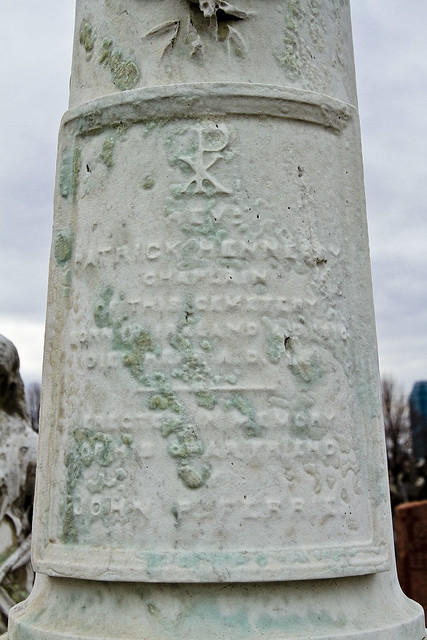
Lords and Ladies, gaze upon the inscription marking this marble as the monument of the First Chaplain of Calvary Cemetery, Rev. Patrick Hennessy.
This column, decorated and inscribed with iconography denoting the burial place of a Roman Catholic Priest, has stood here in section 3 since 1861. It adjoins two other monuments recently described at this, your Newtown Pentacle- the Connell obelisk from “whispered warnings,” and what turned out to be the Jeanne Du Lux and John P. Ferrie monument from “anxious band” and “doubly glad.”
from 1876’s “The visitor’s guide to Calvary cemetery, with map and illustrations” by J. J. Foster, courtesy archive.org
REV. PATRICK HENNESSY, Late Chaplain of the Cemetery, on which are the usual priestly insignia.
In the rear of the monument are statues representing ” Faith,” ” Hope,” and ” Charity,” angels in kneeling posture, and many others. Marble vases containing blooming flowers are scattered around, somewhat relieving the bare aspect of the ground, which is paved with small square-cut flagging, in which is a door leading to the vaults beneath. The whole plot is surrounded with substantial rails of marble.

– photo by Mitch Waxman
According to the quotation above, there is a subterranean vault which lies forgotten below the very spot upon which I stood while shooting the closer in photos which appear above.
Such occluded knowledge and latent danger is nepenthe, of course, for one such as myself. References gleaned from study of ancient tomes indicates that Rev. Hennessy actually lived within the gates of the cemetery itself, but that comes from a single source and is therefore not 100% reliable. If accurate, however, the structure would have been found at the foot of the hill which Section 9 sits upon.
One suspects that unlike myself, who is a vast physical and psychological coward known for his fits of shrieking laughter and terrifying pauses, an Irish priest from the New York of 1861 would have found little problem with straightening his back up and punching some rogue right square in the nose.
an obituary published on January 28 of 1861, found at the NYTimes archive, discusses the passing of Rev. Hennessy
HENNESSY. — At his residence, on Long Island, on Saturday, Jan. 26, Rev. PATRICK HENNESSY, in the 51st year of his age.
His funeral will take place from the Church at Calvary Cemetery, at 10 o’clock A.M., this day, (Monday.) 28th inst. His friends, and the reverend clergy, are respectfully invited to attend.
lost perspective
“follow” me on Twitter at @newtownpentacle

– photo by Mitch Waxman
Back and forth, forth and back.
On yet another of my perambulations twixt ancient Greenpoint and Astoria, the path which presented itself carried me down Greenpoint Avenue and upon the loathsome expanse of the Long Island Expressway did I find myself staring aghast at. Shivering from chills which were not atmospheric in origin, a humble narrator feverishly crossed the pedestrian pathway between the on and off ramps, an island of safety in a sea of automotive sharks.

– photo by Mitch Waxman
On the northern side of the street, yet another singular and abandoned example of the cobblers art was discovered.
Individual shoes are noticed nearly everywhere these days, by one such as myself, so much so that it seems as if some sort of sinister game might be afoot. Is there be some sort of registry for such matters? Some sort of federal list? Can an amputated consumer product such as a shoe be traced back to an owner? Detective fictions opine that this is the case, but who can guess?

– photo by Mitch Waxman
Wild speculation rules my reactions to these abandoned shoe sightings, lending fuel to flights of blasphemous fancy and outrageous possibility. Commonalities in the sightings of these orphaned singlets include their presence on out of the way, commonly traveled but seldom walked, streets. Most examples seem gently used (with the exception of the damage on the example today,) and that they are conspicuous.
There doesn’t seem to be a bias toward either the left nor right model.
doubly glad
“follow” me on Twitter at @newtownpentacle

– photo by Mitch Waxman
After the “anxious band” posting a couple of weeks ago, an email was received from none other than the Historian of Old St. Pat’s Cathedral- Jim Garrity. Mr. Garrity’s message was gladly accepted, as he offered the key to unlock the mystery of who the enigmatic monument described was dedicated to.
First- it was Jeanne Du Lux and John P. Ferrie inscribed upon the stone, names which were familiar to one such as Mr. Garrity, whose expertise on the subject of the 19th century Irish experience in New York City will be questioned only by madmen and fools.
With the help of Mr. Garrity’s sound advice and excellent tomb stone deciphering skills, the story is now clear.

– photo by Mitch Waxman
“With these provisions of the code in force Jeanne Du Lux a woman of French extraction died November 15th, 1854 at an advanced age in the city of New York intestate leaving a large personal estate to be administered and distributed according to the laws of the place of her domicile.”
That’s from 1871’s “Reports of Cases Argued and Adjudged in the Supreme Court of the United States, Volume 80” (courtesy google books).
So’s this-
“Within a month of her decease John Pierre Ferrie applied to the surrogate of the county of New York for letters of administration on her estate claiming them on the ground that he was her only child and therefore her sole heir at law and next of kin.
This application was opposed… During the pendency of these proceedings, Benoit Julien Caujolle Bert Barthelemy Canjolle, and Mauretta Elie, with their respective wives, appeared before the surrogate and asked to be heard alleging that they were the next of kin and for that reason entitled to intervene in the matter of the administration and to share upon the distribution of the estate and asking to receive their distributive share of the same.”

– photo by Mitch Waxman
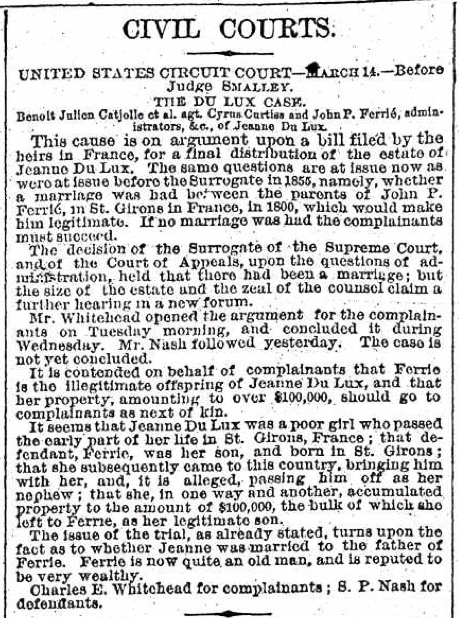
It seems that Mr. Ferrie had to assert and prove his rights as heir in several high profile cases, included defending himself in his native France. The French Consulate and New York State ruled in his favor, but appeals elevated the dispute all the way to the Supreme Court.
At question was his status as having been born a bastard.
In the end, the bastard won, and is buried with his mom beneath an opulent monument that has carried both of their portraits for more than a century. You never know what you’re going to find at Calvary Cemetery in Queens- and sometimes- the things that you do find, you should ask a smart friend about. Thanks Jim!
from 1867’s New York Daily Tribune, courtesy fultonhistory.com
treasures offered

– photo by Mitch Waxman
Lots to do next week, meetings and galas, all sorts of situations to feel socially awkward in are coming up. Smart and well positioned opinion will be available for the price of attendance, at Newtown Creek Alliance’s “Spotlight on Citizen Science” on Monday the 25th in Long Island City.
NCA’s February meeting will highlight the wide array of local citizen and student scientists exploring all angles of the creek. The meeting will be structured as a showcase, with quick presentations on each topic, and materials for you to peruse in person. Come mingle with your local citizen scientists.
NCA Spotlight on Citizen Science
February 25, 2013 at 6pm
LaGuardia Community College
E Building, Room E-242

– photo by Mitch Waxman
A different sort of gathering will be happening at The India House Club, when Working Harbor Committee hosts its annual Gala, and this year’s honoree is Lucy Ambrosino. A great party, the Gala gathers the movers and shakers of NY Harbor together, and proceeds from the event help fund the WHC’s education programs and summer boat tours.
That’s Tuesday the 26th.
from workingharbor.com
Lucy Ambrosino is being honored for her ardent commitment to the Port of New York and New Jersey and the working harbor which supports it. An effective and committed consensus builder, Lucy is a strong advocate and enthusiastic participant in all efforts to educate the public about the value of the working harbor.
The award will be presented by Andrew McGovern, President, New Jersey Sandy Hook Pilots at 7:15 p.m.
Tuesday Evening – 26 February 2013
India House Club — Marine Room
One Hanover Square, New York City, NY 10004
6 o’clock — 8:30 o’clock – Business Attire

– photo by Mitch Waxman
A town hall meeting, with the NYS DOT and several local elected leaders, will discuss the upcoming Kosciuszko Bridge project. The meeting is being hosted by OUTRAGE, a community group concerned by the enormous footprint of truck based industry in North Brooklyn.
That’s Wednesday the 27th.


– photo by Mitch Waxman
Lastly, the unfortunate locale and long neglected and seldom considered municipality called Manhattan will be the setting for a “Long Term Control Plan: Citywide Modeling Workshop.”
Discussions of the recently experienced meteorological phenomena and concurrent flooding is necessitated and accordingly an understanding of the “New Normal” will be offered by the authorities. Ramifications will be explored, existential quandaries expounded upon and considered by representatives of the inestimable NYS DEC and the stalwart NYC DEP.
This one is Thursday the 28th, and I’m sure it will be a civil engineering and urban planning hootenanny.
from nyc.gov
LONG TERM CONTROL PLAN: CITYWIDE MODELING WORKSHOP
Thursday, February 28, 2013 at US Customs House, Auditorium, 1 Bowling Green from 6:00pm – 8:00pm.
The New York City Department of Environmental Protection (DEP) is co-hosting a citywide workshop to present and review the modeling processes that will be used to test potential alternatives identified as part of the Long Term Control Plan (LTCP) Program with the New York State Department of Environmental Conservation (DEC). At the workshop, DEP and DEC staff will review the Watershed/Landside and Hydrodynamic/Water Quality models and the proposed baseline assumptions for evaluating the benefits of CSO control alternatives.
 The Newtown Pentacle