Archive for the ‘Pickman’ Category
of straw and willow

– photo by Mitch Waxman
Before I left Calvary- that day when I finally located the grave of it’s first interment (Esther Ennis, 1848), stepped in a dead rabbit, and picked up a paranormal companion on my long walk- two things came to my notice.
The first was what I’ve been referring to for awhile as “disturbing subsidences”, which in the case of this posting, seem to have been a result of the series of those winter storm events which bedeviled New York City in January and February of 2011. On my few attempts to enter the place during this period, an untrammeled yard deep layering of snow and ice covered the ground.
The second… we’ll talk about that tomorrow.
from wikipedia
Snow remains on the ground until it melts or sublimates. Sublimation of snow directly into water vapor is most likely to occur on a dry and windy day such as when a strong downslope wind, such as a Chinook wind, exists. The water equivalent of a given amount of snow is the depth of a layer of water having the same mass and upper area. For example, if the snow covering a given area has a water equivalent of 50 centimeters (20 in), then it will melt into a pool of water 50 centimeters (20 in) deep covering the same area. This is a much more useful measurement to hydrologists than snow depth, as the density of cool freshly fallen snow widely varies. New snow commonly has a density of around 8% of water. This means that 33 centimeters (13 in) of snow melts down to 2.5 centimeters (1 in) of water. Cloud temperatures and physical processes in the cloud affect the shape of individual snow crystals. Highly branched or dendritic crystals tend to have more space between the arms of ice that form the snowflake and this snow will therefore have a lower density, often referred to as “dry” snow. Conditions that create columnar or plate-like crystals will have much less air space within the crystal and will therefore be denser and feel “wetter”.
Once the snow is on the ground, it will settle under its own weight (largely due to differential evaporation) until its density is approximately 30% of water. Increases in density above this initial compression occur primarily by melting and refreezing, caused by temperatures above freezing or by direct solar radiation. In colder climates, snow lies on the ground all winter. By late spring, snow densities typically reach a maximum of 50% of water. When the snow does not all melt in the summer it evolves into firn, where individual granules become more spherical in nature, evolving into a glacier as the ice flows downhill.

– photo by Mitch Waxman
Take into account the size of this place, with vast acreages unshielded by geological feature or manmade structure (unless one considers that the entire place is a sort of construct). Next, imagine snow… a lot of snow.
With a square foot of snow estimated to weigh some 12.5 to 20 pounds (depending on density, i.e. fluffy versus wet), and calculate not just the crushing weight of this frosty load upon the ground and the graves themselves- but the actions of the tens of millions of gallons of water released into the soil during the melting process.
from wikipedia
In hydrology, snowmelt is surface runoff produced from melting snow. It can also be used to describe the period or season during which such runoff is produced. Water produced by snowmelt is an important part of the annual water cycle in many parts of the world, in some cases contributing high fractions of the annual runoff in a watershed. Predicting snowmelt runoff from a drainage basin may be a part of designing water control projects. Rapid snowmelt can cause flooding. If the snowmelt is then frozen, very dangerous conditions and accidents can occur, introducing the need for salt to melt the ice.

– photo by Mitch Waxman
Understand what I’m attempting to show in these shots, which are not presented for prurient reasons.
The headstones in a cemetery almost always stand on a concrete base which acts a foundation against the shifting of soil and alleviates fears of the heavy monument falling over and shattering- perhaps even wounding a passerby like myself. In some cemeteries, where marshy conditions exist, the graves aren’t truly in the soil but are rather inside of a sort of cement or concrete vault which holds the interment in place (it also aids in not contaminating ground water) that is itself filled in with dirt. A coffin for a coffin, as it were.
The “b” sections of Calvary which are lower in elevation than the rest and lie along the Review Avenue and Laurel Hill Blvd. sides, I am told, use this sort of approach.
from wikipedia
Groundwater is water located beneath the ground surface in soil pore spaces and in the fractures of rock formations. A unit of rock or an unconsolidated deposit is called an aquifer when it can yield a usable quantity of water. The depth at which soil pore spaces or fractures and voids in rock become completely saturated with water is called the water table. Groundwater is recharged from, and eventually flows to, the surface naturally; natural discharge often occurs at springs and seeps, and can form oases or wetlands. Groundwater is also often withdrawn for agricultural, municipal and industrial use by constructing and operating extraction wells. The study of the distribution and movement of groundwater is hydrogeology, also called groundwater hydrology.
Typically, groundwater is thought of as liquid water flowing through shallow aquifers, but technically it can also include soil moisture, permafrost (frozen soil), immobile water in very low permeability bedrock, and deep geothermal or oil formation water. Groundwater is hypothesized to provide lubrication that can possibly influence the movement of faults. It is likely that much of the Earth’s subsurface contains some water, which may be mixed with other fluids in some instances. Groundwater may not be confined only to the Earth. The formation of some of the landforms observed on Mars may have been influenced by groundwater. There is also evidence that liquid water may also exist in the subsurface of Jupiter’s moon Europa.

– photo by Mitch Waxman
What’s interesting about these 2 images is not that the snow melt washed out a section of soil as it sought low ground. It’s that little peak of red brick and masonry in the extreme corner. It’s the first time that we’ve witnessed a part of (what I believe to be) the 1848 structural elements built into the ground poking out. Confidentiality restrains me from discussing certain reminiscences about these red bricks, and their meaning in Calvary’s original section at this point in time, but these are a very important feature. Possibly very important.
More on that in later postings, as researches into the place are going well beyond the normal scope of inquiry practiced by this, your Newtown Pentacle.
from wikipedia
Some couples or groups of people (such as a married couple or other family members) may wish to be buried in the same plot. In some cases, the coffins (or urns) may simply be buried side by side. In others, one casket may be interred above another. If this is planned for in advance, the first casket may be buried more deeply than is the usual practice so that the second casket may be placed over it without disturbing the first. In many states in Australia all graves are designated two or three depth (depending of the water table) for multiple burials, at the discretion of the burial rights holder, with each new interment atop the previous coffin separated by a thin layer of earth. As such all graves are dug to greater depth for the initial burial than the traditional six feet to facilitate this practice.

– photo by Mitch Waxman
At higher elevations in the ancient cemetery, the evidences of the “business” of the place intrude on the dispassionate and detached observer. This grave’s last interment was a mere 30 years ago, but the characteristic and familiar shape of its subsidence make it pretty clear what the rushing torrents of melting snow have caused as they filtered down through the soil. The grounds keepers of the place will add it to their labors, I’m sure, and cosmetically adjust the spot to an even grade.
Oddly, Calvary had it’s own odor this day, one which actually overwhelmed the perfumes emitted by that nearby assassination of joy called the Newtown Creek.
from wikipedia
The habitation of lowlands, such as coastal or delta plains, requires drainage. The resulting aeration of the soil leads to the oxidation of its organic components, such as peat, and this decomposition process may cause significant land subsidence. This applies especially when ground water levels are periodically adapted to subsidence, in order to maintain desired unsaturated zone depths, exposing more and more peat to oxygen. In addition to this, drained soils consolidate as a result of increased effective stress. In this way, land subsidence has the potential of becoming self-perpetuating, having rates up to 5 cm/yr. Water management used to be tuned primarily to factors such as crop optimisation but, to varying extents, avoiding subsidence has come to be taken into account as well.

– photo by Mitch Waxman
It wasn’t coming from this recent burial, nor from the one shown in the shots above. It was in Section 9, on top of the hill and behind the Johnston Mausoleum that it was emanated from. No photos were gathered, as it was a VERY recent burial, and it would violate Newtown Pentacle policy on this subject. Like this shot, the washout had carved a hydrologic pathway down and into the earth, cutting into the loam and descending into the vast unknown that underlies a world known only to these tomb legions. Unlike this shot, the melting water had eroded the soils covering the grave to the point… the outline of a coffin could just be traced out in the clay and sand, and… other… sensory information was also made available. The olfactory, unfortunately, was amongst them.
As the wind turned, your humble narrator shrieked in the manner of a small girl, and as I turned- the shadow which had been following me since I entered the place ducked behind the nearby Lynch Monument.
from wikipedia
Soil mechanics is a branch of engineering mechanics that describes the behavior of soils. It differs from fluid mechanics and solid mechanics in the sense that soils consist of a heterogeneous mixture of fluids (usually air and water) and particles (usually clay, silt, sand, and gravel) but soil may also contain organic solids, liquids, and gasses and other matter. Along with rock mechanics, soil mechanics provides the theoretical basis for analysis in geotechnical engineering, a subdiscipline of Civil engineering. Soil mechanics is used to analyze the deformations of and flow of fluids within natural and man-made structures that are supported on or made of soil, or structures that are buried in soils.

– photo by Mitch Waxman
I always attempt to avoid using cemetery roads, partially because the fear of automotive encounter and disastrous consequences bedevil the frequent pedestrian, but mainly because of some instinctual desire to avoid crossroads in places like this…
But I really needed to get out of here…
from wikipedia
In the folk magic of many cultures, the crossroads is a location “between the worlds” and, as such, a site where supernatural spirits can be contacted and paranormal events can take place. Symbolically, it can mean a locality where two realms touch and therefore represents liminality, a place literally “neither here nor there”, “betwixt and between”.
settled shape

– photo by Mitch Waxman
As stated in yesterday’s posting, a certain “sense of pursuit” possessed me after having visited Calvary Cemetery the other day.
A panicked perambulation, flight more than evasion, came upon me and carried your humble narrator bodily across most of western Queens for the rest of the day as attempts were made to return the rolling hillocks of Astoria. The spectral shadow which dogged my steps, whose identity is suspected, appeared shortly after one particularly gruesome moment.
I stepped in a dead rabbit.
The population of “groundling burrowers” at Calvary Cemetery has been discussed before, in this February 2010 Newtown Pentacle posting “Shoosh… Be Very Quiet… I’m hunting rabbits…“

– photo by Mitch Waxman
The hydrological after effects of the recent snow cover, and its concurrent melt waters, are evidenced across the great cemetery by disturbing subsidence and in some places- wash outs. The ground itself is not altogether stable, given its level of saturation, and caution was exercised in not getting too close to older monuments and headstones for fear of toppling them from an undermined foundation.
A moment of indiscretion resulted in me planting a step right into the carcass of a groundling, however.
(these hydrological events will be discussed in a later posting)
from eho.syr.edu
Dead Animals are associated with the spread of human disease and may present a potential hazard for employees, students and visitors.
The greatest hazard related to dead animals is the potential for the indirect spread of human disease by live animal parasites (fleas and ticks). Fleas and ticks are parasites that feed, breed and live on most wild animals. Both fleas and ticks have irritating bites and can transmit disease. Risk of exposure to fleas and ticks increases when handling dead animals, because these parasites are actively seeking a live host and may be very abundant on the animal or in the immediate area. Dead animals should only be handled by appropriate Physical Plant and Housing employees.
Animal Carcass Disposal Procedures. The following procedures must be used when removing and disposing of an animal carcass:
- At a minimum, workers must wear thick rubber gloves, a long sleeve shirt and pants, and closed toed shoes when handling dead animals.
- Transfer small animal carcasses to doubled plastic bags using shovel or gloved hand.
- Double bagged carcasses must be placed in an outdoor garbage dumpster.
- Large animal carcasses, such as a deer, must be transported to a remote wood area on University property and buried three feet below ground. Only University owned pick-up trucks may be used to transport large animal carcasses.

– photo by Mitch Waxman
What was odd, given the predators which overfly or cross Calvary in a quadripedal manner- and an abundant soil ecosystem whose foodstuffs are better left undescribed- was that the rabbit itself seemed to have just died on the spot and was left to decay. It “came apart” due to my accidental contact, seemed to be quite dehydrated, and was just laying out in the open.
One would expect to witness a cloud of flies, or other forms of insectivorous life at work, but it was curiously intact. Maybe the Chinese New Year figures into it somehow.
from wikipedia
The Chinese Year of the Rabbit ( 兔 ) is actually the Chinese Year of the Hare, as China has seven native species of hares and no native species of rabbits. The Chinese applied their word for hare to the first rabbits to be taken to China, and the word is now erroneously back-translated into English as rabbit. The hare is the fourth animal in the 12-year cycle of the Chinese zodiac. The Year of the Hare is associated with the earthly branch symbol 卯.

– photo by Mitch Waxman
An exquisite irony, of course, is that Calvary Cemetery is the final resting place for many Irish immigrants of the 19th century- including a large number who were members of the legendary street gang “the De’d Ráibéads” or “Dead Rabbits”. When escape from my ghostly pursuer was finally attained, and this tale was breathlessly related back at Newtown Pentacle HQ, my patient listeners thought that I had actually fallen into the grave of some 19th century Lower East Sider like Kit Burns.
from wikipedia
The Dead Rabbits were a gang in New York City in the 1850s, and originally were a part of the Roach Guards. The name has a second meaning rooted in Irish American vernacular of NYC in 1857. The word “Rabbit” is the phonetic corruption of the Irish word ráibéad, meaning “man to be feared”. “Dead” was a slang intensifier meaning “very”. Thus, a “Dead Ráibéad” means a man to be greatly feared. The gang was sometimes also known as the Black Birds.
The gang was led by Priest Valon and achieved great renown for their organization and prowess as thieves and thugs. The fighting uniform of the Roach Guards was a blue stripe on their pantaloons, while the Dead Rabbits adopted a red stripe. In riots their emblem was a dead rabbit impaled on a spike. The Rabbits and the Guards swore undying enmity and constantly fought each other at the Five Points, but in the rows with the water-front and Bowery Boys they made common cause against the enemy, as did other Five Points gangs including the Shirt Tails and Chichesters. The gang was later led by Irishman Aidan Bourke also known as “Black Dog” possibly because a ruthless nature similar to that of the ghost dog in the folklores of the Celtic and British Isles.

– photo by Mitch Waxman
This rabbit’s foot seems to have brought little or no luck to it’s original owner, and little sense has ever accompanied that particular superstition as far as I’m concerned. It was while taking this shot that I suddenly became aware of a “feeling of being watched”, a well honed sense impression for those of us who wander the streets with our cameras, one which normally presages the familiar “bleep bleep” of an NYPD radio patrol car or some Private Security guard about to query “what are you doing?”. Looking around, solitude remained untrammeled, but a weird reflection behind me was observed on the corner of the lens to my glasses.
Upon spinning around, expecting to see a groundskeeper or some other visitor to the place, there was nothing and no one.
from wikipedia
A mild form of hallucination is known as a disturbance, and can occur in any of the senses above. These may be things like seeing movement in peripheral vision, or hearing faint noises and/or voices. Auditory hallucinations are very common in paranoid schizophrenia. They may be benevolent (telling the patient good things about themselves) or malicious, cursing the patient etc. Auditory hallucinations of the malicious type are frequently heard like people talking about the patient behind their back. Like auditory hallucinations, the source of their visual counterpart can also be behind the patient’s back. Their visual counterpart is the feeling of being looked-stared at, usually with malicious intent. Frequently, auditory hallucinations and their visual counterpart are experienced by the patient together.
Hypnagogic hallucinations and hypnopompic hallucinations are considered normal phenomena. Hypnagogic hallucinations can occur as one is falling asleep and hypnopompic hallucinations occur when one is waking up.

– photo by Mitch Waxman
Disturbed at this point by my perception, and by the curious feeling of being watched, I nevertheless continued my “business” at Calvary. Antiquarian pursuits and historical inquiries aside, it was quite a lovely day- and the first hint of spring was in the air.
What better way to spend it than in a lovely garden cemetery?
from wikipedia
The rural cemetery or garden cemetery is a style of burial ground that uses landscaping in a park-like setting.
Landscaping and tree planting at Green-Wood Cemetery in BrooklynAs early as 1711 the architect Sir Christopher Wren had advocated the creation of burial grounds on the outskirts of town, “inclosed with a strong Brick Wall, and having a walk round, and two cross walks, decently planted with Yew-trees”[1]. By the early 19th century, with urban populations expanding, the existing churchyards were growing unhealthily overcrowded with graves stacked upon each other, or emptied and reused for newer burials. As a reaction to this, the first landscaped cemetery was opened in 1804, as the Père Lachaise Cemetery in Paris.
The garden cemetery in the USA was a development of this style. Prior to this, urban burial grounds were generally sectarian located on small plots within cities. The new design took the cemetery out of the control of the church, using an attractive park built on a grander scale, using architectural design and careful planting, inspired by the English garden movement.
sense of pursuit

– photo by Mitch Waxman
Oh boy, I’m all ‘effed up…
Just the other day, while innocently searching through Calvary Cemetery for a certain interment (wholly separate from the one described yesterday), your humble narrator must have suffered some sort of seizure. That would explain the malign paranoia which suddenly infected and disordered my thoughts, birthing a desire to move to a more populated section of the ancient villages for the sake of safety alone. The last time misgivings such as these came upon me was during a November 2009 trip to hoary Mt. Zion, when I was menaced by a certain group of children and their curiously polydactyl feline.
As always, it was a rambling walk-that half dogtrot/half stumble which I call scuttling- that had brought me to the place, and handicapped any chance of escape or avoidance of those extant dangers encountered in the Newtown Pentacle.
As always, solitude and otherness and massive vulnerability were my companions. As always, your humble narrator- physical coward, feckless quisling, and the least of men…
As always, an Outsider.
from wikipedia
The World Health Organization’s ICD-10 lists avoidant personality disorder as (F60.6) Anxious (avoidant) personality disorder.
It is characterized by at least four of the following:
- persistent and pervasive feelings of tension and apprehension;
- belief that one is socially inept, personally unappealing, or inferior to others;
- excessive preoccupation with being criticized or rejected in social situations;
- unwillingness to become involved with people unless certain of being liked;
- restrictions in lifestyle because of need to have physical security;
- avoidance of social or occupational activities that involve significant interpersonal contact because of fear of criticism, disapproval, or rejection.
Associated features may include hypersensitivity to rejection and criticism.

– photo by Mitch Waxman
It was just a trick of the light- the shadow of some statue distorting through thickly polarized prescription sunglasses.
Often, when the brain cannot make sense of; or is overwhelmed by a flood of sensory information; it will perform a sort of short hand during the processing of visual or auditory observation. That’s why kids see dragons in the clouds, and representations of cultic deities are often presented as having spontaneously appeared on foodstuffs. It’s the way the organ functions– using pattern recognition.
That’s why, as my steps hurriedly swept over and through Calvary’s dusty desolations, I chose to ignore that shadowy and peripheral shape which seemed to be dogging my progress and declared it to just be an hallucination. If only it didn’t seem to be the same shape- everywhere I went- there it was- ducking around a tombstone or slipping around a tree.
One observance in particular upset my delicate equilibrium, and forced me to ingest a dosage of the esoteric prescription drugs which my doctors advise consumption of whenever one of “my spells” comes upon me.
Light headed from the medications, the abyssal potions were useless- and your humble narrator was thunderstruck- consumed by cowardice and shock.
from wikipedia
Blasphemous thoughts are a common component of OCD, documented throughout history; notable religious figures such as Martin Luther and St. Ignatius were known to be tormented by intrusive, blasphemous or religious thoughts and urges. Martin Luther had urges to curse God and Jesus, and was obsessed with images of “the Devil’s behind”. St. Ignatius had numerous obsessions, including the fear of stepping on pieces of straw forming a cross, fearing that it showed disrespect to Christ. A study of 50 patients with a primary diagnosis of obsessive-compulsive disorder found that 40% had religious and blasphemous thoughts and doubts—a higher number than the 38% who had the obsessional thoughts related to dirt and contamination more commonly associated with OCD. One study suggests that content of intrusive thoughts may vary depending on culture, and that blasphemous thoughts may be more common in men than in women.
According to Fred Penzel, a New York psychologist, some common religious obsessions and intrusive thoughts are:
-
- sexual thoughts about God, saints, and religious figures such as Mary
- bad thoughts or images during prayer or meditation
- thoughts of being possessed
- fears of sinning or breaking a religious law or performing a ritual incorrectly
- fears of omitting prayers or reciting them incorrectly
- repetitive and intrusive blasphemous thoughts
- urges or impulses to say blasphemous words or commit blasphemous acts during religious services.

– photo by Mitch Waxman
Shaken, and stirred as well- transit from the cemetery into the surrounding “once upon a time” hamlet called Blissville was accomplished by crossing Greenpoint Avenue at Gale Avenue and a hurried flight was carried out along the concrete of Borden Avenue. Two sets of footprints were carved into the sooty deposits which distinguish the walkways of the ancient village, and the second one sure wasn’t Jesus…
In shattered automotive glass and an occasional plate glass window, notice was additionally made of a skirting movement just at the edges of perception. As mentioned- my cognition was altered by the pharmaceutical remedies offered and prescribed by my concerned doctors, but something odd really did seem to be following me.
Before long, I found myself at Hunters Point in Long Island City by the East River… but we’ll be talking about that in a few days…
I had decided that if this specter insisted on stalking me, it was in for one mighty long walk…
more tomorrow…
from wikipedia
A hallucination may occur in a person in a state of good mental and physical health, even in the apparent absence of a transient trigger factor such as fatigue, intoxication or sensory deprivation.
It is not widely recognized that hallucinatory experiences are not merely the prerogative of those suffering from mental illness, or normal people in abnormal states, but that they occur spontaneously in a significant proportion of the normal population, when in good health and not undergoing particular stress or other abnormal circumstance.
The evidence for this statement has been accumulating for more than a century. Studies of hallucinatory experience in the sane go back to 1886 and the early work of the Society for Psychical Research, which suggested approximately 10% of the population had experienced at least one hallucinatory episode in the course of their life. More recent studies have validated these findings; the precise incidence found varies with the nature of the episode and the criteria of ‘hallucination’ adopted, but the basic finding is now well-supported.
shadowed lips

– photo by Mitch Waxman
The fairly excellent Watercourses blog presents this post on Sunswick Creek, a waterbody which once existed here in Astoria, and still runs to the East River through manmade corridors deep below the modern streets. No, really. Watercourses has been down there and has photos! More importantly, the post also carries two maps from the 1870’s which show the early street plan of Astoria.
You’ll notice, on the 2nd one, a “Ridge St.” and a “Camelia St.”. The road running between them is Broadway, and at its intersection with Vernon Ave. the latter takes a wicked hook and becomes Sunswick Creek XXX (at this moment, it remains obfuscated to me whether this is a street or avenue or road, I think I can hear somebody at Greater Astoria Historic Society sighing right now).
This bit of geographic reckoning, of course, is simplified by saying- “Stevens Est.” = Costco, and that weird mouth of the creek is Socrates Sculpture Garden, and these photos were shot just beyond where that little dock shape is, between the “n” and second “s” in Sunswick. (I also wanted to send a shout out to Watercourses. Well Done!)
Whew!

– photo by Mitch Waxman
According to certain sources, two aboriginals named Shawestcont and Erramorhar (as witnessed by their cohorts Warchan and Kethcanaparan) sold much of what we know as Astoria (but which they called Sintsinck) to William Hallett (who was similarly accompanied by a company of witnesses and countrymen) on August 1, 1664- which is how the place got its name.
For a more complete view of highlights from Hallets Cove, and Sunswick Creek- check out this Newtown Pentacle post from February of 2010, and the “The Horrors of Hallet’s Cove“ from June of 2009.
The very fact that temperatures have risen once again to the point at which the atmosphere can sustain water in a liquid state, by the way, is a font of joy for your humble narrator- as walking the East River shoreline is once more possible for both man and duck. Which means that a winter’s worth of book research can finally be explored materially.
Whew!
I’ll be that weirdo in the dirty black raincoat you might spy scuttling along the waterfront…
these realms

– photo by Mitch Waxman
Occasion called for me to meet up with Our Lady of the Pentacle deep in the far eastern (from the perspective of Astoria, at least) neighborhood of Flushing over the last weekend. The obviate path would demand navigating and enduring the exquisite ironies visited upon the hapless weekend customer of the MTA here in western Queens, and though my patience was thin- my wallet is thinner so a cab was out of the question and… it was a really nice day.
Hence, I walked… and walked… and walked… from Astoria to Flushing.
The master, Kevin Walsh over at Forgotten-NY offered a “slice” of Roosevelt Avenue in 2008

– photo by Mitch Waxman
This isn’t one of the “deep history” or “occluded past” kind of posts by the way- it’s more a series of surface observations made on a very long walk.
Roosevelt Avenue is a very, very interesting place and not just because of the elevated subway tracks which dominate its experience. Roosevelt starts off at the East River in Brooklyn as “Greenpoint Avenue” and transforms into “Roosevelt” as it hurtles over Queens Blvd and ultimately ending at Northern Blvd. way out in Flushing.
My route out of Astoria followed Broadway southeasterly toward Jackson Heights, and then East on Roosevelt.
The inestimable and inexhaustable Mr. Walsh of Forgotten-NY presented a post detailing the Woodside to Greenpoint side of things, which be accessed here

– photo by Mitch Waxman
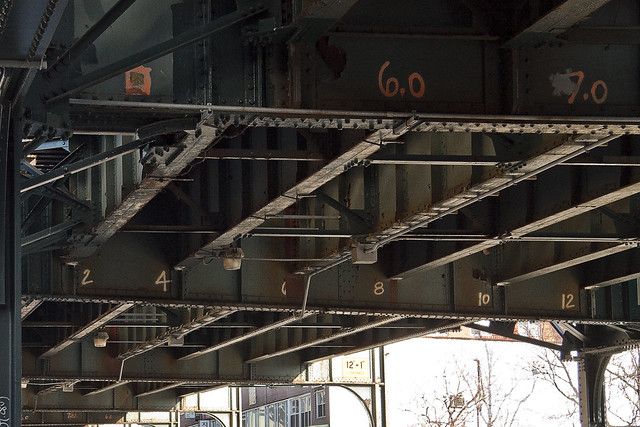
Aforementioned, the elevated tracks of the 7 line really do make you understand why Manhattan tore down its elevated tracks as soon as it was feasible. Loud, the structure is a shadowy and dripping mess, providing a home to what must be entire nations of pigeons. Sidewalk and crosswalk intersections resemble the mad excesses of certain Abstract Expressionist painters popular during the 20th century, and the vast structure dominates and demands an oppressive pall over the street.
The Woodside section of Roosevelt Avenue was given a short and sweet “once-over” a while back in this May of 2010 posting, at this, your Newtown Pentacle.
Additionally, the Flushing River just beyond Roosevelt Avenue was explored from the water in this November 2009 posting, and intriguing municipal machinery was observed along Roosevelt Avenue at Flushing’s Corona Yard in this posting from February of 2010.
– photo by Mitch Waxman
Roosevelt Avenue, and a few of the neighborhoods it passes through are a subject of much conversation amongst area wags. The whole stretch is home to such a vast agglutination of nationalities and ethnicities, representing what seems like a statistical sampling of every variation which the planetary human infestation might take, that it’s hard to say exactly who lives here.
In the section between Woodside and Flushing though, a LOT of people speak Spanish.

– photo by Mitch Waxman
There’s a lot of controversy surrounding these neighborhoods, with long time Queens residents pointing accusing fingers and offering dire prophecies for the future of the borough based on the presumed moral and legal failings of this new population. The spanish speaking community has exploded in the last decade along Roosevelt Avenue, growing by an astounding estimation of 450% since the last Census. That number, of course, is the official one. There is probably a larger number of people extant, but hazy immigration patterns and reticent newcomers leery of government officials contribute to a less than full accounting.
I can tell you from observation, however, that the economic doldrums affecting other commercial streets (like Steinway Street in Astoria, for instance) in the so called “more affluent” sections of Queens does not seem to be affecting this area.

– photo by Mitch Waxman
Perhaps its because the folks who live here will do just about anything they can to make a few bucks, often working multiple shifts, starting work at a lumber yard in the morning and busing a table in a restaurant at night for instance. A buddy of mine lives around here who came to New York from Ecuador, allows himself only 4 hours of sleep a day at the dormitory like and quite illegal rooming house which serves as his address in Corona. He’s sending money back home when he can, and trying to save what he has left over to do “something” with when opportunity presents itself to him.
I’m not going to gloss over the crime and gang life that is here, it’s just that I don’t know too much about it, and thankfully haven’t had any experience with that side of these neighborhoods.

– photo by Mitch Waxman
The newer buildings you see along Roosevelt Avenue are slapdash affairs, and would seem to fit the term “Queenscrap” coined by our friends over at the blog of the same name. The charming early 20th century detached 2 and 3 story homes which were familiar to multiple generations of…
What is the term for Queens natives anyway? Is it “Queensites” or “Queensipolitans” or “Queensicans” or something? If you’re from Brooklyn or Manhattan it’s “ites”, but what about Queens?
At any rate, the newer structures have one governing principle, and it’s that form follows function. The function seems to be a desire to use every square inch of the property lot and build to maximum height allowable by zoning regulations (and often beyond all law). In a lot where one or possibly two families historically declared their address, there can be as many as 10 or 12 today.

– photo by Mitch Waxman
The effect that this huge surge in population has had on area institutions like schools and hospitals has been profound. The usual problems arising from urban life are compounded by the fact that these are a “working class” group of people- often the so called “working poor”, who suffer from a well known and commented upon series of cultural “Gotcha’s” as it is- many amplified by speaking a different language and differing expectations for the future than those born to the culture they’ve joined.
The largely “middle class” (and often college trained) population of surrounding neighborhoods sneer at the Roosevelt Avenue corridor as being populated by illegal immigrants, call everyone here the “Mexicans“; the males of which are all gangsters- and accusing their women as scheming to spawn “anchor babies” in order to guarantee citizenship in “El Norte” and then allowing their lawless spawn to run wild in the streets. It’s blatant, more than a little racist, and I hear it all the time- even from sources you wouldn’t expect. One neighbor recently opined that “mexicans shit in the street”.
And that’s crap, Lords and Ladies. I’m tired of hearing it, frankly, and that’s what this post is really about.

– photo by Mitch Waxman
In no uncertain terms, understand this- what the “Lower East Side” and “Five Points” were to the Irish, Italians, Germans, and Jews 125 years ago is what Roosevelt Avenue is to this “immigrant wave”. As you’re reading this, a future President of the United States is eating Churros in her baby carriage somewhere on Roosevelt Avenue around 100th street. A Supreme Court Justice is kicking a ball around with a future incarnation of Al Capone in some dusty lot near Linden Park. Roosevelt Avenue is where America is being retooled, and you can safely watch it happening from the sidewalk, while the cowboys and arabs draw down on each other in the cool dusty air of some faraway land.
For reasons I can’t really attribute, the necessity of saying this out loud and in public is important to me.

– photo by Mitch Waxman
Running late, it was decided that to save a few steps and cut through Flushing Meadow Corona Park instead of continuing down Roosevelt Avenue, and I was forced to make a right turn instead of my usual left. Some interesting sights were had, which will be discussed and presented in some future (and less grandstandlingly Progressive!) posting of this- your Newtown Pentacle.


