Archive for the ‘LIRR’ Category
unmentionable allies
It’s National Cheese Pizza Day, in these United States.

– photo by Mitch Waxman
As the adage goes, when one gazes into the proverbial abyss, there’s always something staring out of it at you. In the case of the Sunnyside Yards here in Queens, that’s usually a bored Amtrak cop whose eyes have glazed over in front of a bank of monitors connected to security cameras.
Me? I know where every hole in the fencelines can be found, and which one of my lenses will fit through it. In the case of the shot above, the hole is around twenty five millimeters, and I haven’t got anything in my kit that can be inserted through the hole. Luckily, there’s a lot of holes in the fence.

– photo by Mitch Waxman
One attempted to use the downtime last week in a productive fashion, wandering about whenever the weather permitted. Saying that, I didn’t get too much done – on purpose – in order to vouchsafe a bit of time to just sit and think. I did have a couple of things to do that interrupted my reveries, however.
I was asked by Councilmember Van Bramer’s office if I would write a response to an “Op Ed” by the Queens Anti Gentrification Project” aimed at Jimmy and offered at the citylimits site. QAGP seems to have taken some umbrage at my response and published this post at their own site addressed towards me. I’ve known Jimmy Van Bramer for a while now, his Mom lives a couple of blocks away from me here in Astoria, and I emphatically support his reelection campaign. Jimmy has been, and I’m sure will continue to be – an effective advocate for his district.

– photo by Mitch Waxman
One shall be responding in my usual manner – next week – to the QAGP folks, but allow me this:
As I’ve said in the past, “gentrification” is not an apropo term for what’s happening in LIC (or North Brooklyn). The proposal to deck over the Sunnyside Yards, the rezoning of the LIC industrial districts and consequent residential tower construction by monied interests based and interested only in short term benefits to Manhattan offered by this build out, the complete blindness towards the municipal infrastructure costs associated with this process… we haven’t got a word for it yet.
This POV will be crystallized in a post offered next week.

– photo by Mitch Waxman
One does stand ready to be accused of being a shill, again.
When I first “stepped out” in public and began discussing Newtown Creek and the environmental issues affecting our community the accusations were waiting for me. New York City Planning asked me “who do you think you are”? One well known activist openly described my efforts at building awareness of these issues as a shell game initiated by the real estate developers, whom I was obviously a clandestine agent of. My willingness to converse with and try to find common ground between the community and the historical corporate polluters of Newtown Creek – ExxonMobil and the like – saw me accused of being an agent of the petrochemical industry sent amongst the environmental community to sow chaos. When I became involved with transit issues, more recently, accusations of being a Democratic Party operative emerged. The kayakers, the bicycle people… don’t get me started.
I wish my life was that interesting, and that the monies people presume I’m receiving for my activities were actually in my possession. Our Lady of the Pentacle and myself barely scratch by, just like everyone else these days.

– photo by Mitch Waxman
Speaking as the first person in Queens to throw down the gauntlet to City Hall regarding the Sunnyside Yards mega development, and one of the principal flies in the ointment of the people planning it, one finds all of these accusations amusing. Ask the NYC DEP if I’m in their employ, or ExxonMobil, or any of the other entities who’ve I set my focus on over the years. I’m quite popular with the MTA establishment at Jay Street as well, and as far as the BQX goes… let’s just say that when I walk into a meeting room the staffers from EDC collect up in a quiet corner and discuss how to handle the fact that I’ve shown up.
My resume and activist credentials which have defined my life over the last ten years have not been gained by throwing around a bunch of meaningless slogans. Instead it’s been “showing up” to nighttime meetings with bland officials at a sewer plant during snow storms in January, and sweating in the July heat to build consensus and constituency amongst my fellow citizens. I’ve put my name on everything I’ve done, as well. When I’ve been wrong, the first person to bring it up has been “yours, truly.”
This is real life, not some intellectual game, and a looming infrastructure crisis is about to hurt us all.
Upcoming Tours and events
Calvary Cemetery Walking Tour, with Atlas Obscura – Saturday, September 9th, 7 p.m. – 9 p.m.
Explore NYC history, hidden inside sculptural monuments and mafioso grave sites, as you take in iconic city views on this walking tour, with Newtown Creek Alliance Historian Mitch Waxman – details here.
“follow” me on Twitter- @newtownpentacle
old privateers
It’s National Peach Ice Cream Day, in these United States.

– photo by Mitch Waxman
One believes that if you’ve got a problem to solve, the first step towards “victory state” over it involves wrapping your head around the problem and “getting smart.” I like to be fairly well educated about the nature of things before opening the hood and tinkering around with the engine, basically.
The subject of the MTA, or Metropolitan Transit Authority (a public benefit corporation), has been in the news quite a bit of late. The subways have been the particular focus, but the question a friend asked me the other night is what caused today’s post to come into existence.
What, exactly, is the MTA? Well, it’s complicated.
from wikipedia
Chartered by the New York State Legislature in 1965 as the Metropolitan Commuter Transportation Authority(MCTA), it was initially created by Governor Nelson Rockefeller to purchase and operate the bankrupt Long Island Rail Road. The MCTA dropped the word “Commuter” from its name and became the Metropolitan Transportation Authority (MTA) on March 1, 1968 when it took over operations of the New York City Transit Authority (NYCTA) (now MTA New York City Transit (NYCT)) and Triborough Bridge and Tunnel Authority(TBTA) (now MTA Bridges and Tunnels (B&T)). The construction of two bridges over the Long Island Sound was put under the jurisdiction of the MTA.
– photo by Mitch Waxman
To begin with, there’s just over 70,000 employees on the MTA’s payroll. MTA operates, ultimately, in the most densely populated sections of three states with the Shining City of Manhattan as the titular center and bullseye destination for its trains, automotive bridges and tunnels, and multiple fleets of buses.
Nearly all of the MTA train lines were originally built and owned by private businesses (with a significant public investment in the case of the subways) either during the late 19th or early 20th century, but bankruptcies and public foreclosures brought them into government hands. Private bus companies were acquired and folded into the Authority over the decades, along with bridges and tunnels that were formally owned and operated by seperate entities. Today, all of these operations are handled by the individual divisions of the MTA and overseen by a 17 member board of directors (who are all political appointees with virtually zero experience in transportation matters, incidentally).
from wikipedia
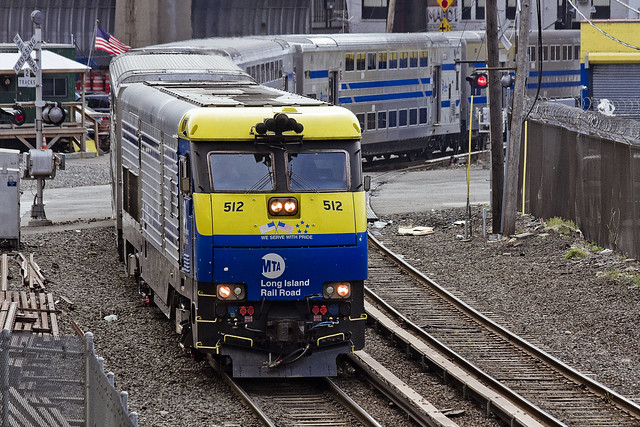
The Long Island Rail Road (reporting mark LI), legally known as the Long Island Rail Road Company and often abbreviated as the LIRR, is a commuter rail system in the southeastern part of the U.S. state of New York, stretching from Manhattan to the eastern tip of Suffolk County on Long Island. With an average weekday ridership of 337,800 passengers in 2014, it is the busiest commuter railroad in North America. It is also one of the world’s few commuter systems that runs 24 hours a day, 7 days a week, year-round. It is publicly owned by the Metropolitan Transportation Authority, which refers to it as MTA Long Island Rail Road.

– photo by Mitch Waxman
Capital Construction is where all the money disappears into, basically. Pictured above is the Second Avenue Subway under construction, and however much I wish that I could show you a shot from the East Side Access project – I haven’t managed to find a way to get my camera down there, yet. The MTA is ostensibly meant to be self funding, through bonds it issues and through fare revenue, but it seldom works out that way and both State and City end up sending a significant amount of tax revenue their way to handle deficits.
Everybody asks why it is that these mega projects orchestrated by Capital Construction have the political support that they do while the wheels are falling off the buses and subways. Short answer is that a shot of a politician watching some mechanic turn a wrench while repairing a track switch is a lot less compelling an image, electoral politics wise, than one showing the same politician cutting a ribbon at the opening ceremony of a fancy new subway stop in the richest section of Manhattan on the Uppper East Side.
Capital Construction, like all of MTA’s divisions, is a vertical silo with its own hierarchy and political patronage. They do what they do, and compete for funding with the other divisions.
from wikipedia
MTA Capital Construction is a subsidiary agency of the Metropolitan Transportation Authority (MTA), formed in July 2003 to manage the MTA’s major capital projects in the New York metropolitan area. It mainly focuses on improving transportation infrastructure and facilities in New York City, the Hudson Valley, and Long Island areas. Funding primarily comes from local, state, and national bond sales and budgets. As of April 2017, the current MTA Capital Construction president is Janno Lieber.

– photo by Mitch Waxman
Long Island Railroad, for instance, is a vertically integrated “thing” all of its own. If someone from the Metro North side of MTA calls in sick, they don’t send LIRR employees upstate to fill in the slack. It doesn’t share “synergies” with Metro North (repair facilities, union contracts etc.) or with the New York City Transit Authority (subways). This situation is owed partially to the formerly seperate corporate entities that created the original lines.
Metro North is the grandchild of the old New York Central Railroad passenger service, and the LIRR is the child of Central’s arch rival and adversarial enemy – the Pennsylvania Railroad Company.
I’m no expert on this subject, so, I reached out to a buddy who is one of my “rail rabbis” and he anonymously offered this statement and assessment of the situation involving Metro North and LIRR, which – despite logic and what you might think, don’t use the same trains nor operate in common fashion or custom.
“Metro-North Railroad is made up of three distinct operations. Two of these operate out of Grand Central Terminal, the third operates out of Hoboken Terminal.
Hudson and Harlem lines are the remnants of the New York Central Railroad (Vanderbilt), out of Grand Central Terminal.
The New Haven line is the former New York, New Haven and Hartford Railroad (New Haven for short).
The New Haven was unique in that they operated commuter trains out of Grand Central Terminal and their long distance trains out of Penn Station. The line over Hell Gate was financed by the New York Connecting Railroad, which was a paper railroad business agreement between the New Haven and the Pennsylvania Railroads.
The third operation is frequently overlooked. it is the former Erie Railroad (Jay Gould, THE robber baron), later Erie Lacawanna Railroad operation to Port Jervis New York. MTA pays for the New York portion, while New Jersey Transit pays for the New Jersey operation. This operates out of Hoboken Terminal.
The New York Central and Pennsylvania Railroad merged in 1968 into the Penn Central (Good book to read is “The Wreck of the Penn Central” by Joseph R. Daughen and Peter Binzen).
It was an unhappy merger, with battles between the two different management ideologies. It ended up with the US Government creation of Conrail in 1976 to salvage what remained of several north east railroad operations (Including Penn Central).
Conrail operated many commuter railroads, which received state subsidies for commuter operations. (Amtrak was formed in 1971 for intercity/long distance passenger trains, not the many commuter operations) Conrail wanted out of commuter operations at its founding and in 1983, it was NY States turn and Metro North was created.
The LIRR and Metro North are two distinct systems, with the only real compatible technology being the train couplings and the gauge of the trains.
Metro North utilizes an under-running third rail and the LIRR utilizes an over running third rail. Diesel locomotives and diesel hauled electric passenger cars also weigh different, with Metro North being able to haul heavier equipment, Long Island bridges are load limited. The Park Avenue Tunnels on Metro North and the East River Tunnels on the Long Island also limit the interchangeability of some equipment. Signal systems are also different.
The Electric Multiple Unit (MU) trains of Metro North and LIRR look similar and are ordered from the same vendor/companies, but they are configured to operate on their respective systems. They are not freely interchangeable. The Arch Street shop of the LIRR is a warranty shop for the recent purchase of the M-7 MU’s. Metro north ships them there for work, but not before all the third rail shoes are removed, and they have to travel over the Hell Gate from New Rochelle, NY. (The Ventilation system vents on the Metro North Roofs won’t fit in the LIRR East River Tunnels).
The LIRR bilevel cars will not fit in the Park Avenue tunnels.
Metro North diesel locomotives are too heavy for the bridges on the eastern end of Long Island.”
from wikipedia
The Metro-North Commuter Railroad (reporting mark MNCW), trading as MTA Metro-North Railroad or simply Metro-North, is a suburban commuter rail service run by the Metropolitan Transportation Authority (MTA), a public authority of the state of New York. With an average weekday ridership of 298,900 in 2014, it is the second-busiest commuter railroad in North America in terms of annual ridership, behind its sister railroad, the Long Island Rail Road. Metro-North runs service between New York City and its northern suburbs in New York and Connecticut, including Port Jervis, Spring Valley, Poughkeepsie, White Plains, and Wassaic in New York and New Canaan, Danbury, Waterbury, and New Haven in Connecticut. Metro-North also provides local rail service within New York City at a reduced fare. There are 124 stations on Metro-North Railroad’s five active lines (plus the Meadowlands Rail Line), which operate on more than 775 miles (1,247 km) of track, with the passenger railroad system totaling 385 miles (620 km) of route.

– photo by Mitch Waxman
Another vertical silo at MTA is the Bridges and Tunnels group. This is Robert Moses’ old Triborough Bridge and Tunnel Authority empire, rebranded and “nationalized” by Nelson Rockefeller back in the late 1960’s. TBTA has always been, and always will be, its own fiefdom.
For those of you not familiar with the terms “vertical silo” or “synergies,” that’s a fairly archaic series of terms used in the investment banking industry to describe business units within a corporate structure. When a corporate merger occurs, the investment bankers will often try to “flatten” these silos and merge them with other units to avoid redundancy, which saves them money and ostensibly streamlines an operation. This is not how Government people think, btw. If the MTA was a company and got taken over by another corporation, the VERY first thing the new owners would do is try to flatten these silos and eliminate the wasteful or redundant departments.
MTA, for instance, has multiple divisions of armed police and guardsmen. There’s TBTA cops, MTA cops, MTA Operations armed guards, a whole seperate department of MTA Security… and they’re all operating under different rules, jurisprudence, and circumstance.
It’s all very complicated.
from wikipedia
The Triborough Bridge and Tunnel Authority, doing business as MTA Bridges and Tunnels, is an affiliate agency of the Metropolitan Transportation Authority that operates seven intrastate toll bridges and two tunnels in New York City. In terms of traffic volume, it is the largest bridge and tunnel toll agency in the United States, serving more than a million people each day and generating more than $1.5 billion in toll revenue annually as of 2012.
The seven bridges are:
- Triborough Bridge (officially Robert F. Kennedy Bridge), the agency’s original namesake and flagship crossing, connecting Manhattan, the Bronx, and Queens, via Randalls and Wards Islands
- Bronx–Whitestone Bridge, connecting the Bronx and Queens
- Verrazano-Narrows Bridge, connecting Brooklyn and Staten Island
- Throgs Neck Bridge, connecting the Bronx and Queens
- Henry Hudson Bridge, connecting Manhattan and the BronxMarine Parkway–Gil Hodges Memorial Bridge, connecting Brooklyn and the Rockaways (Queens)
- Cross Bay Veterans Memorial Bridge, connecting Broad Channel to the Rockaways (Queens)
The two tunnels are:
- Brooklyn–Battery Tunnel (officially Hugh L. Carey Tunnel), connecting Brooklyn and Manhattan
- Queens–Midtown Tunnel, connecting Queens and Manhattan

– photo by Mitch Waxman
The focus of public ennui these days is generally related to the subway system, although this summer the LIRR situation has gathered a lot of storm clouds to the Long Island Railroad. What New Yorker hasn’t stood there on some subway platform and exhorted “EFF YOU, MTA” at least once?
My rail rabbi quoted above offers this, on the subject of the “switch problems” and the MTA’s promises that modernizing them will fix everything wrong with the subways:
“One thing we mentioned about “outdated signal systems” with regard to the subway is that the 100 year old signal, while worn out, allow better utilization of the tracks. As I understand it, typical headways on the NYC subway system are four to seven minutes at rush hour. As a comparison, newer fully automated systems, like BART in San Francisco, WAMATA in Washington DC and MARTA in Atlanta can’t beat seven minutes, with ten minutes being the normal.”
A humble narrator has been getting increasingly involved with transit issues in recent years, and I’ve joined the steering committee of Access Queens, a community organization led by Sunnyside’s Melissa Orlando, which grew out of the “7 train blues” Facebook group. I won’t bore you with the usual song you’ve read everywhere else about switches, overcrowding, deferred maintenance, and aging tracks – instead I’d ask for you to click through to the Access Queens site and see what our group has been working on.
It may be the “Summer of Hell” for the LIRR, but it’s always transit hell in Queens.
from wikipedia
The New York City Transit Authority (also known as NYCTA, The TA or simply Transit, and branded as MTA New York City Transit) is a public authority in the U.S. state of New York that operates public transportation in New York City. Part of the Metropolitan Transportation Authority, the busiest and largest transit system in North America, the NYCTA has a daily ridership of 7 million trips (over 2 billion annually).
The NYCTA operates the following systems:
- New York City Subway, a rapid transit system in Manhattan, The Bronx, Brooklyn, and Queens.
- Staten Island Railway, a rapid transit line in Staten Island (operated by the Staten Island Rapid Transit Operating Authority, a NYCTA subsidiary)
- New York City Bus, an extensive bus network serving all five boroughs, managed by MTA Regional Bus Operations.

– photo by Mitch Waxman
The MTA Bus company is part of NYCTA, or New York City Transit Authority, but that’s not all of it. There’s tons of bus lines in Nassau and Suffolk Counties, Yonkers, and even Westchester which MTA operates. Buses aren’t the sexiest way to get around, of course, but when it’s raining a bus is always superior to walking. Unfortunately, the vertical silo of the bus company seldom coordinates with the NYCTA subway company during outages and planned work, nor coordinates their schedule with them.
from wikipedia
MTA Regional Bus Operations (RBO) is the surface transit division of the Metropolitan Transportation Authority (MTA), created in 2008 to consolidate all bus operations in New York City operated by the MTA.
Upcoming Tours and events
The Poison Cauldron of the Newtown Creek Walking Tour, with Atlas Obscura – July 22nd, 11 a.m. – 2 p.m..
Explore the hellish waste transfer and petroleum districts of North Brooklyn on this daring walk towards the doomed Kosciuszko Bridge, with NCA Historian Mitch Waxman – details here.
“follow” me on Twitter- @newtownpentacle
repeated combination
It’s National French Fries Day, in these United States.

– photo by Mitch Waxman
As mentioned in yesterday’s post, one was invited to attend an event at the Newtown Creek Wastewater Treatment Plant’s Nature Walk last week, and since I was planning on shooting the Kosciuszcko Bridge later in the evening at sunset, a humble narrator hung around for a few minutes taking in the scene at Newtown Creek.
If you haven’t been, the Nature Walk is part of the sewer plant, and is a sculptured public space designed by George Trakas. NYC is under an obligation to spend “1% for art” in all new municipal structures, and the Nature Walk was built as the 1% part. You can access it at the eastern side of Paidge Avenue in Greenpoint, Brooklyn.

– photo by Mitch Waxman
That’s a New York and Atlantic Railway switcher locomotive above, crossing Long Island City’s DB Cabin rail bridge – which carries the LIRR’s Lower Montauk Branch tracks – at the mouth of the Dutch Kills tributary of Newtown Creek. New York and Atlantic was moving freight cars between the Wheelspur Yard (to the west) and the Blissville Yard (to the east). New York and Atlantic is the freight contractor for the Long Island Railroad, which owns the tracks and yards of the Lower Montauk Branch, and the extant lead tracks connecting to it like the Bushwick Branch. Their freight service area includes NYC, as well as Nassau and Suffolk counties.
There used to be passenger service on the Lower Montauk, but LIRR abandoned service to the stations along the Newtown Creek back in the 1990’s.

– photo by Mitch Waxman
The particular engine seen in today’s post is an EMD MP15AC, the New York and Atlantic 151.
It’s a switcher locomotive, one which used to wear the brand colors of the LIRR. It’s a diesel powered unit, generating about 1,500 horse power and was manufactured by General Motors’ Electro-Motive Division sometime between August 1975 and August 1984. Apparently, New York and Atlantic has four of these units.
Upcoming Tours and events
13 Steps Around Dutch Kills Walking Tour, with Newtown Creek Alliance – July 15th, 10 a.m. – 1 p.m..
The “then and now” of Newtown Creek’s Dutch Kills tributary in LIC, once known as the “workshop of the United States.” with NCA Historian Mitch Waxman – details here.
The Poison Cauldron of the Newtown Creek Walking Tour, with Atlas Obscura – July 22nd, 11 a.m. – 2 p.m..
Explore the hellish waste transfer and petroleum districts of North Brooklyn on this daring walk towards the doomed Kosciuszko Bridge, with NCA Historian Mitch Waxman – details here.
“follow” me on Twitter- @newtownpentacle
dull acquiescence
It’s National Candied Orange Peel Day, in these United States.

– photo by Mitch Waxman
Last week was quite a busy one, with the new K bridge opening and the Governor coming to Newtown Creek, and then riding over the thing with the NY Times and all, but my fun didn’t end there. After the green cab ride with Emma G. Fitzsimmons, the NY Times transit reporter who wrote the article, one found himself in Williamsburg where I got to observe the insane amount of traffic typical of the Metropolitan Avenue corridor. I had to get to Maspeth to meet up with Kevin Walsh of Forgotten-NY and a couple of other friends, who had asked me to conduct a Newtown Creek walk for them. I had a full day of scuttling in front of me, so I wanted to conserve my energy.
Luckily, the Q54 bus replicates the route of an old trolley line which connected Williamsburg to Maspeth, so I whipped out my Metrocard and headed for the Clinton or Goodfellas diner. Traffic was horrible all the way there, and I ended up being about a half hour late for the endeavor.

– photo by Mitch Waxman
The walk I took the small group on was a “half Creekathon” which proceeded eastwards from industrial Maspeth through Bushwick and Ridegwood and then west towards Greenpoint. As this was the first truly warm day of the year (and quite humid) our stamina was challenged and we didn’t quite make it all the way, but the roughly five mile walk around the Newtown Creek was – as always – fascinating. The view above is from mid span on the Grand Street Bridge.

– photo by Mitch Waxman
Slouching roughly across a footbridge that spans the Bushwick Branch lead track of the LIRR, we crossed the Brooklyn Queens border and entered into industrial Bushwick. This is an area undergoing tremendous amounts of transformation, but it’s still quite horrible, thankfully.
Waste Transfer stations, heavy trucking, the most heavily polluted section of Newtown Creek, visiting the destination for about a third of NYC’s putrescent trash… ahhh… home.

– photo by Mitch Waxman
Speaking of the Bushwick Branch, we spotted this double engine setup crossing Varick Street from the Waste Management facility which processes and handles the trash which will fill up the garbage train. Those green box cars on the left are the containers for the stuff, and it was a bit surprising seeing a bright blue GATX unit back here – normally it’s the black and emerald color way of the NY & Atlantic company you see.
Upcoming Tours and events
First Calvary Cemetery walking tour, May 6th.
With Atlas Obscura’s Obscura Day 2017, Calvary Cemetery Walking Tour – details and tix here.
MAS Janeswalk free walking tour, May 7th.
Visit the new Newtown Creek Alliance/Broadway Stages green roof, and the NCA North Henry Street Project – details and tix here.
“follow” me on Twitter- @newtownpentacle
displayed during
It’s National Peanut Butter day, here in these United States.

– photo by Mitch Waxman
Occasion carried me towards Brooklyn recently, at a chronological interval during which the burning thermonuclear eye of God itself had already dipped behind the mysteries of New Jersey. Accordingly, I packed up my “night kit” and headed south from “Point A” in Astoria and down to the flood plains of Williamsburg in Brooklyn.
My night kit, as previously mentioned, are my two Sigma zoom lenses – the 50-100 f1.8, and 18-35 f1.8, as well as a trusty Canon “nifty fifty” 50mm f1.8 prime lens.

– photo by Mitch Waxman
My path was simply scouted. Heading south along Steinway and across the “Carridor” of Northen Blvd., west on Skillman and then south to the Pulaski Bridge, across Newtown Creek, then west on Greenpoint’s Franklin Avenue, and then south to my destination on Williamsburg’s north side near Berry street.
This somewhat photogenic route resulted in the crossing of wonders and landmarks like the Sunnyside Yards, the Skillman Avenue Corridor, and the legendary Newtown Creek. I could have just taken the train, but then you don’t get to see the wonders of Western Queens and North Brooklyn on your way.

– photo by Mitch Waxman
Couldn’t help but utilize one of the many “holes in the fence” at Sunnyside Yards which I’ve mapped and catalogued over the years ,and grabbing some shots of a passing rush hour Long Island Railroad unit heading towards Woodside and points further to the east. Gotta love the interlockings, I always say.

– photo by Mitch Waxman
One turned right (or west) onto the Skillman Avenue corridor, and the incredible horizon of rampant gentrification it displays. In pre industrial times, just a block or two away, you’d have been able to visit a “pest house” where suffers of contagious diseases were quarantined and left to die by their loved ones.

– photo by Mitch Waxman
Skillman Avenue took me to Queens Plaza, where one crossed under the tracks of the 7 Line and across one of the worst pedestrian intersections in all of NYC. Drivers here exhibit the same sort of behavior as stampeding cattle in this spot, moving from the feedlot to the abattoir.

– photo by Mitch Waxman
In my opinion, should the large scale decking of the Sunnyside Yards, as proposed by our Mayor – the Dope from Park Slope – happens, it will encompass the area pictured above will be first, an acreage which spans the area between Thomson Avenue and Queens Plaza. There’s a triangular section found at Jackson Avenue and 21st street which will happen initially, but that will merely be an air raid siren signaling the coming of the Luftwaffe over London. This is where the blitzkrieg will happen.

– photo by Mitch Waxman
Once the “Subway Building,” which housed both the offices of the Borough President of Queens and those of master builder Michael Degnon, the Paragon Oil building is being converted from a documents storage building over to office space as you read this. This seems to be “stage 2” of the LIC buildout, the construction and conversion of former industrial buildings over to commercial – rather than residential – usage.

– photo by Mitch Waxman
The Subway Building overlooks the Hunters Point Avenue stop of the LIRR, and sits astride the Hunters Point stop of the IRT Flushing – or “7” – line. The LIRR station is criminally underused by the MTA, IMHO.
“follow” me on Twitter- @newtownpentacle


 The Newtown Pentacle