Archive for the ‘Subway’ Category
hath forgotten
It’s 99 for the 7’s original 11.
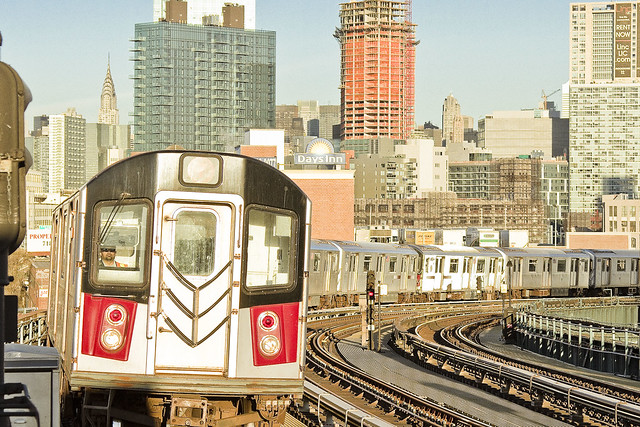
– photo by Mitch Waxman
On April 21st, 1917 – the original 11 stops of the IRT Subway line in Queens opened for business. We call the IRT Flushing line the 7, of course. The first stops on the line in Queens – Vernon/Jackson, Hunters Point Avenue, Court Square, and Queensboro were completed a couple of years earlier – but the stretch along Queens Blvd. and Roosevelt Avenue from 33rd Rawson to 103rd Corona Plaza is 99 years old today.
The NY Times was along for that first ride – leaving Grand Central at 3 p.m. and visiting the first 11 stations of the so called Corona Extension. Check out their reportage here.
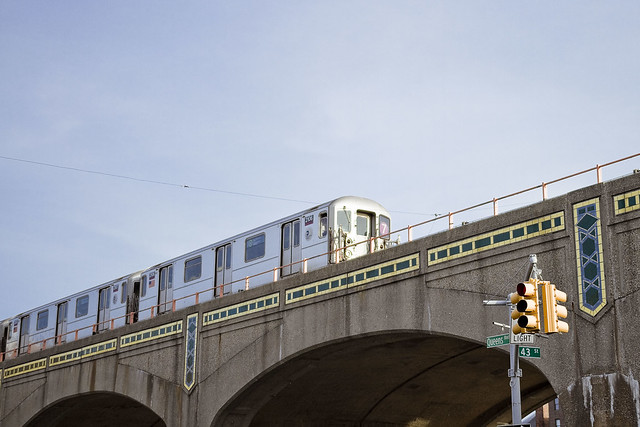
– photo by Mitch Waxman
The original names for these IRT Flushing line stops were Rawson street (33rd), Lowery street (40th), Bliss street (46th), Lincoln street (52nd), Flake street (61st), Fiske Avenue (69th), Broadway (74th), 25th avenue (82nd), Elmhurst avenue, Junction Blvd., and Alburtis avenue (103 Corona Plaza). Willets Point came online in May of 1917, and Main Street in Flushing would open in February of 1928.
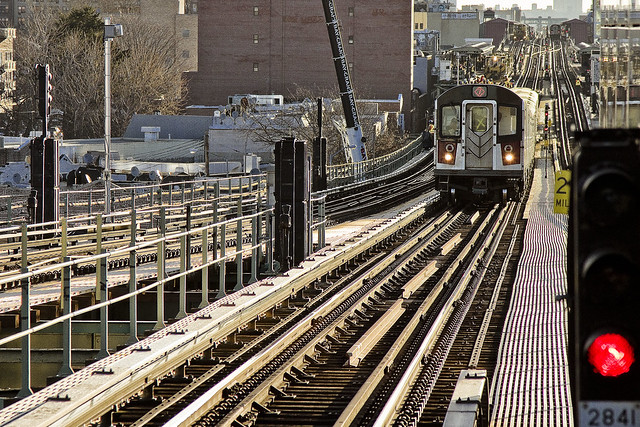
– photo by Mitch Waxman
I actually spent my afternoon yesterday visiting and photographing all of these locations, but was unable to deliver the finished product in time for the anniversary this year, so archive shots of the 7 – some of which have been presented before – are here in their stead.
The historical development of western Queens from a community of farmers and dairymen to the bustling and crowded community of modernity is tied back to several watershed moments in the early 20th century. The opening of Queensboro in 1909, Sunnyside Yards in 1910, and the Steinway subway tunnels opening for business in 1907.
“follow” me on Twitter- @newtownpentacle
Walking Tour – Saturday, April 23rd, 2016 –
First Calvary Cemetery Walk.
Join Newtown Creek Alliance historian Mitch Waxman at First Calvary Cemetery, found in LIC’s Blissville neighborhood along Newtown Creek. Attendance limited to 15 people.
Click here for more info and ticketing.
iron gray
More meeting reportage, in today’s post.

– photo by Mitch Waxman
Recently, I joined up with another community group – Access Queens – an organization which got its start as a Facebook group called the “7 Train Blues.” I’ve been invited onto the steering committee of Access Queens, which seeks to improve communications between the communities found along the “international express” and the MTA, and to advocate for the riding public. All the history projects I’d been working on in 2014 involving the Sunnyside Yards, and Queens rail in general, has gotten me pretty interested in the Subways.
A recent meeting – on Tuesday, the fifth of April, in fact – was organized by Access Queens in conjunction with Councilmember Van Bramer’s office over at the Sunnyside Community Services facility on 39th street, and the MTA sent out a group of its officers for an “Ask the MTA” session wherein the ridership of the aforementioned IRT Flushing Line could express their frustrations and interact with the agency.
Since I’m the new kid on the block, I kept to the sidelines and took pictures rather than running my mouth for a change. Access Queens had a seat at the table with MTA, in the person of one the group’s leaders – Sunnyside’s Melissa Orlando – and believe you me, I don’t have to say a word when Melissa is present – she’s the real deal.

– photo by Mitch Waxman
An interesting facet to this effort, one that I found particularly novel and kind of fascinating, was that both Van Bramer and Orlando were advancing questions to the transit officials which were being live posted on Twitter and on the 7 Train Blues Facebook group. MTA assured all present, and those in other realms, that their “CBTC” switching conversion work was on schedule. Completion of the project would ultimately allow them to increase the hourly frequency of trains on the already “at capacity” line. Overcrowding on platform and train alike were described by the petitioners from the community. There was also a shed load of media in the room.
A recurring theme emerging from the community was that given the ridiculous amount of real estate mega development occurring all along the Queens side of the 7 – Flushing Commons, Willets Point, and Hunters Point were mentioned in particular – NYC’s infrastructure is being badly strained and pushed to the breaking point.
One of the more interesting things that emerged from the community comments was a request to synchronize the timing of the bus system to coincide with the 7 train delays so as to avoid the “wagon train” phenomena of one full then two empty buses all traveling together. A sight commonly observed by Queensicans.

– photo by Mitch Waxman
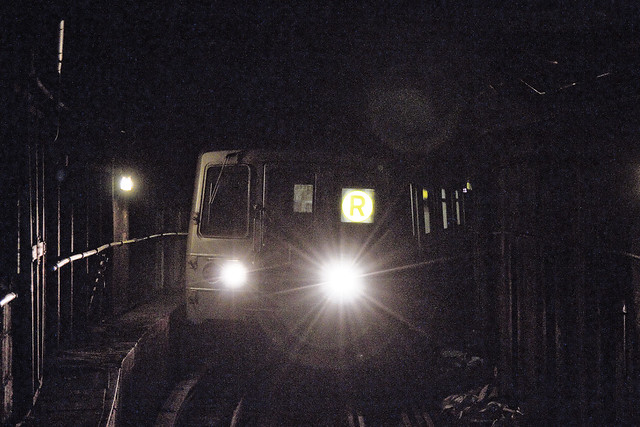
A humble narrator, of course, seldom has the “7 Train Blues” given that one dwells upon the IND R line along Broadway in Astoria rather than the IRT 7 along Queens Blvd. and Roosevelt Avenue. The case has been made, however, that when the 7 is delayed, the masses of Flushing, Roosevelt, and Corona use the IND lines (R, M, E, F) instead of the IRT one. This results in quite a situation during morning commutes, and dangerous overcrowding. This is a borough wide phenomena, and is forecast to get worse before it gets better as the population continues to expand along the already overbuilt transit corridors.
Guess that the folks on my side of Northern Blvd. have the “R train blues.”
“follow” me on Twitter- @newtownpentacle
April 16th, Obscura Day 2016 –
“Creek to Creek Industrial Greenpoint Walking Tour” with Mitch Waxman and Geoff Cobb.
Join Newtown Creek Alliance historian Mitch Waxman and Greenpoint historian and author Geoff Cobb for a three-hour exploration of the coastline of Greenpoint. Click here for more info and ticketing.
mapped egress
The horror, in Today’s Post.
– photo by Mitch Waxman
My post last Friday about the 7 line got me thinking about the Subways of Western Queens, which are referred to as “the horror” in conversations with Our Lady of the Pentacle.
It was the 3rd of April, in 1913, that the City of New York purchased the (Steinway) tunnels utilized by what would become known as the 7 line from August Belmont, and in 1915 service started on June 22. They didn’t know it at the time, but those old timey types were creating the most photogenic of all of New York City’s subway lines.

– photo by Mitch Waxman
Even when it’s underground, such as the busted ass Vernon Jackson stop, the IRT line’s 7 looks good. It’s when it moves into Sunnyside and Woodside that the 7 looks best, of course, but there are few stops in Queens where it doesn’t look pretty cool to this itinerant photographer – notably the stop pictured above and the last one in Flushing are comparatively kind of “meh.”
Everything looks terrible in Manhattan, and nobody would go there if they weren’t paid to do so.
– photo by Mitch Waxman
In comparison, the R – which travels on the IND – is the reliable but visually uninteresting line. It didn’t reach Queens until 1920, but back then it only went to Queens Plaza. The modern route, which goes all the way to Forest Hills, was established in 1949 – but back then it was known as the “RR.”

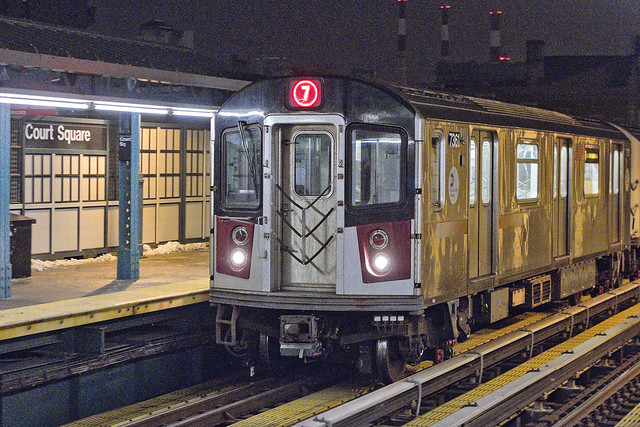
– photo by Mitch Waxman
The interesting thing about the Court Square station, to me at least, is that – at least these days – it offers a free transfer between the IND and IRT systems. Downstairs, you’ve got the G, M, and E lines, and upstairs the 7. To continue with the arcane Subway knowledge – the G line became active in 1933, but it was known as the GG back then. The E also came online in 1933, and it is one of the Subway lines that never sees the light of day operationally as its entire route is underground.

– photo by Mitch Waxman
The M is something of a newcomer to the IND Sixth Avenue tracks, although the line was officially designated as early as 1914. It wasn’t until 2010 that the line was routed into its current path mirroring the R service. It actually pisses me off, M wise, that if I wanted to go to Ridgewood – a mere five miles from Newtown Pentacle HQ on Astoria’s southern border – I would need to endure an hour and change long journey through the Shining City to get there.
Before you inform me – yes – I know all about taking the R to Newtown Grand Avenue and catching the bus – I do it all the time.
“follow” me on Twitter- @newtownpentacle
contracted chill
Nothing like an adventure, MTA style.
– photo by Mitch Waxman
Recent endeavor found me leaving HQ just after the burning thermonuclear eye of God itself had begun its journey across the sky. A humble narrator’s intention was to have been out and about for a couple of hours in the pre dawn part of the day, but one overslept and left the house just as dawn arrived. My eventual destination was in lower Manhattan, and my plan was to be mid span on the Queensboro Bridge when dawn occurred, but as mentioned – I rolled over and kept on sleeping rather than springing out of bed when the alarm sounded at four in the morning. It wasn’t until about 5:30 that I stumbled out into the staggering realities of Astoria.
A brief scuttle across Northern Blvd. and the Sunnyside Yards ensued, and bored with the idea of walking across Queensboro at this point, it was elected that I would catch the most photogenic of all NYC’s Subway lines – the 7 – at 33rd street and cruise into the shadowed corridors of midtown Manhattan.

– photo by Mitch Waxman
The “international express” as it’s known, arrived in the station accompanied by announcements that due to construction there was no Manhattan bound service at 33rd street. Having set aside literally five hours for the walk, I figured I’d just play along and see where the MTA wanted to take me.
As a note, with the exception of the F line, on the weekend of the 5th and 6th of March – there was “no way to get there from here” without playing the game laid out by the MTA.

– photo by Mitch Waxman
The 7 carried me to the 61st Woodside stop, where Manhattan bound service could be accessed. Off in the distance, at what must have been the 69th street station, there were crews of laborers and what seemed like a crane busily at work. The normal “Manhattan bound” side was entirely subsumed by their activity.

– photo by Mitch Waxman
The 7 train, with its multitudinous delays and seemingly constant construction, has spawned a bit of activism. My pal Melissa Orlando, and others, formed first a Facebook group called “The 7 Train Blues,” and have since begun the formation of an organization called “Access Queens” with the intention of acting as advocates for the ridership community along this “international express” traveling between Flushing and Manhattan’s west side.

– photo by Mitch Waxman
On the subject of the 7 train, my immediate response is to discuss its immense photogeneity.

– photo by Mitch Waxman
It is virtually impossible to point a camera at the 7 and not get something interesting. Maybe it’s the low lying nature of Western Queens, with the elevated tracks running at rooftop level… can’t say. After running through the MTA’s perverse hoops, a humble narrator found himself in the Shining City, and what was encountered at my destination will be discussed in a post presented next week at this – your Newtown Pentacle.
“follow” me on Twitter- @newtownpentacle
terrible unseeing
Fear and loathing, in today’s post.

– photo by Mitch Waxman
A bit of research was committed here at HQ to try and ascertain what sort of critters might be found down in the Subway tunnels. I found an interesting study which discussed the distribution of Manhattan bedbug populations – it seems that east side bedbugs display a different DNA profile than west side ones – which the researchers attributed to the separated subway lines. There’s certainly roaches and rats below, no secret there.
Thing is, in a cave system – which is essentially what the subway tunnel network is – rodents, roaches, and beetles are close to the top of the food chain and subsist on diets of lesser insects and invertebrates. Conventional wisdom suggests that it’s the human infestation which supplies caloric fuel to the biota down here, but you never hear tell about centipedes, spiders, worms and all the other creepy crawlies which logically have to be resident in the system. Supposedly there’s a rich and variegated world of micro organisms found in the tunnels, but little in the way of accessible documentation on the subject. Maybe I just haven’t figured out what to call a subway taxonomy, or transit biota census, or whatever obfuscation it’s customary to use for this sort of thing.
A separate study of DNA harvested from the Subway system has reported that a certain percentage of the nucleotides and genetic material present down here emanate from no creature known to science.

– photo by Mitch Waxman
Most everyone has heard stories about “the condos.” For those not in the know: the condos are residences found in side tunnels and abandoned stations that are populated by groups of homeless individuals who are referred to as the “mole people.” MTA says this is both a fabrication and a myth. Urban apocryphals dictate that track workers will freeze in place and refuse to enter subterranean areas where furniture or camping equipment is observed. I’m no Steve Duncan nor LTV Squad, so I can’t intelligently describe these less common sections of the underground, but I can’t imagine that “mole people” would be anything other than strictly anomalous and out of the ordinary in the underground complexes. Simply put, there’s a lot of street level ATM rooms out there these days, and they are air conditioned during the summer.
Saying that, I’m certain that there are a few individuals here and there who have found a Subway hidey hole to camp in. Maybe there are mole people, which I certainly do hope. NYC needs more mole people.

– photo by Mitch Waxman
There’s a surprising lack of occult oriented Subway lore, especially when compared to the famously haunted London system. A humble narrator is always looking around the web for ghostly tales (actually, I have an automated Google search gadget that does it for me) involving NYC, and there’s virtually nothing I can relate. The ghost of a slain track worker here, a 7 foot tall demon seen at Port Authority there – nothing other than that which a decent psychiatrist could prescribe away. That’s weird, actually, but I’ve always found New York somewhat lacking in folkloric traditions as compared to places like Boston or New Orleans or even White Plains.
Most of the subway horror stories I see on the web involve unwanted sexual attention – women being victimized by nut jobs with their nuts out, gropers, lewd talkers and so on. Men of debased mind whom my grandmother would have referred to as “meshigga poyvoyts.”
It should be mentioned that this sort of behavior has always mystified me, and the behavior set is beyond my understanding. I really don’t understand, and wish y’all ladies didn’t have to deal with it.

– photo by Mitch Waxman
Most of New York’s folklore seems to involve real world circumstance rather than the spooky stuff, in my experience. The ones involving the mob, or crime figures in general, have always been the most prevalent. There’s the ones which describe suicides landing on cars or sidewalk cafes, the aforementioned mole people, and sinister or conspiratorial attributions to otherwise mundane occurrences such as “alternate side of the street parking.” The one about dropping a penny off the Empire State Building onto a guys head, the ghost train at Hell Gate Bridge, and that old chestnut about the birth rate jumping nine months after the 1965 blackout.
It’s actually fairly hard to find a good New York City ghost story, as in something iconic. Guess all the superstitious types moved north or west after the civil war.

– photo by Mitch Waxman
Personally, I miss earwire. That’s the name I assigned to some nut who I used to see on the R train during daily commutes, whose “thing” was dipping a length of copper wire into a jar of what looked like mercurochrome and then playing a lighter over the anointed cable, whereupon he’d jam it into and then dig it around in his ear. He’d pull the wire back out, thoughtfully consider the length and then talk to it.
He was puzzling and grotesque, but hardly an urban legend.
“follow” me on Twitter- @newtownpentacle


 The Newtown Pentacle