Archive for the ‘Sunnyside Yards’ Category
brotherly piety
“follow” me on Twitter at @newtownpentacle

– photo by Mitch Waxman
The back situation seems to be ameliorating itself, thankfully- and as this post is being written- has transmogrified from a crippling stiffness and intermittent sword blade of pain to a dull and omnipresent ache. Ultimately, this is a good thing, as I have actually managed to sleep without interruption for two days in a row and am able to move about in fine fettle. With luck, I will be able to resume my wanderings in a day or two, but for now- here’s another “Then and Now” shot, this time of the Paragon Oil building on Hunters Point Avenue in venerable Long Island City’s industrial quarter. It should be mentioned that I am fascinated by this building.
This edifice- known sometimes as “the Subway Building” and others as the “Paragon Oil building”- was, in fact, Queens Borough Hall. Check out the January 2012 posting “high doors” for more on the structure.

– photo by nycma.lunaimaging.com, August 7, 1936
The shot pictured above emanates from the awesome collection of historic photographs made available by the NYC Municipal Archives, and was captured by a now anonymous municipal photographer in August of 1936. The center of Queens during the 1930’s, this was Borough Hall. Back then, the power brokers of the borough located themselves nearby the Newtown Creek and perched high above the southern extant of the Sunnyside Yard and alongside the Long Island Railroad tracks. Prior to this, the unofficial Borough Hall of Battleaxe Gleason was located at the Miller hotel (which would become the LIC Crab House) and the official one was on Jackson Avenue nearby modern day Court Square.
nature and position

– photo by Mitch Waxman
Shenanigans continue on the weekends, here in the heart of the perennial “next big thing” known to most as Long island City. When the “next big thing” term originally applied, in 1909, it actually was true and a vast industrial city sprang forth from amongst scattered mills and swamps overlaid with rail tracks. That whole thing lasted around twenty or thirty years, whereupon the neighborhood began a long and slow decline. In the late 1980’s, LIC became the “next soho” and then in the late 90’s the “next DUMBO”, and of late the “next Williamsburg”. Problem is that these days, it’s just kind of difficult to get around the place without a car, which is ironic, as this is where all the trains are headed.
from mta.info
Work Completed
Court Sq Station was closed for ten weeks between January and April. During the time the station was closed, we replaced the Manhattan-bound and Flushing-bound platforms and windscreens (platform walls), installed ADA accessible boarding areas, tactile warning strips, and signage. In addition, new track and platform to mezzanine stairways were installed and the station’s mezzanine and columns on station platforms were painted.
At Hunters Point Av, during an 11-month construction project we installed new column and wall tiles, a floor in the mezzanine, new railings and stainless steel handrails and light fixtures above stairs. In addition, we refurbished the street and platform stairs, painted the mezzanine, platform and track ceilings and repaired structural steel above the platforms and tracks. Also, water leaks were sealed and the public address system was modified.
A six-month station improvement project at Vernon Blvd-Jackson Av resulted in repairing/replacing station column and wall tiles; repairing platform surfaces and platform edge concrete; and repairing and painting platform and track ceilings. Station lighting and platform drainage was upgraded, and tactile ADA (Americans with Disabilities Act) warning strips and new rubbing boards (edge of platform) were installed.

– photo by Mitch Waxman
They just love to mess around with us on the weekends, don’t they? Turn off entire subway lines while running the buses on weekend schedules. Just a few weeks ago, signal problems on the R and N tracks also shut down the G, F, and E- all this on the same day that 7 service was closed for maintenance. This put western Queens in quite a pickle, except for those who ride bicycles or drive cars.
from wikipedia
Long Island City is served by the elevated BMT Astoria Line (N Q trains) and IRT Flushing Line (7 ; trains) of the New York City Subway. It is also served by the underground IND 63rd Street Line (F train), IND Queens Boulevard Line (E F M R trains) and IND Crosstown Line (G train). The Long Island City and Hunterspoint Avenue stations of the Long Island Rail Road are here, and a commuter ferry service operated by NY Waterway at the East River Wharf. Cars enter by way of the Queensboro Bridge, the Queens Midtown Tunnel and the Pulaski Bridge. The Roosevelt Island Bridge also connects Long Island City to Roosevelt Island. Queens Boulevard, Northern Boulevard (New York 25A) and the Long Island Expressway all pass through the area.

– photo by Mitch Waxman
The “next big thing”, you have to understand, is the concentrating point of transportation infrastructure on western Long Island. The Long Island Expressway terminates at the Midtown Tunnel, and the various rail tunnels peppered about this ancient city are the choke point for subway, LIRR, and Amtrak service into and out of Manhattan. Losing any one piece of the system is massively disruptive, especially when it becomes a multi month affair as it was in the first quarter of 2012. Luckily, we are about to enjoy another protracted period of transit outages in 2013, and your humble narrator has grown quite used to walking.
from wikipedia
The Steinway Tunnel carries the 7 ; trains of the New York City Subway under the East River between 42nd Street in Manhattan and 51st Avenue in Long Island City, Queens, in New York City. It was originally designed and built as an interurban trolley tunnel (hence the narrow loading gauge and height), with stations near the 7 ; trains’ current Hunters Point Avenue and Grand Central stations. It is named for William Steinway, who was a major promoter of its construction, although he died in 1896 before it was completed.
Also- Upcoming Newtown Creek tours and events:
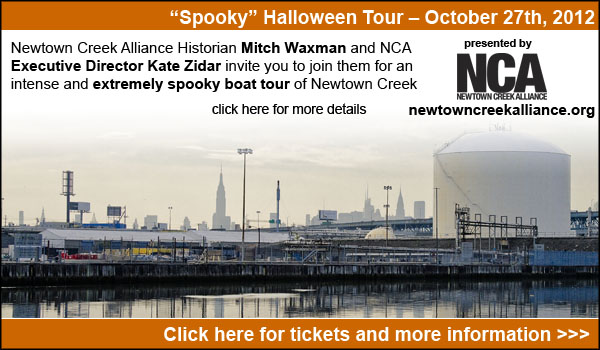
for more information on the October 27th Newtown Creek Boat Tour, click here

for more information on the November 9th Newtown Creek Magic Lantern Show, click here

for an expanded description of the November 11th Newtown Creek tour, please click here
harnessed shadows

– photo by Mitch Waxman
To begin with, you will be hard pressed to find someone who is a bigger supporter of the efforts of the NYPD than your humble narrator. Vast physical inadequacies and a timorous constitution render one a “victim waiting to happen” and the presence and oversight of the gendarme is the only reason that you haven’t heard about finding my corpse lying in the street somewhere, as we live in a community cursed with predators and a criminal element which threatens all. Saying that, I recently attended a meeting of the 114th pct. community council here in Astoria, and one of the speakers was a representative of the “Anti Terror” squad. I have long been a proponent of the single truth of a “Terror War” which is that the side which most scares the shit out of the other is the one who wins. Apparently, the other guys have the upper hand at the moment, as we continue to be a reactionary and terrified opponent given to wild flights of fancy about the capabilities enjoyed by the enemy- including the deadly martial art of photography.

– photo by Mitch Waxman
This unit is tasked with subverting and detecting terrorist plots, gathering intelligence on “bad actors”, and performing a role few would ask for. The representative who spoke at this meeting, however, informed the community that should they witness- for example, someone taking photographs of bridges or other “odd” things- that they should call the police and report it as suspicious behavior. After his statement was concluded, the Lieutenant was suddenly faced with an odd mendicant named Mitch who confronted him on this. I asked “Did you actually just tell the room that photography is a precursor to terrorism”?

– photo by Mitch Waxman
I let the Lieutenant know that I ran a blog, and was speaking to him in the manner of a journalist. “Other than the fact that there is no documented evidence of this, and that google maps would actually be a far more effective tool to scout a potential target than sending out an operative with a dslr, there are specific orders curtailing the harassment of photographers issued by Chief Kelly” I continued. Then, I asked him about the glaring lack of security and holes in the fences around the Sunnyside Yard and the energy infrastructure around Newtown Creek. I asked about the boats tied off to the Buckeye pipeline at Vernon Blvd. street end, the ferry boat on English Kills, and several other choice spots for undocumented and uncommented deviltry to occur. Additionally, did he know that there are websites which claim that anyone can find a free berth on Newtown Creek and that boats regularly show up there these days from unknown points carrying who knows what? I had to remind him where Newtown Creek and the largest rail yard in New York City was, as he seemed rather focused on Manhattan.
Also- Upcoming Newtown Creek tours and events:

for an expanded description of the October 20th Newtown Creek tour, please click here
for more information on the October 27th Newtown Creek Boat Tour, click here
for more information on the November 9th Newtown Creek Magic Lantern Show, click here
for an expanded description of the November 11th Newtown Creek tour, please click here
lands adjacent

– photo by Mitch Waxman
Found along Jackson Avenue in Long Island City, in the stretch between 21st Street and Queens Plaza, there are several truncated little blocks. Part of an earlier street grid pre dating the 20th century and the Queensboro Bridge, some host residences while others are partly residential while others are entirely industrial. All of these lanes share one commonality, which is ending where the Sunnyside Yard begins. Dutch Kills Street starts at Jackson Avenue and ends a mere block later at the fenced in rail yard.
from wikipedia
Dutch Kills is an area within Long Island City, in the New York City borough of Queens. It was a hamlet, named for its navigable tributary of Newtown Creek, that occupied what today is centrally Queensboro Plaza. Dutch Kills was an important road hub during the American Revolutionary War, and the site of a British Army garrison from 1776 to 1783. The area supported farms during the 19th Century, and was finally consolidated in 1870 with the villages of Astoria, Ravenswood, Hunters Point and Blissville to form Long Island City.

– photo by Mitch Waxman
Perpetual shadow stains the street here, titan masonry is sky flung and the steel of mighty Queensboro’s exit ramps is singing high above the pavement. Tumultuous passings of rail on the other side of an overgrown fence declare themselves loudly, and all around is evidence of poor drainage. A lonely dead end, it is one of the places where the residents of Queens enjoy indulging in the two art forms that the Borough is known for- illegal dumping and graffiti.
from wikipedia
The Pennsylvania Railroad (PRR) completed construction of the yard in 1910. At that time Sunnyside was the largest coach yard in the world, occupying 192 acres (0.78 km2) and containing 25.7 mi (41.4 km) of track. The yard served as the main train storage and service point for PRR trains serving New York City. It is connected to Pennsylvania Station in Midtown Manhattan by the East River Tunnels. The Sunnyside North Yard initially had 45 tracks with a capacity of 526 cars. The South Yard had 45 tracks with a 552 car capacity.

– photo by Mitch Waxman
A lurking menace is sensed here, the surety that one is being watched from cover. A risible smell colors the air, one which betrays the odors of mold and rot and urine. It is odd to be so close to the center of the human infestation, yet so totally alone. It would be very easy to disappear here, and imagined perils spring into the forefront of ones mind. The shining promise of the Degnon Terminal glowers with ambition and thwarted aspiration, providing backdrop and counterpoint.
from nytimes.com
PROGRESS is the watchword of Queens Borough at the present time, especially of the Queensboro Bridge Plaza and the adjacent parts of Long Island City. Never before have there been so many striking object lessons of this forward movement in that long-neglected borough as may be seen today within a few blocks of the spacious approach to the bridge.

– photo by Mitch Waxman
Some poor soul calls this place their own, living in a makeshift shanty. So many of the “working homeless” are observed around these back alleys and forgotten corners, lonely vagabonds ekeing out a subsistence living while living in squalor, surviving by craft and guile. What strange experiences and odd tales could they relate about what happens in the dark of night, here on Dutch Kills Street?
from wikipedia
Modern homelessness started as a result of economic stresses in society and reductions in the availability of affordable housing such as single room occupancies (SROs) for poorer people. In the United States, in the 1970s, the deinstitutionalisation of patients from state psychiatric hospitals was a precipitating factor which seeded the homeless population, especially in urban areas such as New York City.
The Community Mental Health Act of 1963 was a predisposing factor in setting the stage for homelessness in the United States. Long term psychiatric patients were released from state hospitals into SROs and supposed to be sent to community mental health centers for treatment and follow-up. It never quite worked out properly, the community mental health centers mostly did not materialize, and this population largely was found living in the streets soon thereafter with no sustainable support system.
Also, as real estate prices and neighborhood pressure increased to move these people out of their areas, the SROs diminished in number, putting most of their residents in the streets. Other populations were mixed in later, such as people losing their homes for economic reasons, and those with addictions (although alcoholic hobos had been visible as homeless people since the 1890s, and those stereotypes fueled public perceptions of homeless people in general), the elderly, and others.

– photo by Mitch Waxman
Although nothing of the sort was observed on this visit, one often sees candles and small altars to unknown gods in these places. Offerings of coins, foodstuffs, and cigars have often been noted amongst these arrangements. Peasant superstition and magicks are often the recourse of the desperate and desolated, however.
from wikipedia
Beliefs in witchcraft, and resulting witch-hunts, existed in many cultures worldwide and still exist in some today, mostly in Sub-Saharan Africa (e.g. in the witch smellers in Bantu culture). Historically these beliefs were notable in Early Modern Europe of the 14th to 18th century, where witchcraft came to be seen as a vast diabolical conspiracy against Christianity, and accusations of witchcraft led to large-scale witch-hunts, especially in Germanic Europe.
The “witch-cult hypothesis”, a controversial theory that European witchcraft was a suppressed pagan religion, was popular in the 19th and 20th centuries. Since the mid-20th century, Witchcraft has become the self-designation of a branch of neopaganism, especially in the Wicca tradition following Gerald Gardner, who claimed a religious tradition of Witchcraft with pre-Christian roots.
____________________________________________________________________________
Click for details on Mitch Waxman’s
Upcoming walking and boat tours of Newtown Creek
July 8th, 2012- Atlas Obscura Walking Tour- The Insalubrious Valley
(note: there was just one ticket left for this one when I hit “publish”)
for July 8th tickets, click here for the Atlas Obscura ticketing page
July 22nd, 2012- Working Harbor Committee Newtown Creek Boat Tour

graceful valleys

– photo by Mitch Waxman
A structure which may be discerned in the distance, within the shot above, at Sunnyside Yards is the 35th street or Honeywell Bridge. The location of the camera which captured it was astride the 39th street or Harold Avenue bridge at Steinway Street, where ongoing construction has rendered a hidden breach in the fencing which normally frustrates its purpose by obfuscating the view.
For a discussion of another of the bridges which cross these titan rail yards, click here for the posting “incaculable profusion”, examining the Thomson Avenue Viaduct to the west.
from forgotten-ny.com
When the Yards were built, Long Island City, to the north of the Yards, was effectively cut off from Sunnyside and Maspeth, to the south. Viaducts were built at Queens Boulevard (which was itself under construction in 1910), Honeywell Street, Harold Avenue, and Thomson Avenue. Laurel Hill Avenue (43rd Street) Gosman Avenue (48th Street) and Woodside Avenue were carried under the railroad.

– photo by Mitch Waxman
A paucity of such apertures in the fence lines around the yards exists, which is appropriate in this age of heightened vigilance, and the discovery of something large enough to accept the lens of a dslr is tantamount to observing a unicorn to one such as myself. Of course in the midst of all this faux security and theater, I can show you a dozen different places where you could work mischief if you chose to. Such is always the case with large installations like this one, however, and illegal trespass is not the Newtown Pentacle way.
The real estate happy characters in Manhattan are desirous to rob me of this vista, as evidenced in the document linked to below, describing the feasibility and benefits of decking over these yards and expanding the population of western Queens by tens of thousands. It seems to be a plan of some vintage, however, crafted before the financial crisis and concurrent economic crisis experienced by the region and country at large since 2008 (when do we get to start calling this a depression?).
from nyc.gov
Sunnyside Yards, one and three-quarters of a mile long and 1,600 feet across at its widest point, is the largest site in this inventory. The total deckable airspace of its 14 parcels – over 167 acres – is more than double the size of the next largest airspace site, the 74-acre NYCT Coney Island Maintenance Shop and Yards (K5000). This one corridor contains around one-sixth of the entire deckable airspace in this inventory.
The potential for large scale land uses above these yards is extraordinary. With the possible exception of Staten Island’s west shore, no other large tracts of “vacant” land remain in the City. Moreover, Sunnyside Yards is defined by a surrounding context of relatively dense development and plentiful transit access.
At the behest of former Deputy Mayor for Economic Development and Rebuilding Daniel Doctoroff, DCP’s Housing, Economic and Infrastructure Planning (HEIP) unit conducted a preliminary analysis concerning the viability of decking over and developing Sunnyside Yards. The HEIP unit determined that the most desirable sites within the yards were two roughly rectangular areas running from the southwest to the northeast; the northern third of both sites is located northeast of Queens Boulevard.

– photo by Mitch Waxman
These trusses which fly over the Sunnyside Yards are actually rather new. The Honeywell and Harold Bridges (39th and 35th streets), for instance, were totally rebuilt recently. The Honeywell Bridge reopened in 2003 after having laid fallow and closed to pedestrian and vehicle traffic for better than 20 years. The night shot above, by the way, is betrayed by its format and shape as being from my trusty old Canon G10, which is still in service at this- your Newtown Pentacle.
from nytimes.com
In 1979, inspectors from the city’s Department of Transportation judged the 1,600-foot four-lane bridge, which was built in 1909, to be on the verge of falling down. The inspection occurred near the end of an era in which the city, nearly broke and as exhausted as a disco dancer at dawn, partly balanced its budget by deferring maintenance on bridges. Tom Cocola, a department spokesman, said once costs had been cut by removing the bridge from the city’s regular inspection schedule, ”we probably just forgot about it.”


 The Newtown Pentacle