Archive for the ‘Moran’ Category
curious customs
– photo by Mitch Waxman
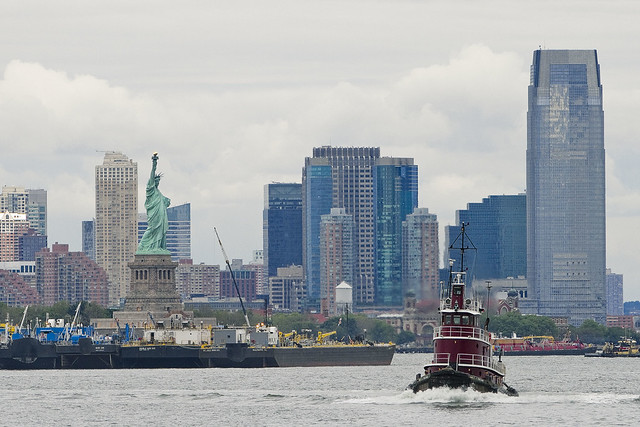
The Marie J. Turecamo tug presented itself to a humble narrator recently, framing iconic views of the harbor for your perusal on this week’s “Maritime Sunday”. Periodically, when some magazine art buyer or advertising stalwart is looking for a harbor shot, my phone will ring and someone will ask for “a tugboat moving past the Statue of Liberty” or something similar. Invariably, the caller is seeking out free usage of the shot.

– photo by Mitch Waxman
Other photographers get angry with me when I allow free usage of this shot or that to various personages or groups, accusing me of devaluing the craft. “Information wants to be free” is my normal reply, and “an image too dearly held has no intrinsic valuation” is the follow up. This is when I’m called a schmuck, and informed that I’m being “taken advantage of”. Allow me to set the record straight on this subject, lords and ladies.

– photo by Mitch Waxman
A regular beneficiary of my largesse, whether it be the estimable Working Harbor Committee or the Newtown Creek Alliance or any of the other “worthy” harbor groups whom I regularly supply images to, receives a limited license to the photo. They cannot, for instance, use my shots in a manner which I haven’t specified or agreed to- web usage versus printed material. A byline is required, and if at any time I decide to ask them to pull the shot, this is my right as I’m retaining the image copyright and full usage rights. In advertising lingo, the shots are offered and licensed as “stock”, and the compensation asked for use of them is somewhat asymmetrical and seldom monetary.

– photo by Mitch Waxman
What I’m ultimately after is photographic access to people, places, and situations which are normally unattainable. I’ve been inside the Manhattan Bridge, walked on a Queensboro bridge completely devoid of traffic, been privy to dozens of situations that “press” photographers would have killed to get near. I’ve been to off limits spots all around the harbor, delved into the deepest recesses of the City, ascended to unattainable and high vantages, and seen things that most living New Yorkers barely suspect. If a group is doing something worth doing, as in the case of WHC with its education programs and senior citizen programming, or NCA’s quest to save the Newtown Creek from sophistry- I’m happy to donate the usage of a few images. On the other hand, if you see something you’d like a print of, or would like to license an image or two for commercial usage- contact me here.
sight within

– photo by Mitch Waxman
Maritime Sunday is here once again, and this time around your Newtown Pentacle is focusing in on something most New Yorkers wouldn’t believe exists within the five boroughs- graving or dry docks. These shots are of the Cadell yard, along the Staten Island border formed by the Kill Van Kull.
from wikipedia
A floating drydock is a type of pontoon for dry docking ships, possessing floodable buoyancy chambers and a “U” shaped cross-section. The walls are used to give the drydock stability when the floor or deck is below the surface of the water. When valves are opened, the chambers fill with water, causing the drydock to float lower in the water. The deck becomes submerged and this allows a ship to be moved into position inside. When the water is pumped out of the chambers, the drydock rises and the ship is lifted out of the water on the rising deck, allowing work to proceed on the ship’s hull.

– photo by Mitch Waxman
Tugs, in particular, take a lot of abuse. Towing hundreds of millions of tons through choppy waters puts terrific strain on their hull and superstructure. Just like the family car, they occasionally need to head for a garage to be inspected and repaired- or just painted to avoid the corruption of oxidation.
from caddelldrydock.com
CADDELL DRY DOCK AND REPAIR CO., INC (Caddell) accommodates a wide variety of marine vessels on its floating dry docks and piers. The Caddell facility is one of the largest full service shipyards in the New York Metropolitan Area. In addition to our dry docking services, we offer pier side repair work available on our network of eight piers with crane operations able to extend up to 200′ and capable handling loads up to 6500 tons. Caddell has carried on the noble maritime tradition and legacy of a uniquely exceptional shipyard by providing quality and prompt service at competitive prices for the surounding New York City region for more than a century.

– photo by Mitch Waxman
Like a lot of heavy industries, the graving docks have largely left New York City. Large facilities at Atlantic Basin in Red Hook and other places have simply been left to rot away. The ones in Staten Island seem to be hanging on, doing essential work that keeps the harbor moving.
from globalsecurity.org
Building and repairing boats and ships was Staten Island’s most important industry before the First World War. One of the Island’s earliest and most important shipyards belonged to William and James M. Rutan. Their shipyard produced about a 100 schooners and sloops per year. There were 17 shipyards on Staten Island by 1880, located on the North Shore, in Stapleton and in Tottenville. Tugs, propeller yachts and coal barges were built there. US Navy and international shipping in the late 1800s produced a need for large shipyards. They could be found along the Kill van Kull near Mariners Harbor and Port Richmond. In 1901-1902, Townsend and Downey Shipyard built the Meteor III, an imperial yacht for Kaiser Wilhelm. By the 1920s, 18 shipyards employed 6,800 people.

– photo by Mitch Waxman
This is from the Brooklyn Navy Yard, and shows the other sort of drydock, a granite pit outfitted with sea walls and gargantuan pumping mechanisms that can accommodate all but the very largest shipping.
from wikipedia
On the eve of World War II, the yard contained more than five miles (8 km) of paved streets, four drydocks ranging in length from 326 to 700 feet (99 to 213 meters), two steel shipways, and six pontoons and cylindrical floats for salvage work, barracks for marines, a power plant, a large radio station, and a railroad spur, as well as the expected foundries, machine shops, and warehouses. In 1937 the battleship North Carolina was laid down. In 1938, the yard employed about ten thousand men, of whom one-third were Works Progress Administration (WPA) workers. The battleship Iowa was completed in 1942 followed by the Missouri which became the site of the Surrender of Japan 2 September 1945. On 12 January 1953, test operations began on Antietam, which emerged in December 1952 from the yard as America’s first angled-deck aircraft carrier.
The US Navy took possession of PT 109 on 10 July 1942, and the boat was delivered to the Brooklyn Navy Yard for fitting.
This boat was sunk in the Pacific in August 1943 and became famous years later when its young commander, Lt. John F. Kennedy, entered politics.
At its peak, during World War II, the yard employed 70,000 people, 24 hours a day.
wild dances

– photo by Mitch Waxman
It’s Maritime Sunday again, here at your Newtown Pentacle, a weekly post which focuses in on and examines some aspect of NY Harbor- or the Sixth Borough as our friends from Tugster call it.
As many of you know, your humble narrator is quite the enthusiast for such matters, and serves as a Steering Committee member for the Working Harbor Committee. This role and set of interests often puts me in a position to witness and photograph interesting circumstance around the harbor, which these “Maritime Sunday” postings endeavor to share.
Today’s spotlight is cast upon the Moran Towing Tug “Kimberly Turecamo”.

– photo by Mitch Waxman
There are quite a few tugs with the surname Turecamo that are operated by Moran Towing, the result of a merger between two towing companies in the age of corporate expansion and conglomeration. The founder of Turecamo Coastal was born on an island in the Tyrrhenian Sea called Isola Lipari, part of the Aeolian Archipelago that straddles the distance between Mount Vesuvius and Mount Etna in fabled Italy. Lipari has a long and sordid history, a story which stretches back in time to the Estruscans, Greeks, and the Romans. The Island was once conquered by Arab Pirates, after all.
This of course, has nothing to do with the Tugboat Kimberly Turecamo, its just nice to know where certain folks hail from. The guy from Cake Boss on the TLC Channel, and Natalie Imbruglia- their dads come from Isola Lipari as well.
Turecamo Coastal and Harbor Towing Corporation was foundeded by Bartholdi Turecamo, who immigrated from Isola Lipari, a small island between the northern coast of Sicily and the southern tip of Italy. As an immigrant Turecamo found work in road construction around New York.

– photo by Mitch Waxman
Kimberly Turecamo, the tug, is from Louisiana. She also was one of the ships which assisted in the evacuation of lower Manhattan on September 11, 2001. One of the great stories from that day, it’s only the persistent modesty of those sailors who managed to move more than a quarter million people out of harms way that prevents this story from pervading the popular imagination.
Sailors are a different breed, and immodest only amongst themselves.
from morantug.com
It is reported that as many as 300,000 people were evacuated from lower Manhattan during an eight hour period following the attacks. When the evacuation first began, Moran had 11 tugs on the scene, each taking as many as 100 people to designated sites around the port, and to New Jersey. “After the initial surge of evacuation, we went down to about five boats on the scene, still working around the clock, and after four or five days we still had two boats working there at the end,” said Keyes. “As soon as the people were taken off, the boats were used for moving emergency crews, equipment and supplies.”
Moran tugs logged a total of 256 hours during the operation, according to Keyes. The tug Turecamo Boys was on the scene longest, with 84 hours logged, followed by Marie J. Turecamo with 51 hours and Margaret Moran with 49 hours. Other tugs involved with the evacuation were Nancy Moran, Brendan Turecamo, Kathleen Turecamo, Diana Moran, Kimberly Turecamo, Miriam Moran, Turecamo Girls and Catherine Turecamo.

– photo by Mitch Waxman
The iconic white “M” on their black stacks, coupled with the scarlet hull and white detailing, make Moran tugs the easiest craft to spot in NY Harbor. As mentioned in the past, there is just something iconic about them, and if you were to ask someone to describe a tugboat blindly- they would probably craft an image of something not unlike the Kimberly Turecamo.
Built in 1980, by McDermott Shipyard of Morgan City, Louisiana (hull #255) as the Rebecca P.
The tug was later acquired by Turecamo Maritime where she was renamed as the Kimberly Turecamo .
In 1998, Turecamo Maritime was acquired by the Moran Towing Corporation where the tug retained her name.

– photo by Mitch Waxman
Kimberly Turecamo is at work in the shot above, guiding a fuel tanker through the narrow Kill Van Kull waterway. The Kill Van Kull at it’s narrowest point, between New Jersey and Staten Island, is a scant thousand feet wide and might boast a depth of merely 40-45 feet above the soft bottom. The cargo ships which come here in pursuit of trade are ocean going vessels whose titan engines would provide a lack of subtlety in handing such conditions.
The Kill Van Kull is a tidal straight, incidentally.
from morantug.com
Moran commenced operations in 1860 when founder Michael Moran opened a towing brokerage, Moran Towing and Transportation Company, in New York Harbor. The company was transformed from a brokerage into an owner-operator of tugboats in 1863, when it purchased a one-half interest in the tugboat Ida Miller for $2,700.
At the time, the Harbor was alive with ships – many of them still sail-powered – and Moran’s enterprise soon grew into a fleet of tugboats. It was Michael Moran himself who painted the first white “M” on a Moran tugboat stack, reportedly around 1880.

– photo by Mitch Waxman
An interesting bit of trivia about the harbor of New York is that its natural depth is a mere 17 feet, but was deepened by the actions of dredging to 24 feet before the end of the 19th century. The large ships of modernity utilize shipping channels which are deeper than the surrounding area, in particular the Ambrose Channel- a 1914 construct.
Ambrose leads the way in from a spectacular natural formation, a depression on the continental shelf called the New York Bight.
The Bight is clove by the terrifying depths of the Hudson Canyon.
from wikipedia
The western edge of Newark Bay was originally shallow tidal wetlands covering approximately 12 square miles (31 km2). In 1910s the City of Newark began excavating an angled shipping channel in the northeastern quadrant of the wetland which formed the basis of Port Newark. Work on the channel and terminal facilities on its north side accelerated during World War I, when the federal government took control of Port Newark. During the war there were close to 25,000 troops stationed at the Newark Bay Shipyard.
crooked boughs

– photo by Mitch Waxman
This Tug, the Gramma Lee T. Moran, was mentioned in a Newtown Pentacle posting of November 26- “loose and displaced“. As it’s one of my favorite tugs in New York Harbor to shoot, I felt a little bad that the starring role in that posting had gone to a cargo ship- and that Gramma Lee T. Moran had to share the second banana position with another Moran Tug- the estimable Marion Moran.
Can’t tell you why I like the esthetics of this ship so much, nor can I say why exactly it always reminds me of the Millennium Falcon (from the Star Wars movies) as it slides along the Kill Van Kull.
from wikipedia
The Kill Van Kull is a tidal strait approximately 3 miles (4.8 km) long and 1,000 feet (305 m) wide separating Staten Island and Bayonne, New Jersey, USA. The name kill comes from the Middle Dutch word kille, meaning “riverbed” or “water channel.”
Kill Van Kull connects Newark Bay with Upper New York Bay. The Robbins Reef Light marks the eastern end. Historically it has been one of the most important channels for the commerce of the region, providing a passage for marine traffic between Manhattan and the industrial towns of New Jersey. Since the final third of the 20th century, it has provided the principal access for ocean-going container ships to Port Newark-Elizabeth Marine Terminal, the busiest port facility in the eastern United States and the principal marine terminal for New York Harbor.

– photo by Mitch Waxman
These two shots are from just a few months ago, captured in the fall of 2011. It’s always odd seeing a tugboat operating without a barge, or tending a larger vessel which can be hundreds of times larger than itself. The majesty of these ships, and their crews, come alive when they are tasked with bearing such sisyphean burdens.
Can you imagine what it must be like guiding a fuel tanker into the narrow Kill Van Kull or down the East River? It must take nerves of steel to muster the confidence needed to Captain such tasks.
from tugboatenthusiastsociety.org
Tugs are “displacement” hull vessels, the hull is designed so water flows around it, there is no consideration for having the vessel “plane”. Because of this the hull form is limited to a maximum speed when running “free” that is about 1.5 times the square root of the waterline length. As the tug approaches this speed when running “free” it is perched between the bow wave and the stern wave. Since the hull cannot plane, application of additional power when approaching maximum hull speed only results in a larger bow wave, with the tug “squatting” further into the trough.

– photo by Mitch Waxman
The shot above, and the one below are from earlier in 2011- April to be exact.
Moran is a well established company which operates tugs all over North America. A century and a half old, the company’s fleet can be found on the USA’s Pacific and Atlantic coasts and within the Great Lakes, both along the west coast of- and in the Gulf of- Mexico, and within the inland waters of the eastern United States. They’ve been known to operate periodically as far away as the Caribbean Sea and South American waters.
from morantug.com
The LEE T. MORAN is an expression of brute power and utility that belies the refinements of technical engineering below her waterline. There, twin ports are cut into the steel hull to make room for the tug’s Z-drive units. On the floor of the shop they look like the lower units of giant outboard engines. Made by Ulstein, a subsidiary of Rolls-Royce, the Z-drive functions much like an outboard. Imagine two outboards extending straight down through the hull, each having the ability to rotate 360 degrees. That makes even a heavy, 92-foot tug with a 450-ton displacement very maneuverable. “It can turn on a dime,” says Doughty. “The hull bottom is slightly flatter to adjust to the two drive units. By turning each drive out 90 degrees, the captain can go from full-ahead (14 knots) to a dead stop in no time.”

– photo by Mitch Waxman
Perhaps it’s the low slung aspect of the wheelhouse, or the gentle curves observed in its hull… I can’t say, but there is just something pleasing about the design of this boat. A big toot goes out from this, your Newtown Pentacle, to one of my favorite citizens of the NY Harbor- the Gramma Lee T. Moran.
Moran Towing began operations in 1860 when founder Michael Moran opened a towing brokerage, Moran Towing and Transportation Company, in New York Harbor. In 1863, the company was transformed from a brokerage into an owner-operator of tugboats when it purchased a one-half interest in the tugboat Ida Miller for $2,700. Over time Moran acquires a fleet of tugboats. It was Michael Moran who painted the first white “M” on a Moran tugboat stack, in 1880.
loose and displaced

– photo by Mitch Waxman
Recent activities had carried your humble narrator to… Staten Island… A friend’s photography was included in a gallery exhibit at the venerable Snug Harbor, and wishing to both show support for another photographer and to witness his work in print form- I began the long journey from Astoria in Queens to the outermost of boroughs. After exiting the ferry, I was titillated by the sudden appearance of the gargantuan “Hanjin Lisbon” being guided toward the Kill Van Kull by two Moran tugs.
from marinetraffic.com
- Hanjin Lisbon Vessel’s Details
- Ship Type: Cargo
- Year Built: 2003
- Length x Breadth: 278 m X 40 m
- DeadWeight: 67979 t
- Speed recorded (Max / Average): 21 / 20.6 knots (20.6 knots = 23.7060566 mph)

– photo by Mitch Waxman
Like all the ocean going vessels of its type, the Lisbon is a lumbering monster of a ship. Nearly 1,000 feet in length, the cargo ship was most likely headed to the Port facilities at Newark Bay, and requires the use of tender boats to navigate the relatively narrow and hazard fraught coastal leg of its journey to New York harbor from some impossibly foreign port. It’s titan engines and onboard electronics can propel the ship through open ocean with great accuracy, of course, but the giant cargo ship can’t exactly “stop on a dime”.
from marinetraffic.com
MARION MORAN Vessel’s Details
- Ship Type: Tug
- Year Built: 1982
- Length x Breadth: 39 m X 12 m
- DeadWeight: 10 t
- Speed recorded (Max / Average): 14.5 / 8.9 knots
- Flag: USA [US]
- Call Sign: WRS2924
- IMO: 8121812, MMSI: 366941020

– photo by Mitch Waxman
Tugboat and towing services of the modern era, like Moran towing, are inheritors of centuried wisdom passed down from generations of mariners. The complex currents, mores, and eddies of the harbor are well known to the crews of these vessels and their job includes guiding such massive visitors to the port into safe harborage. Two tugs were observed at work, the Marion Moran and the Gramma Lee T. Moran.
Moran Towing began operations in 1860 when founder Michael Moran opened a towing brokerage, Moran Towing and Transportation Company, in New York Harbor. In 1863, the company was transformed from a brokerage into an owner-operator of tugboats when it purchased a one-half interest in the tugboat Ida Miller for $2,700. Over time Moran acquires a fleet of tugboats. It was Michael Moran who painted the first white “M” on a Moran tugboat stack, in 1880.

– photo by Mitch Waxman
Iconic, Moran tugs are distinguished their large white “M” logo and the white and maroon “color way” which allows them to be identified at great distances across the harbor. Like all tugs, they are built with highly reinforced steel superstructures and powerful engines that allow them to pursue an occupation which requires the ability to precisely handle tonnages which are clumsy and thousands of times their own weight.
from morantug.com
The LEE T. MORAN is an expression of brute power and utility that belies the refinements of technical engineering below her waterline. There, twin ports are cut into the steel hull to make room for the tug’s Z-drive units. On the floor of the shop they look like the lower units of giant outboard engines. Made by Ulstein, a subsidiary of Rolls-Royce, the Z-drive functions much like an outboard. Imagine two outboards extending straight down through the hull, each having the ability to rotate 360 degrees. That makes even a heavy, 92-foot tug with a 450-ton displacement very maneuverable. “It can turn on a dime,” says Doughty. “The hull bottom is slightly flatter to adjust to the two drive units. By turning each drive out 90 degrees, the captain can go from full-ahead (14 knots) to a dead stop in no time.”

– photo by Mitch Waxman
Containerized shipping is what makes the modern world tick, of course, and has enabled the business model of “just in time delivery” to take hold. The steel boxes which adorn the Lisbon’s decks will be unloaded by Gantry Crane at the dock and will find their way onto either rail or truck for delivery to the final consignee. What isn’t commonly known about these cargo ships is that ordinary people can book passage onboard, finding accommodation in a variety of staterooms, and cruise the world on a proverbial “slow boat to china”.
from hanjin.com
Hanjin Shipping (http://www.hanjin.com President& CEO Young Min Kim) is Korea’s largest and one of the world’s top ten container carriers that operates some 60 liner and tramper services around the globe transporting over 100 million tons of cargo annually. Its fleet consists of some 200 containerships, bulk and LNG carriers.

– photo by Mitch Waxman
The mind reels at such suggestions, and your humble narrator is both titillated at the notion of meeting and interacting with the sailors onboard (undoubtedly Koreans, Tagalog, and Chinese- citizens from all over the manufacturing hubs of the Pacific) and terrified by the lore and knowledge they must carry with them about the true nature of the world. Often these cargo ships will encounter pirates, terrorists, and other malingering forces on both the open sea and in coastal waters. Perhaps they have other experiences, of the sort which sailors do not discuss with outsiders, which only a hip pocket flask of raw whiskey might pry out of them.
from wikipedia
The Port Authority of New York and New Jersey was formed in 1921 and the Newark Bay Channels were authorized by the Rivers and Harbors Acts in 1922. Shipping operations languished after the war, and in 1927, the City of Newark started construction of Newark Airport (now known as Newark Liberty International Airport) on the northwest quadrant of the wetlands which lay between Port Newark and the edge of the developed city. Port Authority took over the operations of Port Newark and Newark Airport in 1948 and began modernizing and expanding both facilities southward. In 1958, the Port Authority dredged another shipping channel which straightened the course of Bound Brook, the tidal inlet forming the boundary between Newark and Elizabeth. Dredged materials was used to create new upland south of the new Elizabeth Channel, where the Port Authority constructed the Elizabeth Marine Terminal. The first shipping facility to open upon the Elizabeth Channel was the new 90-acre (36 ha) Sea-Land Container Terminal, which was the prototype for virtually every other container terminal constructed thereafter.
The building of the port facility antiquated most of the traditional waterfront port facilities in New York Harbor, leading to a steep decline in such areas as Manhattan, Hoboken, and Brooklyn. The automated nature of the facility requires far fewer workers and does not require the opening of containers before onward shipping.


 The Newtown Pentacle