Archive for the ‘Tugboat’ Category
sizable rift
“follow” me on Twitter at @newtownpentacle
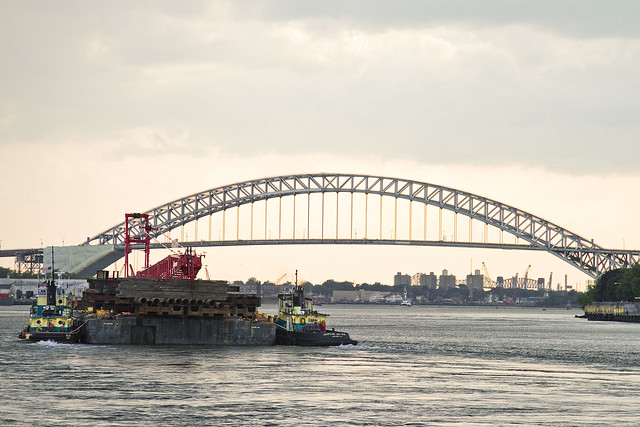
– photo by Mitch Waxman
This Maritime Sunday posting presents the crossing of the Kill Van Kull by two tugs of the Coastline Marine Towing Corporation. They are moving a crane barge from points unknown to some destination at the Port Elizabeth Newark complex. Said shots were captured while onboard a Working Harbor Committee expedition during the summer of 2012. As you can see, it was a dark and stormy night.
from coastlinemarinetowing.com
Coastline Marine Towing has been serving the New York-Metro Harbors and US Eastern Seaboard for 20 years. We provide experienced crew and vessels that are ready to accommodate the logistics of your marine project.

– photo by Mitch Waxman
Little information is available on the tug Ireland, although a friend of mine asserts that it’s a 1940 vintage vessel. It did not display radio call sign information on its hull, which would have aided me in discerning its past and capabilities. The radio call sign, for maritime vessels, performs the same function which a license plate does for motor vehicles.
from workingharbor.com
Whether it’s a single barge, a group of barges made up as a single unit, or a vessel, when being moved by a tugboat, it’s called the “tow” (singular). A tug can move a tow in one of three different ways:
- Astern – The tug pulls the tow via a tow line from the stern of the tug. This is common for ocean towing but less used in confined harbors as it may be difficult to keep the tow from swinging side to side.
- Pushing – The tug ties off behind the tow, and pushes it forward. This provides a greater deal of control compared to towing astern.
- Alongside (on the hip) – The tug ties up alongside the tow, typically aft of the midpoint of the tow. This method also provides a good deal of control.

– photo by Mitch Waxman
The capabilities of google are confounded when a search term like “Tug Ireland” is offered to it. Lacking syntax, the algorithms of the search giant deliver a cogent result describing the coastal towing capabilities of a European nation state rather than those which would define and encapsulate the history of a single tugboat. Nevertheless, a hearty Maritime Sunday shout out is sent to both the faraway coast of an Emerald Island and to the crew of a singular tugboat alike.
also from workingharbor.com
Port refers to the left hand side of a vessel as you face forward and starboard refers to the right hand side. Before the rudder was invented (by the Chinese), boats and ships were steered by means of a steering board. Since most people are right handed, it was customary to mount the steering board on the right hand side of the ship. This, the right hand side became know as the “steering board” side, which was eventually shortened to “starboard” side, and this term is still in use today.
caravan route
“follow” me on Twitter at @newtownpentacle

– photo by Mitch Waxman
From the 2010 archives emerge these shots, depicting employees of the estimable Moran company displaying their knowledge of applied physics.
The two tugs, Turecamo Girls and Marie J. Turecamo, work in concert against the tidal forces of the East River and the inertia of a loaded cargo ship. The mathematics of what is going on in these photos would be staggering to work out, but the Tug crews prefer not to over think things and “just get it done”.

– photo by Mitch Waxman
Maritime professionals live in a somewhat four dimensional world. It’s not necessarily about the “X, Y, and Z” axes of your current position, rather its how those three factors will contribute to your situation as you move through space over time. Where you’re headed and how fast you are moving is rather more important than where you are now. As mentioned above- applied physics.

– photo by Mitch Waxman
Imagine it, coordinating the position of hundreds of tons of steel blindly, as it is simultaneously affected by tide and wind. Your goal is to move the thing into a precise position with a tolerance of less than a foot or two of the dock, and the effort needs to be seamlessly performed not just by you but by a partner vessel working in concert. This maritime sunday, your humble narrator is overwhelmed just thinking about the calculations of the forces at work.
terrible gateway
“follow” me on Twitter at @newtownpentacle

– photo by Mitch Waxman
The last Maritime Sunday of 2012 brings the estimable Buchanan 1 before you. A 1967 era tug, it is still observed navigating the Harbor of New York and New Jersey even in the dross modernity of 2012. Notice that in the shot above, it wears a different paint job than the shots below.

– photo by Mitch Waxman
Just the facts: Buchanan 1 was built in 1967. 89.4 length, 12 draft, and 28.1 beam, she weighs 191 Gross Tons, and is actuated by twin screws supplying 2,200 HP. tugboatinformation.com has a bit more of her story, which can be accessed by clicking here.

– photo by Mitch Waxman
A hearty Maritime Sunday shout out is sent to the crew of the boat, the last time this year that any such message will be sent.
radiant energy
“follow” me on Twitter at @newtownpentacle

– photo by Mitch Waxman
Once more doth the angels sing, and the devil weepeth, for the holiday season springs forth upon us. Since most of y’all are either traveling somewhere or busy with final preparations for the annual gorging, lets take it a bit easy this Maritime Sunday, and admire the estimable Captain D tug hauling a dredge down the Kill Van Kull.
Tonight is Festivus, by the way, and I’m accepting donations for the Human Fund. Make the checks out to me, I’ll see that your donations go where they will do the most good.
heavy articles
“follow” me on Twitter at @newtownpentacle

– photo by Mitch Waxman
Just a short one today, the tug Mary Alice rolling along at twilight. Back tomorrow with something a bit more substantial, but today must be spent with loved ones as the world soon ends.
Only 12 days left until the 13th b’ak’tun ends, initiating the Mayan Apocalypse on December 21st, after all.


 The Newtown Pentacle